Emissions control technologies

What is Pollution?
“Pollution” is anything harmful or unwanted that has been added to the environment. Pollution makes the environment unsafe or unhealthy for living beings. It can take many forms: smog in the air, polluted rivers, plastic waste on beaches, excessive noise, or too much light that doesn’t allow us to see the night sky unhindered. Interestingly, pollution need not only be anthropogenic1, although it usually is- examples of naturally originated pollution are ash from volcanic eruptions12 exploding into the air around it, wildfires13 ignited by lightning causing smoke, ash, and burnt soil (in fact, air pollution can help wildfires create their own lightning and rain!!), dust storms4, sea spray (salt aerosols)5, pollen from plants6, radioactive gases from the earth like radon7, or even just the natural decay of organic matter8. A substance is categorised as a pollutant not by its origin, but by its effect- if it overwhelms nature’s ability to process or neutralise it, it is a pollutant.

Industrial vs. Natural Pollution
Industrial pollution comes from factories, power plants, and other places that make goods or energy. When these places take in raw materials (like oil, coal, metal, or chemicals) and turn them into products, the act of converting one product into another creates waste or toxins which are often released untreated into the environment in quantities the planet cannot naturally digest, and thus are left to infiltrate the natural world instead.

The planet has ways to cleanse itself—think forests soaking up CO₂9, wetlands filtering water1011, or microbes breaking down organic matter1213. But when industries release more pollutants than the ecosystems can handle, several things happen14:

  • Bioaccumulation: Heavy metals and persistent toxins build up in soils, water, and living organisms, threatening animals and humans over time.14
  • Eutrophication: Nutrient pollution (nitrogen, phosphorus) from factories causes massive algae blooms in water, choking aquatic life.15
  • Smog and Acid Rain: Sulfur and nitrogen emissions react in the atmosphere, causing acid rain that harms forests and water bodies, and smog that damages lungs.16
  • Climate Change: Industrial greenhouse gases overload natural carbon sinks—heating the planet faster than forests or oceans can reabsorb emissions.17181920

Industrial pollution is quite different from pollution of a natural origin. For one, it’s caused directly by human activity, which means it often contains complex mixtures of artificial chemicals, persistent organic pollutants (POPs)21, heavy metals23, synthetic compounds22, and engineered nanoparticles22. Many of these substances do not exist in significant quantities naturally and can remain toxic or disruptive for decades or centuries.1824 Industrial pollution tends to be constant, widespread, and cumulative, with sustained emissions over years or decades (e.g., daily smokestack releases, persistent wastewater discharge), building up in our air, water, and soil to levels far beyond our home’s natural processing capacity, all of which creates long- term, regional, and global problems (e.g., acid rain, climate change, ocean acidification).1824 Industrial pollutants are novel and often have no natural analogs, and can result in chronic overexposure for living systems.22

In contrast, natural pollution, while hazardous, is typically more easily integrated or remediated by environmental processes, is episodic in nature, is naturally occurring and thus can be eventually reabsorbed by the Earth that produced it.251

Treatment Technologies
There are a number of methods used to treat industrial pollution. Here’s a brief rundown:

1. Particulate Matter Control Technologies
Electrostatic Precipitators (ESPs)26

  • How They Work: ESPs use strong electrical fields to “charge” tiny dust particles in factory exhaust. The charged particles are then attracted to plates with the opposite charge, sticking to them and leaving the air much cleaner.
  • Effectiveness: ESPs can remove up to 99.9% of dust and fine particulates—making them a powerhouse for cleaning industrial air, especially in power plants, steel mills, cement factories, and chemical works.
  • Variants: Dry ESPs: plates are shaken mechanically to dislodge and collect dust, Wet ESPs: Plates are sprayed with water, which continuously washes away dust.

Fabric Filters and Baghouses27

  • How They Work: Picture a giant vacuum cleaner with hundreds of long, sturdy bags acting as filters. Dirty air passes through these bags; dust sticks to the fabric and forms a “dust cake.” It’s actually this cake that does most of the filtering.
  • Effectiveness: Baghouses trap over 99% of dust and even extremely tiny particles, outperforming most other dust controls for submicron pollution.
  • Cleaning Methods: Shaker: Bags are gently shaken to dislodge dust, Reverse Air: Air is blown backwards to release the dust, Pulse-Jet: Bursts of compressed air blast dust off the bags.28

2. Gaseous Pollutant Control Technologies

Wet Scrubbing Systems29

  • How They Work: Exhaust gases are washed or “scrubbed” with water or chemicals. Harmful gases dissolve in the scrubbing liquid or react to form “captured” compounds, which can then be removed.
  • Uses: These systems remove acid gases like sulfur dioxide, nitrogen oxides, and hazardous vapors in industries ranging from chemical plants to steel works.
  • Configurations: Venturi Scrubbers accelerate dirty air and spray it through water at high speed to trap both gas pollution and dust, Packed Bed Scrubbers pass polluted gas through a tower packed with materials (plastic, ceramic) to maximize contact with the scrubbing fluid, Spray Towers: Sprinklers ensure the widest possible liquid-air contact.
  • Benefits: Not only do wet scrubbers clear harmful gases from air, but they can also remove dust, cool hot gases, and help prevent fires.

Selective Catalytic Reduction (SCR)3031

  • How They Work: SCR is the gold standard for cleaning nitrogen oxides (NOx) from exhaust. It injects ammonia or urea into hot industrial gases, which then react on a special catalyst to turn NOx into harmless nitrogen and water vapor.
  • Effectiveness: Can cut NOx pollution by 70-95%, which is crucial for power plants, ships, and large boilers.
  • Key Features: Requires careful temperature control (typically 180°C to 450°C) for best results, uses advanced catalyst materials (like titanium, vanadium, tungsten) for durability and performance in tough conditions.
  1. Technologies for Volatile Organic Compound (VOC) Destruction
    Thermal Oxidation Systems

    How They Work: VOCs (volatile organic compounds) and other hazardous pollutants are destroyed by burning them at very high temperatures (around 1400–1600°F). The process breaks down harmful chemicals into carbon dioxide and water vapor.32

Direct-fired oxidizers: Simple units that rely purely on heat.3334

  • Recuperative oxidizers: Use heat exchangers to recover energy for improved efficiency.
  • Effectiveness: When properly run, these systems can destroy over 99% of the target pollutants.
  • Safety & Control: Advanced thermal oxidizers continuously monitor temperature and emissions, shutting down automatically if anything goes wrong.

Regenerative Thermal Oxidizers (RTOs)35

  • How They Work: RTOs take thermal oxidation a step further—they use beds of special ceramic material to trap and reuse heat, slashing energy costs.
  • Process: Air is directed through different sets of ceramic beds that absorb heat from outgoing clean air and transfer it to incoming dirty air, minimizing additional fuel requirements.
  • Effectiveness: Modern RTOs achieve up to 97% thermal efficiency and can sometimes run “fuel-free” if incoming air is rich enough in VOCs.

There are now also biological ways to treat the menace:

  • Biofilters: Air is pushed through beds filled with soil, straw, wood chips, or compost. Microbes living in the filter “eat” bad chemicals and smells (like VOCs—volatile organic compounds—from paint factories, food plants, or sewage treatments). The result is clean air and harmless byproducts.36
  • Biotrickling Filters: Polluted air moves through towers packed with plastic or rock, sprayed with nutrient-rich water. Microbes grow on these surfaces. As the air flows, microbes capture and sponge up pollutants.3738
  • Bioscrubbers: Air is washed in tanks containing water and bacteria. Pollutants dissolve in the water, and the microbes digest them over time.36
  • Industrial Wastewater Treatment with Microbes: Factories often create dirty water full of chemicals, oils, or heavy metals. Specialized treatment tanks use bacteria to eat these contaminants. Through activated sludge processes, millions of microbes clean water effectively before it’s released back to rivers or reused.36

Industries often use layered strategies: A scrubber might remove much of the pollution, but a biofilter finishes the job, catching what remains.

Sources

  1. Sources of pollution
  2. Air pollution during a volcanic eruption
  3. Air pollution helps wildfires create their own lightning
  4. Sand and Dust Storms: Impacts and Mitigation
  5. Accessing the Impact of Sea-Salt Emissions on Aerosol Chemical Formation and Deposition over Pearl River Delta, China – Yiming Liu, Shuting Zhang, Qi Fan, Dui Wu, Pakwai Chan, Xuemei Wang, Shaojia Fan, Yerong Feng, Yingying Hong
  6. 47 worst plants for pollen allergies – Medical News Today
  7. What is Radon and How are We Exposed to It? – IAEA
  8. Iron index as an organic matter decay intensity indicator in a shallow groundwater system highly contaminated with phenol (case study in northern Poland) – Dorota Pierri & Mariusz Czop 
  9. The role of carbon sinks in mitigating climate change and their current status
  10. Self-cleaning ability of water source
  11. Processes of Natural Self-Cleaning of Small Watercourses with Increasing Anthropogenic Load in the Dniester River Basin – Roman Hnativ, Volodymyr Cherniuk, Petro Khirivskyi, Natalia Kachmar, Natalia Lopotych, Ihor Hnativ
  12. The role of soil microbes in the global carbon cycle: tracking the below-ground microbial processing of plant-derived carbon for manipulating carbon dynamics in agricultural systems – Christos Gougoulias, Joanna M Clark, Liz J Shaw
  13. Understanding Soil Microbes and Nutrient Recycling
  14. Bioaccumulation for heavy metal removal: a review – Nnabueze Darlington Nnaji, Helen Onyeaka, Taghi Miri & Chinenye Ugwa
  15. Sources and Solutions: Agriculture – USEPA
  16. What is Acid Rain? – USEPA
  17. The role of carbon sinks in mitigating climate change and their current status
  18. Climate change: atmospheric carbon dioxide
  19. How Do Forests & Oceans Contribute to Averting Climate Change?
  20. CO₂ and Greenhouse Gas Emissions
  21. Sustainable remediation of persistent organic Pollutants: A review on Recent innovative technologies – Fatihu Kabir Sadiq, Abdulalim Ahovi Sadiq, Tiroyaone Albertinah Matsika, Barikisu Ahuoyiza Momoh
  22. Toxic Chemicals and Persistent Organic Pollutants Associated with Micro-and Nanoplastics Pollution – Charles Obinwanne Okoye, Charles Izuma Addey, Olayinka Oderinde, Joseph Onyekwere Okoro, Jean Yves Uwamungu, Chukwudozie Kingsley Ikechukwu, Emmanuel Sunday Okeke, Onome Ejeromedoghene, Elijah Chibueze Odii
  23. Nanomaterials for Remediation of Environmental Pollutants – Arpita Roy, Apoorva Sharma, Saanya Yadav, Leta Tesfaye Jule, Ramaswamy Krishnaraj
  24. Industrial Pollution: Definition, Causes, Effects, Prevention
  25. Classifying Air Pollution: A Comprehensive Guide to Its Types and Sources
  26. electrostatic precipitator – Britannica
  27. Fabric Filter Baghouse: Comprehensive Guide on Operation, Design, Wear Parts, and Disposal
  28. Monitoring by Control Technique – Fabric Filters – USEPA
  29. Wet Scrubbers
  30. SCR (Selective Catalytic Reduction) is one of the best available technologies for NOx reduction in industrial processes.
  31. Selective Catalytic Reduction (SCR) System – Mitsubishi Power
  32. VOC THERMAL OXIDIZER
  33. Direct Thermal Oxidizers
  34. Direct Fired Thermal Oxidisers (DTFO)
  35. How Efficient are Regenerative Thermal Oxidizers in Terms of Energy Use and Pollution Control?
  36. A review on biofiltration techniques: recent advancements in the removal of volatile organic compounds and heavy metals in the treatment of polluted water – Rekha Pachaiappan, Lorena Cornejo-Ponce, Rathika Rajendran, Kovendhan Manavalan, Vincent Femilaa Rajan, Fathi Awad
  37. Bio trickling Filter (BTF) for polluted Air treatment
  38. Biotrickling filter

Decarbonising the healthcare sector

I’ve unfortunately had a fair few run ins with the medical sector in India since 2023, and that has naturally made me curious about how it operates, especially from the point of view of decarbonisation (also, for anyone who is curious, the operation theatre I was operated upon in looked more like an enormous store room than what they look like in Grey’s Anatomy). Here’s what I found out.

The Sector
The healthcare sector is a sprawl of the multiple interacting industries, and includes healthcare providers (hospitals, clinics, nursing homes, physiotherapy), medical equipment & supplies (devices, diagnostic machines, consumables), pharmaceuticals & biotechnology (drug/vaccine makers, gene therapy, diagnostics), health IT & digital health (electronic records, telemedicine, AI platforms), managed Care/insurance (public/private health insurers, billing services), medical research & education (clinical trials, medical/nursing colleges, consulting), and ancillary/ wellness industries (medical tourism, public health, waste disposal). There’s also sectoral overlap with the real estate sector for the buildings these services are performed, or equipment manufacture at, supply chain and logistics, food and nutrition, and marketing.

So that’s a lot.

Global Statistics
All these industries accounted for approximately 10% of worldwide GDP- translating to nearly $10 trillion in health spending annually.1 At the moment, the sector is the 5th largest emitter in the world, making for between 4.4% (2019) and 5.2% of total global greenhouse gas emissions currently12, and might reach 6 gigatons by 2050 without aggressive decarbonisation efforts.1 To help put this into perspective, 6 gigatons are 6,000,000,000 metric tons of carbon dioxide (CO₂). A typical passenger vehicle emits about 4.6 metric tons of CO₂3 per year, so the sector may emit as much as 1.3 billion passenger cars by 2050- and there are currently between 1.23 to 1.47 billion passenger cars in operation worldwide.45

Before we go into the energy use, let’s understand how the emission break ups are categorised (Emissions are organised into three “scopes” to make it easier to identify where pollution comes from and how to address it): Scope 1 emissions are those emitted directly by the activities performed by the emitter, for example, the gas burned in your hospital’s boilers, emissions from ambulances and owned vehicles, or fumes from certain medical gases; Scope 2 emissions are indirect emissions related to the electricity, steam, heating, or cooling you purchase from someone else (like a utility company)- the pollution from this type of usage is created at the point of energy generation; and Scope 3 emissions are those not covered in the previous two, but are still only produced to be used in the healthcare sector- this makes it the trickiest and also the largest part of all the emissions from the sector- it includes the entire supply chain- so, for example, if a hospital buys a surgical kit, Scope 3 includes the emissions from making, packaging, and delivering it.

So now onto the break ups: globally these industries used 17% for Scope 1 emissions, 12% for Scope 2, and the remaining (71%) for Scope 3 uses in 2019.2

The India Story
The Indian healthcare sector made up 3.3% of national GDP as of 2022 (USD 80 per capita7), with expectations of this rising to 5% by 2030.6 India’s GDP in 2022 was approximately $3.35 trillion USD.89 India’s total GHG emissions in 2022 were about 217.9 million metric tons CO₂ equivalent.10 3.3% of National GHG Emissions (if scaled directly from GDP share) would be 217.9 million tonnes multiplied by 3.3%, or 217.9 multiplied by 0.033, which is approximately 7.19 million metric tons CO₂ equivalent (1,563,000 passenger cars). Actual sectoral emissions may vary depending on emissions intensity (a measure of how much energy is used to produce a unit of economic output). The Indian healthcare sector is estimated to account for about 2%11 of national GHG emissions (4.36 million metric tons ÷ 4.6 ≈ 948,000 passenger cars), but if we scale strictly by GDP share (because there are no confirmed numbers), this figure is about 7.2 million metric tons CO₂e for 2022. I’ve also taken it as an equivalent percentage of GDP rather than the reported numbers because the Indian healthcare sector was estimated to emit 2% of India’s total GHG emissions in 20192, but between 2019 and 2022, the Indian healthcare sector grew by 17.5% annually12, significantly outpacing the growth of the economy as a whole between these years89. The healthcare sector’s 17+% CAGR versus the broader economy’s 7–8% CAGR means healthcare’s portion of the economy (and its GHG emissions footprint) increased during these years, likely easily outstripping the 2% estimate for 2019.

Decarbonisation Pathways

Why Is Healthcare So Carbon-Intensive? Because it uses a lot of energy, equipment, and material, many of which are:

  • Single-use: For sterility and safety, everything from syringes to gowns and often surgical tools are single-use. Single-use medical devices and consumables can account for up to 86% of the total carbon footprint of a hospital surgery, driven mostly by the production and use of such disposable items.14
  • Resource intensive: Hospitals need round-the-clock, energy-guzzling HVAC, lighting, emergency backup power, and sterilisation.2
  • Dependent on imports: Many hospitals, especially in countries like India, depend on imported medical technology, devices, and pharmaceuticals. The carbon footprint of these goods includes not just their production but also packaging, long-haul transport, and storage, increasing the indirect (Scope 3) emissions portion of healthcare’s footprint.15
  • Hazardous waste products: (e.g., sharps, blood-stained items, infectious waste) along with general plastic and food waste. Treatment and safe disposal—often via incineration—consumes a lot of energy and may itself release greenhouse gases and toxic substances such as dioxins and furans.16
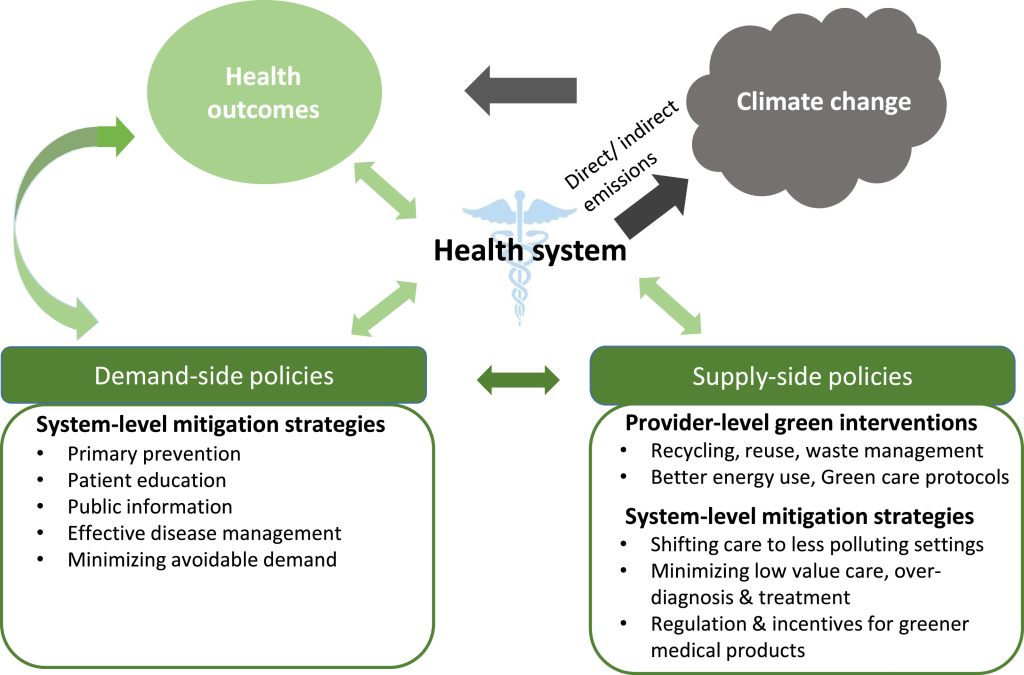
Relationship between the healthcare system, climate change, and sustainability strategies and interventions. Source: The role of the health sector in tackling climate change: A narrative review – Zeynep Or, Anna-Veera Seppänen

A number of general and specialised strategies can be used to decarbonise operations in the healthcare sector.

General strategies (common to all energy users):

  • Transition to Renewable Energy: Switching to solar, wind, hydroelectric, and even geothermal sources for electricity, dramatically cutting GHG emissions. On-site solar photovoltaic (PV) installations, especially in hospitals, are reducing operational costs and increasing resilience.
  • Onsite energy generation: While not quire fully operational, or even fully sustainable yet, non renewable energy generation such as cogeneration or trigeneration, are certainly better than grid electricity usage as they will reduce transmission and distribution losses, and further the waste heat can be used to generate both heating and cooling, or both, for the premises.
  • Energy Efficiency Improvements: Upgrading and retrofitting buildings with energy-efficient lighting, HVAC (heating, ventilation, air conditioning), chillers, star-rated equipment, and insulation cuts down consumption by 30–50% in some cases. Use of variable frequency drives (VFDs)17, intelligent sensors, and IoT-based monitoring allows real-time optimization.
  • Green Building Design and Retrofitting: Buildings that follow green building codes and energy conservation codes consume fewer resources, while existing facilities can be retrofitted with modern energy management systems and green technologies.
  • Decarbonizing Supply Chains: Emphasis on green procurement, sustainable sourcing, and responsible supplier engagement ensures that scope 3 emissions are reduced and managed on an continuously.
  • Waste Management and Reduction: Sustainable waste handling, recycling, and waste-to-energy programs decrease landfill emissions and support circular economy practices.
  • Renewable or Low-GWP Refrigerants: A shift to low global warming potential (GWP) refrigerants to meet emerging regulations and climate commitments. (Global Warming Potential (GWP) is a measure of how much a greenhouse gas traps heat in the atmosphere compared to the same amount of carbon dioxide (CO2) over a specific time period, usually 100 years.18) Moving to refrigerants with GWPs far below 700 can cut emissions from these systems by as much as 78% (relative to older HFCs).19

Healthcare-specific strategies:

  • Low-carbon pharmaceuticals: Pharmaceuticals are among the highest-emitting components of healthcare’s carbon footprint, often due to energy-intensive manufacturing, complex supply chains, and waste at the point of use. A McKinsey study found that adopting green-chemistry principles to redesign synthetic processes and use recyclable solvents could cut pharmaceutical active ingredient (API) manufacturing emissions by up to 30%.20
  • Reducing Low-Value Care: Avoiding unnecessary admissions, surgeries, and tests not only saves resources but reduces both direct (hospital-based) and indirect (supply-chain) emissions. Evidence-based guidelines to minimize unwarranted care can have substantial savings.21
  • Telemedicine and home- based care: Shifting care (where safe and appropriate) from hospitals to home or community settings lowers the need for energy-intensive infrastructure. For instance, remote physiotherapy after surgery demonstrated fewer rehospitalizations and better outcomes at lower environmental cost.21
  • Digistisation of care: Telehealth cut CO₂ emissions associated with cancer care by over 80% at one major U.S. center. Another 2023 multi-state analysis found telehealth averted 21.4–47.6 million kg of CO₂ per month—equivalent to keeping up to 130,000 cars off the road every month.22
  • Treatments: Anaesthetic gases (like desflurane and nitrous oxide) have very high GWPs and alternatives (total intravenous or regional/local anesthesia) can be used where clinically appropriate without compromising treatment outcomes and patient health.23

The healthcare sector is a vital, vibrant part of our world. It’s complexities and interdependencies make it difficult to decarbonise, not least that each decision should be made keeping patient service in mind, and at first it looks like decarbonisation does the opposite. Yet, we also know that climate change is making people sick: heatwaves, floods, wildfires, and storms are becoming more frequent and severe, and the World Health Organization (WHO) estimates that between 2030 and 2050, climate change will cause roughly 250,000 additional deaths per year from malnutrition, malaria, diarrhea, and heat stress alone- in some regions, heat-related deaths among people over 65 have risen by 70% in two decades24; vector-borne diseases (like malaria, dengue, and Zika) are spreading to new areas as rising temperatures and altered rainfall enable disease-carrying insects to thrive in new regions and seasons, and water- and food- borne illnesses become more common when heavy rains, floods, or droughts contaminate water sources or affect food supply chains25; rising air pollution including smog and higher particulate matter in the air we breathe smog and particulates), increases rates of asthma, chronic lung conditions, and cardiovascular disease affecting children, people with chronic illnesses, and urban residents are especially vulnerable; crop failures contribute to malnutrition and stunting2425; extreme events, displacement, and ecosystem loss contribute to greater rates of anxiety, depression, PTSD, and other mental health disruptions26; rising seas, severe storms, and food/water shortages also force people from their homes, increasing displacement, conflict, and health emergencies- often overwhelming local health systems and worsening inequities24… and working on sectoral decarbonisation will help those same people the sector works to protect.


Sources

  1. Five Fast Facts on Healthcare’s Climate Footprint
  2. Healthcare’s Climate Footprint – How the global health sector contributes to the global climate crisis and opportunities for action – Health Care Without Harm (Climate-smart health care series) Produced in collaboration with Arup, September 2019
  3. Greenhouse Gas Emissions from a Typical Passenger Vehicle
  4. Number of Cars in the World? Actual Answer
  5. Number of Cars in the World 2025: Key Stats & Figures
  6. India’s healthcare expenditure expected to surge from 3.3% to 5% of its GDP by 2030: CareEdge
  7. India’s Healthcare Expenditure Expected to Surge from 3.3% to 5% of its GDP by 2030 – CareEdge
  8. India GDP Macrotrends
  9. India: Gross domestic product (GDP) in current prices from 1987 to 2030(in billion U.S. dollars) – Statista
  10. India Total Greenhouse Gas Emissions: Tonnes of CO2 Equivalent per Year: Fuel Exploitation
  11. The healthcare sector needs to lead the way on decarbonisation – Asian Hospital and Healthcare Management
  12. Indian Healthcare Market projected to reach $638 billion by 2025: Bajaj Finserv AMC
  13. Decarbonizing the Health Care System
  14. Experts address single-use plastics in healthcare – University of Edinburgh
  15. Why India is poised to become a global hub for MedTech manufacturing
  16. Healthcare Waste—A Serious Problem for Global Health
  17. What is a VFD?
  18. The Future of Refrigeration: Low-GWP Refrigerants
  19. Innovating for Impact: Next Generation Refrigerants for a Sustainable Tomorrow
  20. Decarbonizing API manufacturing: Unpacking the cost and regulatory requirements
  21. Getting Started: Low carbon clinical care in hospitals
  22. Evidence that telehealth cuts carbon emissions grows
  23. Green health: how to decarbonise global healthcare systems
  24. Climate change – World Health Organisation
  25. Health and Climate Change – World Bank
  26. Climate change and health – Better Health

Financing Climate Solutions – III: Weather or Climate Derivatives

A derivative is an asset whose value is based on a different underlying asset. They are called derivatives because they derive their value based on the value of something else. That something else is called the “underlying asset” and can be any asset, such as a stock/ share in a company, land, bags of grain, plant and machinery, inventory, or any other asset, group of assets, or even a benchmark1, or a variable, such as the weather, or an event (outcome of an election). If something has an associated measurement that can be reliably quantified, it can be the “underlying asset”. The underlying asset is also called the “Primary Instrument”.1

If there is any uncertainty about what the value of the underlying will be in the future, whether it is the price of a house, the earnings of a film, or how much rainfall there will be in the month of July next year, there can be a derivative about it. This is because derivatives are based on risk- some parties wish to protect themselves from a particular risk they foresee, and others believe that risk is worth taking. A derivative is a transaction between such risk averse/ risk protective and risk friendly parties.

Why do some people wish to take on more risk while others avoid it? Because humans have different opinions about what will happen in the future, generally believe they are correct about their assessments, and have varying risk appetites. Those with higher risk appetites may think of derivatives either as a wager, or a bet, and those with lower risk appetites may look at them as insurance or hedging against risk.

When thinking of derivatives as wagers or bets, we can liken them to sports betting, and just like organisations that run bets on sports matches have books of odds of what they think the result is likely to be, weather derivatives have an “index” of what is the normal or average or expected weather for a particular geography at a particular time of the year, and how likely it is to be that kind of weather. This is also called speculation- we are speculating on what the associated value measurement of the primary instrument will be at some point in the future, or, we are making a bet or a wager that it will be a particular value, but their value in climate finance lies in the security they provide against weather abnormalities. For example, both less and more rainfall than expected can be negative outcomes for farmers as both can ruin their crop. This sounds like an insurance, except that insurances pay out only when all their conditions are met- derivatives pay out when there is any deviation of the value of the underlying asset from what it was supposed, or expected, to be (the average value).

This is how derivatives can be used instead of insurance, and also why they are often considered better than insurance for those who know how to use them- insurance firms pay out only if there is evidence of a loss, and the loss must be proven to their standards, and even so your entire amount may not be covered due to contractual issues or because they don’t cover certain common types of losses, or even because the insurance company does not consider the evidence you provide to be sufficient. A derivative will pay out immediately as long as there is a difference between what was supposed to happen according to the contract, and what actually happened.

There are two general types of derivatives- firm commitments, and contingent claims. If parties participate in a firm commitment, that is, they promise, they must then fulfill the promise and complete the contract. For contingent claims, you have the option to follow through or not at the time the contract becomes due.

Because the value or price of the primary asset on which the derivative is based can move upwards or downwards, derivatives can also be thought of as being based on the direction of this movement. This is why some contracts are called “long” and some are called “short”:

Long contracts- you will benefit if the value of the underlying asset increases in the future. In case of sports for a match between Teams A and B for Team A to win, you are long (bullish) or you are long on Team A’s chances to win (winning being considered positive, generally).

Short contracts- You will benefit if the value of the underlying asset decreases in the future. In the case of the sports teams, since you are expecting Team A’s victory to take place, you will be short on Team B, because you expect their loss to take place or their value to decrease after the given match.

Example: Let’s say you come to know that Company X will purchase Company Y in the future, you are likely to purchase more shares of Company Y, because usually the purchasee is overvalued by the purchasing company, therefore the price of the shares of Y will increase since X is likely (via historical evidence) to have paid more for Y than Y is actually worth. Simultaneously X’s value is likely to reduce in the future because they have paid more than they should have. You are therefore long on Y and short on X.

Types of derivatives:

Futures

A Futures contract is an agreement to buy or sell an underlying asset at a future date and price that are both set down in the contract.

Futures contracts are standardised, and the counterparty is always the exchange it is traded on- this means, the entities buying or selling the contract do not have contact with the party selling or buying (respectively) the contract. Each party only interacts with the exchange on which the trade is taking place. Because they are exchange traded, the contracts are standardised rather than personalised.

These contracts are also settled daily by the exchange with the involved parties, so if the buying price of the contract increases, the exchange will ask the purchasing party to top up the difference, further discouraging rogue traders. Further, since these contracts are standardised and exchange traded, they are liquid and transparent.

Example: A natural dye trader worried that her crop of marigolds has not yielded enough flowers in time to make the dye for her next shipment due. She decides to purchase a futures contract for a few additional caseloads of fresh marigold petals, thinking that it’s okay if she ends up with more golden dye rather than less of it. 

The contract states that two weeks from the date of purchase, the purchaser of the contract will pay the USD 150 for two kilos of fresh marigold petals. Now the farmer is certain that weather her farm produces enough marigold or not, she will have ready to use fresh petals for making her dye.

Let’s assume that on the date of delivery the price of two kilos of fresh marigold petals is USD 140 in the market, then the farmer still has to pay USD 150 for her delivery. And vice versa.

Forward

A Forward contract is similar to a Futures Contract, with the sole difference that these are customised private contracts between two parties rather than exchange traded.

Therefore these are not centrally settled, they are not liquid, and there is a possibility that the counterparty, which is the other trader and not a central exchange, may renounce the contract at any point, leaving the other party hanging.

Example:  Morgan and Akanksha enter into a contract with each other to buy and sell 10 crayons of the now discontinued Crayola Daffodil Yellow. These are not available in the market any longer, and Akanksha is the only seller available, so she can decide any terms. This is also a very small quantity of product and an unusual product for the commodity markets. Morgan and Akanksha therefore enter into a Forward contract to accomodate all the unstandardised elements of their exchange.

If either party were to decide to dishonour the contract at any time before the exchange is completed, there would be no penalties exacted upon them, and the contract would fall through.

Options

Options, give people the possibility of doing something in the future. There are two kinds of options: A Put option, and a Call option.

A Put option is the right, but not the obligation (that is, the option), to sell an underlying asset in the future at a certain price which will be decided at the time of the contract.

A call is the right, but not the obligation, to purchase an underlying asset in the future at a certain price which will be decided at the time of the contract.

Example: A restaurant does not know how many tourists the city will host next year. Depending on whether more than expected tourists come, the owners of the restaurant wish to secure their supply of onions for their famous French onion soup. If there are more tourists, there will be more demand for onions, and then their prices will increase- and yet, the restaurant cannot always increase the price of the soup to reflect the increased price of the onions.

To secure their future supply, and to save themselves price uncertainty, they buy the option to buy more onions during tourist season at current prices. Now they are assured that if prices increase, or supply is tight, they will still have access to the produce. In case at the specified time the option can be exercised, the price of onions drops, they can always just buy from the market, and their only loss is a small fee paid to purchase the option, which for the restaurant is a call option.

If the market price of onions is higher than the price they agreed to pay as part of the Call Option they have bought (that is, they bought the option to buy onions), the restaurant can buy at the Call price and save money in comparison to what they would have paid for buying onions off the open market.

If the market price is less than the call price, they can just buy from the market and the only money they lose is the small amount they paid to buy the Call Option.

Example: For a Put Option, think of a scuba diving instructor, whose business is weather dependent, buys the Option to sell his lessons to a cruise shipping company. This is a Put Option, because it is the option to sell. If during the given week, the weather is good, the scuba diving instructor can sell his lessons at a higher price to other tourists and make more money. However if the weather is poor and tourists do not wish to go scuba diving, he can still sell to the cruise ship company.

Swaps

Swaps allow us to exchange cashflows.

Certain types of financial contract result in a stream of cashflows. For example, a debt contract results in a stream of interest income. Parties can agree to swap the interest they will receive (or pay) in the future with each other.

Example: In terms of climate financing, think of a weather dependent business, for example a movie shooting outdoors. The film production house can get into a Swap contract with a financing company. Let’s say the film company requires 20 continuous days of sunshine and warm weather at their location. They can get into a Swap Contract that says they require an  average of 10 hours of sunshine daily, and another Swap that says they want an average of 25°C temperature daily for the twenty days of their shoot.

If the weather is different over the time period for which the film producing company bought the derivatives, they will automatically be paid (just by comparing the actual weather to the base index) and can use the money to cover additional costs that were incurred due to the different weather (like it was rainy instead of sunny).

So, a film production company (Party A) and a financial institution (Party B) enter into a weather swap that says that if there is more than 0 cm of rain between June 20 and July 10 at their location, Party B will pay $10,000 per day where there is more than 0 cm of rain to Party A.

Weather Swaps are generally two way contracts, so depending on the contract, perhaps if there are no rain disruptions, the Production Company may pay the financial institution $10,000 x 20 days = $200,000 instead. This depends on the contract they have entered into.

Sources

  1. Understanding Derivatives: A Comprehensive Guide to Their Uses and Benefits

Financing climate solutions – II: adaptation finance

Climate change adaptation finance is the gangplank between addressing constantly escalating climate threats, and our current level of climate adversity preparedness- that is, it is used to help adjust to the adverse effects of climate change, such as floods, fires, or other extreme weather events.

The UNEP’s Emissions Gap Report 2024 states that while it remains technically possible to get on a 1.5°C pathway, a failure to deliver superior results would put the world on course for a temperature increase of 2.6-3.1°C over the course of this century.1 To achieve the pathway to limiting temperature rise to 1.5°C, the current estimates are that the annual adaptation finance gap is US$187-359 billion per year2, and developed countries, that did most of the climate damage must double adaptation finance to at least $40 billion a year by 20253.

In 2022, the total financial flows to adaptation efforts were assessed to be $32.4 billion4, while another approximation puts this value at $63 billion5, which is nearly twice the first estimate- and yet, to put our requirements into further perspective, the all nations at COP29 agreed that the all sources of finances should generate $1.3 trillion annually by 2035, less than 10 years from now6.

Various financial mechanisms and instruments have been devised to address the gap. Here is a brief run down of some interesting ones:

1. Results based finance/ Outcome-Based Instruments- Money is paid out only once the previously agreed results are achieved. Debt-for-climate swaps/ Debt-for-Nature Swaps- “In a debt-for-adaptation swap, countries who borrowed money from other nations or multilateral development banks (e.g., the IMF and World Bank) could have that debt forgiven, if the money that was to be spent on repayment was instead diverted to climate adaptation and resilience projects.”7 These are a type of Results Based Financing.

2. Blended finance- The use of cataclytic finance to increase private sector participation in climate financing.8 Catalytic capital—debt, equity, guarantees, and other investments that accept disproportionate risk or concessionary returns compared to a conventional investment in order to generate positive impact.9 For example, guarantees are an assurance by a party that they will bear all losses for a project in case any occur, so that other investors come in to finance the project. Pooled investments are another example of blended finance, where capital from different entities is combined to finance projects.8

3. Payment for Ecosystem Services (PES)- The beneficiaries of ecosystem services remunerate those who tend to the ecosystem in question. A hypothetical example is paying the tribespeople who live in and tend to the Amazonian forests for providing a green lung to the rest of the world.

4. Liquidity facilities- Providing loans at the time of a crisis, often at concessional rates, or deferring repayments of old debts after an extreme weather event so that the nation(s) suffering from it have adequate liquidity to help their citizens.

5. Bonds- A bond is a debt instrument which offers an interest rate in exchange for lending money to the issuer of the bond. When the issuer is a sovereign, the interest rates are usually low since it is believed that they can cover at least the nominal value of the interest and the basic capital borrowed, whereas riskier debts such as corporations must offer more attractive rates of interest.

Catastrophe bonds are bonds issued to investors by insurers or pension funds which are offered at attractive rates and cover the risk of a climate catastrophe. In case such an event occurs, these funds are called in, however in case no such disaster happens, the investors benefit from the high interest rates.

There are also a variety of sustainable bonds, such as green bonds, sustainability-linked bonds, blue bonds, etc. and are used to fund different types of climate projects.

6. Green securitisation- Securitisation is the practice of clumping various financial instruments with similar characteristics together to form a completely new instrument which can then be sold to those willing to accept the risks and rewards associated with that new instrument, and the underlying securities. If the underlying securities were originally issued for climate friendly projects, they are called “Green Securitisation”.10

These and other mechanisms are all geared towards luring private funds into covering the gaping mouth of climate change adaptation requirements. Its clear that the need is dire, however these and other climate related mechanisms still form a tine part of the global capital markets.

Sources

  1. Emissions Gap Report 2024, UNEP
  2. Adaptation Gap Report 2024, UNEP
  3. Huge uplift needed on climate adaptation, starting with finance commitment at COP 29
  4. Climate Finance and the USD 100 billion goal
  5. Climate Finance Is a Top Story to Watch in 2025
  6. State and Trends in Climate Adaptation Finance 2024, CFI
  7. Debt-for-adaptation swaps: A financial tool to help climate vulnerable nations
  8. Innovative Financial Instruments and Their Potential to Finance Climate Change Adaptation in Developing Countries, IISD
  9. Catalytic Capital Consortium, MacArthur Foundation
  10. Inventory of Innovative Financial Instruments for Climate Change Adaptation

The path to a just transition – II

In this part of the series of posts on a just energy transition, I’ll explore what an energy transition is, and why we must achieve it.

Energy transition is simply the switch our current dependence on fossil fuels to renewable or low carbon sources for energy production. This is essential because climate change is being fueled by our dependence on mineral fuels- the use of which release greenhouse gases into our atmosphere.

Greenhouse gases are gases that trap the Sun’s heat in our atmosphere, leading to a long term warming of our planet, causing local and global weather changes that living beings on the planet did not evolve with, and also causing abiotic planetary forces to react in ways that harm life and infrastructure- for example, warmer oceans lead to more hurricanes, causing greater property damage and loss of human, animal, and plant lives.

Since these gases collect in the atmosphere, there is a build up of heat absorbing chemicals in the air over time. Carbon Dioxide in particular persists in the atmosphere fore thousands of years, which means that the CO2 released into the atmosphere by, for example, burning coal to fire steam engines during the industrial revolution, is still blanketing us today. Other gases issued due to the combustion of fossils have shorter lifespans, but greater warming effects due to the structure of their molecules- although methane (CH4) on average lasts in the atmosphere for less than 12 years, it’s 100 year warming potential can be between 28 to 36 times as potent as CO2, for example1.

Just like if the planet were to cool (and continue cooling) overmuch, a planet that is heating up is catastrophic to life and property.

In comparison, non fossil sources of energy are considered clean fuels, since they do not liberate the greenhouse gas genie into our atmosphere while operating to produce energy. Please do note that while they contribute negligible amounts to global warming while making electricity, they do contribute to it through their supply chains- that is, scope 2 and 3 emissions.

The National Renewable Energy Laboratory (NREL) reviewed nearly 3,000 published life cycle assessment studies on utility-scale electricity generation
from wind, solar photovoltaics, concentrating solar power, biopower, geothermal, ocean energy, hydropower, nuclear, natural gas, and coal technologies, as well as lithium-ion battery, pumped storage hydropower, and hydrogen storage technologies, greenhouse gas (GHG) emissions from various sources of energy to inform policy, planning, and investment decisions. Less than 15% of the studies passed the various quality and relevance checks. On studying the ones that did pass these checks, NREL came to the conclusion that the Median Published Life Cycle Emissions Factors for Electricity Generation Technologies was as follows2:

S. No.Type of TechnologyGeneration TechnologyMedian Published Life Cycle Emissions Factors
1.RenewableBiomass52
2.RenewablePhotovoltaica43
3.RenewableConcentrating Solar Powerb28
4.RenewableGeothermal37
5.RenewableHydropower21
6.RenewableOcean8
7.RenewableWindc13
8.StoragePumped Storage Hydropower7.4
9.StorageLithium-ion Battery33
10.StorageHydrogen Fuel Cell38
11.Non RenewableNucleard13
12.Non RenewableNatural Gas486
13.Non RenewableOil840
14.Non RenewableCoal1001
Median Published Life Cycle Emissions Factors for Electricity Generation Technologies
a Thin film and crystalline silicon; b Tower and trough; c Land-based and offshore; d Light-water reactor (including pressurized water and boiling water) only

As can be seen in the table above, the median Emission Factor (Emission Factors are a way to understand how much GHG emissions were released due to a particular activity) for the total lifecycle Non Renewables are far greater than those of either storage or renewable technologies. These emissions are primarily released during the combustion phase for the Non Renewables, however non of the other technologies require combustion to create electricity (and neither does Nuclear Light-Water Reactor technology, resulting in the very low Median Lifecycle EF).

Global greenhouse gas (GHG) emissions grew by 51% from 1990 to 2021, and more than 75% of these emissions come from the energy sector.3 Thus it’s obvious that by switching over to sources of energy that are not carbon intensive, we will be able to target the most conspicuous source of planet warming emissions. Shifting out of non renewable sources of energy will also reduce our dependence on fossils, and diversify our energy mix and enhance global energy security (in 2022 fossil fuels provided 81% of the total energy supply globally4), improve global health outcomes by reducing pollution, and finally- also improve the climate outlook.

Sources

  1. Climate Change Indicators: Greenhouse Gases, USEPA
  2. Life Cycle Greenhouse Gas Emissions from Electricity Generation: Update, NREL
  3. Where Do Emissions Come From? 4 Charts Explain Greenhouse Gas Emissions by Sector, WRI
  4. Greenhouse Gas Emissions from Energy Data Explorer, IEA

The path to a just transition – I

It is known even now the world will go through extreme climate events that cannot be avoided. Such events, caused by human activities indirectly trapping heat in our planet’s atmosphere which has already resulted in an increase of nearly 2 degrees Fahrenheit (1.1 degrees Celsius) between 1850-19001, are likely to include more wildfires, more floods, more hurricanes, more droughts, more heatwaves, different precipitation patterns,2 seasonal changes that happen at different times than a century, or even just a couple of decades ago among other negative outcomes. Weather events are also expected to be more intense than earlier ones- that is, there will be more incidence of hotter heatwaves, hurricanes on the higher side of the scale, more intense precipitation, etc.

While many of these adverse impacts cannot be avoided any longer, we can prevent an exacerbation of these outcomes by shifting to a lower carbon economic system than what we have now. This shift from carbon intensive economic activities to an economy that is either carbon neutral (net zero) or negative is referred to as climate transition.

Our global economy is heavily reliant on mineral fuels- currently two-thirds of our fuel demand is met through fossil fuels3. In the Global Energy Review 2025, the International Energy Agency (IEA) has stated that the carbon intensity of global economic activity is the product of the energy intensity of GDP and the carbon intensity of total energy supply.4 That is, we first find out how much energy it takes to produce the entire world’s Gross Domestic Product, and then multiply it with the amount of carbon produced to make that much energy. This means we can slow down carbon emissions in two ways- reduce our production and consumption activities, or make sure it takes less energy to keep them at the same level they are today.

In 2019, heat and electricity production cost us 34% of the global greenhouse gas production, industry accounted for 24%, transportation 15%, and buildings 6% of the global greenhouse gas emissions in that year. It may be noted that 95% of the transportation sector runs on fossil fuels.5 And, in 2024, the CO2 intensity per unit of economic activity was lower than the average improvement seen over the previous decade.4 So not only are we using a lot of energy to support our lifestyles, we are also failing to decrease the amount of greenhouse gases that are released into the atmosphere due to these activities.

It is clear that the change to a lower carbon economy is emergent, must be large scale, and involve every sector and industry in the global economy, including the labour markets, and therefore the communities those workers belong to. It’s a systemic shift that will affect all living beings on our planet, and cause significant human distress unless it is planned and executed with careful compassion.

“The scientific evidence is unequivocal: climate change is a threat to human wellbeing and the health of the planet. Any further delay in concerted global action will miss a brief and rapidly closing window to secure a liveable future,”

– IPCC Working Group II Co-Chair, Hans-Otto Pörtner3

Given the above, energy transition is a formidable task ahead of our species. A just transition, which distributes an equitable burden for the resources required to finance the transition among those who are wealthy and those who are not, is going to be even more challenging.

Accelerating climate actions and progress towards a just transition is essential to reducing climate risks and addressing sustainable development priorities, including water, food and human security.

-IPCC Sixth Assessment Report Working Group III: Mitigation of Climate Change7

The consequences of climate change affect people disproportionately- the impoverished suffer much more than those who have the resources to avoid the results of the adverse fallout of climate change. Climate change energy transitions are also going to have widespread consequences. A “just” climate transition is one where the economic burden of the transition falls on people in the proportion in which they contributed to climate change- this means that the wealthy with extravagant lifestyles bear more responsibility, and cost, for the shift to a carbon neutral or negative economy than workers who are living within a system they did not create. This also means countries which industrialised in the 1800s must answer for the greenhouse gases they pumped into the atmosphere to achieve their prosperity, and that most corporations bear greater responsibilities than most individuals.

In this series of posts, I’ll explore what the energy transition will require, how we may go about achieving it, and what we must do for the transition to be just.

Sources

  1. Climate Change 2021: The Physical Science Basis, IPCC
  2. The Effects of Climate Change, NASA
  3. Fueling a Transition Away from Fossil: The Outlook for Global Fossil Fuel Demand
  4. Global Energy Review 2025, IEA
  5. Global Greenhouse Gas Overview, USEPA
  6. 2025 emissions set to surpass 1990 levels by over 50% despite current climate pledges, UNFCCC warns
  7. Chapter 17: Accelerating the transition in the context of sustainable development, IPCC Sixth Assessment Report Working Group III: Mitigation of Climate Change

A note on industrial decarbonisation

Industrial decarbonisation refers to the transition of the industrial sector from the use of fossil fuels to less carbon intensive sources of fuel, as well as for their processes to release fewer greenhouse gases into our atmosphere. This will help minimise the impact of the industrial sector on our planet and reduce negative externalities. An externality is a positive or negative consequence of an action that affects someone without affecting the person who did the original action. In this case, pollution caused by industries negatively impacts planetary warming, health outcomes, biodiversity, etc. causing poor outcomes and imposing costs on people and other living beings. Externalities are not reflected in costs to the entity that executed the original act, but either benefit or impose costs on bystanders.

Industries emitted 4.1 GtCO2-eq or 24% of global emissions in 2019. This figure does not take emissions from their use of power and heat, which raises the figure to 20 GtCO2-eq or 34%. However, direct fuel use emissions from industrial activities were found to have decreased to 7 GtCO2-eq, 50% of direct industrial emissions (of the 4.1 GtCO2-eq) in 2019.1

The authors of the Intergovernmental Panel on Climate Change’s (IPCC) 6th assessment report had high confidence that “Net zero CO2 emissions from the industrial sector are possible but challenging”, and stated that while energy efficiency will continue to be important, switching production to less energy intensive processes is vital. The report further states that industrial emissions have been growing faster since 2000 than emissions in any other sector, driven by increased basic materials (raw material, such as those extracted through mining or forestry, etc. used in the industrial sector) extraction and production1

Innovation and accounting are the backbones of decarbonisation, and any sustainability strategy, here are some available to those wish to pursue decarbonisation:

i. Energy efficiency – Reducing energy consumption reduces emissions, and happily, reduces production costs.

ii. Using low carbon energy sources – Using clean energy sources for all or part of the production process, such as equipment powered by electricity rather than traditional fuels (think gas burners vs. induction stove tops- the latter removes fossil fuel from the equation, except for what is used at source to produce the electricity).

iii. Greater supply chain accountability – While addressing Scope 3 emissions are egregiously challenging, organisations taking care of their S1 and S2 emissions while working with their supply chain partners to address their S1 and S2 emissions will help minimise S3 for the entire chain.

iv. Targeting Scope 4 – Any industrial decarbonisation strategy must embrace innovating to increase S4 emissions, which are emissions avoided that would otherwise have been made if the current prevalent technology, was used. For example, if a motion triggered lighting system in hospital corridors is more energy efficient than one which is left switched on the entire time. The emissions avoided due to the development and use of motion sensing lights are an example of S4 emissions. Work from home, or using video conferencing technology instead of working daily from office, or traveling for meetings are other contemporary examples.

v. Reducing energy losses – According to the USEIA, more than 60% energy is lost to conversion.3 When fuel is burnt for producing heat, which is then used indirectly to produce electricity- for example, burning coal (level 1 – stored chemical energy to thermal energy) to heat water to produce steam (level 2 – thermal energy used to change the state of water from liquid to gas) to power turbines (level 3 – thermal energy to mechanical energy) to run a generator rotor to produce electricity (level 4 – Mechanical energy to electricity) – energy is lost to various inefficiencies such as incomplete chemical conversion of the raw material to heat, friction, heat loss, transition losses, electrical losses, and so on. These losses are significantly reduced when renewable energy is used to power turbines, but grid dependent industries will receive their electricity after transmission and distribution (T&D) losses.

Industries can help address this by using better captive technologies such as Trigeneration, also known as Combined Heating Cooling and power (CHPC), which uses natural gas as a fuel source (I know) to produce electricity, and uses the waste heat to produce heating (say for heating buildings or for process heating) and refrigeration (through vapor absorption refrigeration systems) as required. Of course, this way the organisation will have greater control over its power source, and low grid-dependence- and no T&D losses.

v. Using artificial intelligence – artificial intelligence can identify redundancies in our systems, and find where and how we can reduce emissions through our industrial supply chains. Whether the suggestions are usable or not is for humans to decide once the computers have done their work.

Lastly, I’ve seen a lot of content advocating for Carbon Capture and related technologies/ processes, but I don’t quite understand them yet, and I do think abatement is better than storage. Also trees already do capture and use carbon, and perhaps we can just increase the global natural forest coverage.

I’d love to go into industry specific strategies in further posts, so stay tuned for those posts.

Sources:

1. IPCC AR6 Chapter 11

2. World Bank data on global T&D losses, 2014

3. More than 60% of energy used for electricity generation is lost in conversion

Understanding Minimum Energy Performance Standards (MEPS)

I’ve worked on four appliance MEPS projects (colloquially also known as ‘Energy Star Rating’), one of which was approved for implementation by the Bureau of Energy Efficiency (BEE).

MEPS are a comparative rating system through which appliances are rated on their energy consumption. It’s called Minimum Energy Performance Standard because anything that is rated below 1 star is not allowed to be sold in the India any longer. Each star symbolises a bin, or interval scale, indicating energy consumed by appliances. The most efficient appliances find themselves in the highest bin, and the least are in the lowest.

The first stem while creating an MEPS is to choose the appliance. If the appliance is not widely used, or generally does not consume too much energy, the impact on national energy consumption statistics will be limited (think bread toasters). The next step is to understand the market itself. A thorough market survey of the products in the market for a particular appliance- for example, if the appliance is an air conditioner, what are the kinds of air conditioners being used? Air conditioners are primarily sold to households, so the the right people to collect data from for this appliance are the companies that make and sell them. If the appliance is used primarily by commercial entities, such as a Visicooler, a comprehensive primary research of the brands, models, usage hours, product lifecycle, whether it has any inbuilt energy saving mechanisms (such as automatic sleep mode), and other relevant data points is the way to go forth. Also, BEE does not care about any feature of the product that does not relate to energy consumption- so if your refrigerator deoderises its insides, or your fan can play music- these extras are not relevant to the star rating process (but they will consume more energy than the same product without them). A systematic literature review of other jurisdictions who have regulated the energy consumption of the product is beneficial at this stage- it makes sure we don’t miss anything important, and also allows us to learn from their work.

Once the data is available and sorted, we can find the range for each level of capacity for all the products- for example, a 36 inch television will have a lower range of minimum and maximum rated energy consumption (as provided by the brand) when compared with a 52 inch television of the same type- Since the greater the resolution of a television, the more energy it will consume, on average. This is why the same scale cannot be applied to all devices of a particular type of appliance.

Electrical appliances have outputs, and for producing the output they use electricity. For example refrigerators (of any sort) deliver cooling per unit time, and use electricity as fuel to do that. To find out how much energy a device consumes, we divide the electricity used by the time the device was used for. Nota bene, not every appliance is run 24 hours a day, 365 days a year- but some certainly are- a refrigerator will usually run the entire 24 hours, daily, but a an air conditioner is a seasonal product and will be used only in summers. Consequently, to estimate the energy consumed by the average device of a particular type of appliance, we will also have to estimate the number of hours they will be used. A year has (24 hours a day x 365 days a year) 8,760 hours. If we assume that the appliance we are regulating is used for 5 hours a day daily on average in all households, then it is on average used for 1,825 hours every year. So the formula for finding out the average energy consumed by a particular type of device, say, an LED television of 40 inches by Brand A is:

Average annual electricity consumed = electricity consumed through the year/ time used through the year

We find this number out for each device in the market. How would we get the information? Well for an organised market, the manufacturers usually have an idea (whether they advertise it or not, or whether that product is regulated or not). To understand the kind of products I mean here, think of walking into a snazzy consumer durables store- most products there (laptops, geysers, most types of space conditioners, etc.) are too sophisticated to be manufactured by back alley producers. On the other hand, products like water coolers or desert coolers are easier to put together, and finding enough small manufactures is a skirmish with listings on websites like India Mart. Finding enough manufacturers is vital to understand the size of the market, the types of devices being sold, the energy they consume, etc. Since in such cases small manufacturers are unlikely to know the annual energy consumption of the units they sell, a test at an NABL certified laboratory for the same is part of the picture.

Once all this information is received and processed, the next step is to estimate the growth of that product’s market in the next ten years, and make the star rating table. The table will naturally disqualify some devices from being sold, since anything under 1 star will not be allowed in the market any longer – which is another reason it’s important to have an inclusive table of manufacturers rather than just the large corporations: it affects livelihoods. Further, the government may find ways to offer such small businesses compliance aid, or decide to make the rating discretionary for a few years. The rating scale selected is usually one where most devices in the market fall within 2 stars and 4 stars. Over time, usually every 1 – 1.5 years, the scale is shifted so that what was once a 5 star becomes a 4 or 3 star, and the baseline energy efficiency in the market increases (since what was once a 2 or 3 star product is now rated 1 star, anything less energy efficient will be retired from the market).

Once the scale is selected, we can multiply the current sales data for each device with the projected sales data for the next 10 years and the average energy consumed for each star rating bin (accounting for upward shifts in the rating scale), and we will have an estimate of the energy saved by the implementation of this policy for the time period.

I hope this blog post inspires you to always purchase a 5 star energy rated product, since a lot of thought, effort, and money goes into making sure your devices consume as little electricity as possible.

Ecosystem services- how humans utilise unpriced planetary resources

Ecosystem services are all the benefits humans derive from nature. Whether directly or indirectly, human societies derive all their economic and non economic resources from nature, but that is not all we can attribute to it.

Ecosystems are formed when organisms interact with the physical space they occupy on the planet. It consists of biotic and abiotic components (biotic: anything that is or was once alive, abiotic: was never alive), and deliver various functions, such as:

i. Providing energy – Animals cannot convert our Sun’s heat and light to nutrients. When plants do that, and are consumed by herbivores, who are then consumed by other animals, they enable animal life and activity on earth. It is the ancient Sun’s bounty we use when we consume fossil fuels, for they are nothing but dead and buried plants and animals of several ages.

ii. Providing habitat – Life usually has a type of space it prefers to live in: a certain temperature range, an amount of humidity it can tolerate, the land it grows in, where its prey lives. These preferences are evolved over millennia and organisms that belong to a certain area have a distinct evolutionary advantage in that type of region.

iv. Providing planetary cycle regulation – Ecosystems and their interactions regulate all the biogeochemical cycles of our planet. Whether directly or indirectly, they produce most of the resources present in nature. Examples include fresh water, oxygen, seeds, and biomass decomposition which leads to richer soils and removal of dead creatures.

v. Providing commercial raw material – nearly every molecule on our planet comes either directly or indirectly through the ecosystem production factory. Even synthetic molecules are completely or in part sourced through this production cycle. Think of anything you own, anything you use, anything you want to possess- it was created by the planetary ecosystem in one way or another. Even synthetic molecules require humans to formulate them.

vi. Providing rehabilitation services – Humans use nature for exposure to beauty, companionship, relaxation, spiritual experiences, and cognitive enrichment. Nearly none of the revenue generated by industries based on the participation in these activities is reinvested in preserving or enhancing the ecosystems that support them.

Our empire of commerce and poverty is rooted in the soil we stand on, and everything that made it.

Is it possible to price these activities? Of course. The easiest ways are to simply add up what can be traced to nature in our global GDP… which is everything (Since we have not yet started mining extraterrestrial worlds, so at the moment nature simply means our own home). However, what about pricing the services that save us from spending money? When a bee pollinates a flower so we don’t use human hands to do it, or when a bird eats an insect that would otherwise eat our crop, so we don’t require insecticides, how do we count that? One way to do that is to simply destroy all ecosystems, and see how everything is priced with only humans and human food alive. A less dystopian way is perhaps to understand the services provided by the ecosystems as thoroughly as we can, and invest in them so that they become both, healthy and self sustaining, and replace the parts of our economy that are dedicated to being nature-substitutes, as well as enhances it (and we can later compare how much we are saving).

It’s important to understand that not all nature based solutions are harmless to nature itself. Of course fossil fuels are the greatest examples- because yes those are as natural as they come, but even more direct sources of energy, such as using solar energy requires the use of mining for rare earth metals; Hydroelectricity can devastate large land areas and damage life in the fresh water source used for it; Restoring apex predator population (as much as we are able) will inevitably lead to conflicts between those predators and the local human population. Even so, on balance, the scale is very much tipped to one side in favour of choosing solutions that restore ecosystems.

So how do we build our solar punk paradise? Here are some suggestions:

i. Education – Early and continuous instruction in what ecosystems are, the local ecosystems, their safeguarding, and their sustainable uses will help society as a whole understand how to live as part of ecosystems, and use them for human benefit (monetary and otherwise) without depleting them.

ii. Investment in Ecosystems – Large swathes of the planet have been left in desolation due to human economic activities. These devastated lands are in need of restoration, and investment in such restoration will help nearby areas by resulting in more predictable weather, and a nicer place to live, among other rewards.

iii. Payment for ecosystem guardianship – There is absolutely no reason communities who traditionally maintain ecosystems as part of their culture should do that work for free. First, it must be recognised as work, and next, it must be valued fairly and paid so that they are compensated for their efforts, and are also able to continue their cultural planet nurturing practices rather than joining the conventional economy.

iv. Creating safe zones – Humans are everywhere. Creating ecological hotspots without human settlements will help many species of flora and fauna thrive. Such areas can be sustained through tourism.

v. Policy interventions – Coordinated government action at the local, national and multinational levels which may include policies, regulation, taxation, market controls, or other intercessions in partnership with local and regional bodies at every level to drive change forward and bring people together.

Financing climate solutions – I

Climate oriented finance is often a nebulous, not-quite-defined cloud of international funds, bilateral and multilateral agreements, public and private initiatives. It’s an ever changing landscape, and several trillions of United States Dollars are required as of date to truly combat the ever escalating events 1, 2, 3 so there is no one way to pinpoint its exact components, but here is a first primer on climate finance.

Money used to help adjust to the effects of climate change (adaptation finance), reduce the future burden attributable to climate change (mitigation finance), and/ or help change our current ways of working that contribute to the perpetuation of climate change towards a low (or lower) carbon intensive economy (transition finance) is classified roughly as climate finance. Additionally, money used for capacity building or educating people about climate change and how we can adjust to or tackle the situation in the shorter and longer terms is also part of the money bag.

There are various mechanisms used to activate financing for climate change related projects, such as:

i. Multilateral Funding – money provided by a group of countries for a project.

ii. Bilateral Investments – Funds invested by one country into projects in another country.

iii. Global or Regional Climate Funds – These funds may operate at any geographical level. Some global examples are the Global Environment Facility (GEF), and the Adaptation Fund.

iv. Blended Finance – using more than one source of funds in a way that different funding agencies take up different different risks depending on their own risk appetite, as well as different rates of returns. For example, a government agency may not require any rate of return on a project, but a private entity is likely to have a base requirement. These bodies will also have different capacity for risk. using a combination of such sources will allow for projects that may otherwise be difficult to fund. These sources of funds may be sovereign funds, private grants, loans, scholarships, crowd sourced, etc.

These funding sources use a variety of instruments to distribute money among various deserving projects. Financial instruments are a monetary contract that promise to transfer value from the giver to the receiver. A bank note is an example of a financial instrument. These instruments may be:

i. Debt, such as climate bonds or loans.

ii. Equity, such as investing in companies that work directly on climate solutions (for example, a company that researched how to produce electricity from non fossil fuel sources).

iii. Climate projects may also be financed through what I think of as ‘Indirect Financing’ or ‘Risk Financing’, such as providing guarantees for the funding of higher risk projects, in which case the guarantor is not providing the money to run the project directly, but instead assuring the financier that if they do not meet the required return, the guarantor will meet the deficit.

iv. Climate Derivatives are a type of instrument in which a party takes on the weather related risk associated with a particular event or project, and depending on the outcome, they may keep the premium paid to them to cover the risk, or they will have to pay for the weather damages.

As mentioned previously, climate related finance is a complex subject, and while this is a pithy overview of the basics, in the next articles in this series I’ll take up these topics in greater detail.