NB: Yes I know they lost to Zimbabwe at home in a dead rubber within 10 minutes of my posting this 😂
Maybe? I have hopes. At least in T20s.
Vs Australia – T20 World Cup 2026, Group B, Pallekele (Feb 16, 2026)Sri Lanka 184/2 (18) beat Australia 181 (20) – won by 8 wickets.1
Vs Oman – T20 World Cup 2026, Group B, Pallekele (Feb 12, 2026)Sri Lanka 225/5 (20) beat Oman 120/9 (20) – won by 105 runs.2
Vs Ireland – T20 World Cup 2026, Group B, Colombo (Feb 8, 2026)Sri Lanka 163/6 (20) beat Ireland 143 (19.5) – won by 20 runs.3
Vs England – 3rd T20I, Kandy (Feb 3, 2026)Sri Lanka 116 (19.3) lost to England 128/9 (20) – lost by 12 runs.4
Vs England – 2nd T20I, Kandy (Feb 1, 2026)Sri Lanka 189/5 (20) lost to England 173/4 (16.4) – lost by 6 wickets (DLS).5
Vs England – 1st T20I, Kandy (Jan 30, 2026)Sri Lanka 133 (16.2) lost to England 125/4 (15) – lost by 11 runs (DLS).6
Vs Pakistan – 3rd T20I, Dambulla (Jan 11, 2026)Sri Lanka 160/6 (12) beat Pakistan 146/8 (12) – won by 14 runs (DLS).7
Vs Pakistan – 2nd T20I, Dambulla (Jan 9, 2026)Match abandoned – no result.8
Vs Pakistan – 1st T20I, Dambulla (Jan 7, 2026)Sri Lanka 128 (19.2) lost to Pakistan 129/4 (16.4) – lost by 6 wickets.9
Vs Pakistan – Tri-series match, Rawalpindi (Nov 27, 2025)Pakistan 178/7 (20) lost to Sri Lanka 184/5 (20) – Sri Lanka won by 6 runs.10
So. Its not perfect, and England is far from a T20 loss one can take solace from, but this does look much more like that old punchy Sri Lanka than what we’ve seen in the last ten years, doesn’t it?
Just three years ago, Sri Lanka were ninth out of ten teams, winning just two matches (against the Netherlands and England) and losing seven in the 2023 ODI CWC.11 Their bowling averaged 43.1, their economy rate was the worst in the tournament (6.5), and their catching efficiency — at 64.7% — was the worst of any team.1213 Captain Dasun Shanaka was injured mid-tournament; Matheesha Pathirana and Lahiru Kumara were also ruled out.14 Eighteen different players turned up in the playing XI across nine games. This also meant they missed qualification for the 2025 Champions Trophy.15
Backroom Meanwhile they had also failed to make the Super 8 round in the 2024 T20 world Cup, which led to their coach Chris Silverwood’s resignation.16 Into this breach walked Sanath Jayasuriya.1718 As far as I know, he hadn’t formally coached any teams before the national side,18 although he’d been chief selector twice,18 and… been banned for two years under ICC’s anti-corruption code.19 But the team’s results showed that he was bringing the magic of his playing days to the coaching job too:
2-0 ODI series win against India at home — Sri Lanka’s first bilateral ODI series victory over India in 27 years, since 1997.20
Test win at The Oval against England — Sri Lanka’s first Test victory on English soil in a decade, since Headingley 2014.21
2-0 Test series whitewash of New Zealand at home — Sri Lanka’s first Test series win over the Kiwis in 15 years.22
Series wins against West Indies in both ODIs (2-1) and T20Is (2-1).23
In 2024, Sri Lanka participated in 14 bilateral series and won 11 of them. At home, they were near-invincible, winning nine out of ten series.24
Sri Lanka also appointed Lasith Malinga as consultant fast‑bowling coach as part of their build‑up to the 2026 T20 World Cup at home.25 Malinga has previously served as Sri Lanka’s fast bowling/ strategy coach in 2022.26 Malinga captained Sri Lanka to the 2014 T20 World Cup title,25 so he knows exactly how to manage high‑stakes tournament play, but he’s also been fast‑bowling coach/mentor in leagues like the IPL (Mumbai Indians, Rajasthan Royals),27 bringing cutting‑edge tactical trends back into the Sri Lankan dressing room.
Random aside: when I first saw Jasprit Bumrah, I thought, yay, we’ve got someone like Lasith now.
In December 2025, Sri Lanka Cricket appointed R. Sridhar as fielding coach of the men’s team until the end of the 2026 T20 World Cup. Sridhar’s CV is serious:28
India’s fielding coach from 2014 to 2021, across 300‑plus internationals and multiple World Cups.
Recent consultant work with Afghanistan.
And for the batting, Sri Lanka hired former India batting coach Vikram Rathour as a consultant batting coach on a short‑term contract, running from 18 January to 10 March 2026. The board was explicit in its statement: Rathour’s appointment had a “primary focus” on preparing for the 2026 T20 World Cup. Rathore:29
Spent five years (2019–2024) as India’s batting coach, including their T20 World Cup 2024 title.
Has IPL experience as assistant coach with Rajasthan Royals.
Board Room Joy Bhattacharjya wrote recently30 about one of Indian cricket’s great, under‑appreciated superpowers: whatever circus is going on in the BCCI’s boardrooms, it almost never leaks into the running of the cricket itself. The cricket is insulated from the politics, and that insulation is part of the competitive advantage.
For years, Sri Lanka were the opposite of that. In November 2023 the ICC suspended Sri Lanka Cricket for “serious breach” of its obligation to run the game autonomously, citing explicit government interference.31 The sports minister had sacked the SLC board after the World Cup and tried to install an interim committee – which included political figures – only for the courts to reverse it within 24 hours.32 Sri Lanka’s sports law literally requires the minister to sign off on every national squad, and that’s been the case since the 1970s.33 It hasn’t changed too much- their current sports minister recently had to hold a press conference defending recent changes.34 Ministers don’t really have to do this in most countries.
Despite this noise, the selection outcomes in the last 18–24 months have been more coherent and cricket‑driven than they’ve been in years. Players are being given proper runs before the axe falls— a stark contrast to Maheesh Theekshana being discarded after two Tests and Jeffrey Vandersay after one.
Front page Sri Lanka replaced Charith Asalanka with veteran all-rounder Dasun Shanaka as T20I captain in December 2025, just weeks before the World Cup.35 Shanaka, the most experienced T20I captain in Sri Lanka’s history (53 matches leading the side), had been through three previous World Cups.36 He seems to be the spine SL are building their team around.
But also, if you’re only catching results like me, it’s easy to miss just how many Sri Lankan players are having mini-career peaks at the same time.
Pathum Nissanka: he became the first centurion of the 2026 T20 World Cup, smashing 100 off 52 balls against Australia with 10 fours and 5 sixes, and walking them into the Super 8s with an eight‑wicket win.37 He also scored Sri Lanka’s first-ever ODI double hundred (210* vs Afghanistan in 2024).38
Kamindu Mendis: He’s less visible in comparison to the incandescent Nissanka, but in 2024 he reached 1000 Test runs in just 13 innings, equalling Don Bradman as joint second‑fastest ever and becoming the fastest Asian to the landmark.39
Dunith Wellalage: In the 2024 home ODI series against India, he ripped through a full-strength batting line‑up with 5 for 27 in the decider, knocking India over for 138.20 He’s also been central to West Indies getting routed for 89 in a T20I in Dambulla – 3 for 9 on debut in that series, on a pitch where West Indies went 37 balls without a boundary.40
Another couple names I’ve found are Kamil Mishara and Eshan Malinga. Kamil Mishara keeps threatening to break games open in fast‑forward: he’s peeled off T20 innings like a 73* off 43 balls with 6 fours and 2 sixes,41 and a 76‑run blitz in the Pakistan tri‑series.42 That’s on top of an unbeaten maiden T20I fifty in a 192‑run chase, where he walked away with Player of the Match.43 With the ball, Eshan Malinga has been quietly auditioning to become the next problem: a left‑arm quick with enough pace and movement to have best figures 4 for 33 in first‑class cricket,4445 and 13 wickets in seven games in his first IPL season.46
Sri Lankan cricket taught me how to love Test cricket all the way back in 2007, when — dejected after an ignominious World Cup exit — I couldn’t even bring myself to look at my own team. So I watched Kumar Sangakkara and Mahela Jayawardene pile on runs instead.
Why did Ishan Kishan come out swinging at 6/2 chasing 209 instead of playing it safe? Why did Pat Cummins bowl first in the 2023 World Cup final despite everyone expecting him to bat? Why did Harmanpreet Kaur throw the ball to part-time bowler Shafali Verma in the 2025 Women’s World Cup final when India desperately needed wickets?
These aren’t random decisions. They follow patterns that psychologists and economists have studied for decades. Three frameworks help us understand these three cricket choices:
Expected Utility Theory – How perfectly rational people should make decisions (decision making for robots)
Prospect Theory – How people actually make decisions when facing risk, or when they feel like they are winning or losing
Behavioral Economics – The mental shortcuts and biases that affect our choices
Expected Utility Theory1 Expected Utility Theory assumes people make decisions by calculating the average outcome of their choices. They think about the all the possible outcomes, try to understand how likely each outcome is, and how much they would like or dislike it if any of these outcomes happened. Then pick the option where this calculation works out best.
Expected Utility Theory assumes three things:
People can calculate probabilities accurately
They will pick the option with the best average outcome
They make decisions based on pure logic, not emotions
This theory is useful because it gives us a standard for what “rational” decision-making looks like. It’s like the baseline or the “correct answer” against which we can compare real human behavior.
But here’s the problem: people don’t actually follow this framework, because we are not always rational beings.
Prospect Theory2 Developed by Nobel Prize-winning psychologists Daniel Kahneman and Amos Tversky,3 Prospect Theory says that people behave in predictable but “irrational” ways. The central insight of the theory is that Losses hurt about twice as much as equivalent gains feel good,4 and that outcomes are evaluated based on the current position of the person evaluating them- not on absolute values of satisfaction.
Here are two examples:
Scenario 1: Gain Frame
Option A: You’re guaranteed to get $450
Option B: Flip a coin—50% chance you get $1,000, 50% chance you get nothing
Expected Utility Theory says: Both options have the same expected value ($500- the value you would get on average if the coin is flipped many times), so you should be indifferent.
But Prospect Theory predicts: Most people choose Option A (the guaranteed $450). Why? Because the certainty of a gain feels good, even if it’s smaller.
Scenario 2: Loss Frame
Option A: You’re guaranteed to lose $450
Option B: Flip a coin—50% chance you lose $1,000, 50% chance you lose nothing
Expected Utility Theory says: Both have the same average loss, so again you should be indifferent.
But Prospect Theory predicts: Most people choose Option B (the coin flip). Why? Because they’ll take a gamble to avoid a certain loss. The possibility of losing nothing appeals to them.
Behavioral Economics5 While Expected Utility Theory focuses on rationality and Prospect Theory focuses on how we evaluate gains vs. losses, Behavioral Economics is the broader field studying all the ways our brains take shortcuts that lead us astray. It’s the study of cognitive biases.
Anchoring Bias: We get too attached to the first piece of information we hear, even if it’s wrong or irrelevant.
Status Quo Bias: We prefer to keep things as they are, even if alternatives are better (“We’ve Always Done It This Way”).
Confirmation Bias: We seek out information that confirms what we already believe, and ignore contradictory evidence.
Availability heuristic: Overweighting recent memorable incidents while discounting regular events. A heuristic is a mental short cut, like a rule of thumb. For example, my dad just wears whatever my mom takes out for him to wear. If he has to make a decision, his heuristic is to wear whatever is at the top of the pile of clothes in his cupboard.
Recency Bias: We overweight recent events when making decisions, ignoring longer-term patterns.
Sunk Cost Bias: We make decisions based on money we’ve already spent, even though that money is gone and shouldn’t affect future decisions.
These biases often work together to distort decisions:
Anchoring + Confirmation bias = You anchor on an initial belief, then only see evidence confirming it
Recency bias + Availability heuristic = Recent vivid events feel more common than they are
Status quo bias + Sunk cost bias = You stick with current choices because of what you’ve already invested, even if better alternatives exist
Kishan7 Now back to cricket. Ishan Kishan walked in and launched an all-out assault—76 runs off just 32 balls at a strike rate of 237.5. He reached his fifty in 21 balls, the fastest by any Indian against New Zealand. Together with Suryakumar Yadav, he added 122 runs in just 49 balls. India won with 28 balls remaining.
Captain Suryakumar later said: “I’ve never seen anyone bat at 6/2 in that manner and still end the powerplay around 67 or 70”.8
From a pure Expected Utility perspective, when chasing very high totals in T20 cricket, the mathematics often favor immediate aggression because conservative batting creates an impossible required run rate in later overs.9Studies using dynamic programming and, more recently, advanced machine learning techniques to analyse Twenty20 (T20) cricket suggest that, when facing high targets, chasing teams are often more successful when they adopt an aggressive approach from the beginning, which inherently requires accepting elevated risk.10
In Prospect Theory terms:
Reference point: The current losing position (6/2, massive target)
Frame: Loss domain (already behind, likely heading toward defeat)
Predicted behavior: Risk-seeking to escape the loss domain
Research on sports shows11 that athletes in trailing positions consistently take more risks: higher shot volumes in basketball, more aggressive substitutions in football, elevated foul rates. Trailing teams recognise that maintaining the status quo (playing safe) guarantees defeat, so they escalate risk dramatically.
Kishan’s aggressive batting aligns perfectly with Prospect Theory’s prediction: when facing almost certain defeat through conventional cricket, players become willing to take massive risks for a chance at victory. The post-match quote captures this psychology: “I asked myself, can I do it again? I had a very clear answer”.8 This suggests Kishan mentally framed the situation as an opportunity (a chance to produce something extraordinary) rather than a threat (protecting his wicket).
The partnership transformed what looked like a losing position into a comfortable victory. India reached the target with 28 balls to spare. Kishan’s risk-seeking behavior in a loss frame achieved precisely what conservative cricket might not have done—a pathway to victory from an apparently losing position.
Cummins12 In the 2023 CWC final, Pat Cummins won the toss and chose to field. Conventional wisdom… indeed old Australian wisdom certainly suggested batting first and setting a target,13 but against an unbeaten India playing at home, his instincts were unfortunately proven correct (Cummins admitted he was “unsure right until the toss”14).
Cummins articulated this logic: “Not getting it right with the bat first would be fatal in a way not doing so with the ball wouldn’t”.14 This is sophisticated risk assessment—recognising that different choices carry different consequences even if probabilities are similar. Besides, research on toss decisions shows that in modern ODI cricket, there’s no consistent advantage to batting first.15The decision was called “one of the bravest in Australian sport history”, because if it failed, criticism would be merciless.16 The “safe” choice (bat first) protects reputation even if suboptimal. Cummins accepted the reputational risk to make what he calculated as the statistically better decision. Rare leadership.
Abhishek Sharma, India’s incandescent T20 opener later spoke with his IPL team mate Travis Head to understand Head’s mindset during Australia’s chase. Abhishek says Head told him, “when I asked him about his mindset in the World Cup, he told me that we only had the batter’s meeting. And in the batter’s meeting, we only thought about how to make 400 today”.17
Now think from an Indian batter’s perspective. The pressure of playing a home world cup final in front of thousands of fans vociferously supporting your team… I would have thought it would let them express themselves openly, but the opposite happened.
Why did the pressure of a home World Cup final constrain Indian batters instead of liberating them? The answer might sit at the intersection of Prospect Theory, loss aversion, and reputational risk.
Prospect Theory tells us that people in a gain frame become risk-averse. After winning every match before the final and spreading true joy through the nation, every wicket that fell in the final may have felt like a loss from a guaranteed future, not a normal match event. Loss aversion might have kicked in hard here: the pain of being the one who throws it away may have felt far greater than the joy of being the hero. This is textbook loss aversion: the psychological weight of potential failure exceeded the psychological reward of potential glory.
So Indian batters subconsciously optimised for:
Minimising blame
Preserving wickets
Maintaining respectability
Not maximising runs.
Contrast this with Ishan Kishan whacking the skin off the cricket ball earlier this week… the contrast is clear, isn’t it? Note here that Kishan had earlier been dropped and treated poorly by the BCCI after making a double hundred,18 plus he had failed in the previous match. He still backed himself and chose the (objectively) riskiest option.
Elite cricket decisions are clearly less about skill or courage and more about how players psychologically locate themselves on the gain–loss spectrum. In all three moments—Kishan’s assault, Cummins’ toss call, and India’s batting freeze—the decisive factor wasn’t talent or tactics, but where each decision-maker placed their psychological reference point. None of these decisions become correct because they succeeded or failed. They become understandable because the theory predicts them before the outcome is known. Human beings behave differently under different frames—and elite sport amplifies those tendencies.
Kaur And now to something joyful. Remember when Harmanpreet Kaur threw the ball in the final to Shafali Verma?19 Me too! Shafali is a specialist batter who had bowled only 14 overs in 30 ODIs with just 1 wicket.20 Shafali took 2 wickets in her first over (Sune Luus caught and bowled, Marizanne Kapp).19
From a rational Expected Utility perspective, Harmanpreet’s decision seems questionable. Pure EUT would favour specialist bowlers with known probabilities and track records over using an untested part-timer who could get whacked for a 30 run over on a bad day. But Shafali was having a good day, and Harman trusted that. Shafali’s ongoing frame of mind was of confidence. and Prospect Theory says people evaluate their options based on their current position. Shafali also represented an unexpected variation that South African batters hadn’t prepared for.
Harman successfully overcame several behavioural biases to toss the ball to Shafali that night:
Status Quo Bias Overcome: The “safe” choice was continuing with regular bowlers—what teams typically do. Harman broke this pattern. Research shows captains typically exhibit strong status quo bias, especially in high-pressure situations. Harman went against this natural tendency.
Sunk Cost Fallacy Avoided: Teams often persist with established bowlers because they’re “supposed to be” the specialists—they’ve been selected for this role, practiced extensively, etc. Harman didn’t fall into this trap. The fact that Shafali wasn’t a specialist shouldn’t matter if the situation calls for something different.
Availability Heuristic Countered: The most “available” option mentally was the regular bowlers—they’re the specialists, they’ve bowled throughout the match. But Harman looked beyond the obvious choice.
She later explained, “When Laura and Sune were batting, they were looking really good, and I just saw Shafali standing there. The way she was batting today, I knew today’s her day. She was doing something special today, and I just thought I have to go with my gut feeling”.20 This represents what researchers call “recognition-primed decision making”—experienced decision-makers recognising patterns and trusting intuition developed through years of experience.21 MS Dhoni’s captaincy showed similar intuitive leaps: giving the last over to Joginder Sharma in the 2007 T20 World Cup final, promoting himself ahead of Yuvraj in 2011.22 Neither Kaur nor MS South African captain Laura Wolvaardt later admitted: “Shafali’s bowling was the surprise factor, frustrating that we didn’t expect it”.23
In all,
Ishan was risk-seeking because he perceived himself in a loss frame.
Indian batters became risk-averse because they perceived themselves in a gain frame.
Cummins accepted reputational risk to avoid catastrophic match risk.
Harman overrode status quo bias by compressing experience into instinct.
Ultimately, none of these choices were brave because they succeeded; they were brave because they resisted the gravitational pull of risk aversion, reputation, and habit. Under pressure, cricket strips decision-making down to its psychological core: how afraid are you? Elite sport doesn’t reward those who merely minimise mistakes. It rewards those who understand when the cost of caution is greater than the cost of failure — and who are willing to act accordingly. The moments we celebrate are not triumphs of bravery so much as triumphs over instinct—reminders that greatness often lives in decisions that feel unsafe.
On a visit to Singapore, after I gushed to him about the beautiful, and very large, museum I had just visited, my cab driver—a man without any personal connection to cricket—said something touching and thoughtful: cricket seemed like a “pan-Indian language.” He’d watched Indian migrant workers playing the sport in parks and public spaces, and felt it was “a way for the Indian workers to keep up their connection with the homeland.”
Academic research confirms what the cab driver observed. Sport provides “diasporic communities with a powerful means for creating transnational ties” while shaping “ideas of their ethnic and racial identities.” Cricket becomes “a significant medium through which local experiences are translated, diasporic parameters reconfigured and national identity complicated.”1
In growth economics, Robert Solow’s work separates economic growth into two parts: what can be explained by adding more labour and capital, and what cannot. The unexplained part is the Solow residual – the contribution of technology, organisation and ideas once more workers and more machines have been accounted for.23
In economics:
Labour is the work people do, and
Capital means all the tools and equipment people use to do the work
Applied to cricket, the analogy is:
Labour: players, coaches, umpires, support staff, administrators.
Capital: stadiums, training facilities, broadcast infrastructure, league investments, media rights.
Cricket’s global rise can be thought of in the same language. There is a visible story of more players, more matches, more money and more stadiums. Alongside these are formats, platforms, new audiences and institutions that are helping the game grow, beyond what labour and capital alone would predict.
This is cricket’s Solow growth story.
The Solow lens: growth beyond inputs In a standard growth-accounting framework, output Y depends on capital K, labour L and a technology term A. When economists measure growth over time, they first calculate how much extra output comes from increases in K and L. The remainder of growth – the part not explained by these inputs – is attributed to changes in A, the Solow residual. It represents effects like better technology, improved organisation and more efficient processes.
Cricket’s output may be thought of in terms of:
Fans and viewership
Match attendance
Revenue and commercial value
Participation and playing nations
Once the contribution of labour and capital is recognised, there is still a large “something else” driving growth: formats, digital reach, women’s cricket, new markets, governance changes and cultural dynamics.
The visible inputs: labour and capital in cricket Over the last two decades, more players, support staff, and officials have been able to treat cricket as full-time work.45 On the capital side, investment has risen sharply.67 More labour and more capital would, on their own, be expected to expand cricket’s footprint. However, the scale and pattern of growth indicate that additional forces are at work.
Residual drivers In Solow’s terms, technology is not just gadgets; it is a better way of combining labour and capital to produce more output. In cricket, “technology” may be read broadly: formats, platforms, governance models and cultural transmission.23
Formats here function like a productivity-enhancing technology, since T20s allow the same talent pool and stadium infrastructure to generate more matches, more broadcast hours and more global attention per season than longer formats alone can do.
The second residual driver is how cricket uses digital platforms to reach and retain fans. Digital reach allows cricket to penetrate markets where linear television had limited presence, to offer short-form content to casual viewers, and to collect granular data on fan behaviour.8910
A major structural shift in cricket’s growth story is the rise of women’s cricket, which expands both the playing base and the fanbase. This is more than an incremental increase in labour. Incorporating women fully into the professional game changes the scale and diversity of talent, opens new commercial categories and attracts new audiences.11121314
Cricket’s growth is also being shaped by its spread into new geographies, particularly through structured leagues and global events.1516
Global tournaments amplify this effect:
ICC has expanded the number of teams in men’s and women’s T20 World Cups and increased the frequency of global events, providing more nations with regular exposure on major platforms.17
Cricket’s inclusion in the Los Angeles 2028 Olympics was confirmed in 2023, with a six-team T20 competition for both men and women approved by the International Olympic Committee.15
Olympic participation is expected to support recognition and funding for cricket in national sports systems that previously gave it little priority, especially in the Americas, Europe and parts of Asia.18
Together, these developments act like opening new export markets in economic growth: the same product – cricket – now reaches more consumers in more countries.
A further contributor to cricket’s Solow-style residual is how the game is organised and governed. The franchise model aligns investors, broadcasters and local boards around shared incentives.1920 Long-term agreements for leagues like the IPL, WPL, PSL, BBL, SA20, ILT20 and MLC encourage sustained investment in academies, scouting and marketing.21
ICC’s governance and commercial approach has also evolved towards a portfolio of global events, with structured revenue-sharing mechanisms and clear qualification pathways, rather than relying solely on bilateral (and my much-missed trilateral) series for income and exposure.2223Separate and more tailored media-rights packages for different regions and for men’s and women’s events reflect more sophisticated commercial design, allowing cricket’s governing bodies to capture greater value from diverse markets.242526
As with economic growth, productivity gains in cricket are not evenly distributed. Franchise leagues and global events concentrate revenues and influence among a small set of boards and investors, widening the gap between cricket’s core and its periphery.27282930At the same time, calendar congestion reflects a classic growth constraint: more formats and competitions compete for the same finite player time, increasing injury risk and diluting bilateral cricket.3132 Rising output, in short, comes with coordination costs—and not all participants share equally in the gains.
No economist can measure the value of a game that allows a migrant worker to feel briefly at home. But whatever that value is, it compounds enough that the cab driver without any links to cricket was able to feel for it. In economic terms, cricket’s “A” – its equivalent of total factor productivity – is rising. The story of the sport’s future will depend not only on how many people play and how much money flows in, but on how effectively formats, institutions and cultures continue to convert those inputs into sustainable, global growth.
Now you ask: “What is the chance that it rained, given that the ground is wet?”
That’s exactly the kind of question Bayes’ Theorem answers.
Think of Bayes’ Theorem as a smart way of changing your mind when new information appears. In life, we start with a belief based on past experience. Then something new happens. Instead of ignoring it, we usually update what we believe. It’s a part of Probability Theory that helps you combine old information you already have, with new information you have just received.
It looks mad, doesn’t it? It took me months to be able to remember the Bayes formula, and it took cricket to help me learn it finally. But first, an explanation of what we have above:
In the formula,
A = the thing you care about (Example: It rained). This is your starting belief before you see new evidence. It could be anything, such as, it’s dry season so it won’t rain today.
P(A) is the probability of the starting belief.
B = the evidence you see. (Example: The ground is wet). This is new information.
P(B) is the probability of the new information happening.
the “|” sign in the formula means “given” so P(A|B) will be read as Probability of A given B, meaning that the probability that A is still true given that the new information B is now known (“Now that I see the ground is wet, how likely is it that it rained?”), and P(B|A) is the probability that B is true given that we know that A happened (“If it did rain, how likely is the ground to be wet?”).
Now let’s take some help from cricket WITH MADE UP NUMBERS:
Let’s say India wins 70% of all cricket matches. This is P(A), where A = India wins 70% of all cricket matches, okay?
Now imagine Virat Kohli makes a century in 40% of the matches he plays. This is P(B), where B is Virat’s imaginary (I haven’t checked) century strike rate.
P(A|B) is the probability that India won a match given that Virat hit a century. Let’s keep this at 80%.Yes I’m a fan, how did you guess?
Now the new information is that India has won a match. So given that we now know that India has won a match, what is the probability that Virat hit a century?
So, now,
P(India winning a match for any reason) = 70% = 0.7
P(Virat’s century in a winning or losing cause) = 40% = 0.4
P(India winning given that Virat has hit a century) = 80% = 0.8
So, if we know India has won, what is the probability that Virat hit a century?
P(Virat’s Century given that India has won) = [P(Virat’s century in a winning or losing cause) × P(India winning given that Virat has hit a century)] / P(India winning a match for any reason)
I know this is all new and complex for many readers (it took me lots of effort and a Virat-inspired intervention to learn this too), so take your time to read it again if you need to, as many times as might help.
Player of Series Monsters At this point I want you to know that Cricinfo doesn’t have a list of women cricketers in decreasing order of player of series awards like they do for the men. There’s also a paucity of tabulated data available for women’s cricket generally. So I’m concentrating only on the men. The list of men is clearly documented, as mentioned:
Name
PoS Awards (Tests, ODIs, T20Is)
Virat Kohli (India)
22
Sachin Tendulkar (India)
20
Shakib Al Hasan (Bangladesh)
17
Jaques Kallis (South Africa)
15
David Warner (Australia)
13
Sanath Jayasuriya (Sri Lanka)
13
Of these, I got Perplexity AI to do some data finding and number crunching for me for Virat, Sachin, and Shakib for ODIs.
BayesUSING REAL NUMBERS When the team won, how often was this player the reason?
~24% of India ODI wins with him include a Kohli hundred
Tendulkar
India (ODI)
0.505
0.11
0.67
0.14 (14%)
~14% of India ODI wins with him include a Tendulkar hundred
Shakib
Bangladesh (ODI)
0.36
0.03
0.77
0.07 (7%)
~7% of all Bangladesh ODI wins include a Shakib hundred
Bayes calculation for Virat, Sachin, and Shakib
What this means
Virat Kohli in a strong India: One in every four ODI wins arrives with a Kohli century inside it. He does not just bat well; he bats well in a machine that is already built to win. His centuries are the accelerant on a fire that’s already burning. When India wins, there’s a strong chance he is the one who decided the margin, the pace, the emotional tone of the chase.
Sachin Tendulkar in a medium India: One in every seven wins contains a Tendulkar century. He played across eras—through the ’90s when Indian cricket was still finding its feet, through the 2000s when it became a force. His centuries had to do more heavy lifting because the team around him was less consistently dominant. The win probability bump he created had to be steeper, had to arrive at moments when India could genuinely lose without him.
Shakib Al Hasan in a historically weaker Bangladesh: One in every fourteen overall Bangladesh ODI wins includes a Shakib century—but here’s the insight: when he does score a hundred, Bangladesh almost never lose that game (6 of 7). On a much thinner winning base, his performances are load‑bearing. He is not the beneficiary of team strength; he is the architect of team possibility.
Shakib is kind of amazing in this that 6 of his 7 centuries have come in wins, and it got me curious about how many 50+ scores have these gents made in wins, but that data is not available in a clean Bayes format.
Kohli and Tendulkar sit on mountains of 50+ scores in ODIs – over a hundred each when you add fifties to centuries.8 Where they differ is in what happens after fifty.9 Kohli’s conversion rate from 50 to 100 in ODIs is significantly higher than Sachin’s. Once he’s crossed fifty, he tends to keep going, especially in chases. Part of that is temperament – an almost obsessive refusal to give away his wicket once set – but a big part is structural: India in his era often had deeper batting, was better at chasing (or he was better at chasing anyway), and capable partnerships.
Tendulkar’s 50+ scores, by contrast, sit in a very different ecosystem. He played long stretches of his career in teams that were less stable, so his fifties often had to be the innings and the platform at the same time. The conversion to hundreds is lower not because the intent wasn’t there, but because the conditional environment around him – partners, match situations, opposition attacks – made it much harder to keep going at the same rate. Yet even as “just” fifties, those scores were repeatedly the spine that held up India’s innings.
Bangladesh’s baseline ODI win percentage is far lower than India’s. That means:
A Shakib 50 – even without going on to a hundred – does outsized work.
His 50+ scores in tournaments like the 2019 World Cup (where he reeled off one high‑impact innings after another) are not just “good knocks”; they are the narrow ledges on which Bangladesh’s entire chase or defence balances.
And because he does this as an all‑rounder, a fifty for Shakib often comes with 10 overs of spin as well, and Bangladesh tend to look competitive almost exactly on the days Shakib has a good outing.
So much of cricket is about context, and this post reinforced that for me. Virat Kohli doesn’t just score centuries; he does so in a system that consistently wins, amplifying his influence. Sachin Tendulkar carried innings for teams that sometimes struggled, meaning his 50+ scores were often the backbone of a win rather than just the flourish. And Shakib Al Hasan? In a team with fewer wins overall, his big performances don’t ride on a strong machine — they create the machine.
TL;DR, because this is not a post for cricket casuals:
Fog in North India in December, heat waves in April, election clashes, and security disruptions are predictable risks, not bad luck.
Indian cricket continues to treat these as isolated incidents rather than as interconnected system-level risks that cascade across scheduling, logistics, player welfare, and revenue.
The BCCI now runs a ₹20,000-crore ecosystem, yet lacks a transparent, enterprise-wide risk management framework appropriate to that scale.
Global sports bodies manage similar uncertainties using formal risk frameworks (e.g., ISO 31000) to decide what risks to avoid, mitigate, insure, or accept.
Applying ISO 31000 to Indian cricket shows that systematic risk management would cost far less than repeated disruptions, cancellations, and credibility damage.
At this scale, ad-hoc risk management is not neutral—it is value-destructive.
And now onto the post.
This post has been inspired by watching the BCCI schedule summer matches in tropical South India, and winter season matches in our smoggy chilled North. Watching Indian cricketers roam about in Lucknow against South Africa while wearing pollution masks while broadcasters told us match was delayed due to low visibility conditions made me wonder what other risks BCCI could just avoid, or at least manage better.
These risks are predictable. FogSmog in North India in December isn’t a surprise. Heat waves in April aren’t black swans. Even geopolitical and security disruptions, while unpredictable, follow recognisable patterns. Yet Indian cricket continues to treat these as isolated “incidents” rather than as interconnected risks that can be anticipated, priced, and managed.
This is not about fog or heat. It’s about running a ₹20,000-crore system without an enterprise risk framework. So I’m doing an ISO 31000 evaluation for the BCCI. FOR FREE. Please someone share this with anyone influential in the BCCI.
Here’s a non-comprehensive list of some risk sources and events that can happen. You can skim through it if you like, I know it’s long, which already tells you lots:
Risk Category
Specific Risk
Example/Evidence
Risk Source
Impact Area
Geopolitical & Security
Cross-border conflict/military escalation
IPL 2025 suspension due to India-Pakistan tensions (May 2025)1
Political/regulatory external context
Tournament suspension, revenue loss, player safety concerns
Geopolitical & Security
Communal/religious tensions
Mustafizur Rahman threats from Ujjain religious leaders (Dec 2025);2
Social/political external context
Player threats, stadium disruptions, player unavailability
Negative sentiment from cancellations, perceived mismanagement
Communications/perception risk
Brand damage, sponsor pressure, fan retention loss
Health & Safety
Pandemic-related restrictions
COVID-like scenarios requiring lockdowns or capacity restrictions
Health emergency/external event
Match cancellation, venue capacity limits, player quarantine requirements
Health & Safety
Food/water safety incidents
Contaminated food/water affecting teams or spectators
Health/hygiene risk
Illness outbreaks, regulatory action, liability
Health & Safety
Air quality/pollution issues
High pollution affecting visibility, player respiratory health
Environmental hazard
Match visibility issues, player health concerns, match cancellation
Before diving into solutions, let’s define what we’re actually talking about. ISO 3107310 establishes the vocabulary for various terms used in ISO 31000,11 which is the ISO framework for risk management. According to the frameworks, risk is “the effect of uncertainty on objectives”. Here,
Objectives are whatever results the organisation wishes to achieve.
Effect means a deviation from the expected, whether the deviation is positive, negative, or both;
Uncertainty occurs from a deficit of information; and
Therefore, risk is a deviation from the aims that an entity is working towards caused due to lack of knowledge about the situations surrounding the objective. The deviation can have a positive or negative outcome, but the deviation means it is still a risk, and leads to risk consequences, or outcomes that affect the objectives.
Uncertainty can never be removed entirely. As we see in the normal distribution, risk events can happen even when we are 99.999% certain of our processes. This is called residual risk, or when a risk event occurs even when controls have been applied against the risk source. An event is the occurrence or change of circumstances (the bridge collapses, prices spike, new regulations take effect that can be the source of a risk. A risk source is an element with potential to give rise to risk (think: aging infrastructure, volatile commodity prices, regulatory change). Understanding residual risk is critical for determining whether further treatment is needed or whether the organisation should accept and monitor what remains. It is important to emphasise here that everyone perceives risk differently (risk perception): engineers might see technical risks as manageable; the public might see the same risks as terrifying. Effective risk communication requires understanding these perceptual differences.
The likelihood of an event, is a broad expression of the chance of something happening, and can be expressed qualitatively or quantitatively, but in the previous posts we have understood what a probability is, as expressed between 0 and 1 (here and here), and frequency, which is when we count the number of the type of events we are quantifying. understanding these basic terms helps us understand how vulnerable we are due to our exposure to a source of risk, as well as how to build resilience. Because we’re discussing a standard, these words have specific definitions:
Vulnerability refers to intrinsic properties creating susceptibility to risk sources.
Exposure measures the extent to which an organization is subject to an event.
Resilience captures adaptive capacity in complex, changing environments, so this isn’t about preventing events, it’s about how to recover from them.
Understanding risk also helps organisations understand which risks to accept, and which to defend against. New Zealand’s sports sector adopted ISO 31000 in 2016; Australia’s sporting associations follow it; international sporting events apply it to pandemic preparedness. This is called Risk attitude- the organisation’s overall approach towards risk, and their tendency to pursue, avoid, or accept it. Attitudes towards risk always depend upon any entity’s risk appetite (the amount and type of risk they are willing to accept), and their risk tolerance, which looks at specific risks for each objective. An example of risk appetite is the willingness to invest in innovative technology, and that of risk tolerance is the amount of specific risk an organisation may accept for data breaches in particular.
ISO 31000 Framework for Indian Cricket While it may appear that these are all just the costs of doing business in India, I don’t think this is true. Also, other sports systems facing similar uncertainties—pandemics, extreme weather, terrorism, financial volatility—don’t operate this way. They use formal risk management frameworks to decide what to avoid, what to mitigate, what to insure, and what to accept. ISO 31000 is one such framework, and it’s suited to complex, multi-stakeholder systems like Indian cricket. Here it is applied to Indian cricket:
Venue operators: own stadium safety, crowd management, emergency response.
Communication & consultation
Regular briefings with teams, broadcasters, police, local authorities.
Clear public communication on cancellations, rescheduling, and safety decisions.
Monitoring
Track near‑misses (e.g. small crushes at gates, close calls with fog or heat).
Maintain dashboards: incidents per season, delays, injuries, corruption alerts.
5. Review & Continuous Improvement (What Did We Learn This Season?)
After each season / major incident:
Incident reviews
IPL suspension: What early warning signs did we miss? Could we have acted sooner?
Chinnaswamy stampede: Which design and process failures led to casualties?
Lucknow fog‑out: How should scheduling rules change for fog‑prone venues?
Mustafizur threats: How do we handle politically sensitive players and venues?
Effectiveness checks
Did our treatments reduce likelihood or consequence as expected?
Did any controls fail or create new risks (e.g. over‑policing crowds)?
Update the system
Revise risk criteria, appetite, and tolerances where needed.
Amend scheduling policies, venue standards, insurance terms, and contracts.
Feed lessons into next season’s planning: same framework, better parameters.
To-Do List If Indian cricket embraced systematic risk management, the BCCI would have:
A Risk Management Policy (BCCI document) establishing appetite and tolerance
A Risk Register (updated quarterly) tracking all relevant risk categories with assessed severity and treatment strategies
Incident Response Protocols that trigger automatically (e.g., if weather forecast shows fog, reserve dates activate; if geopolitical tension rises, security protocols engage)
Venue Certification requiring regular safety audits for all stadiums
Insurance covering defined scenarios with unambiguous language
Player Education on corruption risks, mental health impacts of uncertainty, safety protocols
Stakeholder Transparency (fans, sponsors, broadcasters informed about residual risks and mitigation strategies)
Continuous Learning (post-incident reviews feeding into policy updates)
Why bother? Risks are interconnected: geopolitics affects scheduling, which affects logistics, which affects player welfare, which affects performance, which affects revenue. One shock propagates through the entire system.
But the real argument is how all this affects BCCI’s income: In fiscal year 2024-25, the BCCI earned a total of ₹20,686 crore—double what it was five years earlier. But this income doesn’t flow uniformly. It comes from multiple sources, each vulnerable to different risks:
IPL: ₹5,761 crore (59.1% of FY 2024-25 BCCI revenue)12
International cricket (men’s): ₹361 crore (3.7%)12
Created cascading effects on domestic Ranji Trophy schedules
Disrupted team preparation windows for the Asia Cup (subsequently postponed)
When the IPL shut down due to the events that followed the Pahalgam terrorism, one risk event rippled across all BCCI’s operations. The ₹3,500-4,000 crore total ecosystem loss wasn’t borne by IPL alone—it distributed across broadcasters, sponsors, franchises, international teams visiting India, and state cricket associations that depend on BCCI’s distributions (approximately ₹100-125 crore in combined sponsorship, broadcast, and match-day revenue for 16 matches15 and the broadcaster JioCinema faced losses of ₹1,900-2,000 crore (35% of their ₹5,500 crore seasonal projection)17 While war is a systemic risk (read more here, scroll down to the risk sections), a stampede at a celebration event is not.
Now let’s do some hypothetical maths. Let’s say of BCCI’s total ₹20,686 crore exposure, 10% is under difficult-to-avoid-risk, and another 20% are things that could go wrong but if everything happened normally (planes flew on time, luggage was not lost, people had common sense, etc.) it would not go wrong. Now assume costs of mitigation to be between 10-20% of the cost of losses. This would be the breakdown of that exposure:
Risk Category
% of Total Exposure
Exposure Amount (₹ Crore)
Annual Loss Probability
Expected Annual Loss (₹ Crore)
Mitigation Cost (10-20% of loss)
Net Benefit if Mitigated
High Risk (Geopolitical, Corruption, Major Infrastructure)
10%
₹2,068.6
20-30%
₹414-620
₹41-124
₹290-579
Medium Risk (Weather, Logistics, Personnel, Sponsorship)
20%
₹4,137.2
30-40%
₹1,241-1,655
₹124-331
₹910-1,531
Low Risk (Normal operations)
70%
₹14,480.2
1-5%
₹145-724
₹15-145
₹130-709
TOTAL
100%
₹20,686
~15-20% aggregate
₹1,800-3,000
₹180-600
₹1,200-2,820
Now let’s do scenario analysis with ILLUSTRATIVE NUMBERS.
Scenario A – No Mitigation (Do Nothing)
Element
Amount (₹ Crore)
Notes
Reserves/ Bank Balance
₹20,686
Baseline
Expected Losses (unmitigated)
₹1,800-3,000
From Table 1
Insurance Recovery (40-50% of losses)
₹720-1,500
Partial coverage; war/corruption not covered
Net Loss After Insurance
₹1,080-2,280
Uninsured exposure
Effective Revenue After Losses
₹18,406-19,606
Revenue minus net loss
Annual Cost to Organization
₹0
No prevention investment
Net Outcome
₹18,406-19,606
Revenue minus losses
Scenario B – Full Mitigation (Invest in Risk Management)
Element
Amount (₹ Crore)
Notes
Reserves/ Bank Balance
₹20,686
Baseline (unchanged)
Mitigation Investment
₹180-600
Cost to prevent/reduce losses
Expected Losses (with mitigation)
₹450-900
Reduced by 60-75% through mitigation
Insurance Recovery (40-50%)
₹180-450
Still applicable, lower losses
Net Loss After Insurance & Mitigation
₹270-450
Dramatically reduced
Effective Revenue After Mitigation & Losses
₹20,236-20,416
Revenue minus mitigation cost and net loss
Annual Cost to Organization
₹180-600
Mitigation investment
Net Outcome
₹20,236-20,416
Much better than Scenario A
None of the above means that BCCI doesn’t do risk mitigation at all. They must do. Matches are insured, security is coordinated with state authorities, schedules are adjusted, and contingency plans exist. But much of this risk management remains reactive, fragmented, and event-specific, rather than systematic.
The scale of Indian cricket has outgrown this approach. What is now a ₹20,000-crore ecosystem operates across volatile geopolitics, increasingly extreme climate conditions, aging infrastructure, fragile logistics, and intense public scrutiny. In such an environment, risk does not arrive as isolated shocks. It propagates. A fog-out affects scheduling, which affects logistics, which affects player welfare, which affects performance, which ultimately affects revenue and credibility. Treating each disruption as an unfortunate exception misses the underlying structure of the problem.
Active risk management does not promise certainty, nor does it eliminate risk. What it offers is clarity: an explicit understanding of working to anticipate risks in our cricket system so that most can simply be prevented, and those that cannot be prevented are mitigated. The IPL did not need to be part of India’s war theatre. After the Pahalgam attacks those matches could have been shifted to lower risk areas, such as away from the border, and we wouldn’t have had Ricky Ponting trying to persuade foreigners to stay back and play.18
📷 I dunno, I couldn’t find whom to credit for this picture of a highly common sight.
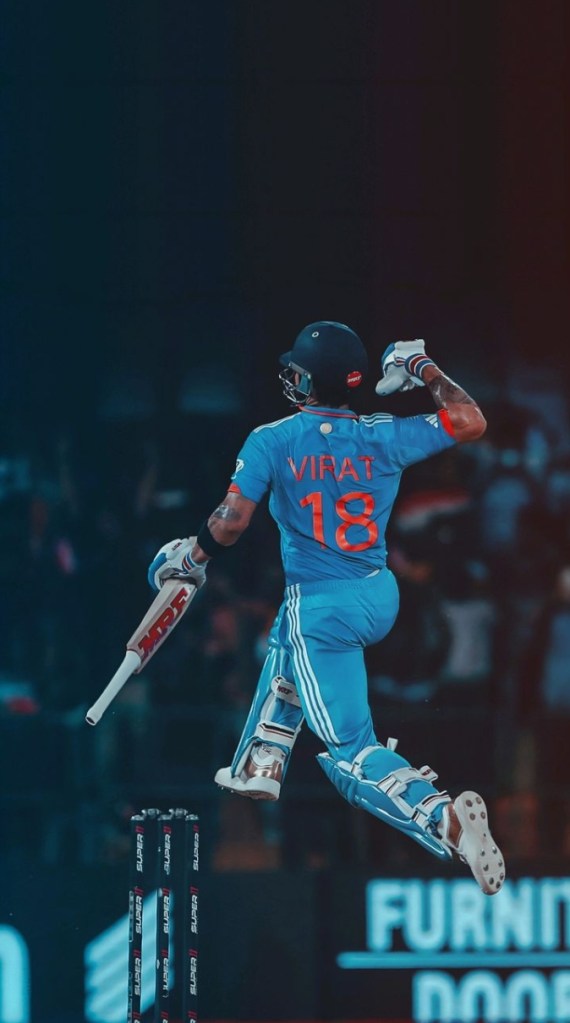
At the heart of every black hole lies a singularity- a point of infinite density where the laws of physics are said to break down. It is the pinpoint centre of an object so massive, not even light can escape it. Virat Kohli is this singularity. Let me clarify: it’s not that he exists in this singularity. He is the singularity. The mass of his will and the impact of his performance forming a Schwarzschild radius* that swallows possibility and spits out improbabilities like mangled previous-truths of no-one-can-do-that, and this-is-not-possible. Virat Kohli is inevitable.
It’s a famous quote by now. The English are understandably fond of it. Nothing has ever demonstrated Kohli’s relentless pursuit for excellence quite like his captaincy- turning every home Test into a trial by fire for opponents, demanding total commitment from his team, and setting a tone that opponents, particularly in their own backyard, could never ignore. He transformed India’s Test mentality, inspiring fast bowlers to attack and fielders to hunt, making each spell about psychological domination and cultural reset.
Under Kohli, for 11 consecutive Test series, India remained undefeated on home soil, a streak spanning over seven years (2015–2021).2 In 31 home Tests, India lost only 2 matches: a fortress so impregnable that it redefined the subcontinent’s dominance.3 No other Indian captain who led in multiple series maintained such a pristine record.23 The team didn’t just win; they devoured oppositions: nine victories by an innings, nine by margins over 150 runs, turning home advantage into an inevitability.45
But home is home. What elevates Kohli was his refusal to accept that Indian teams must bow to foreign conditions. He became the first Asian captain to win Tests in Australia, England, and South Africa. His 16 away Test victories are the most by any Indian captain, surpassing Sourav Ganguly’s 11.46 In SENA countries (South Africa, England, New Zealand, Australia), Kohli secured seven Test wins- the next best is three.47 He captained us in 68 Tests, won 40 of those, lost 17, and drew 11.48 That’s a 58.82% victory rate, which is the highest for any Indian captain to date.48
Across formats, Kohli captained India in 213 matches, winning 135 at an overall win rate of 64.31%, which is the second-best for any Indian captain with at least 50 matches.89 We held the ICC Test Mace for five consecutive years (2016–2021),10 and for a historic period between January 2017 and March 2020, India held the No. 1 ranking in all three formats simultaneously, a feat no other team had achieved before.4 This triple dominance lasted for 38 months, making Kohli’s India the most complete cricketing force of the era.4
Kohli’s impact wasn’t just tactical—it was systemic. He turned fitness from a personal obsession into a team religion. As captain, he institutionalised fitness by making the yo-yo test a non-negotiable selection benchmark, directly impacting team composition.10 Michael Holding noted that while “maybe two players were fit” in the India of old, now “everyone is”—a direct result of Kohli’s blueprint.10 This physical transformation unlocked India’s bowling potential. Fast bowlers, once seen as support acts, became weapons of warfare: Kohli, a batter, built a team of bowlers who took 20 wickets 22 times in 35 away tests under him.4
Unsurprisingly, Virat continues to lead even without formal captaincy. In January 2025, when approached to captain Delhi in the Ranji Trophy, he refused.11 At RCB, after stepping down from captaincy in 2021, he remained the franchise’s emotional leader. Director of Cricket Mo Bobat stated: “Virat doesn’t need a captaincy title to lead. Leadership is one of his strongest instincts. He leads regardless.” When RCB appointed Rajat Patidar as captain for IPL 2025, Bobat noted that Kohli was “so pleased for Rajat” and “right behind him,” actively supporting the decision.12
The Warrior
“Beyond the present and into legend”13
There are so many.
My favourite Virat Kohli innings remains those twin centuries at the dawn of his captaincy stint in Adelaide- emblematic of a man who would drag India across the finish line repeatedly and single handedly if grit were the only ask. Australia won by 48 runs.14
That pre-Diwali rescue 82* with Hardik, DK, and finally Ashwin: facing Pakistan with 90,000 fans at the MCG after India were 31/4, with probably the one shot at 18.5 I’ll still smile about in my deathbed. This man dragged India back from the dead in what is probably the best T20 innings I’ve seen.15 I watched the last few overs of this match at a Croma store with salespeople and customers alike crowded around televisions showing the match, all work forgotten, our pulse clenched in Virat’s fist.
92 in Kolkata in wet-bulb temperatures of more than 40°C, with Australian players collapsing around him: Matthew Wade vomited on the field, Pat Cummins sat on an esky during play, unable to stand. Kane Richardson described it: “We were literally dying. No one was speaking. Even if you got a wicket, there was complete silence because no one had energy.” Kohli was running twos. India posted 252 and won by 50 runs.16
Hobart 2012, when India needed to chase 321 in 40 overs to stay alive in the tri-series, which sounds absurd, right? Kohli’s 133* off 86 balls finished that chase with two balls to spare.17 I remember watching that innings, entirely confident he’d get us there.
His 35 of 49 at just 22 years old in the CWC final at home in a pressure cooker situation, chasing the highest total ever required to win a CWC final? Not his most celebrated innings, and certainly well before the mythos, showed us what was to come.18
Really, there are so many others19, but let’s get on with why I really love him.
The Eternal
“Don’t write India off because Virat Kohli is still there, and we know what he can do.”20
Here’s proof: Virat was the fastest player in ODI history to 8,000, 9,000, 10,000, 11,000, and 12,000 runs.21 He has earned 70 Player of the Tournament / Series awards 555 total international matches (as of date),22 and hit 20 centuries as Test captain, the most Test tons by an Indian captain, and fourth-highest runs globally behind only Graeme Smith, Allan Border, and Ricky Ponting.4 He also made seven double centuries as captain, the most in Test history.4 He reigned as the No. 1 T20I batsman for 1,202 days, the most by any player,23 the No. 1 ODI batsman for 1,258 days, 24 and remains the only player to achieve 900+ rating points across formats.2326 He has more than 8,600 IPL runs in 258 innings, the highest run scorer in IPL,25 and currently the third highest run scorer in international cricket approaching 28,000 runs.27
Only someone who followed his career through those years would be able to tell you the effect these records had on our psyche: Virat the Wonder shaking a nation brought up to be diffident awake to suddenly realise our own agency. And while all these numbers tell a story, they can never explain a fan’s relief at having this man at the crease. Like Isa said, if Virat’s batting, we haven’t lost yet.
Before 2019, it was easy to forget he’s human. The form slump got all of us. Between November 2019 and September 2022, Kohli endured the most public batting crisis of his career- a 1,048-day wilderness without an ODI century, spanning 71 international innings across all formats.29 His Test average collapsed to 26.20 (917 runs, 20 matches, 2020-2022), with zero centuries in both 2020 and 2021.30 Even his white-ball dominance faltered- his ODI average fell below 4030 for the first time in a decade, and familiar strengths became questions. The cover drive, once his signature, became a liability as he nicked off repeatedly. The psychological toll was visible. He spoke of “feeling mentally down” and “not feeling his hands” during drives.30
Now that we’ve been reminded, let’s talk about the man- because for all the centuries and chases, perhaps the most extraordinary thing about Virat Kohli is how he uses the weight of his name.
Long before he and Anushka Sharma married, he defended her when faceless trolls blamed her for losses.32 He posted publicly, forcefully, without calculation, simply because decency demanded it. Years later, when Mohammed Shami was targeted with bigotry after a match, Kohli didn’t hide behind neutrality. He called the abuse “pathetic,” “spineless,” and “the lowest level of human behaviour.”33 He did it in front of cameras, with the nation watching, fully aware that such candour from an Indian captain would ignite a culture war. But on both occasions he understood silence is complicity, and anyway when has this man ever been silent.
Predictably, the defence of religious freedom in a country fraught with public indecency and intellectual degeneration led to rape threats against his infant daughter, and Virat and Anushka chose not to retreat from the public eye, not to negotiate with cowards. Cases were filed and people held accountable.34
He caught criticism for going home during the Test series to be with Anushka for the birth of their child.35 In a cricket culture where paternity leave has seldom been normalised, Kohli’s decision to go home for the birth of his child felt radical. It remains one of the most quietly admirable decisions of his career: a rewiring of what leadership looks like.
But his empathy clearly extends far beyond the personal.
When Steve Smith was booed by Indian fans after the sandpaper incident, Kohli turned to the crowd in the heat of a World Cup match and asked them to stop.36
When Naveen-ul-Haq was being drowned in abuse in an international fixture after an IPL flashpoint, Kohli chose to publicly diffuse the situation.37
And the youngsters, an entire generation he has nurtured and helped forge. Mohammed Siraj, who lost his father during the 2020 Australia tour, has said repeatedly: “Kohli bhai is a brother, a guide, a mentor.”38 Shubman Gill, now India’s Test captain- and Kohli’s ODI captain, has spoken openly about Kohli’s influence on the team.39 Ishan Kishan has recounted Kohli giving up his no. 4 position for him.40
Of all these, what stands out is a recent demonstration of how Kohli the fiery child-star has become a pole star that can guide a nation’s conscience if we allow it: in a candid conversation with sports presenter Gaurav Kapur, Kohli dismantled the romanticisation of his journey with characteristic honesty: “the person who doesn’t get two meals a day is the one who struggles. We are not struggling. You can glorify your hard work by calling it a struggle, put a cherry on top. No one is telling you to go to the gym, but you do have to feed your family. If you think about the real problems regular people face in life, it’s not the same. The problem of getting out in a Test series can’t be compared to someone who doesn’t have a roof over their head. The truth is, for me, there’s been no real struggle or sacrifice. I’m doing what I love, which isn’t an option for everyone”.41
For a man meant for celestial metaphors the truth is astonishingly grounded: Virat Kohli is the only singularity that truly matters: a good man.
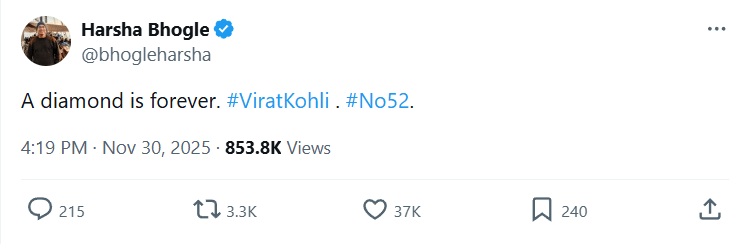
📷 Screenshot of Harsha Bhogle’s tweet on Virat’s 83rd century.
*The Schwarzschild radius is a concept from astrophysics that describes the relationship between a massive object’s mass and the critical radius at which its gravitational pull becomes so strong that nothing can escape, creating a black hole
This post is inspired by Indian Men’s Test Cricket Captain Shubman Gill, who’s suffered three separate head/ neck injuries in 36 days, as well as my friend Sanchita who asked how can such injuries be reduced when I posted about the Skip’s poor run of luck.
Before we proceed, I understand this post has turned into a bit of a book, so here’s a list of sections as well as what they talk about in a line. Feel free to jump to whichever section you wish to read:
A primer on these injuries: explanations of head/ neck injuries
Concussion vs non-concussive impacts: a discussion on injuries that result in a concussion and those that don’t, and their impacts on athletes.
Feeling all wrong in the head: The psychological impacts of getting hit in the head/ neck/ face.
Cumulative trauma and CTE: More about the cumulative load of multiple head hits over the course of a life.
ICC’s concussion guidelines: self explanatory.
Workload management: a discussion of workload management in cricket and why its an important part of this discussion
A bit about helmet design: about cricket helmets.
The technology cricket isn’t using: available helmet technology we could be using but are choosing not to.
Risk Compensation: Humans take more risks if they have more protection.
So what to do?: My solutions.
In conclusion: …the, you know, conclusion to the post.
Appendix 1: No surprises: ACWR calculations for Gill with lots and lots of assumptions and no actual data
Appendix 2:Comparison table between helmets used in F1, NFL, and international cricket: You know… a tabular comparison between helmets used in F1, NFL, and international cricket.
Now back to Shubman, who was injured in three different ways:
10 October 2025, he collided with West Indies keeper Tevin Imlach.12
31 October 2025, he was struck on his helmet by a Josh Hazlewood snorter that seemed to ricochet off his bat.34 This was also immediately after both teams observed a moment of silence for the death of 17 year old Ben Austin after he was struck in the neck while practicing,56 and I wonder what effect that had.
15 November 2025, he suffered a neck spasm (?- I don’t know what the actual diagnosis is, this is just what the media is calling this injury) seemingly due to hitting the ball with great force.78
Gill’s extraordinarily rancid luck has given him a near-complete collection of cricket’s head and neck injury mechanisms—while mercifully leaving him alive and able to walk. With him possibly out of the upcoming second Test in Guwahati, I began wondering: are there ways to prevent these incidents, or at least reduce their impact?
Let’s look at the systemic issues that makes so many cricketers prone to these injuries.
A primer on these injuries A head and/or neck injury can result in a wide spectrum of medical consequences—ranging from mild, temporary symptoms to life-threatening or permanently disabling outcomes. Here’s a table:
Major blow/ trauma to neck, severe vertebral fracture, direct ball impact
Partial or complete paralysis, loss of sensation, loss of bladder/bowel control, breathing problems
Vertebral Artery Dissection (a tear in the wall of the vertebral artery in the neck, which can lead to a blood clot that disrupts blood flow to the brain)1819
Ball impact to neck, rotation injury (rare, catastrophic, eg. Phil Hughes)
Stroke symptoms: weakness, speech difficulty, visual loss; can cause fatal brain bleed (subarachnoid)
Lacerations (tears/ cuts on the skin) & Contusions (a bruise where blood vessels are damaged, causing bleeding under the skin without an open wound)2021
Ball, bat, or ground strike to head, neck or face
Pain, swelling, bleeding, bruising; can mask deeper fracture or brain injury; risk of infection
Concentration, memory deficits, fear of fast bowling, nightmares, performance decline, depression, anxiety
Concussion vs non-concussive impacts A study of elite Australian cricketers over 12 seasons recorded 199 traumatic head and neck injury events, with the incidence increasing to 7.3 per 100 players after helmet regulations were introduced in 2016.262728 Contusions were the most common injury type (41%), with the face being the most frequently injured location (63%), followed by the neck (22%) and skull (15%).262728 Victorian hospitals alone treated 3,907 head, neck, and facial cricket injuries over a decade, with a notable increase from 367 to 435 cases during the 2014/15 season.262728 The burden extends beyond elite cricket. Hospital admission data shows an incidence of 1.2 head and neck injuries requiring hospitalization per 1,000 participants across all participation levels.262728 Males experience significantly higher injury rates (1.3 per 1,000 participants) compared to females (0.4 per 1,000), with the 10-14 age group being the most frequently hospitalized.27
Evidence suggests that batters who suffered helmet strikes without diagnosed concussion experienced significant batting performance decline for up to 3 months, and that performance dropped from +0.24 standard deviations above average to -0.24 below average—a total decline of approximately 0.48 standard deviations, a statistically meaningful performance decline.293031 (DON’T PANIC HERE’S AN ILLUSTRATIVE EXAMPLE WITH MADE UP NUMBERS: This means there might be a reasonable chance, let’s say around 30–40%, that a player who usually averages 50 could instead average something like 42–45 for the next few innings, not because their skill disappeared, but because the non-concussive head impact can affect timing, confidence, decision-making, and overall performance.)
Further, research using computerised cognitive testing on concussed cricketers shows:38
Detection speed (recognising a stimulus) slows by 27 milliseconds
Identification speed (processing what you see) slows by 49 milliseconds
Working memory (holding information while making decisions) slows by 53 milliseconds
No one familiar with cricket needs any explanation about what this means for elite cricketers facing a hard cork ball coming in at 140 kmph: on lucky days it can be the difference between middling the ball or edging to slip. On a bad day it can mean a dead cricketer.
Paradoxically, concussed players showed no significant performance decline, perhaps because they received structured return-to-play protocols, possibly with psychological support.29
This is just more evidence that the sport does not take head/ neck injuries seriously enough: unless it is a concussion, it’s nothing. Compare this to any other physical injury- a sprained ankle receives appropriate treatment, just like a broken one, yet unless there is a proven concussion, it is either seemingly assumed no injury has taken place at all, or it requires no further support. Are we surprised? After all, the box was invented and widely used long before helmets were.3233 Given the documented primate instinct to protect our heads above all else during danger,34 it’s no wonder that when we fail at this, such as when a ball strikes us in the noggin despite our best efforts, the psychological consequences can be severe and lasting.
Feeling all wrong in the head Following his 2014 facial fracture from Varun Aaron’s bouncer, Broad suffered ongoing nightmares and flashbacks for months, even during sleep deprivation.35 His jaw clicked involuntarily, and he saw balls flying at his face in the middle of the night, a form of post-traumatic stress that affected his batting technique for years afterward.35 His confidence was “knocked big time,” and his post-injury batting statistics show measurable decline, particularly his reluctance to play front-foot drives, as he now camps perpetually on the back foot anticipating short balls.3536
Broad’s quality of life went down significantly due to this injury and there’s no knowing if he’ll ever quite be free of this particular demon. Who knows when it might come knocking at his mental doors again? Why does it matter- well, it matters because he’s a person and we don’t want him to be unwell. It also matters because it shows something cricket rarely acknowledges: psychological injuries are also performance injuries.
Cumulative trauma and CTE24 Critically, research increasingly shows it’s not just diagnosed concussions that matter—repeated subconcussive impacts (hits that don’t cause immediate symptoms) carry serious long-term risks. Research on chronic traumatic encephalopathy (CTE, a brain disease that is thought to be caused by repeated head injuries) associates with repetitive head impacts over years that trigger neurodegenerative disease. The CDC’s guidance on traumatic brain injury emphasises that repeated head impacts can produce brain changes detectable on neuroimaging even without concussion symptoms. Studies tracking athletes show that the number of years exposed to contact sports—not the number of diagnosed concussions—most strongly predicts brain pathology severity. To really understand what this means, here is what CTE manifests as: progressive memory loss, mood disturbances, aggression, dementia, and in approximately 45% of CTE cases, full dementia develops. Approximately 66% of CTE patients over age 60 develop dementia, and the number of years of exposure to contact sports (not the number of concussions) is significantly associated with severity.
This means every helmet strike suffered matters. Every bouncer that rattles a helmet. Every collision. Every seemingly “minor” blow that is waved off, often enough by the players themselves. These accumulate over years and decades, potentially causing permanent brain changes long before symptoms appear. And let me tell you something macabre: CTE can only be definitively diagnosed post-mortem.37
All this brings us back to Shubman and a very obvious cricketing: rest. Gill has played an almost uninterrupted international schedule, often under immense leadership pressure. Because better rest means better recovery, it’s not difficult to wonder whether Gill’s ICU trip could have been prevented had his workload and injuries been managed better.
Workload management Sleep restriction has been definitively demonstrated to negatively impact attention and reaction time.39 In cricket, batters and fielders with sleep disturbances or excessive match load develop more muscle strains and are more likely to suffer slips, misfields, or head impacts, while fast bowlers with insufficient rest between spells or days have higher rates of stress fractures, shoulder injuries, and muscle tears.
Research shows that reaction times slow by 26-215 milliseconds (depending on the individual) after concussion injuries. Critically, even athletes cleared for return-to-sport still demonstrate reaction time deficits compared to healthy controls, meaning their brains haven’t fully recovered despite being medically cleared.404142
In cricket, unlike many sports, everyone must be batting-ready—even bowlers and lower-order players face 90-mph deliveries with potentially milliseconds to react. When fast bowlers complete bowling spells without adequate recovery, their neuromuscular function is compromised for up to 24 hours (This means their muscles don’t fire as well, coordination is compromised, and they become more prone to awkward movements that cause injuries. Studies using countermovement jump testing (a standard assessment of neuromuscular readiness) show measurable declines lasting a full day after intense bowling.43
But as previously mentioned, exhaustion leads to lower reaction times, because sleep deprivation and cognitive fatigue directly impair neural processing speed:4445 so, a cricket ball traveling at 90 mph and reaches the batter in approximately 400-500 milliseconds, which is the total available response time to any batter. A 26-millisecond slowdown in reaction time means that the batter now has 5-6% less available time to respond (that is, because sleep deprivation and cognitive fatigue directly impair neural processing speed, a 26-millisecond slowdown in reaction time means the batter has 5–6% less time to respond.).46 For a fatigued player this could easily be the difference between playing the ball and getting hit.
Sudden workload spikes add to general fatigue issues. Sports scientists measure this through a metric called Acute:Chronic Workload Ratio (ACWR), and it is used to predict injury risk. It’s calculated in the following way:4748
Acute workload = work done in the past 7 days
Chronic workload = average work over the past 4 weeks
ACWR = acute divided by chronic
Research shows that when ACWR exceeds 1.5 (meaning you’re doing 50% more work this week than your 4-week average), injury risk spikes dramatically. Above 2.0, players face 5-8 times greater injury risk. Professional teams using GPS tracking to monitor ACWR have reduced injury rates significantly—yet this technology remains underutilis
ed, particularly at international level where scheduling pressures often override medical best practices.
ICC’s concussion guidelines4950 The International Cricket Council (ICC) mandates structured on-field assessment (SCAT6) at match breaks, end of play, and at 24 and 48-hour intervals. Players diagnosed with concussion must be immediately removed and cannot return the same day. Return-to-play protocols typically take at least 7 days and include: 24 hours relative rest, light aerobic exercise, light training, and progressively returning to full participation—but junior players (under 18) must wait a minimum of 14 days after symptom clearance before competitive play.
In June 2025, the ICC introduced a mandatory minimum seven-day stand-down for any player diagnosed with a concussion,51 and teams must now nominate designated concussion replacements before a match52.
The ICC has also set specific standards that all approved helmets must meet. These are (BS 7928:2013 + A1:2019 standard, which includes tests for neck protectors):5354
Faceguard penetration testing at realistic ball impact speeds
Testing against both men’s (5.5 ounce) and junior (4.75 ounce) cricket balls
Neck protector impact testing specifically designed to reduce basal skull and neck injuries
Also, currently the Marylebone Cricket Club (MCC, the body that makes laws for cricket) has concluded after that law changes are not necessary, instead emphasising umpire discretion under Law 41.6, which allows umpires to call dangerous short-pitched deliveries as no-balls if bowlers exceed shoulder height or if the batter lacks skill to face them safely.5556 One would imagine this would cover all scenarios, however, we know this is not the case.
A bit about helmet design Cricket helmets need to meet three competing requirements: protection, visibility, and weight. An improvement in one area is likely to compromise the other two.
When a batter walks out to face 140 kmph bowling, what they need most is clarity. They need to see the ball early and track it right out of the bowler’s hand. That means the helmet can’t be too big, too heavy, too bulky, or too close around the eyes. At the same time, protection demands more coverage, especially around vulnerable areas like the jaw hinge and lower skull. And then there’s weight: add too much carbon fibre or too thick a liner, and the helmet becomes a neck injury waiting to happen, not to mention general discomfort and possibly compromising the athlete’s ability to move their head.
We also have evidence of serious blind spots in helmet design: before Phil Hughes passed in 2014, no major manufacturer seriously considered that the most catastrophic head injury in cricket might come from below the helmet and behind the ear, simply because nothing of the sort had been recorded before. It took Hughes’ fatality for the entire cricket world to realise how vulnerable that area actually was-5758 something any trainee doctor is likely to know. Suddenly, manufacturers scrambled to create neck guards, which remain optional to this day. I shudder to think whose blood is going to buy us the next development in helmet technology.
A hard outer shell of ABS, fibreglass, or carbon fibre
A foam liner, usually EPS or multi-density foam
A steel or titanium grill
Padding around the jaw and chin
They perform very well against linear acceleration (straight-line impacts), but many of the worst brain injuries come from rotational acceleration,6162 when the head violently twists rather than just moves backward: traditional helmets aren’t great at stopping such injuries, and current testing standards often don’t measure it.636465 By the way, learning this has made me genuinely grateful that Gill walked away from his third injury.
To recount, at the moment, the ICC requires helmet’s to be tested for whether the ball can penetrate the grill, peak velocity impacts, protection against both senior and junior cricket balls, and for neck guard impacts.54
What we’re missing: tests for rotational concussion risk, no requirement for repeat-impact safety (a helmet can pass the test once and still weaken after a few blows), and there is no measurement system or guideline that helps medics determine how long a player should be out of the game in case of non-concussive injuries. Or even repeat non-concussive traumas that happen within a short timeframe like Gill’s.
The technology cricket isn’t using66676869707172 In American football, ice hockey, and even rugby, athletes now routinely wear helmets or mouthguards that contain:
accelerometers
gyroscopes
rotational-force sensors
radio transmitters to send impact data to support staff
The moment an athlete suffers a dangerous hit, medical personnel get an alert. There’s no argument, no debate, no “I feel fine, I’ll carry on.”
Cricket could have this tomorrow if our administrators took this issue seriously enough. The technology is cheap, lightweight, and has already been validated in other sports.
A smart cricket helmet could tell the physio: this was a 75g impact with significant rotational acceleration. Used in combination with a standardised medical guideline from the ICC, that player could be removed immediately and rested for as long as required. And maybe if this happens, there may be a cultural shift where we wouldn’t need a Ravindra Jadeja falling about being dizzy during an innings break, and then have the team management answer batshit questions about whether the substitute was a like-for-like replacement.7374
There are also exciting innovations happening which don’t involve adding meters to the helmet, such as 3D-printed lattice structures which deform in controlled ways to absorb and dissipate energy more efficiently than traditional foam (they’re already used in some of the safest American football helmets)757677and multi-impact liners, which maintain their protective performance across several blows7879.
I’ve done a tabular comparison of existing international cricket helmets with those used in F1 races and NFL matches in Appendix 2, if you want to scroll down.
Risk Compensation I just want to note a human tendency that has been verified by research: the safer we feel, the more risk we take. It has been demonstrated repeatedly:
Ice hockey players hit harder when facial cages are added83
American football players tackle more aggressively with better padding8485
There’s no clear, modern (2020s) empirical study linking helmet use leads to increased aggressive shot-making or riskier batting in cricket, but humans are humans, and so hopefully any future studies about the use and usefulness of protective gear in cricket will take this into account.
So what to do? Here are my suggestions as a non-medically trained fan:
A. Medical Safety Protocols
Collaboration between ICC and doctors who specialise in cranial trauma, neck injuries, etc. (whether concussive or not), and sports medicine specialists from other sports with more advanced athlete support for such injuries to study and understand all such injuries better and release recommendations that are either endorsed or updated annually as required.
An athlete who has suffered two head/neck injuries within the space of 30 days (or whatever number medical professionals agree on) should automatically be placed on a two-week mandatory medical rest.
A full set of medical tests and scans at a hospital (not just by the team physio) after every head/neck injury.
Actual regular sports medicine assessments, not just after injuries occur.
Independent medical oversight that is not influenced by team selection pressures (either from the team or the athlete themselves).
MANDATORY MENTAL HEALTH SUPPORT for any injured players, and also for those returning from these kinds of injuries.
B. Monitoring & Injury Tracking
Mandatory biomechanical screening to identify high-risk movement patterns for each athlete.
Career-long injury tracking to identify cumulative trauma patterns and to strengthen vulnerable areas before injuries happen.
Smart helmet or wearable impact monitoring to quantify dangerous blows and guide medical care.
C. Workload Management
Workload management for all cricketers, no matter how important they seem to be for a particular team or cricket ecosystem.
The use of ACWR and/ or other sports science metrics to identify and prevent dangerous spikes in workload.
D. Technical & Skill Interventions
Mandatory bouncer-playing classes for all cricketers. If bouncers are part of the game and cannot be curbed, we need to teach every cricketer how to play them. ICC can standardise these educational modules.
Annual board audits checking whether cricketers have received from each board have received these lessons.
Active field awareness training so players stop colliding. Collisions are so preventable.
E. Equipment, Technology & Design
Using all technology available for helmets that actively prevents ball-hit injuries.
Adoption of advanced materials (3D lattice structures, multi-density liners) to reduce both linear and rotational impact forces.
Exploring mandatory neck guards, redesigned to address current comfort and visibility issues.
F. Cultural Redo
A cultural shift that doesn’t look at injuries as weaknesses.
The cricketing ecosystem needs to stop simply mourning dead cricketers and start actively preventing these deaths.
Stop treating head and neck injuries as “part of cricket.” They’re not inevitable; they’re preventable.
In conclusion As a cricket fan, I’ve admired the several instances of cricketers putting their bodies on the line for … for what? A match? Rishabh Pant batting with a broken foot, Anil Kumble bowling with a broken jaw, Chris Woakes batting with whatever was going on with his shoulder, Cheteshwar Pujara wearing balls, Greame Smith walking out to bat with a broken hand, Phil Hughes dying. All these have something in common: cricket valorises suffering. We celebrate wounded heroes, but never ask why they had to be wounded in the first place.
Our dead: An incomplete list of cricketers dead due to head/ neck trauma. Truly, shame on us.
Cricket is a sport. It’s my favourite sport. It’s a wonderful, beautiful, demanding, meaningful sport. But it is still just a sport. Cricketers are human beings with futures, families, and brains that deserve protection. The solutions exist. The research is clear. The deaths are preventable. And it is well past time we started preventing these unnecessary deaths instead of mourning them.
___
Appendices
Appendix 1: No surprises I don’t have access to Gill’s workload or any personal statistics, but I wanted to understand how correct my instincts were about my hypothesis regarding these three recent injuries and his workload. I’ve made some assumptions, and take everything with a healthy spoonful of salt, but here are my calculations.
I’ve used the following research-established numbers:90919293
ACWR Range
Risk Category
Injury Risk Multiplier
< 0.80
Undertrained
Moderate (fitness declining)
0.80–1.30
Optimal
Lowest injury risk
1.30–1.50
Elevated Risk
1.5–2× baseline risk
1.50–2.00
High Risk
3–5× baseline risk
> 2.00
Danger Zone
5–8× baseline risk
My assumption is that 1 hour of active cricket = 1 workload unit. This leads to the following table:
The weekly ACWR analysis (bold typography used for each of the injuries):
Week Starting
Activity
Acute Workload (7 day period in hours)
Chronic Workload (28-day avg. in hours/ week)
ACWR
Risk Zone
Jan 22
England T20/ODI start
16 hours (2 T20s + 1 ODI)
14 hours/ week baseline
1.14
Optimal
Apr 1
IPL mid-season
8 hours (2 T20s)
8.6 hours/ week
0.93
Optimal
Jun 1
Pre-England Tests
4 hours (1 T20)
8 hours/ week
0.50
Undertrained
Jun 20
England Test 1
35 hours (5-day Test)
14.5 hours/ week
2.41
Danger Zone
Jul 2
England Test 2
35 hours
22 hours/ week
1.59
High Risk
Sep 25
Pre-WI Tests
0 hours (rest)
12 hours/ week
0
Recovery
Oct 2-8
WI Test 1
35 hours
17.5 hours/ week
2.00
Danger Zone
Oct 10-16
WI Test 2 (injured)
21 hours (retired Day 3)
19 hours / week
1.10
Moderate
Oct 19-25
Australia ODIs
16 hours (2 ODIs)
28 hours/ week
0.57
Undertrained
Oct 26-Nov 1
Australia T20s
12 hours(3 T20s)
26 hours/ week
0.46
Severely Undertrained
Nov 9-15
Travel/prep
~7 hours (assuming light training)
21 hours / week
0.33
Undertrained
Nov 14-20
SA Test 1
35 hours
21 hours/ week
1.67
High Risk
Gill’s ACWR analysis
Now, make of the above whatever you will. Correlation is not causation and the ball-hit injury happened after a rest period so that injury doesn’t fit the ACWR model. However, given the above, I’m not sure I’d dismiss the injury-pattern as as just very poor luck: while ACWR may not fully explain all three injuries, the cumulative fatigue coupled with inadequate recovery protocols do seem to create demonstrable vulnerability.
The point isn’t that ACWR perfectly predicts all three injuries. It doesn’t. As a model it predicts risk of something happening rather than saying with surety that it will happen. However, perhaps it can tell us something about the impact of inadequate recovery windows, format transitions, and cumulative load overlapping issues that increase injury susceptibility, especially when combined with psychological stress from captaincy and the normal stochasticity of playing cricket at 140 kmph.
Appendix 2: Comparison table between helmets used in F1, NFL, and international cricket
Here’s a comparison between helmets used by F1 racers, elite American Football athletes, and international cricketers (I’ve used bold typography for features I think cricket helmets should have, and couldn’t find verifiable data for helmet weights):
Toughest shell. Built to survive high-speed crashes, resists hits from all angles and projectiles. Added ballistic strip on visor for extra protection.
Cutting-edge impact protection. Designed to absorb hits from all directions; includes special padding to prevent concussions and uses smart sensors.
Protects against fast balls and bouncers. Hard shell and grille stop balls entering; strong for head-on hits, but less effective for twisting injuries.
Visibility
Maximum: very wide visor, minimal distortion, designed for 180° vision at 300 km/h.
Wide and high field of view. Thin facebars ensure players see clearly, important for catching and dodging tackles.
High: grille and shell designed to allow batters to see the bowler and ball clearly, but some guard designs can slightly obstruct vision above/below.
Special Features
Fire-resistant, radio setup, multiple visor options for sunlight.
Smart sensors detect hard hits, customisable fit, extra light facemasks (titanium options).
Removable padding, neck guards added after recent fatalities, optional extra light titanium grille for better comfort.
Crash/Impact Testing
Most rigorous: tested for hits from race wrecks, flying debris. Top global safety standards.
Lab-tested for head injuries, including concussion risk—best for rotational/twisting impacts.
Tested for direct ball impacts, facial and neck injuries; not formally tested for twisting/rotational impacts yet.
Overall
Most protective helmet in any sport, a bit heavier but unbeatable for safety.
Best for head impacts and preventing concussions in team sports.Tech is advancing fast.
Lightest, adequate for direct hits, but not yet matching F1/NFL for twisting impact safety.
Comparison table between helmets used in F1, NFL, and international cricket
I’m not suggesting just using a helmet from another sport. I’m saying we can make our helmets much better right now if we wanted to.
I cannot believe I’ve put in appendices for a goddamn blog post.
Sources (I’ve removed the duplicates so there are fewer links than the numbered links above)
NB: This post is now updated to include the 18th consecutive toss loss.
It’s come to my attention that we have lost the last 17 18 coin tosses in One Day International matches for men’s cricket,1 so here’s a continuation of our unfortunate probabilities.
Every coin toss is considered an independent event- the outcome of one fair coin toss will not have any impact on the outcomes of any other fair coin tosses.
The probability of two independent events happening at the same time is the product or multiplication of the probabilities of the two events in question. This is called “joint probability”, so If event A has probability P(A) and event B has probability P(B), and their outcomes do not affect each other, the probability that both occur is P(A) × P(B).
#
Date
Opponent
Venue
Captain
Toss Result
1
Nov 19, 2023
Australia
Ahmedabad
Rohit Sharma
Lost
2
Dec 17, 2023
South Africa
Centurion
KL Rahul
Lost
3
Dec 19, 2023
South Africa
Gqeberha
KL Rahul
Lost
4
Dec 21, 2023
South Africa
Paarl
KL Rahul
Lost
5
Feb 6, 2024
England
Hyderabad
Rohit Sharma
Lost
6
Feb 9, 2024
England
Visakhapatnam
Rohit Sharma
Lost
7
Feb 12, 2024
England
Rajkot
Rohit Sharma
Lost
8
Aug 10, 2024
Sri Lanka
Colombo
Rohit Sharma
Lost
9
Aug 12, 2024
Sri Lanka
Pallekele
Rohit Sharma
Lost
10
Aug 15, 2024
Sri Lanka
Dambulla
Rohit Sharma
Lost
11
Feb 20, 2025
Bangladesh
Dubai
Rohit Sharma
Lost
12
Feb 23, 2025
Pakistan
Dubai
Rohit Sharma
Lost
13
Mar 2, 2025
New Zealand
Dubai
Rohit Sharma
Lost
14
Mar 4, 2025
Australia
Dubai
Rohit Sharma
Lost
15
Mar 9, 2025
New Zealand
Dubai
Rohit Sharma
Lost
16
Oct 19, 2025
Australia
Perth
Shubman Gill
Lost
17
Oct 23, 2025
Australia
Adelaide
Shubman Gill
Lost
18
Oct 25, 2025
Australia
Sidney
Shubman Gill
Lost
India’s 17 18 consecutive ODI coin toss losses in men’s international cricket
You’ll notice that once again the tosses have been lost across tournaments, three different captains, and multiple venues (home and away), and the calling captains choosing heads or tails at random and India still losing every time.
Now, at first I thought that the all format streak of losing 16 consecutive tosses and this ODI streak of losing 17 consecutive tosses were just one series of unfortunate events, but now I want to understand what the probability is of these being considered separate streaks and both “events” still occurring.
So here are the two overlapping streaks:
The ODI-specific streak (Nov 2023–Oct 2025):17 18 consecutive ODI toss losses. Probability = (1/2)^17 = 1/131,072 ≈ 0.00076%(1/2)18 = 1/262,144 ≈ 0.000381%; and
The all-format streak (Jan–Oct 2025): 16 consecutive toss losses across formats. Probability = (1/2)16 = 1/65,536 ≈ 0.0015%.
And the probability that these two have coexisted is just the multiplication of the two independent streaks, which is P = (1/131072) × (1/262,144) = 1/8589934592, or about 1/8,600,000,000, which is one in 8.6 billion1/17179869184, or about 1/17,000,000,000, which is one in 17 billion.
As of mid-2025, the world population was estimated to be around 8.2 billion.2 So if in the middle of this year, if every single person had tossed a fair coin TWICE, there is a possibility that these two streaks would still not have overlapped. It’s an astronomical rarity, so of course we’re on the wrong side of it, *depressed emoji*.
In probability theory, there is a concept of waiting time. Waiting time in streak probability asks how long before you see the streak in question happen? So here it will ask, “How many tosses, on average, until you first see a streak of n consecutive heads (or losses, or wins)?” For a fair coin, the expected number of tosses (waiting time) to see an uninterrupted streak of length n is approximately: En = 2(n+1) – 2.3
In the formula, “n” is the length of the streak.
For a streak of 6 coin toss losses, we will have to wait for
E6 = 2(6+1) – 2
E6 = 27 – 2
E6 = 2 × 2 × 2 × 2 × 2 × 2 × 2 – 2
E6 = 128 – 2 = 126 coin tosses.
So, for our first streak of 16 consecutive coin toss losses, the world waited with bated breath for 217 – 2 = 131,070 fair tosses;
For the ODI 17 18 coin toss loss streak, we waited for 218 − 2 = 262,142 219 -2 = 524,286 fair tosses; and
For both to happen together, we waited 131,070 × 262,142524,286 fair tosses, or 68,718,166,020, or more than 34 68.7 billion fair coin tosses- A NUMBER SO WILD (okay, calm down, calm down) even cricket fans don’t expect it.
What the hell, my guys?
NB: I just realised that the most widely accepted scientific estimate for the age of the known universe is about 13.8 billion years,4 so the chances of these two streaks happening at all, let alone together, actually involves numbers several times greater than the entire age of the universe in years. Personal suggestion to Shubman Gill- havan karwale bhai.