
Greenhouse gas emissions 101 – I

Before we begin, if you want to understand the general big picture about what climate is, Earth’s climate history, and/or about climate change, you can read this very comprehensive post.

A greenhouse is a structure, made of glass or plastic, which captures heat inside it so that it’s insides are warmer and drier than the atmosphere outdoors. Greenhouses are situated outdoors so they have a regular supply of sunlight. We’ve all experienced closed indoor spaces with glass façades that heat up due to receiving sunlight, and require specific cooling solutions that encourage air flow, or artificial cooling through air conditioners, such as sitting inside a car or a room with all its windows closed on warm days. These hot-car experiences are also due to the greenhouse effect.

This effect happens because sunlight, which is primarily composed of (a tiny amount of) ultraviolet (UV) light, visible light, and near-infrared (NIR) radiation, easily passes through greenhouse covers (glass or plastic) into the inside of greenhouse, where the objects, plants, and soil absorb the heat, and become warmer. These warmed up objects now radiate heat in the form of long-wavelength thermal infrared (IR) radiation, which, unlike the incoming shortwave radiation (UV, visible light, NIR) is absorbed into the greenhouse envelope (a building’s envelope is the skin of the building- all the outside walls). Since the building envelop has now absorbed the heat, the structure and its insides warm up and stay warm. In short: this effect allows heat energy inside, but doesn’t allow all of it to escape.12

Similarly, greenhouse gases are gas molecules in Earth’s atmosphere that absorb heat emanating from the planet’s surface- that is, they act sort of like the transparent skin of a greenhouse which absorbs heat so that the plants inside can be warm in cold weather.12

Here’s how it works: Solar energy travels through the atmosphere and warms Earth’s surface. As the planet radiates this heat back toward space, it does so primarily as long-wavelength infrared radiation, which is the same form of heat that gets trapped in a physical greenhouse. Greenhouse gases in the atmosphere absorb this infrared radiation. Instead of letting it escape to space, they re-radiate it in all directions, with much of it directed back downward toward Earth’s surface. This creates a second source of heating (the first being our Sun), amplifying the warming effect and keeping our planet warmer than it would otherwise be.12

A point to note is that in an actual greenhouse building, the warm air inside cannot mix with the cooler air outside it. Similarly, because there is nothing to mix with, the air inside the planet cannot be diluted with cooler air.

The greenhouse effect has directly caused life as we know it now to exist on this planet (other forms of life could still exist without it, who knows), as without this natural greenhouse effect, Earth would be a frozen, inhospitable world. Temperatures would average around -18°C instead of the habitable 15°C we currently enjoy.12 But we’re now enjoying too much of a good thing, and the planet is now heating up more than is good for the life that evolved to live in it when the average temperature was the aforementioned the habitable 15°C: it’s not that no life will survive, it’s just that much of it won’t, leading to general ecosystem collapse, and life will be very uncomfortable for the humans who do make it to the hotter planet.345678910

What does parts per million/ billion/ trillion mean?11
ppm/ ppb/ ppt are notations scientists who study climate use to understand how much of the greenhouse gases in question is present in the atmosphere. Different greenhouse gases are measured in different units depending on their concentration levels. Carbon dioxide, which is relatively abundant in the atmosphere, is measured in parts per million. Methane, which exists in much lower concentrations, is measured in parts per billion. The most potent synthetic gases, such as the fluorinated gases like SF₆ and NF₃, are measured in parts per trillion, because even seemingly insignificant amounts have significant warming effects.

Besides, saying “the atmosphere contains 0.000194 of a percent of methane” is far less convenient than saying “the atmosphere contains 1,942 ppb of methane”.

Thus, if a scientist is measuring how many molecules of CO2 are present in our vast atmosphere, and if the atmospheric concentration of CO2 is measured to be 400 ppm, this means that out of every 1 million air molecules, 400 are CO2 molecules, and the remaining 999,600 molecules are other gases. The same principle applies to measuring ppb and ppt. The conversion between these units is the same as for regular numbers:

  • 1 ppm = 1,000 ppb
  • 1 ppm = 1,000,000 ppt
  • 1 ppb = 1,000 ppt

Here’s how Global Warming Potential is measured1213
GWP measures how much heat a greenhouse gas traps in the atmosphere typically calculated over a 100-year time horizon, in comparison to the amount of heat trapped in the atmosphere by CO2. It’s calculated by the Intergovernmental Panel on Climate Change (IPCC) based on the intensity of infrared absorption by each gas and how long emissions remain in the atmosphere. The unit of measurement is called Carbon Dioxide Equivalent (CO₂e).

Carbon Dioxide Equivalents (CO₂e) provide a standardised way to express the impact of different greenhouse gases using a single, comparable metric. CO₂e is calculated by multiplying the quantity of a greenhouse gas emitted by its Global Warming Potential. The formula is:

CO2e = Mass of GHG emitted × GWP of the gas

For example, if you emit one million metric tons of methane (with a GWP of 30) and one million metric tons of nitrous oxide (GWP of 273), this is equivalent to 30 million and 273 million metric tons of CO₂, respectively.14

This standardisation is crucial for several reasons because it allows comparison across GHGs and amounts of emissions, so no matter the gas that has been emitted or the amount of it emitted, it is easy to understand for everyone the effect it will have on the planet. It will also help compare emissions reduction opportunities across different sectors and gases, and help compile comprehensive national and corporate GHG inventories that include all greenhouse gases. Essentially, it provides a common language for understanding greenhouse gas emissions.

Radiative Forcing Vs. GWP1516
Radiative forcing (RF) is a measure of how much a substance or factor disrupts the balance of energy entering and leaving Earth’s atmosphere. It is expressed in watts per square meter (W/m²), representing the amount of energy imbalance imposed on the climate system: it quantifies how much extra energy is being trapped in the atmosphere by a given agent (greenhouse gas, aerosol, or solar change). Therefore,

  • Positive radiative forcing = warming effect (energy trapped)
  • Negative radiative forcing = cooling effect (energy lost to space)

In comparison, GWP is a simplified index that converts radiative forcing into a single comparable number by expressing it relative to CO₂.

GWP = Total radiative forcing from 1 kg of substance over time horizon / Total radiative forcing from 1 kg of CO₂

This formula is asking if 1 kilo of a substance is released into the atmosphere, how many kilograms of CO₂ would produce the same total warming effect.

Radiative forcing tells you the immediate, direct physics of climate impact. It’s precise but complex because each substance has a different RF value. GWP is a policy-friendly simplification that lets users compare “apples to apples”, so that if 1 million tons of methane (GWP 30) are emitted, vs. 1 million tons of N₂O (GWP 273), it is instantly known that the N₂O causes ~9× more warming.

Let’s take a look at the main GHGs
You can read more about pollution (natural and anthropogenic here).

Carbon Dioxide (CO₂)17 is the most abundant and significant human-caused greenhouse gas, accounting for approximately three-quarters of all anthropogenic GHG emissions. Before the Industrial Revolution, atmospheric CO₂ concentration was about 280 parts per million (ppm). By May 2023, it had reached a record 424 ppm, which is a level not seen in approximately three million years.​ Aside from it’s abundance in the atmosphere, CO₂ is also a particularly concerning GHG because of its atmospheric persistence. While about 50% of emitted CO₂ is absorbed by land and ocean sinks within roughly 30 years, about 80% of the excess persists in the atmosphere for centuries to millennia, with some fractions remaining for tens of thousands of years. This means that the CO₂ we emit today will continue warming the planet for generations.​

Methane (CH₄)17 is the second most important greenhouse gas after carbon dioxide. Although it exists in much smaller quantities than CO₂, methane is extraordinarily potent: one ton of methane traps as much heat as 30 tons of carbon dioxide.​14

Methane is emitted from both natural and human sources. Natural sources include wetlands, tundra, and oceans, accounting for about 36% of total methane emissions. Human activities produce the remaining 64%, with the largest contributions coming from agriculture, particularly livestock farming through enteric fermentation (this is a digestive processes in ruminant animals where microbes in their gut ferment food, producing methane as a byproduct) and rice cultivation. Other significant sources include landfills, biomass burning, and fugitive emissions from oil and gas production (unintentional, uncontrolled leaks of gases and vapors that escape the control equipment, sometimes due to poorly maintained infrastructure).13

The good news about methane is its relatively short atmospheric lifetime of approximately 12 years. This means that reducing methane emissions can have a more immediate impact on slowing global warming compared to CO₂, even though its effects are less persistent over the long term.​

Nitrous Oxide (N₂O), also known as laughing gas, is a long-lived and potent greenhouse gas with a Global Warming Potential 273 times higher than CO₂. It has an average atmospheric lifetime of 109-132 years.​14

Nitrous oxide emissions come from both natural and anthropogenic sources. Major natural sources include soils under natural vegetation, tundra, and the oceans. Human sources, which account for over one-third of total emissions, primarily stem from agricultural practices—especially the use of synthetic and organic fertilisers, soil cultivation, and livestock manure management.131417 Additional sources include biomass or fossil fuel combustion, industrial processes, and wastewater treatment.​131417

Fluorinated Gases18 represent a family of synthetic, powerful greenhouse gases including hydrofluorocarbons (HFCs), perfluorocarbons (PFCs), sulfur hexafluoride (SF₆), and nitrogen trifluoride (NF₃). These gases are emitted from various household, commercial, and industrial applications, particularly as refrigerants and in electrical transmission equipment.​

While fluorinated gases are present in much smaller quantities than CO₂, methane, or nitrous oxide, they are extraordinarily potent. Some have Global Warming Potentials thousands of times higher than CO₂. For example, SF₆ has a GWP of 24,300, and some HFCs have GWPs exceeding 10,000. Additionally, many fluorinated gases have extremely long atmospheric lifetimes, ranging from 16 years to over 500 years for certain CFCs, meaning they persist in the atmosphere for decades or even centuries.​14

Water Vapor (H₂O) is technically the strongest and most abundant greenhouse gas. However, its concentration is largely controlled by atmospheric temperature rather than direct human emissions. As air becomes warmer, it can hold more moisture, creating a feedback loop: warming from other greenhouse gases increases water vapor, which in turn amplifies warming. This makes water vapor a climate feedback mechanism rather than a primary driver of climate change.1219

Greenhouse GasAtmospheric Concentration1718Global Warming Potential (100-yr)14Warming Contribution17Primary Sources & Their Contributions20
Carbon Dioxide (CO₂)Pre-industrial: 280 ppm | Current: 423.9 ppm (↑152%)1 (baseline)~74.5% of total GHG emissions; 42% of radiative forcing increase since 1990Fossil fuel combustion: 74.5% of total – Electricity/heat: 29% – Transportation: 15% – Industry: 24% – Deforestation: 6.5-12%
Methane (CH₄) – non-fossilPre-industrial: 730 ppb | Current: 1,942 ppb (↑166%)27.0~17.9% of total GHG emissions; 16% of warming from long-lived GHGsAgriculture: 42% (livestock 27%, rice 9%) – Fossil fuel extraction: 23% – Landfills/waste: 16% – Natural wetlands: 36%
Methane (CH₄) – fossil*29.8Fossil fuel fugitive emissions from oil & gas systems and coal mining
Nitrous Oxide (N₂O)Pre-industrial: 270 ppb | Current: 338 ppb (↑25%)273~4.8% of total GHG emissions; third most important long-lived GHGAgriculture: 74-75% (synthetic fertilisers 30-50% of agricultural emissions) – Industrial processes – Biomass burning
Water Vapor (H₂O)Pre-industrial: 0-4% (variable) | Current: 0-4% (variable), increasing 1-2%/decadeNot directly comparable (feedback amplifier)41-67% of total greenhouse effect (but as feedback, not primary driver)Natural evaporation from oceans/land – Acts as feedback amplifier (increases 7% per 1°C warming) – Not directly emitted by humans
Tropospheric Ozone (O₃)Pre-industrial: 20-25 ppb | Current: 20-100 ppb (varies by location)Varies regionallyThird most important GHG after CO₂ and CH₄; significant regional warmingNot directly emitted – Forms from: NOx + VOCs + sunlight – Sources: Transportation, industry, biomass burning
HFC-134aPre-industrial: 0 ppt | Current: 96.9 ppt1,530Part of 2.8% F-gases contributionRefrigeration and air conditioning: largest use – Aerosol propellants – Foam blowing – Summer emissions 2-3× winter
HFC-23Pre-industrial: 0 ppt | Current: Low but significant14,600Highest CO₂-eq among HFCs despite low concentrationByproduct of HCFC-22 production – Industrial processes
HCFC-22Pre-industrial: 0 ppt | Current: Declining post-ban1,960Part of declining HCFC contributionRefrigeration/Air Conditioning: primary source (97% of HCFC use) – Being phased out under Montreal Protocol
HFC-152aPre-industrial: 0 ppt | Current: 9.93 ppt164Part of 2.8% F-gases contributionAerosol propellants – Foam blowing – Refrigeration
Sulfur Hexafluoride (SF₆)Pre-industrial: Near 0 ppt | Current: 6.7 ppt24,300Part of 2.8% F-gases contribution; Highest CO₂-eq among all FGHGsElectrical equipment: switchgear, transformers – Magnesium production – Semiconductor manufacturing
Perfluoromethane (CF₄)Pre-industrial: 34.7 ppt | Current: 76 ppt7,380Part of 2.8% F-gases contributionAluminum production – Semiconductor manufacturing – Small natural sources: ~10 tonnes/year
Perfluoroethane (C₂F₆)Pre-industrial: Near 0 ppt | Current: 2.9 ppt12,400Part of 2.8% F-gases contributionSemiconductor manufacturing: 1,800 tonnes/year – Aluminum smelting
Nitrogen Trifluoride (NF₃)Pre-industrial: 0 ppt | Current: Growing17,400Part of 2.8% F-gases contributionSemiconductor/electronics manufacturing – Flat panel displays
CFC-12Pre-industrial: 0 ppt | Current: Declining (banned)12,500Declining contribution; negative forcing from ozone depletionPreviously: refrigeration (primary), aerosols – Now banned; emissions from existing equipment
CFC-11Pre-industrial: 0 ppt | Current: Declining (banned)6,230Declining contribution; negative forcing from ozone depletionPreviously: refrigeration, foam, aerosols – Now banned; emissions from existing equipment/foams
Black Carbon (BC/Soot)2122Pre-industrial: Low natural levels | Current: No direct measurement in ppm/ppb450–900 (100-yr GWP)*Second or third most important climate forcer after CO₂ in some regionsDiesel engines – Coal power plants – Biomass burning: wood, agricultural waste (67% of human emissions) – Residential cooking/heating – Wildfires – Ranking: Fossil fuel > biofuel > biomass burning
CFCs (Total)Pre-industrial: 0 ppt | Current: Declining overall6,230–12,500Negative forcing due to ozone depletion (cooling effect)Banned under Montreal Protocol – Residual emissions from existing equipment/foams
HFCs (Total)Pre-industrial: 0 ppt | Current: 89 ppt total164–14,600~2.8% combined with PFCs and SF₆; grown 310% since 1990Refrigeration/AC sector: largest source (replacing CFCs/HCFCs) – Increased 310% since 1990
PFCs (Total)Pre-industrial: 34.7 ppt | Current: 82 ppt total7,380–12,400~2.8% combined with HFCs and SF₆Industrial processes – Aluminum production – Semiconductor manufacturing
HCFCs (Total)Pre-industrial: 0 ppt | Current: Declining90–1,960Declining; negative forcing from ozone depletion offset by GHG warmingTransitional CFC replacement being phased out – HCFC-22 and HCFC-141b represent 97% of HCFC use
Some important Greenhouse Gases and how they contribute to global warming. Specific GWP values come from IPCC assessments and may be updated as science advances.

Key:

  • ppm = parts per million; ppb = parts per billion; ppt = parts per trillion
  • GWP (Global Warming Potential) is measured relative to CO₂ over a 100-year timeframe (IPCC AR6, August 2024)14
  • F-gases (fluorinated gases) collectively contribute 2.8% of total greenhouse gas emissions but have grown 310% since 1990
  • Water vapor is technically the most abundant greenhouse gas but acts primarily as a feedback mechanism rather than a forcing agent
  • Black carbon is not measured in atmospheric concentration like other GHGs because it’s a particulate (soot) rather than a gas, and has a very short atmospheric lifetime (days to weeks). The GWP range reflects uncertainty in mixing state and location; IPCC AR6 provides radiative forcing (+0.44 W/m²) rather than a formal GWP.
  • *Methane split: IPCC AR6 differentiates between fossil and non-fossil methane due to different atmospheric fates. Use CH₄ non-fossil (27.0) for biogenic sources and combustion; use CH₄ fossil (29.8) for fugitive emissions from oil & gas and coal mining where the carbon is of fossil origin.1423 This is because fossil methane (GWP 29.8) adds carbon that was locked underground for millions of years to the active carbon cycle, representing a net addition of CO₂ when oxidised, whereas biogenic methane (GWP 27.0) comes from carbon that was recently in the atmosphere (absorbed by plants, eaten by livestock, etc.), so its oxidation just adds back the same carbon that was already in the atmosphere until recently and there is no net addition in the long term.24

Sources of GHG emissions

  1. The Energy Sector is the largest contributor to greenhouse gas emissions, producing approximately 34% of total net anthropogenic GHG emissions in 2019.25 Within this sector, electricity and heat generation are the single largest emitters, accounting for over 25% of global emissions, with coal-fired power stations alone responsible for about 20% of global greenhouse gas emissions.26 In 2022, 60% of electricity in many countries still came from burning fossil fuels, primarily coal and natural gas.27 And of course, energy underpins every other sector, whether through fuel for agricultural tractors, for building space conditioning, or any other mechanical activity.
  2. ​Industrial activities come next at 24% of global emissions. These emissions are usually from one of two sources: energy consumption for manufacturing processes, and direct emissions from chemical reactions necessary to produce goods from raw materials.2528 Within industry, cement production and metal production, especially steel, are particularly emission-intensive.28 Since 1990, industrial processes have grown by a massive 225%, the fastest growth rate of any emissions source, driven by rapid industrialisation in developing countries.20
  3. Agriculture, Forestry, and Land Use contributed approximately 22% of global emissions in 2019.25 This is an interesting sector because it’s a major source of non-CO₂ greenhouse gases.29 Agriculture is the largest contributor to methane emissions globally, primarily from livestock farming and rice cultivation, which occurs in flooded fields where anaerobic conditions produce methane.29 The sector also produces significant nitrous oxide emissions, primarily from the application of synthetic and organic fertilisers to soils.29 Additionally, deforestation and land-use changes release stored carbon when forests are cleared for agriculture or development.29
  4. Transportation accounts for approximately 15% of global emissions in 2019.25 The vast majority of transportation emissions come from road vehicles (cars, trucks, buses, motorcycles, etc.) which rely overwhelmingly on petroleum-based fuels.30 Aviation and maritime shipping also contribute significantly, with international aviation and shipping representing growing sources of emissions as global trade and travel expand.30 Since 1990, transportation emissions have grown by 66%, making it one of the fastest-growing sources of greenhouse gases.2030 The sector’s heavy dependence on fossil fuels and the long replacement cycles for vehicles make it particularly challenging to decarbonise quickly.30
  5. And finally, Buildings, whether Commercial or Residential, directly contribute approximately 6% of global emissions through fossil fuels burned for heating and cooling, as well as refrigerants used in air conditioning systems.25 However, when indirect emissions from electricity use are included, buildings account for a much larger share, which is about 28% in the United States, because buildings consume approximately 75% of electricity generated, primarily for heating, ventilation, air conditioning, lighting, and appliances.3132

Sources

  1. IRENA – Power to Heat and Cooling: Status
  2. What is the greenhouse effect?
  3. The Greenhouse Effect
  4. 1.5 Degrees C Target Explained
  5. IPCC AR6 Working Group II – Chapter 2
  6. Science Magazine – Climate Study
  7. What does the latest IPCC report mean for wildlife?
  8. Nature – Climate Research Article
  9. Is Earth becoming too hot for humans? Climate change facts & risks
  10. Too Hot to Handle: How Climate Change May Make Some Places Too Hot to Live
  11. Taylor & Francis Online – Climate Research
  12. EPA – Global Greenhouse Gas Overview
  13. UNFCCC – Global Warming Potentials
  14. EPA – Understanding Global Warming Potentials
  15. GHG Protocol – IPCC Global Warming Potential Values
  16. EPA – Climate Change Indicators: Climate Forcing
  17. IPCC – TAR Chapter 6: Radiative Forcing of Climate Change
  18. IPCC AR6 Synthesis Report – Longer Report
  19. IPCC AR6 Updated GWP Values for HFCs and HFOs
  20. OpenLearn – Climate Change and Renewable Energy
  21. World Resources Institute – 4 Charts Explain Greenhouse Gas Emissions by Sector
  22. Climate and Clean Air Coalition – Black Carbon
  23. Visualizing Energy – Global Black Carbon Emissions 1750-2022
  24. IPCC AR6 WGIII – Annex II: Definitions, Units and Conventions
  25. Carbon Brief – Q&A: What the ‘controversial’ GWP* methane metric means for farming emissions
  26. IPCC AR6 Working Group III – Chapter 2: Emissions Trends and Drivers
  27. World Nuclear Association – Carbon Dioxide Emissions From Electricity
  28. Visual Capitalist – Coal Still Dominates Global Electricity Generation
  29. UNECE – Pathways to Carbon-Neutrality in Energy-Intensive Steel
  30. IPCC AR6 Working Group III – Chapter 7: Agriculture, Forestry, and Other Land Uses
  31. UNFCCC – Greenhouse Gas Data Booklet
  32. EIA – U.S. Electricity Generation by Energy Source
Decarbonising the healthcare sector

I’ve unfortunately had a fair few run ins with the medical sector in India since 2023, and that has naturally made me curious about how it operates, especially from the point of view of decarbonisation (also, for anyone who is curious, the operation theatre I was operated upon in looked more like an enormous store room than what they look like in Grey’s Anatomy). Here’s what I found out.

The Sector
The healthcare sector is a sprawl of the multiple interacting industries, and includes healthcare providers (hospitals, clinics, nursing homes, physiotherapy), medical equipment & supplies (devices, diagnostic machines, consumables), pharmaceuticals & biotechnology (drug/vaccine makers, gene therapy, diagnostics), health IT & digital health (electronic records, telemedicine, AI platforms), managed Care/insurance (public/private health insurers, billing services), medical research & education (clinical trials, medical/nursing colleges, consulting), and ancillary/ wellness industries (medical tourism, public health, waste disposal). There’s also sectoral overlap with the real estate sector for the buildings these services are performed, or equipment manufacture at, supply chain and logistics, food and nutrition, and marketing.

So that’s a lot.

Global Statistics
All these industries accounted for approximately 10% of worldwide GDP- translating to nearly $10 trillion in health spending annually.1 At the moment, the sector is the 5th largest emitter in the world, making for between 4.4% (2019) and 5.2% of total global greenhouse gas emissions currently12, and might reach 6 gigatons by 2050 without aggressive decarbonisation efforts.1 To help put this into perspective, 6 gigatons are 6,000,000,000 metric tons of carbon dioxide (CO₂). A typical passenger vehicle emits about 4.6 metric tons of CO₂3 per year, so the sector may emit as much as 1.3 billion passenger cars by 2050- and there are currently between 1.23 to 1.47 billion passenger cars in operation worldwide.45

Before we go into the energy use, let’s understand how the emission break ups are categorised (Emissions are organised into three “scopes” to make it easier to identify where pollution comes from and how to address it): Scope 1 emissions are those emitted directly by the activities performed by the emitter, for example, the gas burned in your hospital’s boilers, emissions from ambulances and owned vehicles, or fumes from certain medical gases; Scope 2 emissions are indirect emissions related to the electricity, steam, heating, or cooling you purchase from someone else (like a utility company)- the pollution from this type of usage is created at the point of energy generation; and Scope 3 emissions are those not covered in the previous two, but are still only produced to be used in the healthcare sector- this makes it the trickiest and also the largest part of all the emissions from the sector- it includes the entire supply chain- so, for example, if a hospital buys a surgical kit, Scope 3 includes the emissions from making, packaging, and delivering it.

So now onto the break ups: globally these industries used 17% for Scope 1 emissions, 12% for Scope 2, and the remaining (71%) for Scope 3 uses in 2019.2

The India Story
The Indian healthcare sector made up 3.3% of national GDP as of 2022 (USD 80 per capita7), with expectations of this rising to 5% by 2030.6 India’s GDP in 2022 was approximately $3.35 trillion USD.89 India’s total GHG emissions in 2022 were about 217.9 million metric tons CO₂ equivalent.10 3.3% of National GHG Emissions (if scaled directly from GDP share) would be 217.9 million tonnes multiplied by 3.3%, or 217.9 multiplied by 0.033, which is approximately 7.19 million metric tons CO₂ equivalent (1,563,000 passenger cars). Actual sectoral emissions may vary depending on emissions intensity (a measure of how much energy is used to produce a unit of economic output). The Indian healthcare sector is estimated to account for about 2%11 of national GHG emissions (4.36 million metric tons ÷ 4.6 ≈ 948,000 passenger cars), but if we scale strictly by GDP share (because there are no confirmed numbers), this figure is about 7.2 million metric tons CO₂e for 2022. I’ve also taken it as an equivalent percentage of GDP rather than the reported numbers because the Indian healthcare sector was estimated to emit 2% of India’s total GHG emissions in 20192, but between 2019 and 2022, the Indian healthcare sector grew by 17.5% annually12, significantly outpacing the growth of the economy as a whole between these years89. The healthcare sector’s 17+% CAGR versus the broader economy’s 7–8% CAGR means healthcare’s portion of the economy (and its GHG emissions footprint) increased during these years, likely easily outstripping the 2% estimate for 2019.

Decarbonisation Pathways

Why Is Healthcare So Carbon-Intensive? Because it uses a lot of energy, equipment, and material, many of which are:

  • Single-use: For sterility and safety, everything from syringes to gowns and often surgical tools are single-use. Single-use medical devices and consumables can account for up to 86% of the total carbon footprint of a hospital surgery, driven mostly by the production and use of such disposable items.14
  • Resource intensive: Hospitals need round-the-clock, energy-guzzling HVAC, lighting, emergency backup power, and sterilisation.2
  • Dependent on imports: Many hospitals, especially in countries like India, depend on imported medical technology, devices, and pharmaceuticals. The carbon footprint of these goods includes not just their production but also packaging, long-haul transport, and storage, increasing the indirect (Scope 3) emissions portion of healthcare’s footprint.15
  • Hazardous waste products: (e.g., sharps, blood-stained items, infectious waste) along with general plastic and food waste. Treatment and safe disposal—often via incineration—consumes a lot of energy and may itself release greenhouse gases and toxic substances such as dioxins and furans.16
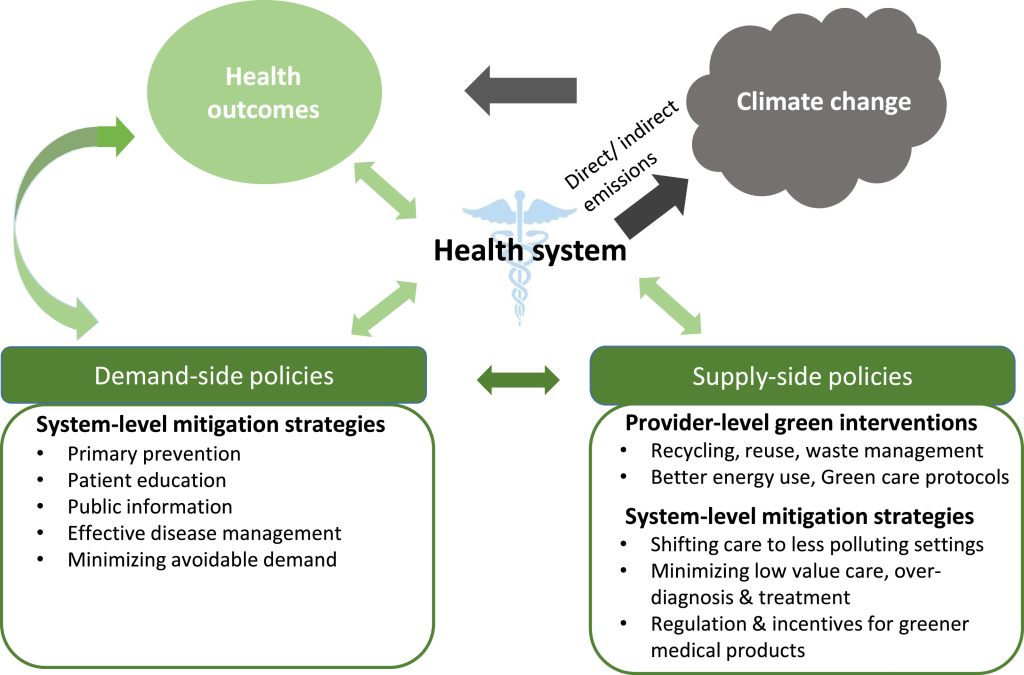
Relationship between the healthcare system, climate change, and sustainability strategies and interventions. Source: The role of the health sector in tackling climate change: A narrative review – Zeynep Or, Anna-Veera Seppänen

A number of general and specialised strategies can be used to decarbonise operations in the healthcare sector.

General strategies (common to all energy users):

  • Transition to Renewable Energy: Switching to solar, wind, hydroelectric, and even geothermal sources for electricity, dramatically cutting GHG emissions. On-site solar photovoltaic (PV) installations, especially in hospitals, are reducing operational costs and increasing resilience.
  • Onsite energy generation: While not quire fully operational, or even fully sustainable yet, non renewable energy generation such as cogeneration or trigeneration, are certainly better than grid electricity usage as they will reduce transmission and distribution losses, and further the waste heat can be used to generate both heating and cooling, or both, for the premises.
  • Energy Efficiency Improvements: Upgrading and retrofitting buildings with energy-efficient lighting, HVAC (heating, ventilation, air conditioning), chillers, star-rated equipment, and insulation cuts down consumption by 30–50% in some cases. Use of variable frequency drives (VFDs)17, intelligent sensors, and IoT-based monitoring allows real-time optimization.
  • Green Building Design and Retrofitting: Buildings that follow green building codes and energy conservation codes consume fewer resources, while existing facilities can be retrofitted with modern energy management systems and green technologies.
  • Decarbonizing Supply Chains: Emphasis on green procurement, sustainable sourcing, and responsible supplier engagement ensures that scope 3 emissions are reduced and managed on an continuously.
  • Waste Management and Reduction: Sustainable waste handling, recycling, and waste-to-energy programs decrease landfill emissions and support circular economy practices.
  • Renewable or Low-GWP Refrigerants: A shift to low global warming potential (GWP) refrigerants to meet emerging regulations and climate commitments. (Global Warming Potential (GWP) is a measure of how much a greenhouse gas traps heat in the atmosphere compared to the same amount of carbon dioxide (CO2) over a specific time period, usually 100 years.18) Moving to refrigerants with GWPs far below 700 can cut emissions from these systems by as much as 78% (relative to older HFCs).19

Healthcare-specific strategies:

  • Low-carbon pharmaceuticals: Pharmaceuticals are among the highest-emitting components of healthcare’s carbon footprint, often due to energy-intensive manufacturing, complex supply chains, and waste at the point of use. A McKinsey study found that adopting green-chemistry principles to redesign synthetic processes and use recyclable solvents could cut pharmaceutical active ingredient (API) manufacturing emissions by up to 30%.20
  • Reducing Low-Value Care: Avoiding unnecessary admissions, surgeries, and tests not only saves resources but reduces both direct (hospital-based) and indirect (supply-chain) emissions. Evidence-based guidelines to minimize unwarranted care can have substantial savings.21
  • Telemedicine and home- based care: Shifting care (where safe and appropriate) from hospitals to home or community settings lowers the need for energy-intensive infrastructure. For instance, remote physiotherapy after surgery demonstrated fewer rehospitalizations and better outcomes at lower environmental cost.21
  • Digistisation of care: Telehealth cut CO₂ emissions associated with cancer care by over 80% at one major U.S. center. Another 2023 multi-state analysis found telehealth averted 21.4–47.6 million kg of CO₂ per month—equivalent to keeping up to 130,000 cars off the road every month.22
  • Treatments: Anaesthetic gases (like desflurane and nitrous oxide) have very high GWPs and alternatives (total intravenous or regional/local anesthesia) can be used where clinically appropriate without compromising treatment outcomes and patient health.23

The healthcare sector is a vital, vibrant part of our world. It’s complexities and interdependencies make it difficult to decarbonise, not least that each decision should be made keeping patient service in mind, and at first it looks like decarbonisation does the opposite. Yet, we also know that climate change is making people sick: heatwaves, floods, wildfires, and storms are becoming more frequent and severe, and the World Health Organization (WHO) estimates that between 2030 and 2050, climate change will cause roughly 250,000 additional deaths per year from malnutrition, malaria, diarrhea, and heat stress alone- in some regions, heat-related deaths among people over 65 have risen by 70% in two decades24; vector-borne diseases (like malaria, dengue, and Zika) are spreading to new areas as rising temperatures and altered rainfall enable disease-carrying insects to thrive in new regions and seasons, and water- and food- borne illnesses become more common when heavy rains, floods, or droughts contaminate water sources or affect food supply chains25; rising air pollution including smog and higher particulate matter in the air we breathe smog and particulates), increases rates of asthma, chronic lung conditions, and cardiovascular disease affecting children, people with chronic illnesses, and urban residents are especially vulnerable; crop failures contribute to malnutrition and stunting2425; extreme events, displacement, and ecosystem loss contribute to greater rates of anxiety, depression, PTSD, and other mental health disruptions26; rising seas, severe storms, and food/water shortages also force people from their homes, increasing displacement, conflict, and health emergencies- often overwhelming local health systems and worsening inequities24… and working on sectoral decarbonisation will help those same people the sector works to protect.


Sources

  1. Five Fast Facts on Healthcare’s Climate Footprint
  2. Healthcare’s Climate Footprint – How the global health sector contributes to the global climate crisis and opportunities for action – Health Care Without Harm (Climate-smart health care series) Produced in collaboration with Arup, September 2019
  3. Greenhouse Gas Emissions from a Typical Passenger Vehicle
  4. Number of Cars in the World? Actual Answer
  5. Number of Cars in the World 2025: Key Stats & Figures
  6. India’s healthcare expenditure expected to surge from 3.3% to 5% of its GDP by 2030: CareEdge
  7. India’s Healthcare Expenditure Expected to Surge from 3.3% to 5% of its GDP by 2030 – CareEdge
  8. India GDP Macrotrends
  9. India: Gross domestic product (GDP) in current prices from 1987 to 2030(in billion U.S. dollars) – Statista
  10. India Total Greenhouse Gas Emissions: Tonnes of CO2 Equivalent per Year: Fuel Exploitation
  11. The healthcare sector needs to lead the way on decarbonisation – Asian Hospital and Healthcare Management
  12. Indian Healthcare Market projected to reach $638 billion by 2025: Bajaj Finserv AMC
  13. Decarbonizing the Health Care System
  14. Experts address single-use plastics in healthcare – University of Edinburgh
  15. Why India is poised to become a global hub for MedTech manufacturing
  16. Healthcare Waste—A Serious Problem for Global Health
  17. What is a VFD?
  18. The Future of Refrigeration: Low-GWP Refrigerants
  19. Innovating for Impact: Next Generation Refrigerants for a Sustainable Tomorrow
  20. Decarbonizing API manufacturing: Unpacking the cost and regulatory requirements
  21. Getting Started: Low carbon clinical care in hospitals
  22. Evidence that telehealth cuts carbon emissions grows
  23. Green health: how to decarbonise global healthcare systems
  24. Climate change – World Health Organisation
  25. Health and Climate Change – World Bank
  26. Climate change and health – Better Health

The path to a just transition – II

In this part of the series of posts on a just energy transition, I’ll explore what an energy transition is, and why we must achieve it.

Energy transition is simply the switch our current dependence on fossil fuels to renewable or low carbon sources for energy production. This is essential because climate change is being fueled by our dependence on mineral fuels- the use of which release greenhouse gases into our atmosphere.

Greenhouse gases are gases that trap the Sun’s heat in our atmosphere, leading to a long term warming of our planet, causing local and global weather changes that living beings on the planet did not evolve with, and also causing abiotic planetary forces to react in ways that harm life and infrastructure- for example, warmer oceans lead to more hurricanes, causing greater property damage and loss of human, animal, and plant lives.

Since these gases collect in the atmosphere, there is a build up of heat absorbing chemicals in the air over time. Carbon Dioxide in particular persists in the atmosphere fore thousands of years, which means that the CO2 released into the atmosphere by, for example, burning coal to fire steam engines during the industrial revolution, is still blanketing us today. Other gases issued due to the combustion of fossils have shorter lifespans, but greater warming effects due to the structure of their molecules- although methane (CH4) on average lasts in the atmosphere for less than 12 years, it’s 100 year warming potential can be between 28 to 36 times as potent as CO2, for example1.

Just like if the planet were to cool (and continue cooling) overmuch, a planet that is heating up is catastrophic to life and property.

In comparison, non fossil sources of energy are considered clean fuels, since they do not liberate the greenhouse gas genie into our atmosphere while operating to produce energy. Please do note that while they contribute negligible amounts to global warming while making electricity, they do contribute to it through their supply chains- that is, scope 2 and 3 emissions.

The National Renewable Energy Laboratory (NREL) reviewed nearly 3,000 published life cycle assessment studies on utility-scale electricity generation
from wind, solar photovoltaics, concentrating solar power, biopower, geothermal, ocean energy, hydropower, nuclear, natural gas, and coal technologies, as well as lithium-ion battery, pumped storage hydropower, and hydrogen storage technologies, greenhouse gas (GHG) emissions from various sources of energy to inform policy, planning, and investment decisions. Less than 15% of the studies passed the various quality and relevance checks. On studying the ones that did pass these checks, NREL came to the conclusion that the Median Published Life Cycle Emissions Factors for Electricity Generation Technologies was as follows2:

S. No.Type of TechnologyGeneration TechnologyMedian Published Life Cycle Emissions Factors
1.RenewableBiomass52
2.RenewablePhotovoltaica43
3.RenewableConcentrating Solar Powerb28
4.RenewableGeothermal37
5.RenewableHydropower21
6.RenewableOcean8
7.RenewableWindc13
8.StoragePumped Storage Hydropower7.4
9.StorageLithium-ion Battery33
10.StorageHydrogen Fuel Cell38
11.Non RenewableNucleard13
12.Non RenewableNatural Gas486
13.Non RenewableOil840
14.Non RenewableCoal1001
Median Published Life Cycle Emissions Factors for Electricity Generation Technologies
a Thin film and crystalline silicon; b Tower and trough; c Land-based and offshore; d Light-water reactor (including pressurized water and boiling water) only

As can be seen in the table above, the median Emission Factor (Emission Factors are a way to understand how much GHG emissions were released due to a particular activity) for the total lifecycle Non Renewables are far greater than those of either storage or renewable technologies. These emissions are primarily released during the combustion phase for the Non Renewables, however non of the other technologies require combustion to create electricity (and neither does Nuclear Light-Water Reactor technology, resulting in the very low Median Lifecycle EF).

Global greenhouse gas (GHG) emissions grew by 51% from 1990 to 2021, and more than 75% of these emissions come from the energy sector.3 Thus it’s obvious that by switching over to sources of energy that are not carbon intensive, we will be able to target the most conspicuous source of planet warming emissions. Shifting out of non renewable sources of energy will also reduce our dependence on fossils, and diversify our energy mix and enhance global energy security (in 2022 fossil fuels provided 81% of the total energy supply globally4), improve global health outcomes by reducing pollution, and finally- also improve the climate outlook.

Sources

  1. Climate Change Indicators: Greenhouse Gases, USEPA
  2. Life Cycle Greenhouse Gas Emissions from Electricity Generation: Update, NREL
  3. Where Do Emissions Come From? 4 Charts Explain Greenhouse Gas Emissions by Sector, WRI
  4. Greenhouse Gas Emissions from Energy Data Explorer, IEA

The path to a just transition – I

It is known even now the world will go through extreme climate events that cannot be avoided. Such events, caused by human activities indirectly trapping heat in our planet’s atmosphere which has already resulted in an increase of nearly 2 degrees Fahrenheit (1.1 degrees Celsius) between 1850-19001, are likely to include more wildfires, more floods, more hurricanes, more droughts, more heatwaves, different precipitation patterns,2 seasonal changes that happen at different times than a century, or even just a couple of decades ago among other negative outcomes. Weather events are also expected to be more intense than earlier ones- that is, there will be more incidence of hotter heatwaves, hurricanes on the higher side of the scale, more intense precipitation, etc.

While many of these adverse impacts cannot be avoided any longer, we can prevent an exacerbation of these outcomes by shifting to a lower carbon economic system than what we have now. This shift from carbon intensive economic activities to an economy that is either carbon neutral (net zero) or negative is referred to as climate transition.

Our global economy is heavily reliant on mineral fuels- currently two-thirds of our fuel demand is met through fossil fuels3. In the Global Energy Review 2025, the International Energy Agency (IEA) has stated that the carbon intensity of global economic activity is the product of the energy intensity of GDP and the carbon intensity of total energy supply.4 That is, we first find out how much energy it takes to produce the entire world’s Gross Domestic Product, and then multiply it with the amount of carbon produced to make that much energy. This means we can slow down carbon emissions in two ways- reduce our production and consumption activities, or make sure it takes less energy to keep them at the same level they are today.

In 2019, heat and electricity production cost us 34% of the global greenhouse gas production, industry accounted for 24%, transportation 15%, and buildings 6% of the global greenhouse gas emissions in that year. It may be noted that 95% of the transportation sector runs on fossil fuels.5 And, in 2024, the CO2 intensity per unit of economic activity was lower than the average improvement seen over the previous decade.4 So not only are we using a lot of energy to support our lifestyles, we are also failing to decrease the amount of greenhouse gases that are released into the atmosphere due to these activities.

It is clear that the change to a lower carbon economy is emergent, must be large scale, and involve every sector and industry in the global economy, including the labour markets, and therefore the communities those workers belong to. It’s a systemic shift that will affect all living beings on our planet, and cause significant human distress unless it is planned and executed with careful compassion.

“The scientific evidence is unequivocal: climate change is a threat to human wellbeing and the health of the planet. Any further delay in concerted global action will miss a brief and rapidly closing window to secure a liveable future,”

– IPCC Working Group II Co-Chair, Hans-Otto Pörtner3

Given the above, energy transition is a formidable task ahead of our species. A just transition, which distributes an equitable burden for the resources required to finance the transition among those who are wealthy and those who are not, is going to be even more challenging.

Accelerating climate actions and progress towards a just transition is essential to reducing climate risks and addressing sustainable development priorities, including water, food and human security.

-IPCC Sixth Assessment Report Working Group III: Mitigation of Climate Change7

The consequences of climate change affect people disproportionately- the impoverished suffer much more than those who have the resources to avoid the results of the adverse fallout of climate change. Climate change energy transitions are also going to have widespread consequences. A “just” climate transition is one where the economic burden of the transition falls on people in the proportion in which they contributed to climate change- this means that the wealthy with extravagant lifestyles bear more responsibility, and cost, for the shift to a carbon neutral or negative economy than workers who are living within a system they did not create. This also means countries which industrialised in the 1800s must answer for the greenhouse gases they pumped into the atmosphere to achieve their prosperity, and that most corporations bear greater responsibilities than most individuals.

In this series of posts, I’ll explore what the energy transition will require, how we may go about achieving it, and what we must do for the transition to be just.

Sources

  1. Climate Change 2021: The Physical Science Basis, IPCC
  2. The Effects of Climate Change, NASA
  3. Fueling a Transition Away from Fossil: The Outlook for Global Fossil Fuel Demand
  4. Global Energy Review 2025, IEA
  5. Global Greenhouse Gas Overview, USEPA
  6. 2025 emissions set to surpass 1990 levels by over 50% despite current climate pledges, UNFCCC warns
  7. Chapter 17: Accelerating the transition in the context of sustainable development, IPCC Sixth Assessment Report Working Group III: Mitigation of Climate Change