There are moments in life that are too difficult to put into words. Print isn’t enough to hold them. India’s women cricketers winning their ODI semi final against the mighty, seemingly invincible Australians was that moment for me.1 I knew we would win the world cup now. And I knew how much was about to change.
Later, on November 2, 2025, old heartbreaks from 2005 and 2017 had no place on the sofa with me as India walked out in blue, one more time, with one more chance not to be a beautiful tragedy. This time the World Cup was not in distant England or New Zealand; it was in our messy, noisy backyard, under floodlights that bounced off the Arabian Sea, and losing the toss was just par for the course now, not a death knell for dreams.2
Every fan carries a private pantheon. Let’s talk about some of mine: women who did not wait for the world to be ready for them.
Earlier
There is Mithali Raj, who spent two decades carrying Indian batting on her back, walking in that day not as a story in progress but as a living archive. She did not give speeches about revolution; she just kept showing up, year after year, with a straight drive that made time slow down: her 409 runs in 2017 stood as India’s World Cup record until Smriti broke it in 2025.3456 In my mind, she is the one who quietly set the table so that others could feast.
There is Jhulan Goswami, the long run‑up that felt like a pilgrimage and the wrist that could still snap a ball past the best batters in the world. Watching her in 201778 was like watching a bridge between eras: one foot in the days when women’s cricket hardly existed on TV, the other in an era she would not fully get to enjoy but had made possible. In a 20-year international career she took a record 255 ODI wickets for India.910
Long ago
Shantha Rangaswamy captained India’s first women’s Test side in the 1970s,1112 scoring 613 Test fifties and a hundred while also opening the bowling (21 Test wickets),13 and later became the first woman to receive the Arjuna Award for cricket.11
Diana Edulji learned her craft bowling at boys in Badhwar Park,14 then became India’s slow left‑arm heartbeat for nearly two decades, captaining the side and taking 63 official Test wickets—still the most by any Indian woman—and 46 ODI wickets.15 She also fought equally hard off the field, using her long Railways career and later her role in the BCCI’s Committee of Administrators to push for jobs, contracts, and dignity for women cricketers.161718
There are so many others who have built the spine of women’s cricket in this country vertebrate by vertebrate: Shubhangi Kulkarni, leg‑spinner and administrator, keeping the game alive in committee rooms;19 Sandhya Agarwal20 and Anju Jain,21 scoring in forgotten World Cups; Purnima Rau2223 and Neetu David,24 taking wickets and then quietly building the teams that would come after them; Anjum Chopra, captaining in the lean years and then talking women’s cricket into Indian living rooms.25
Now26272829
But this tournament had others now- Deepti, Smriti, Amanjot, Richa, Shafali, Pratika, Jemima.
If Deepti was the tournament’s quiet star with 215 runs and 22 wickets, Smriti was the metronome- India’s highest run getter with 434 and multiple catches. Both determinedly carrying this country, up the massive Everest of a home world cup.
Shafali made 199 in just the two matches she played, with that 87 in the final… but my favourite Shafali moment has to be how she was grinning already while anticipating Sune Luus’ catch.
Pratika’s 308 runs, the second‑highest tally for India constantly helped us open (hehe) doors into the match, and who knows how many the poor kid may have had if she hadn’t been injured right at the precipice of the Cup itself?
Jemi made 292 runs, including an unbeaten 127 in the semi‑final vs Australia… in many ways she’s the one who won us the tournament. Her self belief through that match, her bravery through the tournament and even in the press conferences, constantly belied by her jolly nature… Perhaps she’s opened another door for us: talking so openly about mental health in cricket, for cricketers.30
235 runs, with 12 sixes, the most by an Indian in the tournament: Richa Ghosh, keeper-bat par excellence.
Amanjot’s World Cup began with crisis. In the opener against Sri Lanka, India slid from 120 for 2 to 124 for 6, and a quiet stadium in Guwahati felt like it was reliving every old nightmare. On debut, she walked in next to Deepti and hit 57 off 56 – her maiden ODI fifty – in a 103‑run stand that yanked India to safety,3132 and later, in the final against SA, Wolvardt’s outrageous, tumbling catch that essentially won us the match and the Cup… you know the one.33 Those are what I remember.
Sneh’s most talked‑about spell came against Pakistan, in a game that could easily have become sticky. She bowled eight overs for just two wickets on paper, but the control was the real story: a chokehold that kept the chase at arm’s length.
Radha had to wait, watching the first six matches from the bench while everyone discussed India’s “settled XI”. When she finally got her chance against Bangladesh, she made it impossible to ignore her again: 3 for 30, plus a brilliant direct‑hit run‑out. That performance is what pushed her name back into the semi‑final conversation and reminded everyone that India’s spin depth now extends all the way to the dugout.
Renuka’s World Cup was all about the early overs. Even when she went wicketless, like against Pakistan and England, she strangled the run rate – 2.9 an over in one match, 4.6 in another – so that chases never got to breathe. Her new‑ball spell against New Zealand, where she combined discipline with two top‑order wickets, set up the very platform from which Smriti and Pratika later tore the game away.
Harleen, who once went viral for that impossible boundary catch in England,34 spent this World Cup doing the unglamorous versions of the same thing – sharp stops in the ring, calm hands on the rope, and those 20‑run cameos in the middle order that stop an innings from fraying.
Arundhati’s spells were often shorter, sharper: two‑ and three‑over bursts in the middle that changed the mood of an innings more than the scorecard, the kind of work you only notice when it’s missing. But her contribution often also came as that player who wasn’t in the XI, and still carried the team’s attitude. So brilliant.
Sree became one of those quiet tournament stories that suddenly erupts into view at the end. The 21‑year‑old left‑arm spinner from Kadapa took 14 wickets across the World Cup, leading India’s spin tally and being welcomed home to Andhra Pradesh like a local folk hero- as she should be.
Kranti’s World Cup became a small‑town fairy tale written in seam. Already known for a 6 for 52 against England earlier in the year,35 she arrived at the tournament as a young quick with raw menace and left it as one of India’s biggest match‑winners. Her 3 for 20 against Pakistan in the group stage, sharing the new ball with Renuka, smashed the chase early and earned her a Player‑of‑the‑Match award that felt like a coming‑of‑age ceremony.
While Yastika’s job this time, was mostly to wait – pads on, gloves ready, rehearsing every scenario in her head in case anything happened to Richa, Uma showed us what the future looks like. A galaxy of stars awaits.
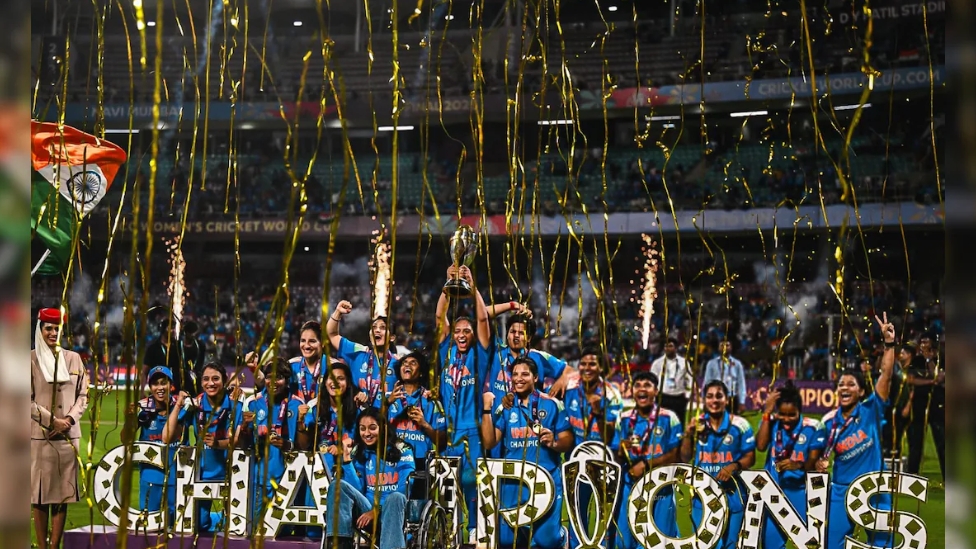
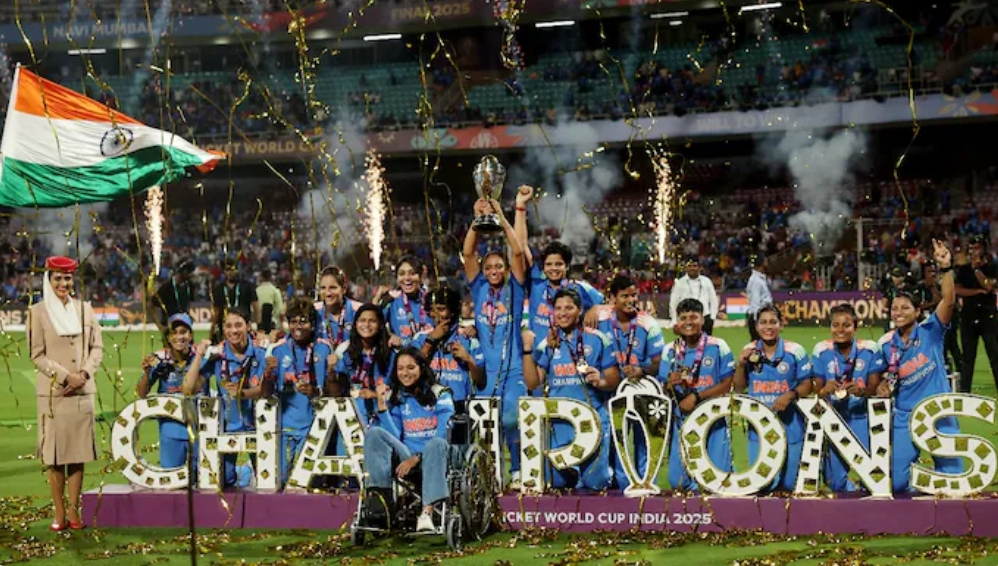
Harmanpreet Kaur went into this tournament as the oldest player in our XI, one day younger than me, and carrying at least ten extra years of history. She had seen 2005 from afar, 2017 from the middle, and every year since then from inside the weight room, the nets, the press conferences where she was asked about the word “chokers” without anyone quite using it. When my girl lifted the trophy, with the Bhangra and her team waiting for her, It’s difficult to explain the joy. Sometimes things can just be felt.
After the world cup, what struck me most was how lightly they wore their victory. No chest-thumping, no proclamations of dominance. Just gratitude, relief, and a deep, unmistakable sense of togetherness. Even Australia, knocked out in the semi‑final absorbed the defeat like a bruise, not a scar. And South Africa, losing the most important match of their life, were still gracious enough to accept hugs.
Women’s cricket, at its best, feels like the game stripped back to its point: the joy of being allowed to play. The records matter. The trophies matter. But they feel like by‑products of something more important: the right to take up space on a cricket field.
So when I call these women immortal, I don’t mean that highlights of Shafali’s 87 or Deepti’s 5 for 39 will live forever on some server farm in Dubai. I mean that a girl somewhere in the tiniest, dustiest, and possibly even the most gender-backward, village possible, balancing a taped tennis ball on her fingers, will one day hear these names and believe that the world will not need to be ready for her either.
📷 Reuters
Sources
- Full Scorecard of India Women vs Australia Women, ICC Women’s World Cup 2025, 2nd Semi Final – ESPNcricinfo
- South Africa win toss in the big Final | CWC25 – ICC
- Who is Mithali Raj? A trailblazer for Indian women’s cricket – Olympics.com
- Stats – Mithali Raj, the most prolific batter in women’s cricket – ESPNcricinfo
- Smriti Mandhana Scripts Massive Women’s World Cup Record, Overtakes India Legend Mithali Raj – NDTV Sports
- Women’s World Cup 2025: Smriti Mandhana Breaks Mithali Raj’s Record – India Today
- ICC Women’s World Cup 2017: ‘Marvellous job’ – Twitterati hail Jhulan Goswami’s performance – The Indian Express
- Jhulan Goswami: She broke world records and coached WPL champions – Femina
- Stats – Jhulan Goswami, the most prolific bowler of women’s cricket – ESPNcricinfo
- Jhulan Goswami: She broke world records and coached WPL champions – Femina
- ‘No one can take away the pride, we are the pioneers’ – Shantha Rangaswamy – RevSportz
- Who was the first captain of the Indian women’s cricket team? – Testbook
- Shantha Rangaswamy profile – ESPNcricinfo
- Diana Edulji: A true pioneer for India’s female cricketers – ICC
- Diana Edulji profile – ESPNcricinfo
- Diana Edulji: A true pioneer for India’s female cricketers / related profiles – ICC / The News Minute / NDTV Sports
- Meet Diana Edulji, the only cricketer and lone woman on SC‑appointed panel to run BCCI – The News Minute
- BCCI Administrators: Profile of Diana Edulji – NDTV Sports
- Shubhangi Kulkarni: One of the pillars of women’s cricket in India – CricketCountry
- Women’s World Cup stats – India women, individual records (ESPN/ICC database page)
- India name team for Cricinfo Women’s World Cup 2000 – ESPNcricinfo
- Purnima Rau interview – YouTube
- P Rao (Purnima Rau) profile – ESPNcricinfo
- Neetu David profile – ESPNcricinfo
- Anjum Chopra profile – ESPNcricinfo
- ICC Women’s Cricket World Cup 2025 – Stats – ICC
- ICC Women’s World Cup 2025/26 – Tournament stats – ESPNcricinfo
- Women’s World Cup player stats – India Today
- Women’s ODI World Cup 2025 – Stats – NDTV Sports
- “I was crying every day”: Jemimah Rodrigues breaks down while revealing battle with anxiety – Times of India
- Women’s ODI World Cup 2025: India vs Sri Lanka match report – Olympics.com
- India Women vs Sri Lanka Women, 1st match, CWC 2025/26 – Match Report – ESPNcricinfo
- Amanjot Kaur’s magical catch that turned Women’s World Cup final in India’s favour – NDTV Sports
- Harleen Deol’s viral boundary catch – YouTube
- England Women vs India Women, 3rd ODI 2025 – Match Report – ESPNcricinfo


 Chasing Tales