Risk – II: ISO 31000:2018 as applied to Indian cricket

TL;DR, because this is not a post for cricket casuals:

  • Fog in North India in December, heat waves in April, election clashes, and security disruptions are predictable risks, not bad luck.
  • Indian cricket continues to treat these as isolated incidents rather than as interconnected system-level risks that cascade across scheduling, logistics, player welfare, and revenue.
  • The BCCI now runs a ₹20,000-crore ecosystem, yet lacks a transparent, enterprise-wide risk management framework appropriate to that scale.
  • Global sports bodies manage similar uncertainties using formal risk frameworks (e.g., ISO 31000) to decide what risks to avoid, mitigate, insure, or accept.
  • Applying ISO 31000 to Indian cricket shows that systematic risk management would cost far less than repeated disruptions, cancellations, and credibility damage.
  • At this scale, ad-hoc risk management is not neutral—it is value-destructive.

And now onto the post.

This post has been inspired by watching the BCCI schedule summer matches in tropical South India, and winter season matches in our smoggy chilled North. Watching Indian cricketers roam about in Lucknow against South Africa while wearing pollution masks while broadcasters told us match was delayed due to low visibility conditions made me wonder what other risks BCCI could just avoid, or at least manage better.

These risks are predictable. FogSmog in North India in December isn’t a surprise. Heat waves in April aren’t black swans. Even geopolitical and security disruptions, while unpredictable, follow recognisable patterns. Yet Indian cricket continues to treat these as isolated “incidents” rather than as interconnected risks that can be anticipated, priced, and managed.

This is not about fog or heat. It’s about running a ₹20,000-crore system without an enterprise risk framework. So I’m doing an ISO 31000 evaluation for the BCCI. FOR FREE. Please someone share this with anyone influential in the BCCI.

Here’s a non-comprehensive list of some risk sources and events that can happen. You can skim through it if you like, I know it’s long, which already tells you lots:

Risk CategorySpecific RiskExample/EvidenceRisk SourceImpact Area
Geopolitical & SecurityCross-border conflict/military escalationIPL 2025 suspension due to India-Pakistan tensions (May 2025)1Political/regulatory external contextTournament suspension, revenue loss, player safety concerns
Geopolitical & SecurityCommunal/religious tensionsMustafizur Rahman threats from Ujjain religious leaders (Dec 2025);2 Social/political external contextPlayer threats, stadium disruptions, player unavailability
Geopolitical & SecurityTerrorism/security incidentsPotential attack on stadium or traveling teamsSecurity threat external contextDeaths/injuries, event cancellation, insurance claims
Weather & ClimateDense fogLucknow T20I abandoned without a ball (Dec 17, 2025);3 Natural hazard/environmentalMatch cancellation, travel disruptions, schedule compression
Weather & ClimateExtreme heatPlayer heat exhaustion risks, crowd attendance declineEnvironmental/climate changePlayer health, match timing changes, spectator safety
Weather & ClimateFlooding/waterloggingMonsoon season pitch damage, venue inaccessibilityEnvironmental/climate changeVenue unusability, match postponement, ground preparation delays
Weather & ClimateDroughtGroundwater depletion affecting pitch maintenanceEnvironmental/climate changePitch quality degradation, venue unusability
Weather & ClimateSevere storms/hailstormsPotential infrastructure damage, match disruptionEnvironmental natural hazardVenue damage, match abandonment, spectator safety
Operational & LogisticsFlight/travel cancellationsFlights cancelled across northern India(just search it, happens bi-weekly in December)Transportation system failureTeam travel delays, venue setup issues, player unavailability
Operational & LogisticsEquipment/supply disruptionMedical supplies, nutrition goods, cricket equipment delays to venuesSupply chain vulnerabilityPlayer preparation delays, competitive disadvantage, safety risks
Operational & LogisticsTransportation of spectatorsMass transit failures, road congestion, parking unavailabilityInfrastructure/logisticsSpectator attendance decline, safety concerns, venue capacity underutilization
Operational & LogisticsAccommodation unavailabilityLimited hotel capacity during tournament, staff housing issuesSupply/demand mismatchTeam comfort degradation, player fatigue, franchise cost overruns
Venue & InfrastructurePoor crowd management systemsChinnaswamy stampede4Operational/design vulnerabilitySpectator casualties, reputational damage, regulatory action, venue unusability
Venue & InfrastructureStructural deteriorationAging concrete, roof damage, electrical system failuresAsset maintenance gapVenue closure, safety risk, remediation costs
Venue & InfrastructureInadequate emergency response systemsPoor medical facilities, limited ambulance access, untrained staffSystem design gapCasualties during medical emergencies, litigation
FinancialBroadcasting rights disruptionDisney+ Hotstar and Star Sports unable to broadcast during IPL suspensionExternal event affecting revenueRevenue loss for franchises/broadcasters (₹crores per day), contractual disputes
FinancialSponsor withdrawal/advertising rate declinePotential sponsorship cancellations due to event suspension or negative publicityMarket condition/risk perceptionFranchise revenue decline, reduced capital for player wages
FinancialInsurance claims disputesAmbiguous “war” and “riot” clauses limiting payout eligibility5Contractual/insurance gapUncompensated losses during suspension or disruption
FinancialCurrency fluctuationOverseas player contracts, broadcast payment variabilityMarket/exchange rate riskPlayer cost increases, sponsor revenue volatility
FinancialFranchise profitability uncertaintyRising costs (venue, insurance, player wages) versus volatile revenue (attendance, viewership)Business model vulnerabilityFranchise owner losses, potential team withdrawal
Corruption & IntegrityMatch-fixing/spot-fixingCSK/RR spot-fixing scandal (2013);6 ongoing betting corruption concernsCriminal/gambling-driven activityPlayer bans, franchise suspension, sport integrity damage, legal action
Corruption & IntegrityIllegal betting ringsVast unregulated Indian betting markets with links to match-fixers78Criminal enterprise/regulatory gapMatch manipulation, player recruitment to fixing, law enforcement involvement
Corruption & IntegrityUmpire/official briberyPotential fixing of key decisions affecting match outcomesCorruption riskMatch integrity compromise, game credibility loss
PersonnelKey player unavailabilityInternational obligations, injuries, visa issues, political reasons (Mustafizur situation)Competing objectives/external restrictionsTeam competitiveness, schedule disruptions, franchise value impact
PersonnelPlayer health/injury risksHeat exhaustion, match injuries, stress-related conditions from uncertaintyPhysical hazards/psychological stressLoss of key players, season disruption, franchise financial impact
PersonnelCoach/staff turnoverMid-season departures, conflicts between franchise and coaching staffHR/organizational riskTeam continuity loss, player morale impact
RegulatoryGovernment restrictions/timeline conflictsElections scheduling conflicts with IPL dates;9 security directives impacting match schedulingGovernment policy/external political contextSchedule changes, venue restrictions, resource allocation changes
RegulatoryVisa/immigration restrictionsPlayer visa delays, border restrictions preventing team travelGovernment/immigration policyPlayer unavailability, team incomplete status
RegulatoryTax/regulatory changesChanging tax levies on sports franchises, regulatory compliance requirementsGovernment fiscal policyFranchise cost increases, profitability compression
Demand & MarketFan disengagement/viewership declineCancellations and disruptions reduce fan engagement, ticket sales sufferMarket/behavioral shiftRevenue decline, reduced franchise valuations, reduced sponsorship interest
Demand & MarketCompetitive threat from other entertainmentSocial media, gaming, OTT platforms diverting cricket viewersTechnology/market disruptionDeclining viewership, reduced sponsorship value, lower ticket sales
Demand & MarketSocial media backlash/reputational damageNegative sentiment from cancellations, perceived mismanagementCommunications/perception riskBrand damage, sponsor pressure, fan retention loss
Health & SafetyPandemic-related restrictionsCOVID-like scenarios requiring lockdowns or capacity restrictionsHealth emergency/external eventMatch cancellation, venue capacity limits, player quarantine requirements
Health & SafetyFood/water safety incidentsContaminated food/water affecting teams or spectatorsHealth/hygiene riskIllness outbreaks, regulatory action, liability
Health & SafetyAir quality/pollution issuesHigh pollution affecting visibility, player respiratory healthEnvironmental hazardMatch visibility issues, player health concerns, match cancellation

Before diving into solutions, let’s define what we’re actually talking about. ISO 3107310 establishes the vocabulary for various terms used in ISO 31000,11 which is the ISO framework for risk management. According to the frameworks, risk is “the effect of uncertainty on objectives”.
Here,

  • Objectives are whatever results the organisation wishes to achieve.
  • Effect means a deviation from the expected, whether the deviation is positive, negative, or both;
  • Uncertainty occurs from a deficit of information; and

Therefore, risk is a deviation from the aims that an entity is working towards caused due to lack of knowledge about the situations surrounding the objective. The deviation can have a positive or negative outcome, but the deviation means it is still a risk, and leads to risk consequences, or outcomes that affect the objectives.

Uncertainty can never be removed entirely. As we see in the normal distribution, risk events can happen even when we are 99.999% certain of our processes. This is called residual risk, or when a risk event occurs even when controls have been applied against the risk source. An event is the occurrence or change of circumstances (the bridge collapses, prices spike, new regulations take effect that can be the source of a risk. A risk source is an element with potential to give rise to risk (think: aging infrastructure, volatile commodity prices, regulatory change). Understanding residual risk is critical for determining whether further treatment is needed or whether the organisation should accept and monitor what remains. It is important to emphasise here that everyone perceives risk differently (risk perception): engineers might see technical risks as manageable; the public might see the same risks as terrifying. Effective risk communication requires understanding these perceptual differences.​

The likelihood of an event, is a broad expression of the chance of something happening, and can be expressed qualitatively or quantitatively, but in the previous posts we have understood what a probability is, as expressed between 0 and 1 (here and here), and frequency, which is when we count the number of the type of events we are quantifying. understanding these basic terms helps us understand how vulnerable we are due to our exposure to a source of risk, as well as how to build resilience. Because we’re discussing a standard, these words have specific definitions:

  • Vulnerability refers to intrinsic properties creating susceptibility to risk sources. 
  • Exposure measures the extent to which an organization is subject to an event. 
  • Resilience captures adaptive capacity in complex, changing environments, so this isn’t about preventing events, it’s about how to recover from them.

Understanding risk also helps organisations understand which risks to accept, and which to defend against. New Zealand’s sports sector adopted ISO 31000 in 2016; Australia’s sporting associations follow it; international sporting events apply it to pandemic preparedness. This is called Risk attitude- the organisation’s overall approach towards risk, and their tendency to pursue, avoid, or accept it. Attitudes towards risk always depend upon any entity’s risk appetite (the amount and type of risk they are willing to accept), and their risk tolerance, which looks at specific risks for each objective. An example of risk appetite is the willingness to invest in innovative technology, and that of risk tolerance is the amount of specific risk an organisation may accept for data breaches in particular.

ISO 31000 Framework for Indian Cricket
While it may appear that these are all just the costs of doing business in India, I don’t think this is true. Also, other sports systems facing similar uncertainties—pandemics, extreme weather, terrorism, financial volatility—don’t operate this way. They use formal risk management frameworks to decide what to avoid, what to mitigate, what to insure, and what to accept. ISO 31000 is one such framework, and it’s suited to complex, multi-stakeholder systems like Indian cricket. Here it is applied to Indian cricket:

1. Establish Context (Where Are We Playing?)

  • External context
    • Geopolitics: India–Pakistan tensions, elections, security environment.
    • Climate: Fog in North India, heat waves, monsoon, long‑term climate change.
    • Market: OTT platforms, competing sports/entertainment, sponsor expectations.
  • Internal context
    • BCCI governance and decision‑making.
    • Franchise finances, contracts, insurance.
    • Stadium infrastructure, ground staff capacity, logistics capability.
  • Risk criteria
    • What level of disruption is acceptable?
    • Which risks are “never acceptable” (deaths, match‑fixing, major stampedes)?
    • What is the minimum acceptable probability of completing a season as scheduled?

2. Risk Assessment (What Can Go Wrong, How Bad, How Often?)

  • Identify risks
    • Use the big table: geopolitical, weather, logistics, stadium safety, financial, corruption, personnel, regulatory, demand, health.
    • For each, note: risk source → potential event → likely consequences.
  • Analyze risks
    • Estimate likelihood (e.g. “fog in Lucknow in December” = high; “pandemic lockdown every year” = low).
    • Estimate consequence (e.g. “stadium stampede” = catastrophic; “one match fogged off” = moderate).
    • Factor in vulnerability (old stadiums, fragile logistics) and resilience (backup plans, cash reserves).
  • Evaluate risks
    • Plot likelihood × consequence.
    • Decide which risks are:
      • Intolerable (must be treated immediately).
      • Tolerable with treatment (controls and monitoring).
      • Acceptable (monitor only).

3. Risk Treatment (What Do We Do About Each Risk?)

For each major risk, choose a treatment option (or a mix):

  • Avoid the risk
    • Don’t schedule T20Is in dense‑fog cities during December–January.
    • Don’t use stadiums that fail minimum structural and crowd‑safety standards.
  • Mitigate / reduce the risk
    • Upgrade stadium exits, crowd‑control systems, and medical response.
    • Build travel redundancy: buffer days, alternative flight routes, backup buses/trains.
    • Strengthen anti‑corruption: monitoring betting patterns, education, strict sanctions.
    • Heat protocols: evening matches, drinks breaks, heat‑stress monitoring.
  • Share / transfer the risk
    • Tournament‑wide insurance for cancellation, terrorism, extreme weather.
    • Clear contracts with broadcasters/sponsors about rescheduling and force majeure.
  • Retain (accept) residual risk
    • Accept that a few games may still be lost to weather or logistics despite controls.
    • Document what level of residual risk is being accepted, by whom, and with what monitoring.

4. Implementation & Control (Who Owns What, and How Is It Run?)

  • Governance & roles
    • BCCI Risk Committee: owns the overall risk framework and major decisions.
    • Franchise risk owners: handle team‑level logistics, personnel, finances.
    • Venue operators: own stadium safety, crowd management, emergency response.
  • Communication & consultation
    • Regular briefings with teams, broadcasters, police, local authorities.
    • Clear public communication on cancellations, rescheduling, and safety decisions.
  • Monitoring
    • Track near‑misses (e.g. small crushes at gates, close calls with fog or heat).
    • Maintain dashboards: incidents per season, delays, injuries, corruption alerts.

5. Review & Continuous Improvement (What Did We Learn This Season?)

After each season / major incident:

  • Incident reviews
    • IPL suspension: What early warning signs did we miss? Could we have acted sooner?
    • Chinnaswamy stampede: Which design and process failures led to casualties?
    • Lucknow fog‑out: How should scheduling rules change for fog‑prone venues?
    • Mustafizur threats: How do we handle politically sensitive players and venues?
  • Effectiveness checks
    • Did our treatments reduce likelihood or consequence as expected?
    • Did any controls fail or create new risks (e.g. over‑policing crowds)?
  • Update the system
    • Revise risk criteria, appetite, and tolerances where needed.
    • Amend scheduling policies, venue standards, insurance terms, and contracts.
    • Feed lessons into next season’s planning: same framework, better parameters.

To-Do List
If Indian cricket embraced systematic risk management, the BCCI would have:

  • A Risk Management Policy (BCCI document) establishing appetite and tolerance
  • A Risk Register (updated quarterly) tracking all relevant risk categories with assessed severity and treatment strategies
  • Incident Response Protocols that trigger automatically (e.g., if weather forecast shows fog, reserve dates activate; if geopolitical tension rises, security protocols engage)
  • Venue Certification requiring regular safety audits for all stadiums
  • Insurance covering defined scenarios with unambiguous language
  • Player Education on corruption risks, mental health impacts of uncertainty, safety protocols
  • Stakeholder Transparency (fans, sponsors, broadcasters informed about residual risks and mitigation strategies)
  • Continuous Learning (post-incident reviews feeding into policy updates)

Why bother?
Risks are interconnected: geopolitics affects scheduling, which affects logistics, which affects player welfare, which affects performance, which affects revenue. One shock propagates through the entire system.

But the real argument is how all this affects BCCI’s income: In fiscal year 2024-25, the BCCI earned a total of ₹20,686 crore—double what it was five years earlier. But this income doesn’t flow uniformly. It comes from multiple sources, each vulnerable to different risks:

  • IPL: ₹5,761 crore (59.1% of FY 2024-25 BCCI revenue)12
  • International cricket (men’s): ₹361 crore (3.7%)12
  • ICC distributions: ₹1,042 crore (10.7%)12
  • WPL (women’s): ₹951 crore broadcast deal over five years = approximately ₹190 crore annually13
  • Interest and other income: ₹1,500+ crore from treasury management1214
  • Sponsorships, licensing, other: ₹400 crore and growing15

Total bank balance: ₹20,686 crore.16 At this scale, ad-hoc risk management is not neutral—it is negligent.

The numbers are sourced, but even if the numbers are completely wrong, the logic I’m about to present you with will still hold.

Consider the May 2025 IPL suspension. Its immediate impact was ₹1,600-2,000 crore in tournament revenue loss. But the suspension also:

  • Forced reschedules of international T20I series planned around IPL slots
  • Delayed women’s cricket planning (WPL scheduling coordination)
  • Created cascading effects on domestic Ranji Trophy schedules
  • Disrupted team preparation windows for the Asia Cup (subsequently postponed)

When the IPL shut down due to the events that followed the Pahalgam terrorism, one risk event rippled across all BCCI’s operations. The ₹3,500-4,000 crore total ecosystem loss wasn’t borne by IPL alone—it distributed across broadcasters, sponsors, franchises, international teams visiting India, and state cricket associations that depend on BCCI’s distributions (approximately ₹100-125 crore in combined sponsorship, broadcast, and match-day revenue for 16 matches15 and the broadcaster JioCinema faced losses of ₹1,900-2,000 crore (35% of their ₹5,500 crore seasonal projection)17 While war is a systemic risk (read more here, scroll down to the risk sections), a stampede at a celebration event is not.

Now let’s do some hypothetical maths. Let’s say of BCCI’s total ₹20,686 crore exposure, 10% is under difficult-to-avoid-risk, and another 20% are things that could go wrong but if everything happened normally (planes flew on time, luggage was not lost, people had common sense, etc.) it would not go wrong. Now assume costs of mitigation to be between 10-20% of the cost of losses. This would be the breakdown of that exposure:

Risk Category% of Total ExposureExposure Amount (₹ Crore)Annual Loss ProbabilityExpected Annual Loss (₹ Crore)Mitigation Cost (10-20% of loss)Net Benefit if Mitigated
High Risk (Geopolitical, Corruption, Major Infrastructure)10%₹2,068.620-30%₹414-620₹41-124₹290-579
Medium Risk (Weather, Logistics, Personnel, Sponsorship)20%₹4,137.230-40%₹1,241-1,655₹124-331₹910-1,531
Low Risk (Normal operations)70%₹14,480.21-5%₹145-724₹15-145₹130-709
TOTAL100%₹20,686~15-20% aggregate₹1,800-3,000₹180-600₹1,200-2,820

Now let’s do scenario analysis with ILLUSTRATIVE NUMBERS.

Scenario A – No Mitigation (Do Nothing)

ElementAmount (₹ Crore)Notes
Reserves/ Bank Balance₹20,686Baseline
Expected Losses (unmitigated)₹1,800-3,000From Table 1
Insurance Recovery (40-50% of losses)₹720-1,500Partial coverage; war/corruption not covered
Net Loss After Insurance₹1,080-2,280Uninsured exposure
Effective Revenue After Losses₹18,406-19,606Revenue minus net loss
Annual Cost to Organization₹0No prevention investment
Net Outcome₹18,406-19,606Revenue minus losses

Scenario B – Full Mitigation (Invest in Risk Management)

ElementAmount (₹ Crore)Notes
Reserves/ Bank Balance₹20,686Baseline (unchanged)
Mitigation Investment₹180-600Cost to prevent/reduce losses
Expected Losses (with mitigation)₹450-900Reduced by 60-75% through mitigation
Insurance Recovery (40-50%)₹180-450Still applicable, lower losses
Net Loss After Insurance & Mitigation₹270-450Dramatically reduced
Effective Revenue After Mitigation & Losses₹20,236-20,416Revenue minus mitigation cost and net loss
Annual Cost to Organization₹180-600Mitigation investment
Net Outcome₹20,236-20,416Much better than Scenario A

None of the above means that BCCI doesn’t do risk mitigation at all. They must do. Matches are insured, security is coordinated with state authorities, schedules are adjusted, and contingency plans exist. But much of this risk management remains reactive, fragmented, and event-specific, rather than systematic.

The scale of Indian cricket has outgrown this approach. What is now a ₹20,000-crore ecosystem operates across volatile geopolitics, increasingly extreme climate conditions, aging infrastructure, fragile logistics, and intense public scrutiny. In such an environment, risk does not arrive as isolated shocks. It propagates. A fog-out affects scheduling, which affects logistics, which affects player welfare, which affects performance, which ultimately affects revenue and credibility. Treating each disruption as an unfortunate exception misses the underlying structure of the problem.

Active risk management does not promise certainty, nor does it eliminate risk. What it offers is clarity: an explicit understanding of working to anticipate risks in our cricket system so that most can simply be prevented, and those that cannot be prevented are mitigated. The IPL did not need to be part of India’s war theatre. After the Pahalgam attacks those matches could have been shifted to lower risk areas, such as away from the border, and we wouldn’t have had Ricky Ponting trying to persuade foreigners to stay back and play.18

Sources

  1. IPL 2025 Suspended As India-Pakistan Tensions Hit World’s Biggest Cricket League (Forbes)
  2. Mustafizur Rahman faces threat for playing in IPL 2026, religious leaders in Ujjain warn of disruptions (Firstpost)
  3. Why has India vs South Africa 4th T20I not started? Excessive fog – reason explained (NDTV Sports)
  4. RCB IPL victory parade stampede: death toll, live updates from Chinnaswamy Stadium (The Hindu)
  5. Will shop insurance provide coverage in case of loss or damage caused due to riots? (PolicyBazaar)
  6. India gambling with cricket’s soul? The spot-fixing scandal explained (BBC)
  7. Betting, Match Fixing and Online Gambling in India: A Study with Special Reference to Cricket (ResearchGate)
  8. Gambling and Betting Market in India (Digital India Foundation PDF)
  9. BCCI reworking IPL 2024 schedule for remainder of season to avoid clashes with polling dates (News18)
  10. ISO 31073:2022 – Risk management — Vocabulary (ISO 31073:2022)
  11. ISO 31000:2018 – Risk management — Guidelines (ISO 31000:2018)
  12. BCCI’s total income shoots up to ₹9,741.71 crore in FY24; IPL alone contributes ₹5,761 crore (Economic Times)
  13. Viacom18 bags WIPL media rights for Rs 951 crore (Economic Times)
  14. BCCI gets richer, bank balance jumps to eye-popping Rs 20,686 crore in FY 2024 (News18)
  15. IPL 2025 suspension due to Ind-Pak conflict cost BCCI nearly INR 125 crore per game (CricTracker)
  16. IPL’s time-out could lead to a 35% ad revenue wipeout (Financial Express)
  17. Ricky Ponting persuades Punjab Kings players to stay in India after ceasefire with Pakistan (Mint)
The man who became hope

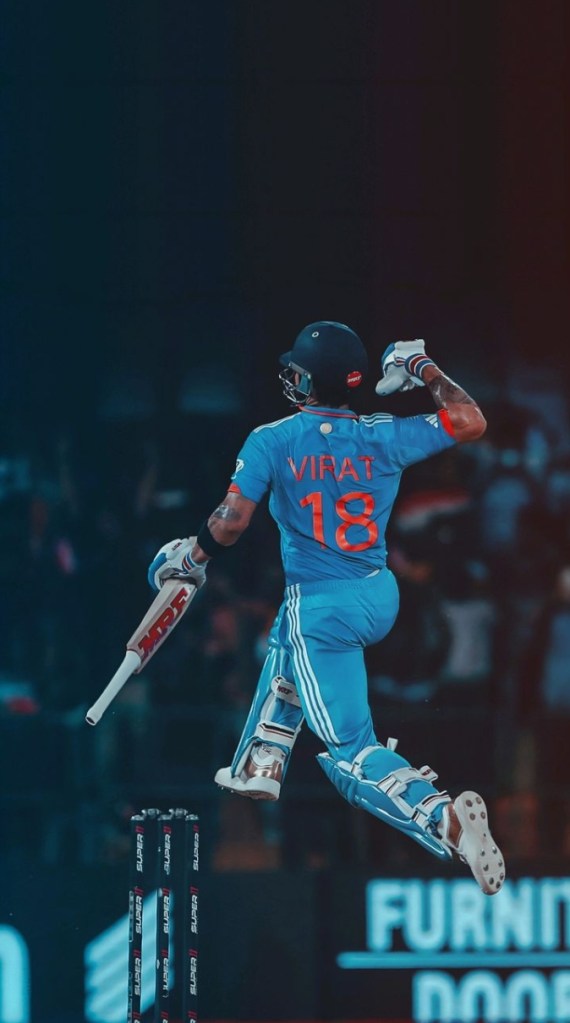
📷 I dunno, I couldn’t find whom to credit for this picture of a highly common sight.

At the heart of every black hole lies a singularity- a point of infinite density where the laws of physics are said to break down. It is the pinpoint centre of an object so massive, not even light can escape it. Virat Kohli is this singularity. Let me clarify: it’s not that he exists in this singularity. He is the singularity. The mass of his will and the impact of his performance forming a Schwarzschild radius* that swallows possibility and spits out improbabilities like mangled previous-truths of no-one-can-do-that, and this-is-not-possible. Virat Kohli is inevitable.

The Commander

“60 overs they should feel like hell out there.”1

It’s a famous quote by now. The English are understandably fond of it. Nothing has ever demonstrated Kohli’s relentless pursuit for excellence quite like his captaincy- turning every home Test into a trial by fire for opponents, demanding total commitment from his team, and setting a tone that opponents, particularly in their own backyard, could never ignore. He transformed India’s Test mentality, inspiring fast bowlers to attack and fielders to hunt, making each spell about psychological domination and cultural reset.

Under Kohli, for 11 consecutive Test series, India remained undefeated on home soil, a streak spanning over seven years (2015–2021).2 In 31 home Tests, India lost only 2 matches: a fortress so impregnable that it redefined the subcontinent’s dominance.3 No other Indian captain who led in multiple series maintained such a pristine record.23 The team didn’t just win; they devoured oppositions: nine victories by an innings, nine by margins over 150 runs, turning home advantage into an inevitability.45

But home is home. What elevates Kohli was his refusal to accept that Indian teams must bow to foreign conditions. He became the first Asian captain to win Tests in Australia, England, and South Africa. His 16 away Test victories are the most by any Indian captain, surpassing Sourav Ganguly’s 11.46 In SENA countries (South Africa, England, New Zealand, Australia), Kohli secured seven Test wins- the next best is three.47 He captained us in 68 Tests, won 40 of those, lost 17, and drew 11.48 That’s a 58.82% victory rate, which is the highest for any Indian captain to date.48

Across formats, Kohli captained India in 213 matches, winning 135 at an overall win rate of 64.31%, which is the second-best for any Indian captain with at least 50 matches.89 We held the ICC Test Mace for five consecutive years (2016–2021),10 and for a historic period between January 2017 and March 2020, India held the No. 1 ranking in all three formats simultaneously, a feat no other team had achieved before.4 This triple dominance lasted for 38 months, making Kohli’s India the most complete cricketing force of the era.4

Kohli’s impact wasn’t just tactical—it was systemic. He turned fitness from a personal obsession into a team religion. As captain, he institutionalised fitness by making the yo-yo test a non-negotiable selection benchmark, directly impacting team composition.10 Michael Holding noted that while “maybe two players were fit” in the India of old, now “everyone is”—a direct result of Kohli’s blueprint.10 This physical transformation unlocked India’s bowling potential. Fast bowlers, once seen as support acts, became weapons of warfare: Kohli, a batter, built a team of bowlers who took 20 wickets 22 times in 35 away tests under him.4

Unsurprisingly, Virat continues to lead even without formal captaincy. In January 2025, when approached to captain Delhi in the Ranji Trophy, he refused.11 At RCB, after stepping down from captaincy in 2021, he remained the franchise’s emotional leader. Director of Cricket Mo Bobat stated: “Virat doesn’t need a captaincy title to lead. Leadership is one of his strongest instincts. He leads regardless.” When RCB appointed Rajat Patidar as captain for IPL 2025, Bobat noted that Kohli was “so pleased for Rajat” and “right behind him,” actively supporting the decision.12

The Warrior

“Beyond the present and into legend”13

There are so many.

  • My favourite Virat Kohli innings remains those twin centuries at the dawn of his captaincy stint in Adelaide- emblematic of a man who would drag India across the finish line repeatedly and single handedly if grit were the only ask. Australia won by 48 runs.14
  • That pre-Diwali rescue 82* with Hardik, DK, and finally Ashwin: facing Pakistan with 90,000 fans at the MCG after India were 31/4, with probably the one shot at 18.5 I’ll still smile about in my deathbed. This man dragged India back from the dead in what is probably the best T20 innings I’ve seen.15 I watched the last few overs of this match at a Croma store with salespeople and customers alike crowded around televisions showing the match, all work forgotten, our pulse clenched in Virat’s fist.
  • 92 in Kolkata in wet-bulb temperatures of more than 40°C, with Australian players collapsing around him: Matthew Wade vomited on the field, Pat Cummins sat on an esky during play, unable to stand. Kane Richardson described it: “We were literally dying. No one was speaking. Even if you got a wicket, there was complete silence because no one had energy.” Kohli was running twos. India posted 252 and won by 50 runs.16
  • Hobart 2012, when India needed to chase 321 in 40 overs to stay alive in the tri-series, which sounds absurd, right? Kohli’s 133* off 86 balls finished that chase with two balls to spare.17 I remember watching that innings, entirely confident he’d get us there.
  • His 35 of 49 at just 22 years old in the CWC final at home in a pressure cooker situation, chasing the highest total ever required to win a CWC final? Not his most celebrated innings, and certainly well before the mythos, showed us what was to come.18

Really, there are so many others19, but let’s get on with why I really love him.

The Eternal

“Don’t write India off because Virat Kohli is still there, and we know what he can do.”20

Here’s proof: Virat was the fastest player in ODI history to 8,000, 9,000, 10,000, 11,000, and 12,000 runs.21 He has earned 70 Player of the Tournament / Series awards 555 total international matches (as of date),22 and hit 20 centuries as Test captain, the most Test tons by an Indian captain, and fourth-highest runs globally behind only Graeme Smith, Allan Border, and Ricky Ponting.4 He also made seven double centuries as captain, the most in Test history.4 He reigned as the No. 1 T20I batsman for 1,202 days, the most by any player,23 the No. 1 ODI batsman for 1,258 days, 24 and remains the only player to achieve 900+ rating points across formats.2326 He has more than 8,600 IPL runs in 258 innings, the highest run scorer in IPL,25 and currently the third highest run scorer in international cricket approaching 28,000 runs.27

Only someone who followed his career through those years would be able to tell you the effect these records had on our psyche: Virat the Wonder shaking a nation brought up to be diffident awake to suddenly realise our own agency. And while all these numbers tell a story, they can never explain a fan’s relief at having this man at the crease. Like Isa said, if Virat’s batting, we haven’t lost yet.

The Man

“Please Call Me Virat”28

Before 2019, it was easy to forget he’s human. The form slump got all of us. Between November 2019 and September 2022, Kohli endured the most public batting crisis of his career- a 1,048-day wilderness without an ODI century, spanning 71 international innings across all formats.29 His Test average collapsed to 26.20 (917 runs, 20 matches, 2020-2022), with zero centuries in both 2020 and 2021.30 Even his white-ball dominance faltered- his ODI average fell below 4030 for the first time in a decade, and familiar strengths became questions. The cover drive, once his signature, became a liability as he nicked off repeatedly. The psychological toll was visible. He spoke of “feeling mentally down” and “not feeling his hands” during drives.30 

Now that we’ve been reminded, let’s talk about the man- because for all the centuries and chases, perhaps the most extraordinary thing about Virat Kohli is how he uses the weight of his name.

Long before he and Anushka Sharma married, he defended her when faceless trolls blamed her for losses.32 He posted publicly, forcefully, without calculation, simply because decency demanded it. Years later, when Mohammed Shami was targeted with bigotry after a match, Kohli didn’t hide behind neutrality. He called the abuse “pathetic,” “spineless,” and “the lowest level of human behaviour.”33 He did it in front of cameras, with the nation watching, fully aware that such candour from an Indian captain would ignite a culture war. But on both occasions he understood silence is complicity, and anyway when has this man ever been silent.

Predictably, the defence of religious freedom in a country fraught with public indecency and intellectual degeneration led to rape threats against his infant daughter, and Virat and Anushka chose not to retreat from the public eye, not to negotiate with cowards. Cases were filed and people held accountable.34

He caught criticism for going home during the Test series to be with Anushka for the birth of their child.35 In a cricket culture where paternity leave has seldom been normalised, Kohli’s decision to go home for the birth of his child felt radical. It remains one of the most quietly admirable decisions of his career: a rewiring of what leadership looks like.

But his empathy clearly extends far beyond the personal.

When Steve Smith was booed by Indian fans after the sandpaper incident, Kohli turned to the crowd in the heat of a World Cup match and asked them to stop.36

When Naveen-ul-Haq was being drowned in abuse in an international fixture after an IPL flashpoint, Kohli chose to publicly diffuse the situation.37

And the youngsters, an entire generation he has nurtured and helped forge.
Mohammed Siraj, who lost his father during the 2020 Australia tour, has said repeatedly: “Kohli bhai is a brother, a guide, a mentor.”38
Shubman Gill, now India’s Test captain- and Kohli’s ODI captain, has spoken openly about Kohli’s influence on the team.39 Ishan Kishan has recounted Kohli giving up his no. 4 position for him.40

Of all these, what stands out is a recent demonstration of how Kohli the fiery child-star has become a pole star that can guide a nation’s conscience if we allow it: in a candid conversation with sports presenter Gaurav Kapur, Kohli dismantled the romanticisation of his journey with characteristic honesty: “the person who doesn’t get two meals a day is the one who struggles. We are not struggling. You can glorify your hard work by calling it a struggle, put a cherry on top. No one is telling you to go to the gym, but you do have to feed your family. If you think about the real problems regular people face in life, it’s not the same. The problem of getting out in a Test series can’t be compared to someone who doesn’t have a roof over their head. The truth is, for me, there’s been no real struggle or sacrifice. I’m doing what I love, which isn’t an option for everyone”.41

For a man meant for celestial metaphors the truth is astonishingly grounded: Virat Kohli is the only singularity that truly matters: a good man.

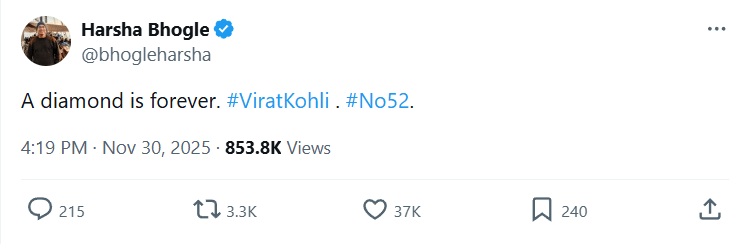
📷 Screenshot of Harsha Bhogle’s tweet on Virat’s 83rd century.

*The Schwarzschild radius is a concept from astrophysics that describes the relationship between a massive object’s mass and the critical radius at which its gravitational pull becomes so strong that nothing can escape, creating a black hole

Sources

  1. Research Sources on Virat Kohli
  2. On this day: Virat Kohli’s ’60 overs of hell’ remark that fueled a Lord’s classic
  3. Data check: With 11 consecutive series wins at home, India break Australia’s record
  4. A look at Virat Kohli’s legacy as Test captain – The Tribune
  5. Stats: Virat Kohli – Asia’s most successful captain in SENA Tests and bowlers’ favourite
  6. 2016 Stats Review: More results, more Kohli runs and more T20Is than ODIs
  7. Virat Kohli is India’s greatest ever Test captain; Sourav Ganguly, MS Dhoni not even close: Stats and more
  8. Most SENA Test Wins as Asian Captains
  9. Virat Kohli captaincy record in all formats – InsideSport
  10. Captains with better win record than MS Dhoni in ICC matches
  11. The Kohli Effect: How One Cricketer Redefined Fitness in India
  12. Virat Kohli’s ‘Captaincy Gesture’ Wins Hearts Ahead Of Ranji Trophy Return
  13. A quote from Harsha Bhogle when commentating on 23 October 2022 during India vs. Pakistan.
  14. IPL 2025 – Mo Bobat: Virat Kohli doesn’t need a captaincy title to lead
  15. When Virat Kohli Scored Twin Centuries In His First Test As India Captain | Watch
  16. ICC Men’s T20 World Cup 2022-23: India vs Pakistan
  17. Aussies struggle in sapping Kolkata heat
  18. On This Day: Virat Kohli’s Herculean 133* stuns Sri Lanka in Hobart
  19. ICC Cricket World Cup 2010-11: India vs Sri Lanka Final
  20. Which Virat Kohli innings do you like the most?
  21. Asia Cup 2011-12: India vs Pakistan
  22. India in Australia 2018-19: Australia vs India 2nd Test
  23. Virat Kohli Instagram Reel
  24. Kohli breaks Tendulkar’s record, is now the fastest to 14000 ODI runs
  25. Most Player of the Match Awards
  26. Virat Kohli becomes the first player to achieve 900 ratings points in ICC rankings across all formats
  27. Babar Azam Ends Virat Kohli’s 1258 Day-supremacy to Become No.1 Ranked ODI Batsman
  28. Virat Kohli IPL 2025 Stats: Runs, Highest Score, Strike Rate, Best Knocks
  29. Virat Kohli’s ICC Rankings | 1st Cricketer to Secure 900+ Rating
  30. Most Runs in Career
  31. Virat Kohli asks fans to stop calling him ‘King’: ‘I feel embarrassed’
  32. Virat Kohli: The Anatomy of a Century Drought
  33. Virat Kohli Stats 2020 to 2022
  34. Rohit, Kohli & Bumrah to get One Month break before Champions Trophy, set to miss IND vs ENG series
  35. The Man Who Became Hope – Perplexity AI Search
  36. Kohli stands up for Shami: Attacks over religion pathetic… spineless people
  37. Man in India arrested over alleged rape threats to cricket star Virat Kohli’s infant daughter
  38. India vs Australia 1st Test: Virat Kohli paternity leave pregnant Anushka Sharma
  39. 2019 World Cup: Virat Kohli tells India fans not to boo Steven Smith
  40. Virat Siraj were sledging and Gautam Bhai got carried away: Naveen ul Haq revisits fight with Kohli in IPL 2023
  41. Brother, guide, mentor: Mohammed Siraj credits Virat Kohli for his intensity and success
  42. Shubman Gill says it’s a big honour to captain Rohit and Kohli in ODIs
  43. When Virat Kohli gave up No. 4 batting position to Ishan Kishan
  44. I cannot use words like struggle and sacrifice: Virat Kohli

Alyssa Healy is the difference

Four years ago, she was a middle order bat, and not doing all that well at it.1 Thankfully, head coach Matthew Mott and assistant coach Tim Coyle decided to give her a go as an opener in 2017-18, and maybe it was their belief in her that helped, because at the time the Australian team had eight players who opened for their respective WBBL teams.2

Alyssa after creating problems for India, as usual.7 📷: ESPN Cricinfo

And her numbers tell a story:1

FormatPeriod/ RoleMatchesRunsAverageStrike Rate
ODIMiddle Order (2010–2016)5283015.9685.0
ODIOpening (2017–2025)682,47035.40100.07
ODIAs Captain (2023–2025)2790033.3395.2
T20IMiddle Order (2010–2016)801,39517.44112.0
T20IOpening (2017–2025)821,66024.25127.60
T20IAs Captain (2023–2025)2560024.00125.00
TestMiddle Order (Early Career)620033.3345.0
TestOpening (Recent)428940.1460.5
TestAs Captain (2023–2025)415037.5055.0
Alyssa Healy’s stats as on 13.10.2025

So that’s 120 ODIs (3,303 runs at 97.90 strike rate), 162 T20Is (3,054 runs at 129.79 strike rate), and 10 Tests (489 runs).1 

The statistical contrast between Healy’s middle-order years and her opening career comes packaged with multiple record breaking innings: In 2019, her unbeaten 148 (off 61) against Sri Lanka set the world record for the highest individual score in women’s T20Is.3 In the 2020–21 Women’s Big Bash League, Healy struck 111 off 52 balls for the Sydney Sixers against the Melbourne Stars, featuring 14 fours and four sixes, then an unbeaten 100 in a chase of 176 in 2022.4

Her record in ICC finals is mind boggling:

  1. In the 2020 T20 World Cup final at the MCG, her 75 off 39 balls in front of 86,174 spectators was transformational for women’s cricket. The innings featured the fastest fifty in an ICC final by any player, male or female, achieved in just 30 balls with a strike rate of 192.30. This was the record across formats at the time, and she broke multiple Indians along the way for it- the record used to belong to Hardik Pandya before this display, and she scored the runs against us. Of course she did.5
  2. But big players routinely do big things. She then made 170 off 138 balls against England broke Adam Gilchrist’s record for the highest individual score in any World Cup final.6 This was also her return to form and her first century as captain.

And now, Healy’s 142 off 107 balls against India in the ongoing World Cup created history as Australia achieved the highest successful chase in women’s ODI history at 331 runs. I’d ask why us, but really, it’s all her.7

She also holds the record for most dismissals by any wicketkeeper in T20I cricket, with 92 dismissals (42 catches and 50 stumpings, MS Dhoni has the most for men, 918). So far, she’s kept in 99 T20Is, the most for any cricketer, male or female.1

Indian cricket fans know world cup heart break a little too well, mostly thanks to Australians like Healy, so we can appreciate how freaking clutch she is. But it extends beyond her individual performances- she’s also a pretty impressive captain: 43 wins from 56 matches across formats at 78.18%. In ODIs specifically, she stands at 84.61% wins, with 22 victories from 27 matches.9 Under her leadership, Australia has maintained their status as cricket’s most dominant team, and now has an extraordinary winning record: 12 consecutive World Cup wins since 2022.9

Her genius and resilience has fundamentally changed Australia’s approach, which means she is shaping cricket itself. As usual, Alyssa Healy is the difference.

Sources

  1. Alyssa Healy – Cricket Player Australia
  2. Pressure for spots helping Healy thrive | cricket.com.au
  3. Healy plunders T20I world record with 148
  4. Alyssa Healy powers Sixers to easy win in WBBL opener
  5. ESPNcricinfo Awards 2020 Women’s batting winner
  6. Alyssa Healy breaks Adam Gilchrist’s world record with 170-run knock
  7. Australia v India Women’s World Cup report, scores, highlights
  8. Alyssa Healy breaks MS Dhoni’s record of most dismissals by wicket keeper in T20Is
  9. Alyssa Healy Captaincy Record in ODI, T20I, Test & WPL

Measuring greatness in sport

Humans like to measure things, and we like to be right… we insist on both nearly all the time, in fact. We often also like sport. Yet, in the sports I follow, there is no one player who can unequivocally be named the Greatest of All Time (GOAT).

The GOAT debate is always engaging, since it paints more of a picture of the person or persons making their case, rather than the athlete or team they are advocating for.

To my mind, there’s no real way to find one athlete who is better than all others, because no athlete ever has the same journey. Why is this important? Because a girl playing sport will always have more barriers to performance than a boy of the same age, socioeconomic status, and innate talent. Kids starting off playing the same sport will have very different paths by being born in different countries- and I’m not even speaking of the differences between developed and not so developed nations – think of the difference in coaching availability for a young tennis player in Spain to one in, say, New Zealand.

Let’s talk about what makes an athlete good.

i. Win-loss % – The most important standard to determine whether an athlete is good or not. Clearly, athletes who play team sports have a disadvantage, and their personal records will determine whether they have contributed to the team’s cause through their career or not.

ii. Inherent Talent – How fast a person can run, how their body works, how they process the knowledge about sport and apply it through the filter of their own personality are all usually inbuilt, and very individual to any person.

iii. Coachability – Are they open to learning new skills?

So aside from exceptional results in the criteria discussed above, what makes me think of a player as a great, or even a GOAT aspirant? Here’s my (nominal) list:

● Biomechanics – How an athlete moves is imprinted in peoples minds. All athletes in a sport learn the same movements, but how those movements interact with any of their

● Motivation – The best of the best are self motivated, and much more so than the regular person. They constantly wish to improve, and they work to do it.

● Ambition – The more ambitious an athlete is, the higher up they climb.

● Focus – They have their eyes on the prize and nothing can distract them from it.

● Sportspersonship – They’re not nasty. They care enough about their sport that they understand their opponent’s effort. Also, they enjoy their opponents’ successes, at least purely from a love-of-their-sport point of view, even if it encumbers them with additional scoreboard pressure.

● Transcendence – Athletes who transcend their team, their sport, their nationality. They have fans across all lines.

● Provocating other fandoms – If you know, you know. Athletes have reached the pinnacle of their sport infuriate fans of other GOAT contenders in the same sport, especially if they play in overlapping timelines.

● Popularity – They bring new fans and new players to their sport.

● They transform their sport – they change how their sport is played. The way they approach the sport and play it is so transformative, their colleagues change how they play and coaches and think tanks have to alter their baselines and expectations from other players.

While all spoortspersons are (correctly) judged on results, there are some who get better results. My second list are the qualities that propel good athletes to great ones.

How would you measure fielding performance in cricket?

Cricket is a statistically oriented sport. Cricket fans are used to scrolling pages of statistics for their teams and players they wish to know more about. And yet, we don’t have reliable metrics for measuring and comparing fielding performances.

Fans know, of course, when we see a cohesive fielding performance, such as New Zealand’s against Pakistan during the inaugural Champions Trophy match in Karachi on Wednesday, 19 February 2025. We also know a sloppy one, such as India’s against Bangladesh the next day in Dubai. Greatness is always visible in the doing on a cricket field.

We fantasise about taking that perfect flying catch, or executing a a sharp run out when we play, but we still do not have a universally accepted set of metrics to really understand what a “perfect” catch is, or what makes a run out “sharp”. For a sport that’s managed to tame the nebulous Leg before Wicket dismissal into four measurable criteria (including the umpire’s decision), it sure is confusing why fielding continues to confound us so. Especially when cricket fans value it so.

I’ve wondered what it would take to build parametres that measured fielding performance, and asked different cricket writers about how they would go about it too. At the moment I think such a measurement must include the following:

1. Define the deconstructed components of fielding

    What are the parts that make the whole for fielding in cricket? I think we can break them down to getting in position, including speed and ball awareness; catching; throwing, with throwing itself divided into speed and accuracy; and field awareness.

    2. Decide how we value different types of catching

    Is slip catching the same as catching at point? Are they equivalent to a boundary catch? What about wicket keeping catches, with those padded cymbals for hands? And what happens when fields tag team a catch?

    3. Scoring

    Each fielder may be rated on the above, that is, scores for emplacement, for catching, and for throwing. Additionally, points can be deducted for errors and added for faultless execution, gymnastics-style.

    Now for expanding upon the four criteria I mentioned in the first point above.

    1. Emplacement- How a fielder gets into position.

      a. Ball Awareness

      A lack of ball awareness is most often evidenced in whether or not fielders are backing throws up. Overthrows are annoying, and often damaging. Dropped catches are also often about active attention, since players who expect the ball to come to them are also ready to field it, and ball awareness will allow us to gauge how attentive a player usually is.

      b. Speed

      Cricket already measures the amount of time a fielder had to react to an incoming catch, and we can certainly measure the distance the fielder is standing from the batter. Therefore, as middle school maths taught us, Speed = Distance/ Time. This will capture a fielder’s fitness and running ability, as well as their reaction time.

      2. Catching- Self explanatory

      Off the top of my head, I can count eight types of catches

      i. Tag-Teamed Catches- When two or more fielders are involved in completing the same catch. Here players must be especially aware of each other and cognizant of throwing the ball before they drop it, or braced to catch one coming at an odd angle from the first catcher. I believe points should be assigned to all the involved fielders.

      ii. Boundary Catches- Catches pouched so close to the boundary that the fielder must be aware of the ropes/ cushions.

      iii. Outfield Catches- Catches outside the 30 yard circle, but before the ball reaches the boundary fielders. It may involve either infielders or boundary fielders running to the catch.

      iv. Infield Catches- Catches at or within the 30 yard circle that do not include the ones detailed below.

      v. Slip Catches- You know the ones.

      vi. Keeper Catches- This is interesting because keepers have such a unique job. Of course they have the advantage of padding, but they often have to catch blind, and when diving can easily end up in front of first slip. They also must actively read the ball while it is being delivered, just like the batter.

      vii. Close Catches- Any variation on Silly Point, Silly Mid Off, Silly Mid On, and Forward Short Leg.

      viii. Caught and Bowled- When the bowler catches the ball during or soon after their follow through.

      3. Throwing- collecting and getting the ball back to the pitch.

      Throw Speed- easily measured.

      Throw Accuracy- also easily measured.

      4. Field Awareness

      Poor calling is exasperating to watch and dangerous for the fielders themselves, and fielders need to be aware of which end of the pitch they should throw to.

      So how will the scoring happen?

      One way to do it is simply begin each match at zero for each fielder, and add points as they field, or misfield, as the numerator, and the number of opportunity they had to field as the denominator. Each act of fielding can have a predetermined value, and at the end of the match, I propose we bring all the scores down to a scale of 10.

      A decision must be taken about whether each day in test cricket is rated separately, or whether performances are rated by innings, since both bring forth interesting insights into how different fielders manage sessions, innings, and days. A fifth continuous session of fielding is sure to differ from the first session in both execution, strategy, and energy.

      This kind of a rating scale will take into account how often a fielder comes into play, and will account for how good they already are, given that they are likely to be placed according to their previously demonstrated abilities.

      Of course, this will add to all the counting and mathematics we already do as cricket tragics, but as matches add up, we’ll have new stats to pour ourselves into and write articles about. I count that as a win.