A Bayesian view of cricket’s player of series monsters

Imagine this:

  • Sometimes it rains, sometimes it doesn’t.
  • You notice that the ground is wet.

Now you ask: “What is the chance that it rained, given that the ground is wet?”

That’s exactly the kind of question Bayes’ Theorem answers.

Think of Bayes’ Theorem as a smart way of changing your mind when new information appears. In life, we start with a belief based on past experience.
Then something new happens. Instead of ignoring it, we usually update what we believe. It’s a part of Probability Theory that helps you combine old information you already have, with new information you have just received.

This is the formula (don’t panic): P(AB)=[P(BA)×P(A)]÷P(B)P(A∣B) = [P(B∣A)×P(A)]​ ÷ P(B)12

It looks mad, doesn’t it? It took me months to be able to remember the Bayes formula, and it took cricket to help me learn it finally. But first, an explanation of what we have above:

In the formula,

  • A = the thing you care about (Example: It rained). This is your starting belief before you see new evidence. It could be anything, such as, it’s dry season so it won’t rain today.
  • P(A) is the probability of the starting belief.
  • B = the evidence you see. (Example: The ground is wet). This is new information.
  • P(B) is the probability of the new information happening.
  • the “|” sign in the formula means “given” so P(A|B) will be read as Probability of A given B, meaning that the probability that A is still true given that the new information B is now known (“Now that I see the ground is wet, how likely is it that it rained?”), and P(B|A) is the probability that B is true given that we know that A happened (“If it did rain, how likely is the ground to be wet?”).

Now let’s take some help from cricket WITH MADE UP NUMBERS:

  • Let’s say India wins 70% of all cricket matches. This is P(A), where A = India wins 70% of all cricket matches, okay?
  • Now imagine Virat Kohli makes a century in 40% of the matches he plays. This is P(B), where B is Virat’s imaginary (I haven’t checked) century strike rate.
  • P(A|B) is the probability that India won a match given that Virat hit a century. Let’s keep this at 80%.Yes I’m a fan, how did you guess?
  • Now the new information is that India has won a match. So given that we now know that India has won a match, what is the probability that Virat hit a century?

So, now,

  • P(India winning a match for any reason) = 70% = 0.7
  • P(Virat’s century in a winning or losing cause) = 40% = 0.4
  • P(India winning given that Virat has hit a century) = 80% = 0.8
  • So, if we know India has won, what is the probability that Virat hit a century?

P(Virat’s Century given that India has won) = [P(Virat’s century in a winning or losing cause) × P(India winning given that Virat has hit a century)] / P(India winning a match for any reason)

or P(Virat Century|India Win) = [P(Century) × P(India Win| Virat Century)] / P(India Win)

P(Virat century∣India wins)= (0.8×0.4​) / 0.70 ≈ 0.457 = 45.7%

I know this is all new and complex for many readers (it took me lots of effort and a Virat-inspired intervention to learn this too), so take your time to read it again if you need to, as many times as might help.

Player of Series Monsters
At this point I want you to know that Cricinfo doesn’t have a list of women cricketers in decreasing order of player of series awards like they do for the men. There’s also a paucity of tabulated data available for women’s cricket generally. So I’m concentrating only on the men. The list of men is clearly documented, as mentioned:

NamePoS Awards (Tests, ODIs, T20Is)
Virat Kohli (India)22
Sachin Tendulkar (India)20
Shakib Al Hasan (Bangladesh)17
Jaques Kallis (South Africa)15
David Warner (Australia)13
Sanath Jayasuriya (Sri Lanka)13

Of these, I got Perplexity AI to do some data finding and number crunching for me for Virat, Sachin, and Shakib for ODIs.

Bayes USING REAL NUMBERS
When the team won, how often was this player the reason?

PlayerTeamDefinition of WDefinition of CP(W) base win%3P(C) frequency of centuriesP(W | C) centuries in wins4
KohliIndia (ODI)India win when Kohli in XIKohli scores ODI century0.616~0.18 (1 per 5.65 inns)~0.83 (44 of 53 hundreds)
TendulkarIndia (ODI)India win when Tendulkar in XITendulkar scores ODI century0.505~0.11 (1 per 9.22 inns)~0.67 (33 of 49 hundreds)
Shakib5Bangladesh (ODI)Bangladesh win (overall ODI record)Shakib scores ODI century (bat)~0.36~0.03 (7 in 234 inns)~0.77 (7 of first 9 tons)
Player details67

Here’s the Bayes calculation:

PlayerTeamP(W) base win%P(C)P(W | C)P(C | W) calculatedInterpretation
KohliIndia (ODI)0.6160.180.830.24 (24%)~24% of India ODI wins with him include a Kohli hundred
TendulkarIndia (ODI)0.5050.110.670.14 (14%)~14% of India ODI wins with him include a Tendulkar hundred
ShakibBangladesh (ODI)0.360.030.770.07 (7%)~7% of all Bangladesh ODI wins include a Shakib hundred
Bayes calculation for Virat, Sachin, and Shakib

What this means

  • Virat Kohli in a strong India: One in every four ODI wins arrives with a Kohli century inside it. He does not just bat well; he bats well in a machine that is already built to win. His centuries are the accelerant on a fire that’s already burning. When India wins, there’s a strong chance he is the one who decided the margin, the pace, the emotional tone of the chase.
  • Sachin Tendulkar in a medium India: One in every seven wins contains a Tendulkar century. He played across eras—through the ’90s when Indian cricket was still finding its feet, through the 2000s when it became a force. His centuries had to do more heavy lifting because the team around him was less consistently dominant. The win probability bump he created had to be steeper, had to arrive at moments when India could genuinely lose without him.
  • Shakib Al Hasan in a historically weaker Bangladesh: One in every fourteen overall Bangladesh ODI wins includes a Shakib century—but here’s the insight: when he does score a hundred, Bangladesh almost never lose that game (6 of 7). On a much thinner winning base, his performances are load‑bearing. He is not the beneficiary of team strength; he is the architect of team possibility.

Shakib is kind of amazing in this that 6 of his 7 centuries have come in wins, and it got me curious about how many 50+ scores have these gents made in wins, but that data is not available in a clean Bayes format.

Kohli and Tendulkar sit on mountains of 50+ scores in ODIs – over a hundred each when you add fifties to centuries.8 Where they differ is in what happens after fifty.9 Kohli’s conversion rate from 50 to 100 in ODIs is significantly higher than Sachin’s. Once he’s crossed fifty, he tends to keep going, especially in chases. Part of that is temperament – an almost obsessive refusal to give away his wicket once set – but a big part is structural: India in his era often had deeper batting, was better at chasing (or he was better at chasing anyway), and capable partnerships.

Tendulkar’s 50+ scores, by contrast, sit in a very different ecosystem. He played long stretches of his career in teams that were less stable, so his fifties often had to be the innings and the platform at the same time. The conversion to hundreds is lower not because the intent wasn’t there, but because the conditional environment around him – partners, match situations, opposition attacks – made it much harder to keep going at the same rate. Yet even as “just” fifties, those scores were repeatedly the spine that held up India’s innings.

Bangladesh’s baseline ODI win percentage is far lower than India’s. That means:

  • A Shakib 50 – even without going on to a hundred – does outsized work.
  • His 50+ scores in tournaments like the 2019 World Cup (where he reeled off one high‑impact innings after another) are not just “good knocks”; they are the narrow ledges on which Bangladesh’s entire chase or defence balances.

And because he does this as an all‑rounder, a fifty for Shakib often comes with 10 overs of spin as well, and Bangladesh tend to look competitive almost exactly on the days Shakib has a good outing.

So much of cricket is about context, and this post reinforced that for me. Virat Kohli doesn’t just score centuries; he does so in a system that consistently wins, amplifying his influence. Sachin Tendulkar carried innings for teams that sometimes struggled, meaning his 50+ scores were often the backbone of a win rather than just the flourish. And Shakib Al Hasan? In a team with fewer wins overall, his big performances don’t ride on a strong machine — they create the machine.

Sources

  1. Bayes Theorem – Formula, Statement, Proof | Cuemath
  2. Bayes’s Theorem for Conditional Probability | GeeksforGeeks
  3. Bangladesh ODI matches team results summary | ESPNcricinfo
  4. Virat Kohli vs Sachin Tendulkar: The real GOAT of ODIs, statistical analysis settles the debate | Hindustan Times
  5. Shakib Al Hasan Centuries | Cricket.one
  6. Kohli vs Tendulkar: A comparison of their 49 ODI hundreds | ESPNcricinfo
  7. Virat Kohli vs Sachin Tendulkar: The real GOAT of ODIs, statistical analysis settles the debate | Hindustan Times
  8. Most Fifties in ODI: From Sachin Tendulkar to Quinton de Kock | MyKhel
  9. Most fifties in career in ODIs – Batting records | ESPNcricinfo
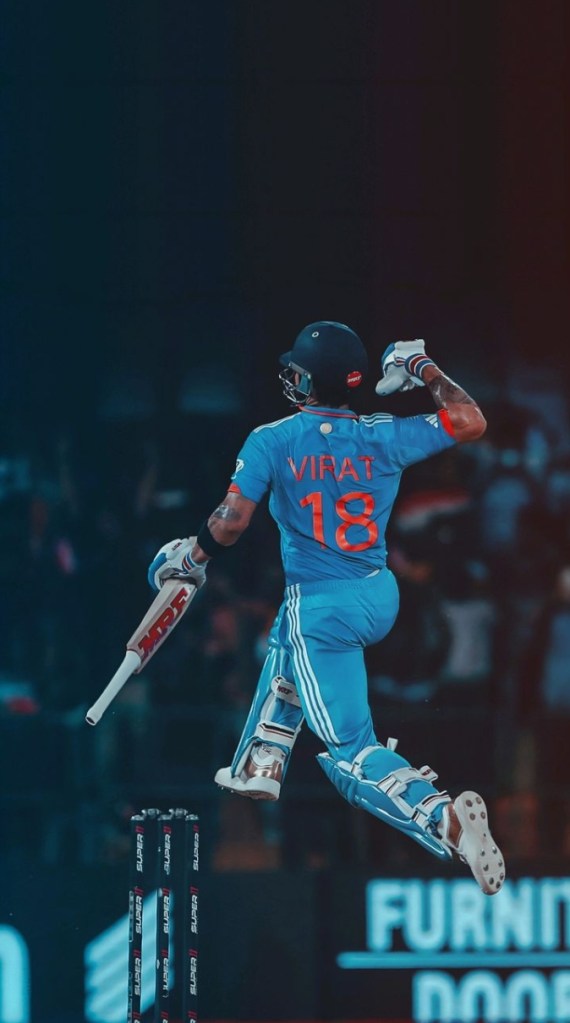
The man who became hope

📷 I dunno, I couldn’t find whom to credit for this picture of a highly common sight.

At the heart of every black hole lies a singularity- a point of infinite density where the laws of physics are said to break down. It is the pinpoint centre of an object so massive, not even light can escape it. Virat Kohli is this singularity. Let me clarify: it’s not that he exists in this singularity. He is the singularity. The mass of his will and the impact of his performance forming a Schwarzschild radius* that swallows possibility and spits out improbabilities like mangled previous-truths of no-one-can-do-that, and this-is-not-possible. Virat Kohli is inevitable.

The Commander

“60 overs they should feel like hell out there.”1

It’s a famous quote by now. The English are understandably fond of it. Nothing has ever demonstrated Kohli’s relentless pursuit for excellence quite like his captaincy- turning every home Test into a trial by fire for opponents, demanding total commitment from his team, and setting a tone that opponents, particularly in their own backyard, could never ignore. He transformed India’s Test mentality, inspiring fast bowlers to attack and fielders to hunt, making each spell about psychological domination and cultural reset.

Under Kohli, for 11 consecutive Test series, India remained undefeated on home soil, a streak spanning over seven years (2015–2021).2 In 31 home Tests, India lost only 2 matches: a fortress so impregnable that it redefined the subcontinent’s dominance.3 No other Indian captain who led in multiple series maintained such a pristine record.23 The team didn’t just win; they devoured oppositions: nine victories by an innings, nine by margins over 150 runs, turning home advantage into an inevitability.45

But home is home. What elevates Kohli was his refusal to accept that Indian teams must bow to foreign conditions. He became the first Asian captain to win Tests in Australia, England, and South Africa. His 16 away Test victories are the most by any Indian captain, surpassing Sourav Ganguly’s 11.46 In SENA countries (South Africa, England, New Zealand, Australia), Kohli secured seven Test wins- the next best is three.47 He captained us in 68 Tests, won 40 of those, lost 17, and drew 11.48 That’s a 58.82% victory rate, which is the highest for any Indian captain to date.48

Across formats, Kohli captained India in 213 matches, winning 135 at an overall win rate of 64.31%, which is the second-best for any Indian captain with at least 50 matches.89 We held the ICC Test Mace for five consecutive years (2016–2021),10 and for a historic period between January 2017 and March 2020, India held the No. 1 ranking in all three formats simultaneously, a feat no other team had achieved before.4 This triple dominance lasted for 38 months, making Kohli’s India the most complete cricketing force of the era.4

Kohli’s impact wasn’t just tactical—it was systemic. He turned fitness from a personal obsession into a team religion. As captain, he institutionalised fitness by making the yo-yo test a non-negotiable selection benchmark, directly impacting team composition.10 Michael Holding noted that while “maybe two players were fit” in the India of old, now “everyone is”—a direct result of Kohli’s blueprint.10 This physical transformation unlocked India’s bowling potential. Fast bowlers, once seen as support acts, became weapons of warfare: Kohli, a batter, built a team of bowlers who took 20 wickets 22 times in 35 away tests under him.4

Unsurprisingly, Virat continues to lead even without formal captaincy. In January 2025, when approached to captain Delhi in the Ranji Trophy, he refused.11 At RCB, after stepping down from captaincy in 2021, he remained the franchise’s emotional leader. Director of Cricket Mo Bobat stated: “Virat doesn’t need a captaincy title to lead. Leadership is one of his strongest instincts. He leads regardless.” When RCB appointed Rajat Patidar as captain for IPL 2025, Bobat noted that Kohli was “so pleased for Rajat” and “right behind him,” actively supporting the decision.12

The Warrior

“Beyond the present and into legend”13

There are so many.

  • My favourite Virat Kohli innings remains those twin centuries at the dawn of his captaincy stint in Adelaide- emblematic of a man who would drag India across the finish line repeatedly and single handedly if grit were the only ask. Australia won by 48 runs.14
  • That pre-Diwali rescue 82* with Hardik, DK, and finally Ashwin: facing Pakistan with 90,000 fans at the MCG after India were 31/4, with probably the one shot at 18.5 I’ll still smile about in my deathbed. This man dragged India back from the dead in what is probably the best T20 innings I’ve seen.15 I watched the last few overs of this match at a Croma store with salespeople and customers alike crowded around televisions showing the match, all work forgotten, our pulse clenched in Virat’s fist.
  • 92 in Kolkata in wet-bulb temperatures of more than 40°C, with Australian players collapsing around him: Matthew Wade vomited on the field, Pat Cummins sat on an esky during play, unable to stand. Kane Richardson described it: “We were literally dying. No one was speaking. Even if you got a wicket, there was complete silence because no one had energy.” Kohli was running twos. India posted 252 and won by 50 runs.16
  • Hobart 2012, when India needed to chase 321 in 40 overs to stay alive in the tri-series, which sounds absurd, right? Kohli’s 133* off 86 balls finished that chase with two balls to spare.17 I remember watching that innings, entirely confident he’d get us there.
  • His 35 of 49 at just 22 years old in the CWC final at home in a pressure cooker situation, chasing the highest total ever required to win a CWC final? Not his most celebrated innings, and certainly well before the mythos, showed us what was to come.18

Really, there are so many others19, but let’s get on with why I really love him.

The Eternal

“Don’t write India off because Virat Kohli is still there, and we know what he can do.”20

Here’s proof: Virat was the fastest player in ODI history to 8,000, 9,000, 10,000, 11,000, and 12,000 runs.21 He has earned 70 Player of the Tournament / Series awards 555 total international matches (as of date),22 and hit 20 centuries as Test captain, the most Test tons by an Indian captain, and fourth-highest runs globally behind only Graeme Smith, Allan Border, and Ricky Ponting.4 He also made seven double centuries as captain, the most in Test history.4 He reigned as the No. 1 T20I batsman for 1,202 days, the most by any player,23 the No. 1 ODI batsman for 1,258 days, 24 and remains the only player to achieve 900+ rating points across formats.2326 He has more than 8,600 IPL runs in 258 innings, the highest run scorer in IPL,25 and currently the third highest run scorer in international cricket approaching 28,000 runs.27

Only someone who followed his career through those years would be able to tell you the effect these records had on our psyche: Virat the Wonder shaking a nation brought up to be diffident awake to suddenly realise our own agency. And while all these numbers tell a story, they can never explain a fan’s relief at having this man at the crease. Like Isa said, if Virat’s batting, we haven’t lost yet.

The Man

“Please Call Me Virat”28

Before 2019, it was easy to forget he’s human. The form slump got all of us. Between November 2019 and September 2022, Kohli endured the most public batting crisis of his career- a 1,048-day wilderness without an ODI century, spanning 71 international innings across all formats.29 His Test average collapsed to 26.20 (917 runs, 20 matches, 2020-2022), with zero centuries in both 2020 and 2021.30 Even his white-ball dominance faltered- his ODI average fell below 4030 for the first time in a decade, and familiar strengths became questions. The cover drive, once his signature, became a liability as he nicked off repeatedly. The psychological toll was visible. He spoke of “feeling mentally down” and “not feeling his hands” during drives.30 

Now that we’ve been reminded, let’s talk about the man- because for all the centuries and chases, perhaps the most extraordinary thing about Virat Kohli is how he uses the weight of his name.

Long before he and Anushka Sharma married, he defended her when faceless trolls blamed her for losses.32 He posted publicly, forcefully, without calculation, simply because decency demanded it. Years later, when Mohammed Shami was targeted with bigotry after a match, Kohli didn’t hide behind neutrality. He called the abuse “pathetic,” “spineless,” and “the lowest level of human behaviour.”33 He did it in front of cameras, with the nation watching, fully aware that such candour from an Indian captain would ignite a culture war. But on both occasions he understood silence is complicity, and anyway when has this man ever been silent.

Predictably, the defence of religious freedom in a country fraught with public indecency and intellectual degeneration led to rape threats against his infant daughter, and Virat and Anushka chose not to retreat from the public eye, not to negotiate with cowards. Cases were filed and people held accountable.34

He caught criticism for going home during the Test series to be with Anushka for the birth of their child.35 In a cricket culture where paternity leave has seldom been normalised, Kohli’s decision to go home for the birth of his child felt radical. It remains one of the most quietly admirable decisions of his career: a rewiring of what leadership looks like.

But his empathy clearly extends far beyond the personal.

When Steve Smith was booed by Indian fans after the sandpaper incident, Kohli turned to the crowd in the heat of a World Cup match and asked them to stop.36

When Naveen-ul-Haq was being drowned in abuse in an international fixture after an IPL flashpoint, Kohli chose to publicly diffuse the situation.37

And the youngsters, an entire generation he has nurtured and helped forge.
Mohammed Siraj, who lost his father during the 2020 Australia tour, has said repeatedly: “Kohli bhai is a brother, a guide, a mentor.”38
Shubman Gill, now India’s Test captain- and Kohli’s ODI captain, has spoken openly about Kohli’s influence on the team.39 Ishan Kishan has recounted Kohli giving up his no. 4 position for him.40

Of all these, what stands out is a recent demonstration of how Kohli the fiery child-star has become a pole star that can guide a nation’s conscience if we allow it: in a candid conversation with sports presenter Gaurav Kapur, Kohli dismantled the romanticisation of his journey with characteristic honesty: “the person who doesn’t get two meals a day is the one who struggles. We are not struggling. You can glorify your hard work by calling it a struggle, put a cherry on top. No one is telling you to go to the gym, but you do have to feed your family. If you think about the real problems regular people face in life, it’s not the same. The problem of getting out in a Test series can’t be compared to someone who doesn’t have a roof over their head. The truth is, for me, there’s been no real struggle or sacrifice. I’m doing what I love, which isn’t an option for everyone”.41

For a man meant for celestial metaphors the truth is astonishingly grounded: Virat Kohli is the only singularity that truly matters: a good man.

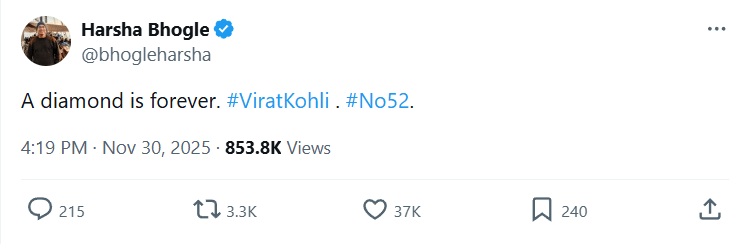
📷 Screenshot of Harsha Bhogle’s tweet on Virat’s 83rd century.

*The Schwarzschild radius is a concept from astrophysics that describes the relationship between a massive object’s mass and the critical radius at which its gravitational pull becomes so strong that nothing can escape, creating a black hole

Sources

  1. Research Sources on Virat Kohli
  2. On this day: Virat Kohli’s ’60 overs of hell’ remark that fueled a Lord’s classic
  3. Data check: With 11 consecutive series wins at home, India break Australia’s record
  4. A look at Virat Kohli’s legacy as Test captain – The Tribune
  5. Stats: Virat Kohli – Asia’s most successful captain in SENA Tests and bowlers’ favourite
  6. 2016 Stats Review: More results, more Kohli runs and more T20Is than ODIs
  7. Virat Kohli is India’s greatest ever Test captain; Sourav Ganguly, MS Dhoni not even close: Stats and more
  8. Most SENA Test Wins as Asian Captains
  9. Virat Kohli captaincy record in all formats – InsideSport
  10. Captains with better win record than MS Dhoni in ICC matches
  11. The Kohli Effect: How One Cricketer Redefined Fitness in India
  12. Virat Kohli’s ‘Captaincy Gesture’ Wins Hearts Ahead Of Ranji Trophy Return
  13. A quote from Harsha Bhogle when commentating on 23 October 2022 during India vs. Pakistan.
  14. IPL 2025 – Mo Bobat: Virat Kohli doesn’t need a captaincy title to lead
  15. When Virat Kohli Scored Twin Centuries In His First Test As India Captain | Watch
  16. ICC Men’s T20 World Cup 2022-23: India vs Pakistan
  17. Aussies struggle in sapping Kolkata heat
  18. On This Day: Virat Kohli’s Herculean 133* stuns Sri Lanka in Hobart
  19. ICC Cricket World Cup 2010-11: India vs Sri Lanka Final
  20. Which Virat Kohli innings do you like the most?
  21. Asia Cup 2011-12: India vs Pakistan
  22. India in Australia 2018-19: Australia vs India 2nd Test
  23. Virat Kohli Instagram Reel
  24. Kohli breaks Tendulkar’s record, is now the fastest to 14000 ODI runs
  25. Most Player of the Match Awards
  26. Virat Kohli becomes the first player to achieve 900 ratings points in ICC rankings across all formats
  27. Babar Azam Ends Virat Kohli’s 1258 Day-supremacy to Become No.1 Ranked ODI Batsman
  28. Virat Kohli IPL 2025 Stats: Runs, Highest Score, Strike Rate, Best Knocks
  29. Virat Kohli’s ICC Rankings | 1st Cricketer to Secure 900+ Rating
  30. Most Runs in Career
  31. Virat Kohli asks fans to stop calling him ‘King’: ‘I feel embarrassed’
  32. Virat Kohli: The Anatomy of a Century Drought
  33. Virat Kohli Stats 2020 to 2022
  34. Rohit, Kohli & Bumrah to get One Month break before Champions Trophy, set to miss IND vs ENG series
  35. The Man Who Became Hope – Perplexity AI Search
  36. Kohli stands up for Shami: Attacks over religion pathetic… spineless people
  37. Man in India arrested over alleged rape threats to cricket star Virat Kohli’s infant daughter
  38. India vs Australia 1st Test: Virat Kohli paternity leave pregnant Anushka Sharma
  39. 2019 World Cup: Virat Kohli tells India fans not to boo Steven Smith
  40. Virat Siraj were sledging and Gautam Bhai got carried away: Naveen ul Haq revisits fight with Kohli in IPL 2023
  41. Brother, guide, mentor: Mohammed Siraj credits Virat Kohli for his intensity and success
  42. Shubman Gill says it’s a big honour to captain Rohit and Kohli in ODIs
  43. When Virat Kohli gave up No. 4 batting position to Ishan Kishan
  44. I cannot use words like struggle and sacrifice: Virat Kohli

How does MRF decide whose bat to sponsor?

MRF, originally Madras Rubber Factory, started as a balloon manufacturer and grew into India’s largest tyre company. Over the years, the group diversified into sporting goods, with active involvement in cricket kits, bats, gloves, and a significant marketing footprint in Indian and, to a limited extent, global sporting culture.1 Over time their bat sponsorship has come to represent a potential enthronement, if not outright coronation of the Indian cricket’s next king. It’s fairly entertaining that MRF, once just a tyre company, now doubles as a premium sporting label—with 350+ retail outlets across India as of 2025.2

I’ve wondered about how MRF chooses, or chooses not to, sponsor someone’s bat, especially since their quick switch to sponsor Shubman Gill’s bat. And yet, the selection is not quite destiny: of the 11 players who have carried an MRF bat, 5 were asked to return it. That’s a 45% failure rate.

Also, two things: 1. The tables are pictures because I’m not mucking about with WordPress tables with this much data. It’s an absurdity. 2. I’ve done my best to check the age figures since it was relevant to this post, but I haven’t checked the cricket stats much.

The Cricketers
Sachin Tendulkar (India)
Brian Lara (WI),
Steve Waugh (Australia),
Gautam Gambhir (India)
Rohit Sharma (India)
Virat Kohli (India),
Sanju Samson (India),
Shikhar Dhawan (India),
AB de Villiers (SA),
Prithvi Shaw (India),
Mignon du Preez (SA),3
Shubman Gill (India)

The Logic
There is clearly a statistical basis for screening the candidates. Each of the cricketers finally offered the bat had a highly successful year 3 years before they got the sponsorship call. The first mottle appears two years before the sponsorship is offered, with Rohit Sharma not quite having a year to remember. One year before the sponsorship, performances from Rohit Sharma and Gautam Gambhir started fading. They were still offered sponsorships, though, so MRF was willing to bet they would pick up, and also be culturally relevant in the future.

Word on the cricketing streets is that MRF spots its talents early in their career, but the average age at the beginning of player sponsorships comes out to be 26.67, with Prithvi Shaw being the earliest pick at 17 (or 18) years old, and Steve Waugh the senior most at 36. Removing these outliers returns an average age of… 26.67 years, and removing anyone who was sponsored before 2010 makes for an average of 25.38 years.

Age of MRF bat sponsorees at the beginning and end of their tenures

It’s obvious that the original three foreign icons (Lara, Waugh, AB) were established greats when they got the MRF deal; the rest, especially Indian batters, were mostly in their 20s. Given that batters usually come into their own around 27-29 (my personal opinion), and can certainly be prodigious well into the 30s, this is consistent with MRF’s search for the next (Indian) batting legend. To be noted, all the averages tallied above fall around or before the age of 27.

These are the statistical inputs I’ve been able to spot for the champaigne:

  • Insatiability, 850–1,200+ runs/year in Tests or ODIs for at least one of the years before signing.
  • Consistent 100s in decisive or pressure games (World Cups, series deciders).
  • ICC event hundreds and being among top run scorers seems to be a trademark.
  • Youth milestones and early leadership (U19 or domestic tournament MVPs- Kohli, Dhawan, Gill, and Shaw were all U19 heroes)
  • Multi-format prowess, such as hundreds in all formats by 25.
  • Longevity (sustained form) or a steep climb in performance

The Magic
MRF’s track record of signing “the next big thing” is so consistent, it borders on magic:

  • They chose Tendulkar just before he ruled the 90s and 00s.
  • Bet on Virat as he broke records and changed Indian cricket’s mindset.
  • Handed Gill the baton right before a record-shattering run in 2025, including 4 consecutive Test hundreds and a string of 20→100 conversions unparalleled among peers, although this was an obvious signing with Virat retiring right before the series, and Gill now the heir apparent to the Indian No. 4 position, and the Test captain).
  • Timing is critical. MRF’s model aims to find the next star on the rise- locking in ambassadors just as they shift from prodigy to global icon (e.g., Sachin before he became Sachin, Kohli before captaincy explosion).

    MRF therefore seems to filter for improvement arcs, multi-format ability, and brand values- not just averages. But cricketing “auras” also matter- hence Kohli, Gill (not just Indian and prodigious, but also temperamentally dignified, in possession of impressive communication skills, the worlds best ODI batter and other top performances in his age cohort, and the Indian Test captain) over otherwise comparable international stars like Dravid (diluted the Indian audience, not a superstar when compared to Sachin), Kallis (not Indian, and not as popular in India as AB), Sangakkara (see Kallis), Laxman (same as Dravid, but also confined to Tests), MS Dhoni (Not an era defining batter), KL Rahul (beautiful, inconsistent), Yashaswi Jaiswal (incredible story but not as established as Shubman, has not yet shown all format ability, although watch out for this in the future), Rishabh Pant (Likely not considered an era defining batter, but is also Spidey, and that doesn’t fit the brand image), Abhishek Sharma (maybe soon?). Ambassadors are chosen not only for statistics, but also for embodying resilience (Tendulkar’s comebacks), toughness (Kohli’s chases), artistic mastery (Lara’s flair), performance (Dhawan’s ICC tournament performances), or next-gen inspiration (Shaw, Samson, Gill). Jaiswal and Pant’s exclusions highlight that charisma alone isn’t enough- they’re watching form across formats, market potential, and personality fit. Not sponsoring MS indicates they’re not too swayed by long term captaincy or intense fandom or even the number of trophies won as skipper- once again, it’s the batting output that matters.

The Business
MRF’s approach to selecting its bat ambassadors is a nuanced blend of data-driven business strategy, brand vision, and razor-sharp market positioning, refined over decades of cricketing association. India is MRF’s largest tyre and sporting market, and cricket is India’s premier sport. MRF therefore focuses on pan-Indian cricket icons as ambassadors to maximise its cultural and commercial return on investment. This also means that non Indians rarely get the MRF sticker.

A selection of players who were not MRF bat ambassadors, and why I think that was so

By not sponsoring too many players simultaneously- and never directly competing with its own ambassadors for limelight- MRF ensures its bat sticker is always exceptional, not generic. The sustained, highly visible association with generational talents strengthens brand recall far beyond the cricket field- from tyre showrooms to street cricket bats. So concerned is MRF with its bat’s legacy, the company has divided its brand into three- the Genius bat for the artists and prodigies (Tendulkar, Kohli, AB, Gill), the Conqueror bat for those known for their grit (Steve Waugh), and the Wizard bat for Brian Lara.

MRF is always looking a generation ahead. As one ambassador (Tendulkar, Kohli) nears twilight, MRF signs the next rising phenom (Gill over Jaiswal, as the latter had not yet ticked every box), displaying continuity and reducing sponsorship risk, while ensuring ongoing cultural presence, with each transition becoming a media/ marketing event in itself. The brand’s investment is offset by massive earned media (“free” advertising) via on-field heroics, social media virality, and generational recall—no other bat sticker is as instantly recognized in world cricket.

Note: This post earlier included Sir Hadlee, but I’ve not been able to find any credible sources for it, so I’ve removed any mention of him, and redone the calculations.

Sources
1. MRF Ltd. – Fortune India
2. MRF Sports
3. @mdpminx22 on Instagram

Goodbye my heart

Virat Kohli, after his final Test Century. Picture courtesy of Star Sports.

In a lifetime of loving cricket and its artists, Virat Kohli and Test cricket has been the most compelling love story, and a farewell that feels like bereavement.

Take care of yourself Virat. You’ve meant the world to me.

Measuring greatness in sport

Humans like to measure things, and we like to be right… we insist on both nearly all the time, in fact. We often also like sport. Yet, in the sports I follow, there is no one player who can unequivocally be named the Greatest of All Time (GOAT).

The GOAT debate is always engaging, since it paints more of a picture of the person or persons making their case, rather than the athlete or team they are advocating for.

To my mind, there’s no real way to find one athlete who is better than all others, because no athlete ever has the same journey. Why is this important? Because a girl playing sport will always have more barriers to performance than a boy of the same age, socioeconomic status, and innate talent. Kids starting off playing the same sport will have very different paths by being born in different countries- and I’m not even speaking of the differences between developed and not so developed nations – think of the difference in coaching availability for a young tennis player in Spain to one in, say, New Zealand.

Let’s talk about what makes an athlete good.

i. Win-loss % – The most important standard to determine whether an athlete is good or not. Clearly, athletes who play team sports have a disadvantage, and their personal records will determine whether they have contributed to the team’s cause through their career or not.

ii. Inherent Talent – How fast a person can run, how their body works, how they process the knowledge about sport and apply it through the filter of their own personality are all usually inbuilt, and very individual to any person.

iii. Coachability – Are they open to learning new skills?

So aside from exceptional results in the criteria discussed above, what makes me think of a player as a great, or even a GOAT aspirant? Here’s my (nominal) list:

● Biomechanics – How an athlete moves is imprinted in peoples minds. All athletes in a sport learn the same movements, but how those movements interact with any of their

● Motivation – The best of the best are self motivated, and much more so than the regular person. They constantly wish to improve, and they work to do it.

● Ambition – The more ambitious an athlete is, the higher up they climb.

● Focus – They have their eyes on the prize and nothing can distract them from it.

● Sportspersonship – They’re not nasty. They care enough about their sport that they understand their opponent’s effort. Also, they enjoy their opponents’ successes, at least purely from a love-of-their-sport point of view, even if it encumbers them with additional scoreboard pressure.

● Transcendence – Athletes who transcend their team, their sport, their nationality. They have fans across all lines.

● Provocating other fandoms – If you know, you know. Athletes have reached the pinnacle of their sport infuriate fans of other GOAT contenders in the same sport, especially if they play in overlapping timelines.

● Popularity – They bring new fans and new players to their sport.

● They transform their sport – they change how their sport is played. The way they approach the sport and play it is so transformative, their colleagues change how they play and coaches and think tanks have to alter their baselines and expectations from other players.

While all spoortspersons are (correctly) judged on results, there are some who get better results. My second list are the qualities that propel good athletes to great ones.