WordPress Promt: What change would you like your blog to make in the world?

What change, big or small, would you like your blog to make in the world?

I’d love it if more people understood a little more about climate change and sustainability through something I wrote.

The more people understand, the more allies we will have. We all must work together to make this a better world.

Decarbonising the healthcare sector

I’ve unfortunately had a fair few run ins with the medical sector in India since 2023, and that has naturally made me curious about how it operates, especially from the point of view of decarbonisation (also, for anyone who is curious, the operation theatre I was operated upon in looked more like an enormous store room than what they look like in Grey’s Anatomy). Here’s what I found out.

The Sector
The healthcare sector is a sprawl of the multiple interacting industries, and includes healthcare providers (hospitals, clinics, nursing homes, physiotherapy), medical equipment & supplies (devices, diagnostic machines, consumables), pharmaceuticals & biotechnology (drug/vaccine makers, gene therapy, diagnostics), health IT & digital health (electronic records, telemedicine, AI platforms), managed Care/insurance (public/private health insurers, billing services), medical research & education (clinical trials, medical/nursing colleges, consulting), and ancillary/ wellness industries (medical tourism, public health, waste disposal). There’s also sectoral overlap with the real estate sector for the buildings these services are performed, or equipment manufacture at, supply chain and logistics, food and nutrition, and marketing.

So that’s a lot.

Global Statistics
All these industries accounted for approximately 10% of worldwide GDP- translating to nearly $10 trillion in health spending annually.1 At the moment, the sector is the 5th largest emitter in the world, making for between 4.4% (2019) and 5.2% of total global greenhouse gas emissions currently12, and might reach 6 gigatons by 2050 without aggressive decarbonisation efforts.1 To help put this into perspective, 6 gigatons are 6,000,000,000 metric tons of carbon dioxide (CO₂). A typical passenger vehicle emits about 4.6 metric tons of CO₂3 per year, so the sector may emit as much as 1.3 billion passenger cars by 2050- and there are currently between 1.23 to 1.47 billion passenger cars in operation worldwide.45

Before we go into the energy use, let’s understand how the emission break ups are categorised (Emissions are organised into three “scopes” to make it easier to identify where pollution comes from and how to address it): Scope 1 emissions are those emitted directly by the activities performed by the emitter, for example, the gas burned in your hospital’s boilers, emissions from ambulances and owned vehicles, or fumes from certain medical gases; Scope 2 emissions are indirect emissions related to the electricity, steam, heating, or cooling you purchase from someone else (like a utility company)- the pollution from this type of usage is created at the point of energy generation; and Scope 3 emissions are those not covered in the previous two, but are still only produced to be used in the healthcare sector- this makes it the trickiest and also the largest part of all the emissions from the sector- it includes the entire supply chain- so, for example, if a hospital buys a surgical kit, Scope 3 includes the emissions from making, packaging, and delivering it.

So now onto the break ups: globally these industries used 17% for Scope 1 emissions, 12% for Scope 2, and the remaining (71%) for Scope 3 uses in 2019.2

The India Story
The Indian healthcare sector made up 3.3% of national GDP as of 2022 (USD 80 per capita7), with expectations of this rising to 5% by 2030.6 India’s GDP in 2022 was approximately $3.35 trillion USD.89 India’s total GHG emissions in 2022 were about 217.9 million metric tons CO₂ equivalent.10 3.3% of National GHG Emissions (if scaled directly from GDP share) would be 217.9 million tonnes multiplied by 3.3%, or 217.9 multiplied by 0.033, which is approximately 7.19 million metric tons CO₂ equivalent (1,563,000 passenger cars). Actual sectoral emissions may vary depending on emissions intensity (a measure of how much energy is used to produce a unit of economic output). The Indian healthcare sector is estimated to account for about 2%11 of national GHG emissions (4.36 million metric tons ÷ 4.6 ≈ 948,000 passenger cars), but if we scale strictly by GDP share (because there are no confirmed numbers), this figure is about 7.2 million metric tons CO₂e for 2022. I’ve also taken it as an equivalent percentage of GDP rather than the reported numbers because the Indian healthcare sector was estimated to emit 2% of India’s total GHG emissions in 20192, but between 2019 and 2022, the Indian healthcare sector grew by 17.5% annually12, significantly outpacing the growth of the economy as a whole between these years89. The healthcare sector’s 17+% CAGR versus the broader economy’s 7–8% CAGR means healthcare’s portion of the economy (and its GHG emissions footprint) increased during these years, likely easily outstripping the 2% estimate for 2019.

Decarbonisation Pathways

Why Is Healthcare So Carbon-Intensive? Because it uses a lot of energy, equipment, and material, many of which are:

  • Single-use: For sterility and safety, everything from syringes to gowns and often surgical tools are single-use. Single-use medical devices and consumables can account for up to 86% of the total carbon footprint of a hospital surgery, driven mostly by the production and use of such disposable items.14
  • Resource intensive: Hospitals need round-the-clock, energy-guzzling HVAC, lighting, emergency backup power, and sterilisation.2
  • Dependent on imports: Many hospitals, especially in countries like India, depend on imported medical technology, devices, and pharmaceuticals. The carbon footprint of these goods includes not just their production but also packaging, long-haul transport, and storage, increasing the indirect (Scope 3) emissions portion of healthcare’s footprint.15
  • Hazardous waste products: (e.g., sharps, blood-stained items, infectious waste) along with general plastic and food waste. Treatment and safe disposal—often via incineration—consumes a lot of energy and may itself release greenhouse gases and toxic substances such as dioxins and furans.16
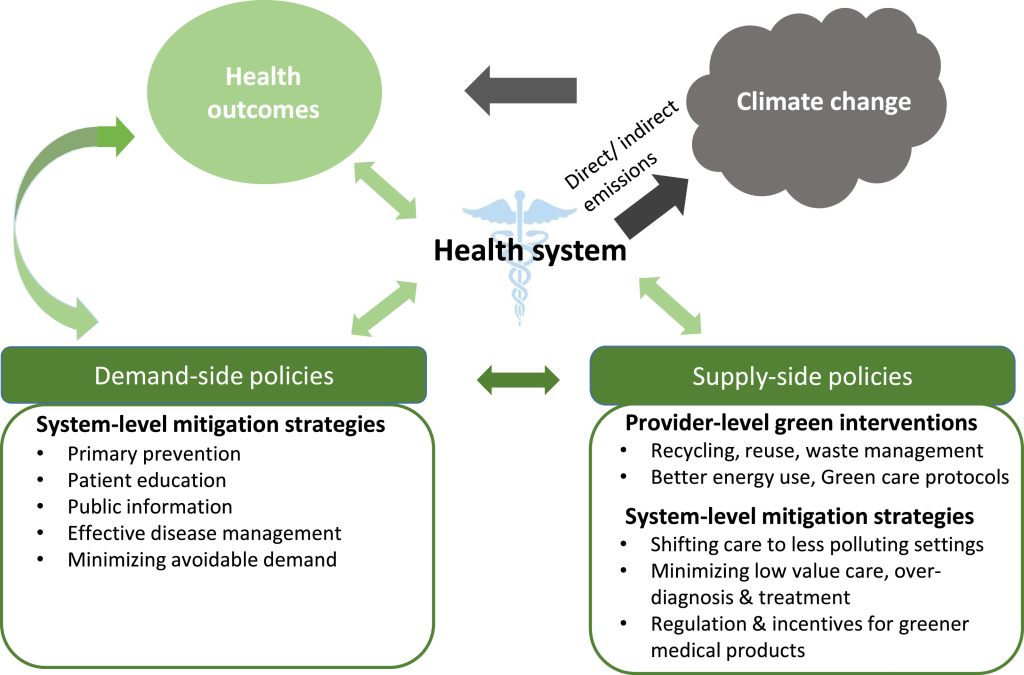
Relationship between the healthcare system, climate change, and sustainability strategies and interventions. Source: The role of the health sector in tackling climate change: A narrative review – Zeynep Or, Anna-Veera Seppänen

A number of general and specialised strategies can be used to decarbonise operations in the healthcare sector.

General strategies (common to all energy users):

  • Transition to Renewable Energy: Switching to solar, wind, hydroelectric, and even geothermal sources for electricity, dramatically cutting GHG emissions. On-site solar photovoltaic (PV) installations, especially in hospitals, are reducing operational costs and increasing resilience.
  • Onsite energy generation: While not quire fully operational, or even fully sustainable yet, non renewable energy generation such as cogeneration or trigeneration, are certainly better than grid electricity usage as they will reduce transmission and distribution losses, and further the waste heat can be used to generate both heating and cooling, or both, for the premises.
  • Energy Efficiency Improvements: Upgrading and retrofitting buildings with energy-efficient lighting, HVAC (heating, ventilation, air conditioning), chillers, star-rated equipment, and insulation cuts down consumption by 30–50% in some cases. Use of variable frequency drives (VFDs)17, intelligent sensors, and IoT-based monitoring allows real-time optimization.
  • Green Building Design and Retrofitting: Buildings that follow green building codes and energy conservation codes consume fewer resources, while existing facilities can be retrofitted with modern energy management systems and green technologies.
  • Decarbonizing Supply Chains: Emphasis on green procurement, sustainable sourcing, and responsible supplier engagement ensures that scope 3 emissions are reduced and managed on an continuously.
  • Waste Management and Reduction: Sustainable waste handling, recycling, and waste-to-energy programs decrease landfill emissions and support circular economy practices.
  • Renewable or Low-GWP Refrigerants: A shift to low global warming potential (GWP) refrigerants to meet emerging regulations and climate commitments. (Global Warming Potential (GWP) is a measure of how much a greenhouse gas traps heat in the atmosphere compared to the same amount of carbon dioxide (CO2) over a specific time period, usually 100 years.18) Moving to refrigerants with GWPs far below 700 can cut emissions from these systems by as much as 78% (relative to older HFCs).19

Healthcare-specific strategies:

  • Low-carbon pharmaceuticals: Pharmaceuticals are among the highest-emitting components of healthcare’s carbon footprint, often due to energy-intensive manufacturing, complex supply chains, and waste at the point of use. A McKinsey study found that adopting green-chemistry principles to redesign synthetic processes and use recyclable solvents could cut pharmaceutical active ingredient (API) manufacturing emissions by up to 30%.20
  • Reducing Low-Value Care: Avoiding unnecessary admissions, surgeries, and tests not only saves resources but reduces both direct (hospital-based) and indirect (supply-chain) emissions. Evidence-based guidelines to minimize unwarranted care can have substantial savings.21
  • Telemedicine and home- based care: Shifting care (where safe and appropriate) from hospitals to home or community settings lowers the need for energy-intensive infrastructure. For instance, remote physiotherapy after surgery demonstrated fewer rehospitalizations and better outcomes at lower environmental cost.21
  • Digistisation of care: Telehealth cut CO₂ emissions associated with cancer care by over 80% at one major U.S. center. Another 2023 multi-state analysis found telehealth averted 21.4–47.6 million kg of CO₂ per month—equivalent to keeping up to 130,000 cars off the road every month.22
  • Treatments: Anaesthetic gases (like desflurane and nitrous oxide) have very high GWPs and alternatives (total intravenous or regional/local anesthesia) can be used where clinically appropriate without compromising treatment outcomes and patient health.23

The healthcare sector is a vital, vibrant part of our world. It’s complexities and interdependencies make it difficult to decarbonise, not least that each decision should be made keeping patient service in mind, and at first it looks like decarbonisation does the opposite. Yet, we also know that climate change is making people sick: heatwaves, floods, wildfires, and storms are becoming more frequent and severe, and the World Health Organization (WHO) estimates that between 2030 and 2050, climate change will cause roughly 250,000 additional deaths per year from malnutrition, malaria, diarrhea, and heat stress alone- in some regions, heat-related deaths among people over 65 have risen by 70% in two decades24; vector-borne diseases (like malaria, dengue, and Zika) are spreading to new areas as rising temperatures and altered rainfall enable disease-carrying insects to thrive in new regions and seasons, and water- and food- borne illnesses become more common when heavy rains, floods, or droughts contaminate water sources or affect food supply chains25; rising air pollution including smog and higher particulate matter in the air we breathe smog and particulates), increases rates of asthma, chronic lung conditions, and cardiovascular disease affecting children, people with chronic illnesses, and urban residents are especially vulnerable; crop failures contribute to malnutrition and stunting2425; extreme events, displacement, and ecosystem loss contribute to greater rates of anxiety, depression, PTSD, and other mental health disruptions26; rising seas, severe storms, and food/water shortages also force people from their homes, increasing displacement, conflict, and health emergencies- often overwhelming local health systems and worsening inequities24… and working on sectoral decarbonisation will help those same people the sector works to protect.


Sources

  1. Five Fast Facts on Healthcare’s Climate Footprint
  2. Healthcare’s Climate Footprint – How the global health sector contributes to the global climate crisis and opportunities for action – Health Care Without Harm (Climate-smart health care series) Produced in collaboration with Arup, September 2019
  3. Greenhouse Gas Emissions from a Typical Passenger Vehicle
  4. Number of Cars in the World? Actual Answer
  5. Number of Cars in the World 2025: Key Stats & Figures
  6. India’s healthcare expenditure expected to surge from 3.3% to 5% of its GDP by 2030: CareEdge
  7. India’s Healthcare Expenditure Expected to Surge from 3.3% to 5% of its GDP by 2030 – CareEdge
  8. India GDP Macrotrends
  9. India: Gross domestic product (GDP) in current prices from 1987 to 2030(in billion U.S. dollars) – Statista
  10. India Total Greenhouse Gas Emissions: Tonnes of CO2 Equivalent per Year: Fuel Exploitation
  11. The healthcare sector needs to lead the way on decarbonisation – Asian Hospital and Healthcare Management
  12. Indian Healthcare Market projected to reach $638 billion by 2025: Bajaj Finserv AMC
  13. Decarbonizing the Health Care System
  14. Experts address single-use plastics in healthcare – University of Edinburgh
  15. Why India is poised to become a global hub for MedTech manufacturing
  16. Healthcare Waste—A Serious Problem for Global Health
  17. What is a VFD?
  18. The Future of Refrigeration: Low-GWP Refrigerants
  19. Innovating for Impact: Next Generation Refrigerants for a Sustainable Tomorrow
  20. Decarbonizing API manufacturing: Unpacking the cost and regulatory requirements
  21. Getting Started: Low carbon clinical care in hospitals
  22. Evidence that telehealth cuts carbon emissions grows
  23. Green health: how to decarbonise global healthcare systems
  24. Climate change – World Health Organisation
  25. Health and Climate Change – World Bank
  26. Climate change and health – Better Health

How does MRF decide whose bat to sponsor?

MRF, originally Madras Rubber Factory, started as a balloon manufacturer and grew into India’s largest tyre company. Over the years, the group diversified into sporting goods, with active involvement in cricket kits, bats, gloves, and a significant marketing footprint in Indian and, to a limited extent, global sporting culture.1 Over time their bat sponsorship has come to represent a potential enthronement, if not outright coronation of the Indian cricket’s next king. It’s fairly entertaining that MRF, once just a tyre company, now doubles as a premium sporting label—with 350+ retail outlets across India as of 2025.2

I’ve wondered about how MRF chooses, or chooses not to, sponsor someone’s bat, especially since their quick switch to sponsor Shubman Gill’s bat. And yet, the selection is not quite destiny: of the 11 players who have carried an MRF bat, 5 were asked to return it. That’s a 45% failure rate.

Also, two things: 1. The tables are pictures because I’m not mucking about with WordPress tables with this much data. It’s an absurdity. 2. I’ve done my best to check the age figures since it was relevant to this post, but I haven’t checked the cricket stats much.

The Cricketers
Sachin Tendulkar (India)
Brian Lara (WI),
Steve Waugh (Australia),
Gautam Gambhir (India)
Rohit Sharma (India)
Virat Kohli (India),
Sanju Samson (India),
Shikhar Dhawan (India),
AB de Villiers (SA),
Prithvi Shaw (India),
Mignon du Preez (SA),3
Shubman Gill (India)

The Logic
There is clearly a statistical basis for screening the candidates. Each of the cricketers finally offered the bat had a highly successful year 3 years before they got the sponsorship call. The first mottle appears two years before the sponsorship is offered, with Rohit Sharma not quite having a year to remember. One year before the sponsorship, performances from Rohit Sharma and Gautam Gambhir started fading. They were still offered sponsorships, though, so MRF was willing to bet they would pick up, and also be culturally relevant in the future.

Word on the cricketing streets is that MRF spots its talents early in their career, but the average age at the beginning of player sponsorships comes out to be 26.67, with Prithvi Shaw being the earliest pick at 17 (or 18) years old, and Steve Waugh the senior most at 36. Removing these outliers returns an average age of… 26.67 years, and removing anyone who was sponsored before 2010 makes for an average of 25.38 years.

Age of MRF bat sponsorees at the beginning and end of their tenures

It’s obvious that the original three foreign icons (Lara, Waugh, AB) were established greats when they got the MRF deal; the rest, especially Indian batters, were mostly in their 20s. Given that batters usually come into their own around 27-29 (my personal opinion), and can certainly be prodigious well into the 30s, this is consistent with MRF’s search for the next (Indian) batting legend. To be noted, all the averages tallied above fall around or before the age of 27.

These are the statistical inputs I’ve been able to spot for the champaigne:

  • Insatiability, 850–1,200+ runs/year in Tests or ODIs for at least one of the years before signing.
  • Consistent 100s in decisive or pressure games (World Cups, series deciders).
  • ICC event hundreds and being among top run scorers seems to be a trademark.
  • Youth milestones and early leadership (U19 or domestic tournament MVPs- Kohli, Dhawan, Gill, and Shaw were all U19 heroes)
  • Multi-format prowess, such as hundreds in all formats by 25.
  • Longevity (sustained form) or a steep climb in performance

The Magic
MRF’s track record of signing “the next big thing” is so consistent, it borders on magic:

  • They chose Tendulkar just before he ruled the 90s and 00s.
  • Bet on Virat as he broke records and changed Indian cricket’s mindset.
  • Handed Gill the baton right before a record-shattering run in 2025, including 4 consecutive Test hundreds and a string of 20→100 conversions unparalleled among peers, although this was an obvious signing with Virat retiring right before the series, and Gill now the heir apparent to the Indian No. 4 position, and the Test captain).
  • Timing is critical. MRF’s model aims to find the next star on the rise- locking in ambassadors just as they shift from prodigy to global icon (e.g., Sachin before he became Sachin, Kohli before captaincy explosion).

    MRF therefore seems to filter for improvement arcs, multi-format ability, and brand values- not just averages. But cricketing “auras” also matter- hence Kohli, Gill (not just Indian and prodigious, but also temperamentally dignified, in possession of impressive communication skills, the worlds best ODI batter and other top performances in his age cohort, and the Indian Test captain) over otherwise comparable international stars like Dravid (diluted the Indian audience, not a superstar when compared to Sachin), Kallis (not Indian, and not as popular in India as AB), Sangakkara (see Kallis), Laxman (same as Dravid, but also confined to Tests), MS Dhoni (Not an era defining batter), KL Rahul (beautiful, inconsistent), Yashaswi Jaiswal (incredible story but not as established as Shubman, has not yet shown all format ability, although watch out for this in the future), Rishabh Pant (Likely not considered an era defining batter, but is also Spidey, and that doesn’t fit the brand image), Abhishek Sharma (maybe soon?). Ambassadors are chosen not only for statistics, but also for embodying resilience (Tendulkar’s comebacks), toughness (Kohli’s chases), artistic mastery (Lara’s flair), performance (Dhawan’s ICC tournament performances), or next-gen inspiration (Shaw, Samson, Gill). Jaiswal and Pant’s exclusions highlight that charisma alone isn’t enough- they’re watching form across formats, market potential, and personality fit. Not sponsoring MS indicates they’re not too swayed by long term captaincy or intense fandom or even the number of trophies won as skipper- once again, it’s the batting output that matters.

The Business
MRF’s approach to selecting its bat ambassadors is a nuanced blend of data-driven business strategy, brand vision, and razor-sharp market positioning, refined over decades of cricketing association. India is MRF’s largest tyre and sporting market, and cricket is India’s premier sport. MRF therefore focuses on pan-Indian cricket icons as ambassadors to maximise its cultural and commercial return on investment. This also means that non Indians rarely get the MRF sticker.

A selection of players who were not MRF bat ambassadors, and why I think that was so

By not sponsoring too many players simultaneously- and never directly competing with its own ambassadors for limelight- MRF ensures its bat sticker is always exceptional, not generic. The sustained, highly visible association with generational talents strengthens brand recall far beyond the cricket field- from tyre showrooms to street cricket bats. So concerned is MRF with its bat’s legacy, the company has divided its brand into three- the Genius bat for the artists and prodigies (Tendulkar, Kohli, AB, Gill), the Conqueror bat for those known for their grit (Steve Waugh), and the Wizard bat for Brian Lara.

MRF is always looking a generation ahead. As one ambassador (Tendulkar, Kohli) nears twilight, MRF signs the next rising phenom (Gill over Jaiswal, as the latter had not yet ticked every box), displaying continuity and reducing sponsorship risk, while ensuring ongoing cultural presence, with each transition becoming a media/ marketing event in itself. The brand’s investment is offset by massive earned media (“free” advertising) via on-field heroics, social media virality, and generational recall—no other bat sticker is as instantly recognized in world cricket.

Note: This post earlier included Sir Hadlee, but I’ve not been able to find any credible sources for it, so I’ve removed any mention of him, and redone the calculations.

Sources
1. MRF Ltd. – Fortune India
2. MRF Sports
3. @mdpminx22 on Instagram

Goodbye my heart

Virat Kohli, after his final Test Century. Picture courtesy of Star Sports.

In a lifetime of loving cricket and its artists, Virat Kohli and Test cricket has been the most compelling love story, and a farewell that feels like bereavement.

Take care of yourself Virat. You’ve meant the world to me.

Indian MSMEs and ESG

The regulatory landscape for Indian MSMEs has shifted dramatically with the Securities and Exchange Board of India’s (SEBI) Business Responsibility and Sustainability Reporting (BRSR) Core framework. This framework now requires India’s largest listed companies to report not only on their own Environmental, Social, and Governance (ESG) performance but also on the ESG practices of key value chain partners—including MSMEs.1

Scope and Coverage2

  1. Applicability: From FY 2024–25, the BRSR Core value chain disclosure applies to the top 250 listed entities by market capitalization, with phased expansion in subsequent years.
  2. Value Chain Reporting: Companies must report ESG data for their top upstream (suppliers) and downstream (customers) partners that individually account for 2% or more of purchases or sales, or collectively represent at least 75% of total purchases and sales by value.
  3. KPIs: Reporting covers greenhouse gas emissions, energy and water use, circularity, and social factors attributable to the listed company’s business with each value chain partner.
  4. Timeline: Mandatory value chain ESG disclosures begin in FY 2025–26, with third-party assessment or assurance required from FY 2026–27.
  5. This means MSMEs that are part of the supply chains of large corporates must now demonstrate their sustainability credentials—or risk exclusion.

The Business Case for MSMEs Going Green

  1. Continued Access to Large Corporate Supply Chains: With large companies under regulatory pressure to disclose their value chain’s ESG performance, MSMEs unable to provide relevant sustainability data or demonstrate green practices risk being replaced by more compliant competitors.
  2. Market and Export Opportunities: Many global buyers and Indian corporates now require ESG compliance from suppliers. MSMEs with green credentials gain access to new markets, preferred vendor status, and export opportunities, especially as international regulations tighten.
  3. Cost Savings and Efficiency: Adopting green practices—energy efficiency, waste reduction, renewable energy—reduces operational costs and improves margins, directly benefiting the bottom line.
  4. Regulatory Preparedness: MSMEs that align early with BRSR and other ESG frameworks are better positioned for future regulations, including potential carbon taxes, border adjustments, and mandatory disclosures.
  5. Enhanced Reputation and Financing: Demonstrating ESG leadership boosts credibility with customers, investors, and lenders, and can improve access to green finance and government incentives. Companies with strong ESG credentials often enjoy better access to financing and lower costs of capital.

Challenges Hindering MSMEs’ Green Transition3

Despite the clear benefits, MSMEs face significant barriers:

  1. High Upfront Costs: Transitioning to green technologies requires capital, which is often scarce for MSMEs operating on thin margins.
  2. Limited Access to Green Finance: Only about 10% of MSMEs access formal green finance, mainly due to collateral and credit barriers. A third are unaware of major schemes like ZED certification.4
  3. Infrastructure Gaps: Many MSMEs, especially in tier II and III cities, rely on outdated machinery and diesel generators due to unreliable power grids.
  4. Technological and Knowledge Constraints: Lower technological sophistication and lack of awareness about sustainability frameworks impede progress.
  5. Opportunities on the Horizon
  6. Sustainable practices are opening new markets and enhancing credibility, especially for MSMEs in global supply chains where environmental compliance is increasingly mandatory. For example, textile MSMEs in Tiruppur have adopted Zero Liquid Discharge systems to meet stringent European export requirements.

The Numbers4

  1. Solar Adoption: By 2024, 21% of Indian MSMEs were powered by solar energy, and 31% had adopted energy-efficient machinery.
  2. Rooftop Solar: Installations reached 11.87 GW, cutting average power bills by 30% and typically paying for themselves within three to five years.
  3. Emission Reductions: This shift could potentially reduce CO₂ emissions by 110 million tonnes annually.
  4. State Leaders: Textile and chemical industries are leading the transition, with Gujarat, Maharashtra, and Kerala making significant progress, and other states like Uttar Pradesh eager to join the movement.
  5. If this momentum continues, MSMEs could contribute up to 50% of India’s 2030 renewable energy goal—a transformative impact for the nation’s sustainability ambitions.
  6. However, not all numbers are positive: The Government of India launched two schemes to help MSMEs adopt environmentally friendly technology, the MSME GIFT (Green Investment and Financing for Transformation) Scheme, which focuses on supporting MSMEs to adopt clean and green technologies through concessional finance and risk-sharing, and the MSME SPICE (Scheme for Promotion and Investment in Circular Economy), which aims to incentivize MSMEs to implement circular economy practices such as recycling, reuse, and resource efficiency, primarily through capital subsidies. As of December 2024, MSME SPICE had assisted only six MSME accounts, with one reported beneficiary from Ahmednagar, Maharashtra. The total expenditure was ₹1.31 crore out of the ₹472.5 crore budget5… and as for MSME GIFT, as of July 2025, there are no published official numbers from the Ministry of MSME, SIDBI, or other government sources specifying the exact number of MSMEs that have received benefits under the GIFT scheme. The World Bank’s implementation report on the broader RAMP program (which includes GIFT) notes that as of November 2024, the program had disbursed $231 million (about 46% of the total loan) for MSME competitiveness and green technology adoption, but does not break down numbers specifically for GIFT.6

The Road Ahead: From Compliance to Competitive Advantage

The SEBI BRSR Core mandate is more than a compliance requirement; it’s a catalyst for a fundamental shift in how Indian MSMEs operate. Integrating ESG principles is no longer just about risk mitigation—it’s about unlocking new business opportunities, future-proofing operations, and contributing to India’s global climate commitments.

For MSMEs, the message is clear: Going green is not just good for the planet—it’s now essential for business survival and growth.

Sources

  1. BRSR Core – Framework for assurance and ESG disclosures for value chain
  2. SEBI’s Latest ESG Disclosure Reforms: Impact on Indian Businesses and Compliance Strategies
  3. The missing link: Why MSMEs need more than just budgetary support for green growth
  4. Sustainable development: The rise of green MSMEs
  5. MSE-SPICE Scheme
  6. Raising and Accelerating MSME Performance (P172226)

A guide to India’s legal framework for ESG

ESG stands for Environmental, Social, and Governance. ESG investing evaluates companies on non financial factors covered under any of these three categories. While many issues are multifaceted and may fall under one or more of these headings, the way to differentiate them may lie in separating into the Planet, People, and Profit maxim: E covers all issues that affect the planet, S is for anything affecting humans directly, and G (the most regulated of the three) is for corporate governance issues.

India has a web of laws, regulations, and policies that can be classified as ESG requirements or enablers (now that the acronym ‘ESG’ exists, that is). Here is a run down of some of the most prominent ones (it’s long):

I. Environmental Legal Requirements in India

1. Wildlife (Protection) Act, 1972
This Act provides a legal framework for the protection of wildlife species and their habitats, including the creation of protected areas such as national parks and wildlife sanctuaries. It prohibits hunting and trade in endangered species, and prescribes penalties for violations. The Act also empowers authorities to regulate activities within protected areas to conserve biodiversity.

2. Water (Prevention and Control of Pollution) Act, 1974
The Water Act is designed to prevent and control water pollution and maintain or restore the wholesomeness of water. Section 16 tasks the Central Pollution Control Board with setting standards for the discharge of pollutants into water bodies, monitoring compliance, and coordinating with state boards. The Act provides for the prosecution of violators and the issuance of directives to polluting entities to cease or modify operations.

3. Forest (Conservation) Act, 1980
The Forest (Conservation) Act restricts the diversion of forest land for non-forest purposes without prior approval from the central government. It aims to curb deforestation and promote sustainable forest management by requiring compensatory afforestation and environmental impact assessments for approved projects. The Act also provides for the protection of forest biodiversity and the rights of forest-dwelling communities.

4. Air (Prevention and Control of Pollution) Act, 1981
This Act establishes a regulatory framework for the prevention, control, and abatement of air pollution in India. Section 17 assigns State Pollution Control Boards the responsibility to set air quality standards, monitor emissions from industrial and vehicular sources, and enforce compliance through permits and penalties. The Act empowers authorities to close or restrict operations of polluting industries and to promote cleaner technologies.

5. Environment (Protection) Act, 1986
The Environment (Protection) Act, 1986, is India’s primary legislation for the protection and improvement of the environment. Section 3 of the Act empowers the central government to take all necessary measures to protect and improve environmental quality, prevent and control pollution, and set standards for emissions and discharges. Section 6 authorizes the government to make rules for regulating environmental pollution, covering aspects such as waste management, hazardous substances, and the preservation of ecological balance.

  1. Key Rules under the Environment (Protection) Act:
  • E-Waste (Management) Rules, 2022:
    These rules establish responsibilities for manufacturers, producers, and recyclers of electronic and electrical equipment to ensure environmentally sound management of e-waste. They require the implementation of extended producer responsibility, mandating producers to collect and channel e-waste to authorized dismantlers or recyclers. The amendments in 2018 further tightened collection targets and reporting obligations, aiming to reduce the environmental impact of rapidly growing electronic waste streams.
  • Battery Waste Management Rules, 2022:
    The 2001 rules regulate the collection, processing, and recycling of used batteries to prevent hazardous lead and acid pollution. The Draft Battery Waste Management Rules, 2020, propose stricter norms for battery producers, including mandatory take-back systems and environmentally safe recycling processes. These provisions are designed to minimize environmental contamination and promote circular economy practices in the battery industry.
  • Bio-Medical Waste Management Rules, 2016:
    These rules provide a framework for the safe handling, segregation, transport, treatment, and disposal of biomedical waste generated by healthcare facilities. They impose strict requirements on hospitals and clinics to ensure that infectious and hazardous waste does not contaminate the environment or pose health risks to the public. Compliance is enforced through regular audits and penalties for violations.
  • Plastic Waste Management Rules, 2016, 2021, 2022:
    The rules aim to reduce plastic pollution by imposing restrictions on the manufacture, sale, and use of certain single-use plastics. They require producers, importers, and brand owners to implement extended producer responsibility, ensuring that plastic waste is collected and recycled or disposed of in an environmentally friendly manner. Amendments in 2021 and 2022 further expanded the scope of regulated items and tightened compliance timelines. The 2022 notification banned Single Use Plastics (SUPs) with effect from 01.07.2022.
  • Solid Waste Management Rules, 2016:
    These rules set out the responsibilities of municipal authorities and other stakeholders for the segregation, collection, processing, and disposal of solid waste. They emphasize the need for source segregation of biodegradable and non-biodegradable waste, and promote composting, recycling, and waste-to-energy initiatives. The rules also mandate the inclusion of informal waste pickers into the formal waste management system.
  • Construction and Demolition Waste Management Rules, 2016:
    The rules require generators of construction and demolition waste to segregate and store waste at source, and ensure its safe transportation to recycling facilities. They promote the recycling and reuse of debris, reducing the burden on landfills and conserving natural resources. Local authorities are tasked with establishing collection centres and monitoring compliance.
  • Hazardous and Other Wastes (Management and Transboundary Movement) Rules, 2016 (amended 2019):
    These rules regulate the generation, handling, storage, transportation, and disposal of hazardous wastes, including their import and export. They mandate that hazardous waste be handled only by authorized operators and in accordance with prescribed safety standards. Amendments in 2019 strengthened provisions for tracking and reporting waste movements, and aligned Indian regulations with international conventions.
  • Manufacture, Storage and Import of Hazardous Chemicals Rules, 1989:
    These rules govern the safe manufacture, storage, and import of hazardous chemicals, requiring companies to undertake risk assessments and prepare on-site and off-site emergency plans. Facilities must notify authorities about the quantities and types of hazardous chemicals handled, and are subject to regular inspections. The aim is to prevent industrial accidents and minimize risks to workers and the surrounding community.
  • Coastal Regulation Zone Notification, 2019; related 2021 procedures:
    The notification demarcates coastal regulation zones and restricts certain activities to protect sensitive coastal ecosystems. It sets out guidelines for permissible development, conservation of mangroves, and protection of traditional fishing communities. The 2021 procedures clarify compliance requirements and streamline the approval process for coastal projects.
  • Environment Impact Assessment (EIA) Notification, 2006 (and amendments):
    The EIA Notification requires prior environmental clearance for specified categories of projects, based on a detailed assessment of their potential impacts. It mandates public consultations, expert appraisal, and periodic monitoring to ensure compliance with environmental safeguards. Amendments over the years have sought to balance developmental needs with environmental protection by refining project categories and timelines. A draft considered controversial was tabled in 2020 which is still under review, and nothing major has been finalised as of writing this.

6. Public Liability Insurance Act, 1991
This Act requires owners handling hazardous substances to take out insurance policies to provide immediate relief to victims of accidents. It ensures that compensation is available for injury, death, or property damage resulting from hazardous activities, regardless of fault. The Act also establishes an Environmental Relief Fund to support compensation payments.

7. Energy Conservation Act 2001 (amended 2022)
The original Energy Conservation Act, 2001 established the Bureau of Energy Efficiency (BEE) and set norms for energy efficiency in appliances, buildings, and large energy consumers. The 2022 amendment (which came into effect on 01.01.2023), establishes a legal basis for a carbon market, mandates non-fossil energy use by designated users, expands efficiency standards, and updates building codes.

8. Biological Diversity Act, 2002
The Biological Diversity Act promotes the conservation of India’s biological diversity and the sustainable use of its components. It establishes mechanisms for equitable sharing of benefits arising from the use of genetic resources, and regulates access to biological resources by domestic and foreign entities. The Act is implemented through the National Biodiversity Authority and State Biodiversity Boards.

9. National Green Tribunal Act, 2010
The National Green Tribunal Act establishes a specialized tribunal for the expeditious resolution of environmental disputes involving multi-disciplinary issues. The Tribunal has the power to provide relief, compensation, and restitution of damaged environments, and its orders are binding. It aims to ensure effective and speedy environmental justice for affected parties.

10. Policies and Schemes

  • Carbon Credit Trading Scheme, 2023
    The Carbon Credit Trading Scheme, 2023, introduces a regulated market for trading carbon credits in India. It enables entities that reduce their greenhouse gas emissions below prescribed targets to sell credits to those exceeding their limits. This market-based mechanism incentivizes emission reductions and supports India’s climate change commitments. This scheme is now operational under the Energy Conservation Act (amended 2022).
  • Green Credit Disclosures (SEBI LODR, BRSR Principle 6)
    From the financial year 2024-25, listed companies are required to disclose the green credits they generate or procure, as well as those of their top-10 value chain partners. This disclosure is part of the Business Responsibility and Sustainability Reporting (BRSR) framework and aims to increase transparency and accountability in corporate environmental performance.
  • Priority Sector Lending for Renewable Energy (RBI Guidelines)
    The Reserve Bank of India’s guidelines on priority sector lending encourage banks to finance renewable energy projects by including them in their priority lending targets. This policy aims to boost the adoption of clean energy technologies and help India meet its renewable energy goals. Loans are extended to enterprises and households for investments in solar, wind, and other renewable energy sources.
  • Green Deposits Framework (RBI)
    The Green Deposits Framework, introduced by the RBI, requires regulated entities to establish board-approved policies for the allocation of green deposits. These deposits are earmarked for financing environmentally sustainable projects, such as renewable energy, clean transportation, and waste management. The framework aims to channel financial resources into projects that contribute to environmental sustainability.

II. Social Legal Requirements in India

1. Human Rights Laws (Constitutional Provisions)
The Indian Constitution enshrines a broad range of fundamental rights that form the foundation of social legal requirements. Articles 14 to 18 guarantee equality before the law and prohibit discrimination based on religion, race, caste, sex, or place of birth, ensuring all citizens are treated fairly. Article 19 protects freedoms such as speech, association, and movement, while Article 21 guarantees the right to life and personal liberty, which courts have interpreted to include the right to livelihood and humane working conditions.

Articles 23 and 24 prohibit trafficking, forced labour, and child labour in hazardous industries, reflecting India’s commitment to protecting vulnerable populations. Article 46, a Directive Principle, directs the State to promote the educational and economic interests of Scheduled Castes, Scheduled Tribes, and other weaker sections, and to protect them from social injustice and exploitation. These provisions are supported by a range of statutes and enforcement mechanisms to ensure compliance and redressal.

2. Protection of Human Rights Act, 1993
The Protection of Human Rights Act, 1993, establishes the National Human Rights Commission (NHRC) and State Human Rights Commissions to investigate human rights violations and promote awareness. The NHRC has powers to inquire into complaints, intervene in court proceedings, and recommend remedial action to the government.

3. Labour Laws

  • Payment of Wages Act, 1936:
    The Act mandates the timely payment of wages to workers, typically by the last working day of the month. It prohibits unauthorized deductions and provides for the resolution of wage-related disputes through designated authorities.
  • Minimum Wages Act, 1948:
    This Act ensures that workers receive at least the minimum wage fixed by the government for different sectors and regions, preventing exploitation and poverty. It also regulates working hours, overtime pay, and conditions of work, contributing to the well-being of the labor force. Enforcement is carried out through labor inspectors and penalties for non-compliance.
  • Employees State Insurance Act, 1948 and Employees’ Provident Fund and Miscellaneous Provisions Act, 1952:
    These Acts provide social security benefits to workers, including retirement savings, medical care, and insurance against sickness, disability, and death for workers and their families. Employers and employees contribute to provident fund and insurance schemes, which are managed by statutory bodies.
  • Factories Act, 1948 & Shops and Establishment Act, 1960:
    These laws regulate working conditions in factories, shops, and commercial establishments, setting standards for health, safety, welfare, and leave entitlements. They require employers to provide safe workplaces, adequate ventilation, and sanitation facilities, and to limit working hours to prevent overwork. The Acts mandate regular inspections and empower authorities to enforce compliance.
  • Maternity Benefit (Amendment) Act, 2017:
    The Act provides for six months of fully paid maternity leave for women employees, as well as additional leave for miscarriage or medical termination of pregnancy. It also requires employers to provide nursing breaks and crèche facilities for young children.
  • Labour Codes (2019–2020):
    44 labour laws have been consolidated into four codes: Code on Wages, Industrial Relations Code, Code on Social Security, and Occupational Safety, Health and Working Conditions Code to streamline compliance, reduce complexity, and increase worker protection, including for gig and platform workers.

4. Gender and Social Equity Laws

  • Protection of Civil Rights Act, 1955:
    Also known as the Untouchability Offences Act, this law abolishes untouchability and protects the civil rights of marginalized communities. It prohibits discrimination in access to public places, services, and employment, and provides for the prosecution of offenders.
  • Equal Remuneration Act, 1976:
    This Act mandates equal pay for equal work for men and women, addressing gender-based wage discrimination in the workplace. It prohibits employers from discriminating in recruitment, promotion, and conditions of service on the basis of gender. The Act is enforced through labor authorities and provides remedies for aggrieved employees.
  • Scheduled Castes and Scheduled Tribes (Prevention of Atrocities) Act, 1989:
    The Act defines specific offences against members of Scheduled Castes and Scheduled Tribes, including violence, humiliation, and social boycott. It establishes special courts for the speedy trial of cases and prescribes stringent penalties to deter discrimination and atrocities. Amendments have expanded protections for women and strengthened enforcement mechanisms.
  • Maintenance and Welfare of Parents and Senior Citizens Act, 2007:
    This Act obligates children and heirs to provide maintenance for their parents and senior citizens, ensuring their welfare and dignity in old age. It establishes tribunals for the speedy resolution of maintenance claims and prescribes penalties for neglect or abandonment.
  • The Transgender Persons (Protection of Rights) Act, 2019:
    The Act recognizes the rights of transgender persons and prohibits discrimination in education, employment, healthcare, and access to public services. It provides for the issuance of identity certificates and mandates the establishment of welfare schemes and grievance redressal mechanisms.
  • Medical Termination of Pregnancy (Amendment) Act, 2021; Assisted Reproductive Technology (ART) Regulation Act, 2021; Surrogacy Regulation Act, 2021:
    These laws expand access to safe and legal abortion services, regulate assisted reproductive technologies, and ban commercial surrogacy while allowing altruistic surrogacy for Indian citizens.

III. Governance Legal Requirements in India

1. Companies Act, 2013

  • Section 149:
    This section requires certain classes of companies to have a specified number of independent directors, including at least one female director, on their boards. Independent directors are expected to bring objectivity and balance to board decisions, and to safeguard the interests of minority shareholders and other stakeholders.
  • Section 166:
    Section 166 outlines the duties of company directors, mandating them to act in good faith and in the best interests of the company, its employees, shareholders, the community, and the environment. Directors must avoid conflicts of interest and act with due care, skill, and diligence in discharging their responsibilities.
  • Section 134:
    This section requires the Board of Directors to prepare an annual report that includes information on the company’s financial performance, conservation of energy, and other ESG-related disclosures. The report must be presented to shareholders at the annual general meeting and filed with the Registrar of Companies.
  • Section 178:
    Section 178 mandates the constitution of Nomination and Remuneration Committees and Stakeholders Relationship Committees for companies with more than 1,000 security holders. These committees oversee the appointment and remuneration of directors and resolve grievances of shareholders and other stakeholders.
  • Schedule IV:
    Schedule IV sets out the code of conduct for independent directors, emphasizing their role in safeguarding the interests of all stakeholders, particularly minority shareholders. It requires independent directors to ensure the company has adequate vigil mechanisms, report unethical behavior, and balance conflicting stakeholder interests.

2. Corporate Social Responsibility (CSR) Requirements (Section 135 and Schedule VII)

Applicability and Committee Formation
Section 135 of the Companies Act, 2013, mandates that every company, including its holding and subsidiary companies, and certain foreign companies operating in India, must comply with CSR requirements if they meet any one of the following financial criteria during the immediately preceding financial year:

  • Net worth of ₹500 crore or more;
  • Annual turnover of ₹1,000 crore or more;
  • Net profit of ₹5 crore or more.

Such companies must constitute a Corporate Social Responsibility Committee of the Board, with at least three directors (including one independent director, where applicable). The Committee formulates and recommends a CSR policy, recommends the amount to be spent, and monitors the policy’s implementation.

The 2% CSR Spending Rule
Section 135(5) requires qualifying companies to spend at least 2% of their average net profits made during the three immediately preceding financial years on CSR activities. Net profits are calculated as per Section 198 of the Act. If a company fails to spend the required amount, the Board must specify the reasons in its annual report. Unspent amounts must be transferred to a fund specified in Schedule VII or, for ongoing projects, to a special “Unspent CSR Account” within prescribed timelines, with penalties for default.

Administrative and Reporting Requirements
Administrative overheads for CSR cannot exceed 5% of total CSR expenditure. Any surplus from CSR activities must not form part of business profits and must be reinvested in CSR. Companies must disclose the composition of their CSR Committee and details of CSR activities in the Board’s Report under Section 134(3).

Schedule VII: Eligible CSR Activities
Schedule VII provides an illustrative list of activities for CSR spending, including:

  1. Eradicating hunger, poverty, and malnutrition; promoting health care and sanitation; safe drinking water.
  2. Promoting education, including special education and employment-enhancing vocational skills, especially among children, women, the elderly, and the differently abled; livelihood enhancement projects.
  3. Promoting gender equality, empowering women, setting up homes and hostels for women and orphans; old age homes, day care centers; reducing inequalities faced by socially and economically backward groups.
  4. Ensuring environmental sustainability, ecological balance, protection of flora and fauna, animal welfare, agroforestry, conservation of natural resources, and maintaining the quality of soil, air, and water.
  5. Protection of national heritage, art, and culture, including restoration of buildings and sites of historical importance; setting up public libraries; promotion and development of traditional arts and handicrafts.
  6. Measures for the benefit of armed forces veterans, war widows, and their dependents.
  7. Training to promote rural sports, nationally recognized sports, Paralympic sports, and Olympic sports.
  8. Contribution to the Prime Minister’s National Relief Fund or any other fund set up by the Central Government for socio-economic development and relief, welfare of Scheduled Castes, Scheduled Tribes, other backward classes, minorities, and women.
  9. Contributions to incubators or R&D projects in science, technology, engineering, and medicine, funded by government bodies or public institutions.
  10. Contributions to public-funded universities, IITs, and national research bodies such as DRDO, ICAR, CSIR, and others.
  11. Rural development projects.
  12. Slum area development.
  13. Disaster management, including relief, rehabilitation, and reconstruction activities.

Failure to comply with CSR spending and transfer requirements attracts monetary penalties for both the company and responsible officers.

3. SEBI Regulations (Listing Obligations and Disclosure Requirements—LODR, 2015)
The LODR Regulations, 2015, issued by the Securities and Exchange Board of India (SEBI), establish comprehensive requirements for the governance and disclosure practices of listed companies. They mandate board composition standards, including the presence of independent directors and mandatory committees such as audit and nomination committees. The regulations require prompt disclosure of material events, transparent reporting of related party transactions, and maintenance of a functional company website with investor information.

4. Business Responsibility and Sustainability Reporting (BRSR, BRSR Core)

  • BRSR (2021):
    The BRSR framework, introduced by SEBI, requires the top 1,000 listed companies to disclose their performance on a broad set of ESG indicators, based on the National Guidelines for Responsible Business Conduct (NGRBC). The disclosures cover areas such as ethics, transparency, employee well-being, stakeholder engagement, human rights, environmental stewardship, inclusive development, consumer welfare, and policy advocacy. The aim is to promote responsible business practices and facilitate informed decision-making by investors and stakeholders.
  • BRSR Core (2023):
    BRSR Core is a streamlined subset of the full BRSR, focusing on a core set of key ESG performance indicators tailored for the Indian context. It introduces phased assurance requirements for the top listed companies and their value chain partners, enhancing the reliability and comparability of ESG disclosures. The framework is designed to facilitate benchmarking and assurance, and to drive continuous improvement in ESG performance.

5. Anti-Corruption and Money Laundering Laws

  • Prevention of Corruption Act, 1988:
    This Act criminalizes bribery and corruption in public and private sector transactions, prescribing stringent penalties for offenders. It empowers authorities to investigate and prosecute corruption cases, and provides for the confiscation of ill-gotten assets.
  • Prevention of Money Laundering Act, 2002:
    The Act establishes a legal framework to prevent and penalize money laundering, requiring regulated entities to maintain records, conduct due diligence, and report suspicious transactions. It provides for the attachment and confiscation of proceeds of crime, and empowers enforcement agencies to investigate and prosecute offenders.

If you want me to add anything I’ve missed, please leave a comment about it, and I’ll work on it. Thanks.

References:

Financing Climate Solutions – III: Weather or Climate Derivatives

A derivative is an asset whose value is based on a different underlying asset. They are called derivatives because they derive their value based on the value of something else. That something else is called the “underlying asset” and can be any asset, such as a stock/ share in a company, land, bags of grain, plant and machinery, inventory, or any other asset, group of assets, or even a benchmark1, or a variable, such as the weather, or an event (outcome of an election). If something has an associated measurement that can be reliably quantified, it can be the “underlying asset”. The underlying asset is also called the “Primary Instrument”.1

If there is any uncertainty about what the value of the underlying will be in the future, whether it is the price of a house, the earnings of a film, or how much rainfall there will be in the month of July next year, there can be a derivative about it. This is because derivatives are based on risk- some parties wish to protect themselves from a particular risk they foresee, and others believe that risk is worth taking. A derivative is a transaction between such risk averse/ risk protective and risk friendly parties.

Why do some people wish to take on more risk while others avoid it? Because humans have different opinions about what will happen in the future, generally believe they are correct about their assessments, and have varying risk appetites. Those with higher risk appetites may think of derivatives either as a wager, or a bet, and those with lower risk appetites may look at them as insurance or hedging against risk.

When thinking of derivatives as wagers or bets, we can liken them to sports betting, and just like organisations that run bets on sports matches have books of odds of what they think the result is likely to be, weather derivatives have an “index” of what is the normal or average or expected weather for a particular geography at a particular time of the year, and how likely it is to be that kind of weather. This is also called speculation- we are speculating on what the associated value measurement of the primary instrument will be at some point in the future, or, we are making a bet or a wager that it will be a particular value, but their value in climate finance lies in the security they provide against weather abnormalities. For example, both less and more rainfall than expected can be negative outcomes for farmers as both can ruin their crop. This sounds like an insurance, except that insurances pay out only when all their conditions are met- derivatives pay out when there is any deviation of the value of the underlying asset from what it was supposed, or expected, to be (the average value).

This is how derivatives can be used instead of insurance, and also why they are often considered better than insurance for those who know how to use them- insurance firms pay out only if there is evidence of a loss, and the loss must be proven to their standards, and even so your entire amount may not be covered due to contractual issues or because they don’t cover certain common types of losses, or even because the insurance company does not consider the evidence you provide to be sufficient. A derivative will pay out immediately as long as there is a difference between what was supposed to happen according to the contract, and what actually happened.

There are two general types of derivatives- firm commitments, and contingent claims. If parties participate in a firm commitment, that is, they promise, they must then fulfill the promise and complete the contract. For contingent claims, you have the option to follow through or not at the time the contract becomes due.

Because the value or price of the primary asset on which the derivative is based can move upwards or downwards, derivatives can also be thought of as being based on the direction of this movement. This is why some contracts are called “long” and some are called “short”:

Long contracts- you will benefit if the value of the underlying asset increases in the future. In case of sports for a match between Teams A and B for Team A to win, you are long (bullish) or you are long on Team A’s chances to win (winning being considered positive, generally).

Short contracts- You will benefit if the value of the underlying asset decreases in the future. In the case of the sports teams, since you are expecting Team A’s victory to take place, you will be short on Team B, because you expect their loss to take place or their value to decrease after the given match.

Example: Let’s say you come to know that Company X will purchase Company Y in the future, you are likely to purchase more shares of Company Y, because usually the purchasee is overvalued by the purchasing company, therefore the price of the shares of Y will increase since X is likely (via historical evidence) to have paid more for Y than Y is actually worth. Simultaneously X’s value is likely to reduce in the future because they have paid more than they should have. You are therefore long on Y and short on X.

Types of derivatives:

Futures

A Futures contract is an agreement to buy or sell an underlying asset at a future date and price that are both set down in the contract.

Futures contracts are standardised, and the counterparty is always the exchange it is traded on- this means, the entities buying or selling the contract do not have contact with the party selling or buying (respectively) the contract. Each party only interacts with the exchange on which the trade is taking place. Because they are exchange traded, the contracts are standardised rather than personalised.

These contracts are also settled daily by the exchange with the involved parties, so if the buying price of the contract increases, the exchange will ask the purchasing party to top up the difference, further discouraging rogue traders. Further, since these contracts are standardised and exchange traded, they are liquid and transparent.

Example: A natural dye trader worried that her crop of marigolds has not yielded enough flowers in time to make the dye for her next shipment due. She decides to purchase a futures contract for a few additional caseloads of fresh marigold petals, thinking that it’s okay if she ends up with more golden dye rather than less of it. 

The contract states that two weeks from the date of purchase, the purchaser of the contract will pay the USD 150 for two kilos of fresh marigold petals. Now the farmer is certain that weather her farm produces enough marigold or not, she will have ready to use fresh petals for making her dye.

Let’s assume that on the date of delivery the price of two kilos of fresh marigold petals is USD 140 in the market, then the farmer still has to pay USD 150 for her delivery. And vice versa.

Forward

A Forward contract is similar to a Futures Contract, with the sole difference that these are customised private contracts between two parties rather than exchange traded.

Therefore these are not centrally settled, they are not liquid, and there is a possibility that the counterparty, which is the other trader and not a central exchange, may renounce the contract at any point, leaving the other party hanging.

Example:  Morgan and Akanksha enter into a contract with each other to buy and sell 10 crayons of the now discontinued Crayola Daffodil Yellow. These are not available in the market any longer, and Akanksha is the only seller available, so she can decide any terms. This is also a very small quantity of product and an unusual product for the commodity markets. Morgan and Akanksha therefore enter into a Forward contract to accomodate all the unstandardised elements of their exchange.

If either party were to decide to dishonour the contract at any time before the exchange is completed, there would be no penalties exacted upon them, and the contract would fall through.

Options

Options, give people the possibility of doing something in the future. There are two kinds of options: A Put option, and a Call option.

A Put option is the right, but not the obligation (that is, the option), to sell an underlying asset in the future at a certain price which will be decided at the time of the contract.

A call is the right, but not the obligation, to purchase an underlying asset in the future at a certain price which will be decided at the time of the contract.

Example: A restaurant does not know how many tourists the city will host next year. Depending on whether more than expected tourists come, the owners of the restaurant wish to secure their supply of onions for their famous French onion soup. If there are more tourists, there will be more demand for onions, and then their prices will increase- and yet, the restaurant cannot always increase the price of the soup to reflect the increased price of the onions.

To secure their future supply, and to save themselves price uncertainty, they buy the option to buy more onions during tourist season at current prices. Now they are assured that if prices increase, or supply is tight, they will still have access to the produce. In case at the specified time the option can be exercised, the price of onions drops, they can always just buy from the market, and their only loss is a small fee paid to purchase the option, which for the restaurant is a call option.

If the market price of onions is higher than the price they agreed to pay as part of the Call Option they have bought (that is, they bought the option to buy onions), the restaurant can buy at the Call price and save money in comparison to what they would have paid for buying onions off the open market.

If the market price is less than the call price, they can just buy from the market and the only money they lose is the small amount they paid to buy the Call Option.

Example: For a Put Option, think of a scuba diving instructor, whose business is weather dependent, buys the Option to sell his lessons to a cruise shipping company. This is a Put Option, because it is the option to sell. If during the given week, the weather is good, the scuba diving instructor can sell his lessons at a higher price to other tourists and make more money. However if the weather is poor and tourists do not wish to go scuba diving, he can still sell to the cruise ship company.

Swaps

Swaps allow us to exchange cashflows.

Certain types of financial contract result in a stream of cashflows. For example, a debt contract results in a stream of interest income. Parties can agree to swap the interest they will receive (or pay) in the future with each other.

Example: In terms of climate financing, think of a weather dependent business, for example a movie shooting outdoors. The film production house can get into a Swap contract with a financing company. Let’s say the film company requires 20 continuous days of sunshine and warm weather at their location. They can get into a Swap Contract that says they require an  average of 10 hours of sunshine daily, and another Swap that says they want an average of 25°C temperature daily for the twenty days of their shoot.

If the weather is different over the time period for which the film producing company bought the derivatives, they will automatically be paid (just by comparing the actual weather to the base index) and can use the money to cover additional costs that were incurred due to the different weather (like it was rainy instead of sunny).

So, a film production company (Party A) and a financial institution (Party B) enter into a weather swap that says that if there is more than 0 cm of rain between June 20 and July 10 at their location, Party B will pay $10,000 per day where there is more than 0 cm of rain to Party A.

Weather Swaps are generally two way contracts, so depending on the contract, perhaps if there are no rain disruptions, the Production Company may pay the financial institution $10,000 x 20 days = $200,000 instead. This depends on the contract they have entered into.

Sources

  1. Understanding Derivatives: A Comprehensive Guide to Their Uses and Benefits
Materials: Plastics

“Plastic” is the generic name of a large group of materials. Conventional plastics are made from fossil fuels, however there are now an increasing number of bioplastics available. This post will be about fossil plastics.

Plastics are organic polymers- this means that while other molecules may be added to their chemical composition if required (to create different properties), they are always composed of hydrogen and oxygen molecules.1 Polymers are large chain-like molecules formed of smaller molecules called monomers2, which may be natural or synthetic, and their chief quality of interest is that they can link together to form polymers.3 Polymers can be formed of between two and seven monomer units.3

The first synthetic plastic was invented in 1907 and called Bakelite.4 Since then, it is estimated that 8.3–9.2 billion metric tons of plastic were produced between 1950 and 2017, with over 400 million metric tons being produced annually in recent years.5

The Good

These enormous production numbers are because plastics are a highly versatile group of materials, and are used in every industry due to their properties- they are easy to mould, can be strong or flexible as required, are both electrical and thermal insulators, lightweight, durable, chemically stable and many are corrosion resistant. Their invention has been a boon to humanity in a variety of ways, an example of which is their usage in the medical industry, which has revolutionised medicine and allowed it to be accessible to many more people- from basic gloves, to prosthetics, to blood bags, plastics are ubiquitous in medicine and pharmaceuticals.6

Yet the medical industry is ultimately a minuscule consumer of plastic. 436.66 million tonnes (Mt) of plastics were traded in 2022, with final products alone accounting for 111 Mt.7 The vast majority (between 31% and 40%) of plastics are used today to package products, followed by the construction industry at ~17%, the automotive sector accounts for ~9-18% of global plastic, followed by household and consumer products which take up ~13% of the plastic produced, and electrical and electronic products with ~9%. The residual plastic, which comes to less than 10% of the total production, is used in a variety of sectors, including medical equipment, road signs, etc.7 8 9

S. No.NameYou’ve Used This In
1Polyethylene (PE or LDPE)10Plastic bags, cling film for food storage, extrusion coatings, insulation for wires, etc.
Medium-Density Polyethylene (MDPE)11 12Shrink wraps, storage tanks, road blocks, traffic cones, fuel tanks, etc.
2High-density polyethylene (HDPE)10Pipes, construction material, insulation, plastic bottles, containers, containers for chemical preparations like shampoos and medical supplies, toys, geomembranes, fuel tanks, and swimming pool equipment are some uses.
3Linear Low-Density Polyethylene (LLDPE)13Shopping bags, dustbin liners, bubble wrap, stretch and, shrink wrap, plant pots, pipes and tubing, fluid reservoirs, automotive consoles, toys, kayaks, paddleboards, detergent containers, etc.
4Ultra-High Molecular Weight Polyethylene (UHMWPE)10Pipes, valves, bulletproof material, aircraft and spacecraft components, battery separators, sail cloths, helmets, Conveyor belts, etc.
5Polypropylene (PP)15 16
Food containers, bottles, plastic bags, car parts such as dashboards or bumpers, disposable syringes, surgical tools, non woven fabrics, fibre and textiles, battery cases, wire insulation, pipes, roofing material, outdoor furniture, etc.

6Polyvinyl Chloride (PVC)17Pipes, credit cards, IV bags, windows, clamshell and other types of packaging, rain wear, shower curtains, etc.
7Polystyrene (PS)18
Disposable cutlery, construction material, seat cushions in cars, automotive door panels, CD cases, foam cups, shock lining in helmets, packaging, insulation material, diagnostic tools, laboratory apparatus, and other uses.
8Polyethylene Terephthalate (PET)19 20Beverage bottles, food backaging, clothing and textile, other packaging, disposable cups, photovoltaic parts, gear housing, greenhouses, and other applications.
9Acrylonitrile Butadiene Styrene (ABS)20There are more than 6,000 grades of ABS produced today. LEGO bricks, hutomotive parts, household appliances, consumer goods, walking sticks, 3D printing, medical devices, pipes and fittings, sports equipment, etc.
10Polyurethane (PU)21 22Automotive components such as dashboards, mud flaps, car door panels, etc., footwear, medical materials, insulation, paint, coatings, aerospace components, agricultural products, cutting sticks, gaskets, Diablo rollers, manufacturing industries, mining, quarrying, oil and gas sectors, and other uses.
11Polycarbonate (PC)23Coffee machines, food processors, automotive headlamp bezel and lenses, hair driers, construction material, surgical instruments, blood reservoirs, protect eye gears, etc.
12Polylactic Acid (PLA)24This polymer is biodegradable, and degrates into lactic acid.

Used in medical implants, food packaging, engineering plastics, drink packaging, disposable cutlery, shrink wrap, 3D printing.
13Polyethylene Terephthalate Glycol (PETG)253D printing filament, Consumer electronics, automotive parts, construction material, art and other customised products, etc.
14Nylon26Ropes, automotive parts, workout wear, swimwear, rain protective wear, guitar strings, nets, and many other uses.
15Ethylene-vinyl acetate (EVA)27 28Shoe soles, foam mats, adhesives, protective padding, solar panels, automotive interiors components like mats and cushions, sports equipment, toys, etc.
16Thermoplastic polyurethane (TPU)29Automotive parts, animal identification tags, textile coatings, garments, adhesives, military equipment, conveyor belts, seals, and other uses.
A few commonly used plastics

The global demand for plastics has quadrupled over the past decades7 and the OECD suggests that under the business-as-usual scenario it is projected to triple by 2060, and of this only 12% is likely to be secondary, or recycled plastic.30 The entire plastics market was valued at $712 billion in 2023 and is projected to continue growing, and thus supports millions of jobs at the moment: As of 2023, the U.S. plastics industry directly employed over 1 million people in the United States, with total plastics-related jobs (such as sales, etc. in the U.S. reaching up to 1.55 million.31 In India, the plastics industry comprises over 50,000 processors and employs over 5 million people directly and indirectly32. It’s also good to remember that the industry does not only consist of direct plastics manufacturing and usage, but has also made several other activities possible in other industries which would not otherwise have been possible (the example of the medical industry is discussed above), thus also adding to jobs in those sectors. In totality, it is approximated that there were 7,637,284 people employed in just the Global Plastic Product & Packaging Manufacturing as of 2024.33

The Bad

On the flip side, this gargantuan human appetite for plastics has caused a macro and micro plastic buildup in the planet.34 According to the United Nations, 51 trillion microplastic particles – 500 times more than stars in our galaxy – litter the seas. They go on to say that by 2050, oceans will have more plastic than fish 99% of seabirds alive will consume microplastic if ongoing trends of plastic pollution are not abated35– and microplastics are now increasingly being found inside humans as well.36 37

Plastics are now in our seafood, the air we breathe38, our tap water38, and even in our fetuses37. In fact, a study approximates that the average adult consumes approximately 2,000 microplastics per year simply by consuming salt. But plastics being found in our systems are a new phenomenon, and therefore are poorly studied. We don’t yet know even the short term impacts of being made up, to a small extent, of our plastic- except they may just be contributing to preterm births37, and hundreds of thousands of annual heart disease deaths39. The OECD has stated that plastic leakage to the environment is likely to double to 44 million tonnes (Mt) annually, while the build-up of plastics in aquatic environments will more than triple, and greenhouse gas emissions from the plastics lifecycle will more than double, from 1.8 gigatonnes of carbon dioxide equivalent (Gt CO2e) to 4.3 Gt CO2e further aggravating environmental and human toxicity.30

In 2022, only 2% of plastics produced were made from renewable sources- of the remaining 98%, 44% was derived from coal, 40% from petroleum, 8% from natural gas, 5% from coke and 1% from other sources.7 In 2019, plastic production amounted to 5.3% of total greenhouse gas (GHG) emissions that year, or ~2.24 billion mt of carbon dioxide equivalent. Of this, extracting feedstock fossil fuels used accounted for 20% of the 2.24 billion mt, creating monomers for 26%, and refining hydrocarbons and producing other plastic ingredients kick out 29%.40 41 This spotlights the first of plastic’s environmental issues- even though plastics result in lower greenhouse gas emissions throughout their life cycle compared to alternative materials like metals or glass7, as long as they are extracted from mineral fuels, they will continue to have an outsized impact on the planet, because most of their GHG emissions are produced not during their lifecycle as plastics, but well before they come into existence, at the extraction, monomerisation, and refining stages. Upto 70% of the fossil fuel used in plastic creation comes from the raw materials used in production, and not the electricity used in processing them.42 Another way to look at this is that in a 2018 study it was determined that recycled PET, recycled HDPE, and recycled PP consume 79%, 88%, and 88% less total energy respectively than producing virgin PET, HDPE, and PP43– So while plastics live a virtuous life, the physical and chemical processes during their conception, birth, and post mortem are traumatic for our planet and all living beings on it.

In 2024, humans were projected to have generated 220 million tonnes of plastic waste, an increase of 7.11% from 2021.44 in the same year, Greyparrot.ai, detected 40 billion waste objects at 55 facilities across 20 countries in North America, Europe and Asia. They tracked over 35,000 tonnes of recyclable plastics which were not recycled, and also detected clear plastic containers (like thermoform packaging), and over 7 billion flexible film objects.45 The Alliance to End Plastic Waste estimated in 2023 that at least 360 million tonnes of plastic waste are generated annually, and of that 70% remains uncollected, or was improperly disposed off, leading to leaks into the environment, landfill dumping, open burning.46 Researchers have estimated that ~34% of global plastic waste is incinerated, which is emerging as the most practiced method for disposal.7 About 40% of plastic waste is still fed to landfills (a method of disposal found to be shrinking), and only 9% is recycled.7

Incineration is simply the burning of waste matter, also known as Waste-to-energy (WTE), Thermal treatment, Energy-from-waste, or Energy recovery. When burnt, plastic remembers its fossil origins and generates high temperatures. The combustion is often open, without any way to capture the toxins released.47 Without plastic as part of municipal waste, municipal waste management systems have been known to add coal48 to the waste mix to help achieve the kind of temperatures plastic waste achieves when set fire to49. Thus, firstly, municipal waste management plants have an incentive to encourage plastic waste (so they don’t spend on fuel/ they spend less on fuel). Waste incineration is also known to produce carbon dioxide, carbon monoxide, hydrogen chloride, sulfur oxides, nitrogen oxides, metal oxides, and metal vapours, fly ash, bottom ash, dioxins, polychlorinated biphenyls, and black carbon.47 48 Contaminants also get into the soil and groundwater and frequently contain additives (such as fillers, plasticizers, flame retardants, colorants, stabilizers, lubricants, foaming agents, antistatic agents, and metals, including cadmium, chromium, lead, mercury, cobalt, tin, and zinc), in addition to adhesives and coatings.47 In 2019 CIEL estimated that just burning plastic packaging in the open releases 2.9 Mt CO2e of greenhouse gases into air per ton of plastic packaging50. Further, the open burning of plastics is associated with an increased risk of heart disease, respiratory issues, neurological disorders, nausea, skin rashes, numbness or tingling in the fingers, headaches, memory loss, confusion, cancer and birth defects.47

The second method of plastic disposal mentioned are landfills. A landfill is an ecological system, where the inputs are solid waste and water, and the outputs are leachate (The liquid produced when water percolates through any permeable material) and gas produced by the joint action of biological, chemical, and physical processes. Leachate Recycling landfills are designed to capture and recycle aqueous leachate to prevent or reduce the environmental leakage of potentially harmful waste or degradation residues. Controlled Contaminant Release landfills allow the leachate to migrate to the environment under monitored conditions to prevent harmful events. Unrestricted Contaminant Release landfills, which are older waste dumps, have no controls on leachate or environmental contamination.51 There is no method of knowing what is ultimately happening inside landfills, however, due to the fluctuating temperatures (reaching as high as 60 to 90 °C) and pH (4.5–9), deep-seated fires, physical stress, and compaction, as well as limited microbial activity, landfilled microplastics are likely to continue to fragment into nanoplastics. While most polymers and plastics remain unchanged in landfills, some may degrade into further fragments or biodegrade to water and either are carbon dioxide in aerobic environments or a mixture of carbon dioxide, methane, and volatile organic compounds (VOCs) in an anaerobic environment.51

This brings us to our third plastic problem- plastic exists everywhere, including places it shouldn’t be in. Plastic litter is categorised as macroplastics (those bits of plastic detritus which are larger than 5 mm), microplastics (the infamous plastic discard sibling, coming in at <5 mm), and nanoplastics (ultrafine particles <100 nm).52 Macroplastics made up 88% of the global plastic waste in 2019, tallying up to ~20 million metric tons in that year. This is the plastic that breaks down into smaller bits due to physical and chemical processes- such as incineration, leaks from landfills, interations with biotic and abiotic forces, etc.52 53

The Solutions

In order of what I think will have the quickest impact/ be the easiest to do:

1. Clean up macro plastic waste, and fine littering.

2. Mandating superior waste sorting, so that recyclable plastics are removed from being incinerator or landfill food. This will require more than just regulation- waste segregators, whether human or AI, will have to be taught how to identify recyclable plastics, which at the moment are PET, HDPE, PP, LDPE, and PVC, with varying levels of ease54 55 56 ,and the number of recycling facilities will have to be increased around the world for all kinds of plastics.

3. Ban (or tax) single use plastics, including those that cannot be recycled (in theory all plastics can be recycled).

4. Investment in and policies to encourage biodegradable plastics.

5. Reduce consumption. Of course this will require a cultural shift, and goes against our general capitalist consumerist values, but less consumption leads to less plastic used for making, packaging, transporting, installing, using, and disposing off the product.

6. Have some compassion- plastics have made all our lives better, but especially so for disadvantaged people. This mess was created over a century, so we can take a few years to sort it out without demonising or causing problems to those who need help the most.57 58 59 60

Sources:

  1. Plastic Definition and Examples in Chemistry
  2. What Is a Polymer?
  3. Monomers: Types, Examples, Classification, Uses
  4. Leo Hendrick Baekeland and the Invention of Bakelite®
  5. Humans have made 8.3 billion tons of plastic. Where does it all go?
  6. How plastics helped save millions of human lives.
  7. Complexities of the global plastics supply chain revealed in a trade-linked material flow analysis
  8. Global plastic consumption, production, and sustainability efforts
  9. Global projections of plastic use, end-of-life fate and potential changes in consumption, reduction, recycling and replacement with bioplastics to 2050
  10. Polyethylene (PE): Types, Applications and Processing
  11. MDPE (Medium Density Polyethylene)
  12. Applications of MDPE in Different_Industries
  13. What is LLDPE Plastic and Its Benefits and Usage
  14. Polypropylene (PP)
  15. Polypropylene Products
  16. Polyvinyl Chloride
  17. Polystyrene (PS)
  18. What is PET ? – Definition, Uses, Properties & Structure
  19. What are the main applications of PET?
  20. Acrylonitrile Butadiene Styrene Applications
  21. What is the use of PU material?
  22. What is polyurethane used for? Top Industrial applications
  23. Uses and Applications of Polycarbonate
  24. Polylactic Acid (PLA): The Environment-friendly Plastic
  25. Understanding PETG: Properties, Advantages, and Applications
  26. What is Nylon: Types, Pros & Cons, Uses
  27. EVA Polymer: Benefits, Uses, and Properties Explained
  28. What is Eva Material and Its Uses
  29. Popular Applications of TPUs
  30. Global Plastics Outlook, OECD
  31. 2024 Size and Impact Report: Plastics Industry Thrives, Vital to Job Creation, Economic Growth and Manufacturing
  32. The plastics industry in India: A catalyst for youth employment and economic growth
  33. Global Plastic Product & Packaging Manufacturing – Employment (2005–2031)
  34. Plastic Pollution
  35. ‘Turn the tide on plastic’ urges UN, as microplastics in the seas now outnumber stars in our galaxy
  36. New study shows microplastics in human ovaries, potentially putting human reproduction at risk
  37. New Study Finds High Concentrations of Plastics in the Placentae of Infants Born Prematurely
  38. Microplastics on Human Health: How much do they harm us?
  39. Startling New Research Links Plastic Chemical to Hundreds of Thousands of Heart Disease Deaths
  40. Plastic production belches out over 5% of global greenhouse gas emissions
  41. Climate Impact of Primary Plastic Production: Karali, Nihan; Khanna, Nina; Shah, Nihar
  42. Plastic-production emissions could triple to one-fifth of Earth’s carbon budget – report
  43. Life Cycle Impacts for Postconsumer Recycled Resins: PET, HDPE, and PP
  44. Research: 2024 sees continued increase in plastic waste
  45. What we learned about recycling by detecting 40 billion waste objects in 2024
  46. The Plastic Waste Management Framework – White paper by Roland Berger for the Alliance to End Plastic Waste
  47. Plastic pollution and the open burning of plastic wastes
  48. Incineration Processes and Environmental Releases
  49. Densification of Biomass and Waste Plastic Blends as a Solid Fuel: Hazards, Advantages, and Perspectives
  50. Plastic & Climate – The hidden Costs of a Plastic Planet
  51. Plastic Waste Degradation in Landfill Conditions: The Problem with Microplastics, and Their Direct and Indirect Environmental Effects
  52. Plastic pollution – IUCN
  53. Micro and nanoplastics pollution: Sources, distribution, uptake in plants, toxicological effects, and innovative remediation strategies for environmental sustainability
  54. Which Plastic Can Be Recycled?
  55. Which Plastics Can Be Recycled?
  56. What are the top plastics that get recycled?
  57. Can Recycled Plastic Homes Solve The Housing Shortage?
  58. These researchers are turning plastic bottles into prosthetic limbs
  59. How empowering local communities can help solve global plastic waste
  60. Affordable Prosthetic Solutions: Options for Budget-Conscious Buyers

Financing climate solutions – II: adaptation finance

Climate change adaptation finance is the gangplank between addressing constantly escalating climate threats, and our current level of climate adversity preparedness- that is, it is used to help adjust to the adverse effects of climate change, such as floods, fires, or other extreme weather events.

The UNEP’s Emissions Gap Report 2024 states that while it remains technically possible to get on a 1.5°C pathway, a failure to deliver superior results would put the world on course for a temperature increase of 2.6-3.1°C over the course of this century.1 To achieve the pathway to limiting temperature rise to 1.5°C, the current estimates are that the annual adaptation finance gap is US$187-359 billion per year2, and developed countries, that did most of the climate damage must double adaptation finance to at least $40 billion a year by 20253.

In 2022, the total financial flows to adaptation efforts were assessed to be $32.4 billion4, while another approximation puts this value at $63 billion5, which is nearly twice the first estimate- and yet, to put our requirements into further perspective, the all nations at COP29 agreed that the all sources of finances should generate $1.3 trillion annually by 2035, less than 10 years from now6.

Various financial mechanisms and instruments have been devised to address the gap. Here is a brief run down of some interesting ones:

1. Results based finance/ Outcome-Based Instruments- Money is paid out only once the previously agreed results are achieved. Debt-for-climate swaps/ Debt-for-Nature Swaps- “In a debt-for-adaptation swap, countries who borrowed money from other nations or multilateral development banks (e.g., the IMF and World Bank) could have that debt forgiven, if the money that was to be spent on repayment was instead diverted to climate adaptation and resilience projects.”7 These are a type of Results Based Financing.

2. Blended finance- The use of cataclytic finance to increase private sector participation in climate financing.8 Catalytic capital—debt, equity, guarantees, and other investments that accept disproportionate risk or concessionary returns compared to a conventional investment in order to generate positive impact.9 For example, guarantees are an assurance by a party that they will bear all losses for a project in case any occur, so that other investors come in to finance the project. Pooled investments are another example of blended finance, where capital from different entities is combined to finance projects.8

3. Payment for Ecosystem Services (PES)- The beneficiaries of ecosystem services remunerate those who tend to the ecosystem in question. A hypothetical example is paying the tribespeople who live in and tend to the Amazonian forests for providing a green lung to the rest of the world.

4. Liquidity facilities- Providing loans at the time of a crisis, often at concessional rates, or deferring repayments of old debts after an extreme weather event so that the nation(s) suffering from it have adequate liquidity to help their citizens.

5. Bonds- A bond is a debt instrument which offers an interest rate in exchange for lending money to the issuer of the bond. When the issuer is a sovereign, the interest rates are usually low since it is believed that they can cover at least the nominal value of the interest and the basic capital borrowed, whereas riskier debts such as corporations must offer more attractive rates of interest.

Catastrophe bonds are bonds issued to investors by insurers or pension funds which are offered at attractive rates and cover the risk of a climate catastrophe. In case such an event occurs, these funds are called in, however in case no such disaster happens, the investors benefit from the high interest rates.

There are also a variety of sustainable bonds, such as green bonds, sustainability-linked bonds, blue bonds, etc. and are used to fund different types of climate projects.

6. Green securitisation- Securitisation is the practice of clumping various financial instruments with similar characteristics together to form a completely new instrument which can then be sold to those willing to accept the risks and rewards associated with that new instrument, and the underlying securities. If the underlying securities were originally issued for climate friendly projects, they are called “Green Securitisation”.10

These and other mechanisms are all geared towards luring private funds into covering the gaping mouth of climate change adaptation requirements. Its clear that the need is dire, however these and other climate related mechanisms still form a tine part of the global capital markets.

Sources

  1. Emissions Gap Report 2024, UNEP
  2. Adaptation Gap Report 2024, UNEP
  3. Huge uplift needed on climate adaptation, starting with finance commitment at COP 29
  4. Climate Finance and the USD 100 billion goal
  5. Climate Finance Is a Top Story to Watch in 2025
  6. State and Trends in Climate Adaptation Finance 2024, CFI
  7. Debt-for-adaptation swaps: A financial tool to help climate vulnerable nations
  8. Innovative Financial Instruments and Their Potential to Finance Climate Change Adaptation in Developing Countries, IISD
  9. Catalytic Capital Consortium, MacArthur Foundation
  10. Inventory of Innovative Financial Instruments for Climate Change Adaptation

Biomimicry for sustainable living

Biomimicry is the process of imitating nature to achieve solutions for human problems. An example is imitating the structure of a bird’s body to create aeroplanes, thus reducing drag, noise pollution, and fuel consumption while the plane is flying. Such designs are slowly proliferating across the world in the form of material design (think velcro)1, product design (solar cells)1, and architectural design (The Water Cube, also known as the National Aquatics Centre in Beijing, China)2.

Biomimetic designs have several advantages:

1. Resource efficiency- Biomimicry encourages resource efficiency, so that fewer materials are used, and less waste generated when such design principles are used- termite mounds used as a model for buildings, since they are naturally cooler, have led to a smaller energy footprint due to lower cooling requirement, and copying whale fins have allowed wind turbines to be upgraded to greater efficiency.2

2. Resilience- Since it is a copy of a naturally efficient design, such products or spaces are congenitally resilient and not prone to breakage or damage.

3. Regeneration- Nature is regenerative, and thus nature-inspired design is too. Harvesting rainwater can help replenish groundwater resources. Other examples include public food gardens, public green spaces, green walls, restoring damaged landscapes, etc.

4. Cradle to Cradle- Designers can aim for long product lives, scientists for increased material stability, manufacturers can take back old products and remanufacture, and governments can legislate the right to repair, as well as connecting industries as much as possible so that where possible waste from one industry may be used as raw material for another, whenever virgin material is not a requirement due to health or other concerns.

5. Innovative- biomimetic designs spur technology, human comfort, and positive environmental outcomes to newer heights. Examples include the development of super hydrophobic material inspired by lotus leaves, synthetic spider silk, antimicrobial medical devices, and many more.2

Biomimicry uses design that have been perfected over billions of years of evolution to adapt to and take advantage of the environment in which they function, and offers real world scalable solutions can address sustainable development goals. Studying and replicating these designs allows us to benefit from evolutionary specialisation and live in closer harmony with our own environment. However, there are several challenges in commercialising such designs:

1. Scalability- biology is complex and organisms are a intricate interweaving of multilayered interactions between different compounds such as proteins, lipids, muscle cells, immune systems, nervous systems, defence mechanisms, etc. producing such material is difficult in labs, let alone at scale.

2. Education- Biomimicry is not studied or taught at most schools and its principles are not well known. This limits the number of people who are able to access the knowledge of how to imitate natural beings to the few who are already interested or conversant with the matter.

3. Interdisciplinenary nature-biomimicry requires interdisciplinary cooperation. Since different professions often don’t work together unless brought together for a specific project, opportunities to create biomimic outcomes are limited unless that is the specific project aim.

4. Material stability- biological material often cannot survive outside of an organism, so creating a similar compound, or a synthetic compound that mimics it is problematic and economically unviable due to their short lifespans or inability of synthetics to perform at the same level as the biotic compounds.

5. Experimental- Such projects are uncertain by nature. There is no guarantee that the creators who set out to make a particular solution will be able to do so. There is therefore no standard business model.

6. Limited inspiration- few organisms have been studied deeply enough for humans to be able to replicate their biology and processes. Currently, it is approximated that research has focused on a mere 20 organisms.3

7. Geometry- biological molecules are incredibly small. Human labs can often not replicate the chemistry of these compounds and layers at such scales.

8. Costs- due to all the above factors, plus a lack of policy support, financing such projects is often an uphill battle.

Overcoming these challenges will require vision, time, policy support, and financing, but the returns on investment will be abundant for society, science, and sustainable development.

Sources

  1. Biomimicry: Nature-Inspired Sustainable Design Solutions
  2. Beijing National Aquatics Center
  3. The challenges related to biomimicry