
Risk – VIII: A Hidden Vulnerability- Civilian Infrastructure in War

In October 2023, Sikkim suffered a Glacial Lake Outburst Flood (GLOF)1, which means that the Teesta River surged after the South Lhonak glacial lake burst, destroying the Chungthang dam, sweeping away 11 bridges, damaging NH-1023, and disrupting mobile coverage across northern Sikkim.4 Rescue operations were immediately hampered because road access, communications, and power failed at the same time. The government’s own situation reports noted that teams from multiple ministries had to be deployed simultaneously because all three systems had gone down together.5 Twenty-three Army personnel were among the missing.67

In my previous post, I explored how climate change was affecting India’s national security with a broad brush, but while doing this I realised that civilian infrastructure is also, often, military infrastructure. And as everyone knows, India’s well known for the upkeep of her civilian infrastructure, and mild climate, so this post was born.

Systemic failure cascading through civil infrastructure is a danger to Indians and to India’s national security.

What Is Happening
Climate can damage infrastructure in two ways:

  1. Disaster events, which are sudden unforeseen shocks, or the more mundane,
  2. Daily stress due to newer ambient conditions, that among other impacts also compresses the window between maintenance cycles.

The former is usually visible, localised, and patched up through specially sanctioned money.

The Science

Chemistry
Most infrastructure is built from steel and concrete. Climate change affects both through several chemical processes.

  • Corrosion is the oxidation of steel, which is the process that produces rust. It is driven by a reaction that speeds up as temperature and humidity increase.8 Higher ambient temperatures and higher humidity therefore accelerate the corrosion of exposed steel and of steel reinforcement bars inside concrete.9 Studies have found that this reduces structural resistance and threatens the safety of buildings and infrastructure.1011
  • For India’s coastal infrastructure, corrosion is intensified by chlorides from seawater and sea spray. Chloride ions penetrate concrete and break down the protective chemical layer on the steel reinforcement inside it.12 Once that protective layer is lost, corrosion accelerates. As sea levels rise and storm surges push saltwater further inland, more structures are exposed to chloride-rich conditions than they were originally designed for.1314
  • Carbonation is another process affecting concrete.15 Carbon dioxide from the atmosphere reacts with calcium hydroxide in concrete, gradually lowering the concrete’s alkalinity. Concrete normally protects embedded steel because its high alkalinity creates a passive film on the rebar. When carbonation reduces that alkalinity, the steel loses that protection and becomes vulnerable to corrosion. Research suggests that under climate change, carbonation can advance much further than expected over a structure’s lifetime, potentially causing corrosion-related failure 15 to 20 years earlier than expected.

Physics
Climate change also affects infrastructure through physical processes.

  • Materials such as steel, concrete, and asphalt expand when heated and contract when cooled through a process called thermal expansion. Roads, bridges, and railway lines are designed with this in mind, using expansion joints and stress tolerances based on the historical temperature range of the area.16 When temperatures exceed those historical ranges more often, the materials expand more than expected. This can cause bridge cracking, road deformation, and rail distortion. India’s National Disaster Management Authority identifies all of these as current extreme heat risks.17
  • Thermal cycling fatigue is when repeated expansion and contraction over months and years creates cumulative mechanical stress.18 Tiny cracks form, widen, and eventually reduce the strength of the structure.19 This is especially important in regions with large temperature swings, including mountain areas where freeze-thaw and heat-cold cycles can be intense.20
  • Freeze-thaw damage is a physical mechanism relevant to Himalayan infrastructure. Water enters small cracks in concrete or rock-supported structures.21 When it freezes, it expands and exerts pressure on the surrounding material.22 Repeated freeze-thaw cycles gradually widen cracks and weaken the structure. Roads, retaining walls, bridges, and tunnels in mountain zones are especially vulnerable to this.23
  • Electrical infrastructure is also affected by basic physics. Transmission lines sag more in high heat because the metal expands.2425 Transformers and cables become less efficient as ambient temperature rises and can operate closer to their thermal limits for longer periods.26 This reduces efficiency and can shorten equipment lifespan for equipment rated for a maximum ambient of 40°C, a threshold India’s plains now routinely exceed.27
  • The troposphere, which is the lowest layer of the atmosphere, is getting wetter and more turbulent as climate change increases evaporation and convective activity.2829 Water vapour absorbs and scatters microwave signals. This creates what’s called tropospheric delay so that signals from GPS and navigation satellites arrive slightly later than they should because they’re passing through a more moisture-loaded atmosphere.30 For civilian navigation this is a minor annoyance. For precision-guided systems, artillery corrections, or drone navigation that depend on GPS accuracy, accumulated error matters.31
  • Heavier rainfall also causes direct signal attenuation for satellites operating in the Ku and Ka frequency bands32, which are commonly used for broadband and military communications satellites33. During intense monsoon rain events, which are becoming more intense, the signal can degrade significantly.34 This is called rain fade.35 Climate change is making extreme rainfall events more frequent, which means rain fade events are also more frequent.36

Biology
Climate change changes biological conditions in ways that matter for infrastructure.

  • Mold and fungal growth increase when warm temperatures combine with moisture and poor ventilation. More humid conditions, heavier rainfall, and more water intrusion into buildings create better conditions for mold on and inside building materials. Mold does not usually collapse a bridge, but it does damage internal building materials, coatings, insulation, sealants, and indoor air quality, and it increases maintenance burdens in buildings.37 The US Army Corps of Engineers identifies hot, humid conditions and climate-linked flooding as important drivers of mold risk in buildings.3839
  • Termites are another biological stressor. Research has found that termite decomposition activity increases sharply with temperature, with one study reporting an almost sevenfold increase for every 10°C increase in temperature.40 Warmer conditions can lengthen termite active seasons and expand their range.41 In India, where termites are already a major issue in many regions, this can increase damage to wooden structures, fittings, and stored materials.42
  • However, the most important biological effect may be on people, specifically the people who inspect, repair, and maintain infrastructure. Outdoor workers face direct heat stress. Studies from India show that high heat impairs hydration, reaction time, and cognitive performance, and reduces labour productivity.43 One study found heat stress was associated with impaired cognitive function among outdoor workers in northeast India.44 Another found significant productivity losses under high heat conditions in southern India.45 Broader modelling suggests work performance in India could decline by 30-40% by the end of the century under high-emissions scenarios because of heat stress.46 This matters because infrastructure maintenance is done by human beings. If workers can safely spend fewer hours outdoors, inspections are delayed, repairs take longer, and maintenance backlogs grow.

Why This Matters

Think of a bridge. It’s close to the Western front, but maybe somewhere hot rather than cold. Our troops and civilians use it. When war happens, it risks becoming a chokepoint. This is what climate change is doing to that bridge:

Chemistry

  • Atmospheric CO₂ rises → carbonation front advances through concrete → alkalinity drops → passive film on rebar breaks down
  • Simultaneously: Monsoon rainfall carries agricultural fertiliser runoff into the river→ sulfates and chlorides enter river water → they penetrate the concrete of bridge piers standing in the river → chloride ions attack rebar from below while carbonation attacks from above
  • All of this converges in the same steel. Corrosion begins. The steel expands as it rusts, cracking the concrete around it from the inside. The cracks then let in more water and more chlorides. The process accelerates itself.

Physics

  • Summer temperatures exceed original design range → expansion joints in the bridge deck are stressed beyond tolerance → micro-cracking at joints
  • Winter cold → contraction → same joints stressed in the other direction
  • This thermal cycling repeats every year → cumulative fatigue damage accumulates in the deck and in the connections between the superstructure and the piers
  • Monsoon floods → river scour around the bridge foundations → soil removed from around pier bases → foundations become more exposed, less supported
  • The cracks from thermal fatigue now provide entry points for the chloride-rich floodwater. The chemical and physical tracks have merged.

Biology

  • Heat + humidity + monsoon moisture → mold grows on bearing pads, sealants, and expansion joint filler → these materials degrade faster than designed
  • Summer wet-bulb temperatures rise → outdoor workers hit safe heat limits earlier in the day → inspection teams spend fewer hours on the bridge → the cracking goes unlogged for longer.
  • Maintenance is scheduled based on the old assumption of X inspections per year. The bridge now needs X+2. It might get X-1.

The military uses the national grid, national highways, ports, telecom networks, and fuel systems because these already exist at national scale.47 Building separate military-only versions of all of them would be costly and, in many cases, impractical.48

In forward areas, large fixed installations like wind turbines or solar arrays are visible on satellite imagery and can mark out military positions, a very obvious security liability.

There is also a wider internal security reason for treating civilian infrastructure as a national security issue: power failures, water shortages, and infrastructure breakdowns can contribute to unrest and instability. India has already seen public disorder linked to extended power cuts and water disruptions.4950

This means the military will continue to depend on civilian infrastructure in most cases. As a result, strengthening civilian infrastructure is not separate from strengthening national defence.


Each issue discussed in this post is treated in planning as a separate system with separate vulnerabilities. The problem is that they are not experienced separately.

They fail together.

India has a Ministry of Power, a Ministry of Jal Shakti, a Department of Telecommunications, a Ministry of Petroleum and Natural Gas, a Department of Space, and a Ministry of Road Transport and Highways. Each has its own climate resilience concerns, its own planning horizon, and its own budget. What India does not have is any institution whose job it is to look at all of these physical risks simultaneously and ask what their combined failure would cost during war, or during a 26/11-style attack.5152

The cascade matters because the response to any single infrastructure failure can usually be managed: reroute the convoy, use the satellite phone, run the generator. It is when several failures occur in the same region simultaneously that the workarounds stop working. In a conflict scenario, an adversary that understands India’s infrastructure dependencies does not need to attack each system individually.53 A weather event that the adversary did not cause, hitting infrastructure that climate change has already weakened, can achieve the same effect at no cost.54 The Sikkim GLOF was not engineered. But the military vulnerability it exposed- an entire strategically sensitive zone simultaneously cut off by road, by communication, and by power- is exactly the condition a competent adversary would try to manufacture.

Sources

  1. The Sikkim Flood of October 2023: Drivers, Causes, and Impacts of a Multihazard Cascade — Science
  2. Flash Flood Press Release: South Lhonak — NDMA
  3. Sikkim Flash Flood Preliminary Assessment Report — Sphere India
  4. Sikkim Flash Floods: One Soldier Out of 23 Missing Has Been Rescued — India Today
  5. Government Situation Report, October 5, 2023 — PIB
  6. Sikkim Flash Floods: One Soldier Out of 23 Missing Has Been Rescued — India Today
  7. Bodies of 8 Army Personnel Who Went Missing in Sikkim Flash Floods Recovered — NDTV
  8. Effect of Ambient Temperature and Humidity on Corrosion Rate of Steel Bars in Concrete — Korean Journal of Construction Engineering
  9. Expected Implications of Climate Change on the Corrosion of Structures — European Commission Joint Research Centre
  10. Investigating the Effects of Climate Change on Material Deterioration — HAL Science
  11. Impacts of Climate Change on the Assessment of Long-Term Structural Reliability — ASCE-ASME Journal of Risk and Uncertainty
  12. A Review on Chloride Induced Corrosion in Reinforced Concrete — RSC Advances
  13. Sea-Level Rise and Coastal City Vulnerabilities — PIB
  14. Adapting to Sea Level Rise: Is India On- or Off-Track? — Frontiers in Marine Science
  15. Carbonation in Concrete Infrastructure in the Context of Global Climate Change: Development of a Service Life Span Model — Academia.edu
  16. Enhancing Climate Resilience of National Highways — TERI
  17. Risks to Critical Infrastructure due to Extreme Heat — NDMA
  18. Fatigue Failure Mechanism of Reinforced Concrete Slabs under Coupled Action of Corrosion and Cyclic Loading — Nature Scientific Reports
  19. Thermally-Induced Cracks and Their Effects on Natural and Industrial Structures — ScienceDirect
  20. Design of Thermally Adaptive Concrete for Cold and High-Altitude Regions — Central Building Research Institute
  21. Freeze-Thaw Damage Characteristics of Concrete — PMC
  22. Physical and Mechanical Properties under Freeze-Thaw Cycling — Frontiers in Built Environment
  23. Freeze-Thaw Erosion Mechanism and Preventive Actions of Highway Slopes in Cold Regions — ScienceDirect
  24. Effects of Global Warming on Transmission Line Sag — Wichita State University
  25. Adapting Overhead Lines in Response to Increasing Temperatures — European Environment Agency
  26. Comprehensive Guide to Transformer Specification: IEC 60076 — Electrical Engineering Portal
  27. How Does Temperature Influence the Lifespan of a Transformer? — Triad Magnetics
  28. Increase in Tropospheric Water Vapor Amplifies Global Warming — Science Partner Journals
  29. Significant Increase in Water Vapour over India and Indian Ocean — Science of the Total Environment
  30. Tropospheric Delay Performance for GNSS Integrated Water Vapor Estimation — Copernicus Advances in Geosciences
  31. Impact of Tropospheric Modelling on GNSS Vertical Precision — Taylor & Francis
  32. The Impact of Weather on Ka-Band Frequencies — ROOM Space Journal
  33. Characterization of Rain Specific Attenuation for Satellite Communication — Wiley
  34. Climate Change Impact on the Indian Monsoon — WCRP/CLIVAR
  35. How to Prevent Rain Fade in Satellite Communications — Bliley Technologies
  36. A Threefold Rise in Widespread Extreme Rains over India — Climate.rocksea.org
  37. Moisture Control Guidance for Building Design, Construction and Maintenance — US EPA
  38. Microbes Are Degrading Infrastructure, Compounding Health Risks — Science Daily
  39. US Army Corps of Engineers 2024–2027 Climate Adaptation Plan — USACE
  40. Termite Sensitivity to Temperature Affects Global Wood Decay Rates — Science
  41. Climate Change and Termite Dispersal — Professional Pest Manager
  42. Invasive Termites in a Changing Climate: A Global Perspective — PMC
  43. Impact of Heat Stress on Thermal Balance, Hydration and Cognitive Performance in Outdoor Workers — PubMed
  44. Occupational Heat Stress and Cognitive Impairment Among Outdoor Workers — World Open Science
  45. Quantifying the Impact of Heat Stress on Labour Productivity in India — Nature Scientific Reports
  46. Projections of Heat Stress and Associated Work Performance over India — PMC
  47. Is India’s Infrastructure War-Ready? — EPC World
  48. Limiting Attacks on Dual-Use Facilities Performing Indispensable Civilian Functions — Cornell International Law Journal
  49. Power Cuts in North India Spark Riots — Al Jazeera
  50. India Caste Unrest: Ten Million Without Water in Delhi — BBC News
  51. Towards a Critical Infrastructure Protection Programme for India — FINS India
  52. Climate Change Governance in India: Building the Institutional Framework — CSEP
  53. Enabling NATO’s Collective Defense: Critical Infrastructure Security — NATO CoE DAT
  54. Climate Change: A National Security Threat Multiplier — India — ReliefWeb
Risk – VII: Climate Change and India’s National Security Emergency

NB: I don’t know anything about national security. I’m a climate person now exploring risk and this seems… obvious. This is the toughest thing I’ve ever written.

Siachen is the world’s highest active battlefield, at approximately 6,300 metres above sea level in the eastern Karakoram range.1 During a complete ceasefire between 2013 and March 2016, 41 soldiers still died there. This is what the glacier costs India in peacetime.2

Now the glacier is melting.

what is climate change
Over time, the atmosphere of our planet has been composed of different material. How much heat is retained by the planet is determined in part by this. If the atmosphere has more greenhouse gases, it will lead to a hotter planet, which leads to cascading effects.

Example: As temperatures rise, glaciers and polar ice sheets melt causing sea levels to rise and threatening to inundate coastal cities, erode coastlines, and displace millions of people. Concurrently, this warming disturbs weather patterns, resulting in more intense heatwaves, devastating droughts, and stronger, more destructive storms and floods. These physical disruptions destroy ecosystems and agricultural productivity, creating severe food and water shortages, while simultaneously expanding the range of pests and diseases that endanger human health. Ultimately, these interconnected hazards damage critical infrastructure, destabilise economies, and heighten the risk of mass migration, poverty, and conflict over declining natural resources.

What are India’s prevalent national security issues
From what I understand, our main national security issues are external aggression, terrorism, and militancy.

Threat multiplier34
Climate change doesn’t create new conflicts. It takes every single problem in the list above, such as water, food, borders, internal stability, regional rivalry, and makes it harder to manage, more frequent, and more explosive through resource stress. For example, it tightens the supply of water and food, which increases competition for both, which drives displacement, which destabilises borders and communities, which creates the conditions in which existing conflicts (ethnic, political, territorial) escalate. A drought isn’t just an agricultural event. It is, potentially, a political one, which can always make it a military one too.

Let’s explore how:

I. Internal Security

1. Water
India is the 13th most water-stressed country in the world5, and climate-change-driven precipitation changes are projected to worsen this dramatically, with more rain falls in violent bursts, and the moderate, sustained rainfall that actually recharges groundwater becoming rarer6. A 2024 peer-reviewed study in AGU Geophysical Research Letters found that monsoon drying combined with winter warming has already caused massive groundwater loss between 2002 and 2021- and that this trend will worsen as irrigation demand rises and recharge declines.7 A 2018 Niti Aayog report found that states performing poorly on the water index are home to about 40% of India’s population and account for 40% of its agricultural output, creating a cascading risk for food and economic security.8 By 2050, the water crisis is projected to cost India nearly 6% of its GDP.9

Similarly, communal tensions in water-stressed regions are increasingly animated by resource competition.10 As river flows decline and groundwater depletes, communities that share or contest watersheds become sites of conflict.11 The state-level Cauvery riots are a visible example; but beneath the surface, a growing number of smaller, less-reported water conflicts are simmering across India, and their frequency is directly tied to climate variability.

The Cauvery water dispute between Tamil Nadu and Karnataka is a preview of what’s coming. The 2016 riots12, triggered in large part by what was the worst drought Tamil Nadu had experienced in 140 years13, left people dead, millions of rupees in damages, and required significant law enforcement mobilisation. While water disputes between Indian states date back to the colonial era, climate change is ratcheting up the intensity by making droughts more frequent and more severe. he Water, Peace and Security (WPS) partnership’s conflict early-warning tool, which uses machine learning across 15–20 indicators and claims 86% accuracy, has consistently flagged large parts of India and Pakistan as high-risk zones for water-driven conflict.14

2. Heat
Famously, at the moment the world’s 95 hottest cities are in India15, rompting Redditors to calculate that you’d need 4.3 million ten-metre tunnels — stacked eighteen rows high across the entire mountain range, ideally with RGB lighting — to reduce India’s temperature by 5°C (Favourite comment: “Would it not be easier to just raise India? Put it on some tire jacks or something? Pixar’s Up but with India maybe?”16).1718

This has an internal security dimension that rarely gets discussed: heat is an economic catastrophe. India’s agricultural workforce, which still constitutes roughly 46%19 of total employment, is almost entirely outdoor and informal. When a heat event destroys a harvest, it doesn’t just create hunger. It destroys livelihoods, triggers distress migration into already-strained cities, and adds pressure to communities where other tensions already exist.20

3. Food Security
India feeds 1.4 billion people largely through rain-fed agriculture- and rain-fed agriculture accounts for 60%2122 of all cultivated land in India. This is the singular vulnerability that makes climate change so existential: a disruption of the monsoon is a disruption of the nation’s food supply. And that disruption is already underway.

Erratic rainfall, increased droughts, and more intense floods are reducing crop yields, pushing up food prices, and deepening malnutrition, particularly among the most marginalised communities. Staple crops are losing nutrients as rising CO2 speeds up photosynthesis while reducing protein and mineral content.23 Lower yields lead to food scarcity, which leads to price spikes, which lead to social unrest, which is a feedback loop that historically has destabilised governments and ignited conflicts. The most recent example is the Syrian civil war, which multiple studies have linked to a catastrophic 2007-2010 drought that drove 1.5 million Syrian farmers into cities.24

4. Disease
Climate change expands both the geographic range and the seasonal window of vector-borne diseases such as malaria, dengue, chikungunya, and others, by making previously inhospitable environments hospitable to the mosquitoes that carry them.25 As temperatures rise, these mosquitoes move to higher altitudes and higher latitudes: places that were, until recently, simply too cold for them to survive and reproduce year-round.26

This matters for India’s security because the Indian Army already manages significant morbidity from malaria in its northeastern and jungle deployments.2728 The Northeast is already one of the most malaria-endemic regions in the country, and it is also one of the most militarily active, with ongoing counterinsurgency operations across Manipur, Nagaland, and Arunachal Pradesh (during World War II in Manipur and Nagaland, malaria casualties far exceeded those from Japanese aggression)29. Climate change will extend both the altitude and the season of that disease burden, moving it upward into Himalayan deployment zones that were previously disease-free, and lengthening the transmission window in zones that already carry it.30

5. Migration
Between 2015 and 2024, 32.32 million people were internally displaced in India due to natural disasters (mostly floods and storms).31 In 2024 alone, the figure was 5.4 million: the highest single-year displacement in over a decade.32 Nearly half of those 5.4 million were in Assam, which experienced its most intense floods in more than a decade.33 Cyclone Dana, which tore through Odisha and West Bengal in October 2024, added another million on top of that.34 The World Bank projects that South Asia could see up to 40 million internal climate migrants by 2050 in a worst-case scenario.35

So where are our people moving? Cities, it seems. This means that people are fleeing climate-stressed rural areas and moving into climate-stressed cities.36 The downstream effects are predictable: “expanding informal settlements, rising unemployment, worsening public health, increased competition for water and space, and communities under pressure in the exact ways that historically precede unrest.”37 Research on climate-induced displacement in India found that discrimination, violence, and the lack of basic amenities in urban areas meant that migrants who arrived seeking economic survival found themselves in conditions of compounded vulnerability.38

Distress migration does not produce stable, integrated urban populations. It produces large numbers of people with very little to lose.

And the thing to note here is that security issues like insurgency and climate change share a common engine: desperation- witnessed as the regions most vulnerable to rainfall variability often overlapping with areas prone to Left-Wing Extremism (LWE).3940 As climate change degrades agricultural livelihoods and forces displacement, it provides fertile recruiting ground for insurgent movements that thrive on grievance.41 The relief web analysis on India and climate security explicitly highlights how climate change’s adverse interaction with insurgencies could “create or exacerbate national security threats” across multiple domains.42

II. External Security

1. Water
China is building what will be the largest hydroelectric dams in human history on the Yarlung Tsangpo (Brahmaputra) river in Tibet, near Arunachal Pradesh.43 This dam, alongside several others upstream, would give China enormous water storage capacity and the ability to control the flow of the Brahmaputra into India’s northeast.44 During the 2017 Doklam standoff, China demonstrated its willingness to use water coercively by stopping the sharing of hydrological data with India, impeding India’s ability to predict and manage downstream floods.45 In fact, no such data has been shared since 2022.46

India itself responded to the Pahalgam attacks by weaponising water. On 23 April 2025, forty-eight hours after the Pahalgam attack killed 26 civilians in Baisaran valley, India formally notified Pakistan that the Indus Waters Treaty (IWT) of 1960 was being “held in abeyance with immediate effect”, until Pakistan “credibly and irrevocably” ends cross-border terrorism.47 In early May 2025, India physically cut off water flow through the Baglihar Dam on the Chenab River and announced it was planning identical measures at the Kishanganga Dam on the Jhelum- both rivers that under the IWT belonged to Pakistan’s allocation.48 Pakistan’s foreign minister called any withholding of water “an act of war.”49

What happens when a desperate, water-starved, nuclear-armed Pakistan faces internal collapse that starts affecting its ruling classes? Does it start bombing us? Because Climate change isn’t just about “resource competition”- it’s about state failure, and Pakistan’s per capita water availability has fallen by 83% since 1951.50

Water is already a coercive instrument in our region.

2. Heat
We have a coastline of 11,098.81 kilometers51, with several economically important and culturally vibrant city-civilisations on them. Rising sea levels and intensifying cyclones are putting all of this at risk.

The surface temperature of the tropical Indian Ocean has already increased by 1°C between 1951 and 2015, higher than the global average sea surface temperature rise.52 Higher ocean temperature contributes directly to cyclones.53 During Cyclone Hudhud in 2014, the Indian Navy suffered infrastructure damage worth ₹2,000 crore at Visakhapatnam.54 Rising seas threaten dry docks, repair infrastructure, and coastal logistics networks. The frequency of very intense cyclones in the post-monsoon period has increased significantly during 2000–2018.55 Each such event doesn’t just damage physical infrastructure — it pulls naval and military assets away from their primary strategic responsibilities and into disaster relief, degrading operational readiness.

Meanwhile, sea level rise in the North Indian Ocean accelerated from 1.06–1.75mm per year during 1874–2004 to 3.3mm per year during 1993–2017.56 A 2025 study published in Nature Scientific Reports confirmed that Mumbai, Kolkata, and Chennai face “intensified risks across all emission projections” due to their low elevation and high population concentration.57 Mumbai has already witnessed the maximum rise in sea levels of any Indian city (4.44 cm between 1987 and 2021), and that figure is projected to increase sharply by 2100.58

3. Migration
India shares a 4,000+ kilometre border with Bangladesh.59 That’s a long border. Bangladesh is also the world’s seventh most climate-vulnerable country60, and climate change is projected to submerge approximately 17% of its landmass, displacing roughly 13 percent of its population by 205061.

When Bangladesh floods, its people move north and west- into India. India has already spent billions62 constructing border fencing, but field reports from the West Bengal border describe fencing on the Bangladesh side with crossing as compromised63, and crossings are facilitated by narrow canals that cannot be fully monitored.64 Migration pressure is unlikely to be evenly distributed- it concentrates in Bengal and the Northeast, regions already marked by ethnic tension65, political volatility, and a complex history with Bangladeshi migration dating back to 197166.67

What transforms this from a humanitarian issue into a security one is the documented presence of banned militant organisations like Jamaat-ul-Mujahideen Bangladesh near the border68– groups that can exploit mass migration events for infiltration.

Climate TriggerThe “Climate” ImpactThe “Security” ResultWhy it matters for National Security
Glacial MeltRetreating snouts; unstable moraine; GLOFs (floods).Tactical InstabilityTraditional borders (like the AGPL in Siachen) physically shift; supply routes disappear.
Monsoon ShiftExtreme rainfall or prolonged drought.Economic Despair44% of the workforce loses income; rural “desperation” becomes a recruitment tool for insurgents.
Extreme Heat45°C+ days in the plains and high-altitude zones.Operational DecaySoldiers face physiological limits; equipment (engines/ammo) fails; training routines are halted.
Sea Level RiseCoastal inundation and salt-water intrusion.Base DegradationStrategic naval assets (like Visakhapatnam) face infrastructure damage; dry docks become unusable.
Water StressDepleting groundwater and drying river basins.Inter-state RiotsWater becomes a “zero-sum” game; leads to internal unrest (Cauvery) or external “Water Wars.”
Crop FailureReduced yields and nutrient loss in staples.Food RiotsHigh food prices historically lead to urban instability and the potential collapse of state legitimacy.
MigrationMillions displaced by floods (Assam) or cyclones.Border Pressure“Distress migration” creates dense, vulnerable urban slums and pushes people across sensitive borders.
Vector ShiftMosquitoes moving to higher altitudes.Morbidity BurdenHigh malaria/dengue rates in active zones (Northeast/Himalayas) reduce troop readiness.
Cheat Sheet

Military Readiness
The April 2026 Planetary Security Initiative report produced by the Clingendael Institute in collaboration with India’s Institute of Peace and Conflict Studies offers this analysis of how climate change degrades military readiness across four core pillars: personnel, infrastructure, platforms, and equipment.69

  • Personnel: Extreme heat is degrading recruitment pools and training routines. India is already experiencing record-breaking heat events across the Indo-Gangetic Plain, and soldiers training in 45°C heat in Rajasthan or operating in flooded terrain in Assam face physiological limits that reduce performance and increase casualties.
  • Infrastructure: Naval bases, Himalayan forward posts, and logistical nodes are threatened by sea-level rise, cyclones, and flash floods. The 2014 Kashmir floods, which damaged over 40 km of three-tier border fencing and flood-lighting LoC fencing70, are a preview of a recurring problem.
  • Platforms: Extreme temperature fluctuations and humidity degrade armour, engines, and vehicles. The US military has already begun designing vehicles for higher heat and cold tolerance- India must follow suit.71
  • Equipment: Ordnance and ammunition have defined storage and operational temperature ranges. A changing climate expands the operational environments beyond these ranges.

Climate change is also squeezing the defence budget from two directions. India already spends about 5.6% of its GDP managing climate change impacts- a share expected to grow.72 A Stanford University study found that climate change had a negative 31% impact on India’s GDP per capita from 1961 to 2010.73 Defence spending as a share of GDP has declined steadily, falling below 2 percent in 2024–25 for the first time in over a decade.74 As climate disasters redirect more public spending toward relief and rehabilitation, the defence budget will face even greater compression, precisely at a time when India faces two active, nuclear-armed rivals on its borders.

Despite all this evidence, India’s strategic doctrine has been slow to formally integrate climate change into its national security framework. The 2008 National Action Plan on Climate Change (NAPCC)75 and the Prime Minister’s Council on Climate Change were early institutional steps, but as a 2024 Tandfonline study noted, India has “remained opposed to discussing security implications of climate change in the UNSC.”.76 The Indian strategic discourse, as the Planetary Security Initiative’s 2026 report notes, “remains primarily focused on civilian-centric impacts” rather than hard military readiness69, and as recently as March 2026, the Ministry of Defence released its ‘Defence Forces Vision 2047’ — a comprehensive modernisation blueprint that makes no explicit mention of climate change as a security variable77.

When the UNSC debate “Maintenance of International Peace and Security: Climate and Security” was convened, India’s permanent representative, TS Tirumurti, voted against a draft resolution in December 2021 on the grounds that it “attempted to securitise climate action and undermine the hard-won consensual agreements” reached at Glasgow COP26.78 India’s position, restated across multiple UNSC sessions over 15 years, is philosophically coherent: securitising climate change risks bringing militarised solutions to problems that are inherently non-military in nature;79 the UNSC, with its five veto-wielding permanent members who are historically the world’s largest emitters, is not a legitimate forum to decide climate governance;80 and the right place for climate action is the UNFCCC, the UNGA, and ECOSOC, which are more representative and participatory78.

This is not entirely wrong. The securitisation of climate change at the UN level has real risks- it can be used to justify military interventions dressed up as climate responses, and it gives P5 countries disproportionate control over a global problem they caused.8182 India’s resistance carries the moral weight of the Global South.

But there is a distinction that India has repeatedly failed to make cleanly. There is a difference between opposing the international securitisation of climate change (arguing that the UNSC shouldn’t police it) and failing to integrate climate risks into your own domestic security planning (refusing to acknowledge it as a threat to your own military).

India’s 2017 Joint Doctrine of the Armed Forces labels climate change a “non-traditional security issue”76, a categorisation that is both technically accurate and practically meaningless, since it places glacier melt in the same administrative drawer as piracy and pandemics83. That framing, non-traditional, therefore not urgent, is the problem.

This is a critical gap. Peer militaries, particularly in the US and within NATO, have been conducting disaster war games, climate risk audits of military installations, and equipment redesign programmes for years.8485 India’s CLAWS has called for the Integrated Defence Staff (IDS) to become the nodal body for climate security planning86, and for a “risk-risk” orientation in policy one that weighs the cost of climate inaction against the cost of adaptation (A “risk-risk”69 a decision-making approach used to analyze the trade-offs between different risks, specifically comparing the risk reduced by a particular action (e.g., regulation, mitigation) against new risks created by that same action).


So what about Siachen?
ISRO and the Wadia Institute of Himalayan Geology have documented a recession of approximately 800 metres from the Siachen Glacier’s snout over the last 20 years.87 As glaciers retreat, the terrain they leave behind is not clean, empty ground. It is unstable moraine(Moraine is the debris (rock, sediment, dirt) that a glacier picks up and deposits as it retreats. It is loose, unconsolidated, and structurally unreliable. It also tends to form dams across glacial meltwater, creating glacial lakes that can burst suddenly and catastrophically, these are called glacial lake outburst floods, or GLOFs)88 prone to collapse, to sudden flooding, to avalanche patterns that have no historical precedent because the ice that shaped them is no longer there. Old military positions may find themselves sitting on terrain that is physically changing beneath them.89 Routes that were stable for decades become lethal. Strategic high points, held at enormous human cost, may shift in their tactical value as the topography itself rearranges.

Can troops continue to serve there? Technically, they currently do despite conditions that would be described, in any other context, as incompatible with human habitation. But the question climate change forces is not just whether they can- it’s whether the positions they hold will still make military sense as the glacier retreats and new terrain emerges. The Army will have to continuously reassess which positions are defensible, which supply routes remain viable and, what seems more frightening to me, which points are downstream of newly forming glacial lakes that could burst without warning.

All over our country, the ground is changing, shifting, melting under our feet. To ignore the security dimension of climate change is to believe that a nation can be “secure” even if its cities are underwater and its breadbasket is a dust bowl, and its soldiers don’t know where to stand. True autonomy in the coming century won’t just be measured by the size of our arsenal, but by the resilience of our resources. If national security is preparing for the worst case scenarios, it is time to acknowledge that climate change is also our war theatre.

Sources

  1. Siachen: The Highest Battlefield in the World — PMF IAS
  2. Govt: 41 Soldiers Killed in Siachen Since 2013 — Indian Express
  3. Climate Change as a “Threat Multiplier”: History, Uses and Future of the Concept — Center for Climate and Security
  4. Climate Change: A National Security Threat Multiplier — ReliefWeb / Observer Research Foundation
  5. India: World’s 13th Most Water-Stressed Country — Down to Earth
  6. Decoding India’s Changing Monsoon Rainfall Patterns — CEEW
  7. Summer Monsoon Drying Accelerates India’s Groundwater Depletion — AGU Geophysical Research Letters
  8. Composite Water Management Index — NITI Aayog (PDF)
  9. India’s Water Policy: Between Scarcity, Reform, and a Sustainable Future — India Water Portal
  10. Water and Communal Conflict: A Review of the Literature — WIREs Water (2026)
  11. Competition and Conflict Around Groundwater Resources in India — SOPPECOM (PDF)
  12. Centuries-Old Water Dispute Re-ignites Riots in India — Time Magazine
  13. Worst Drought in 140 Years Leads to Farmer Deaths, Riots, Policy Impasse — Ecologise
  14. WPS Global Early Warning Tool: 2023 Annual Review — Water, Peace and Security
  15. India Turns Into a Hotbox: 95 of 100 World’s Hottest Cities Are in India — India Today
  16. Why Doesn’t India Just Flatten the Himalayas to Cool Down? — Reddit r/mapporncirclejerk
  17. How Many Tunnels of 10m Diameter Need to Be Built to Cool India? — Reddit r/theydidthemath
  18. Why Doesn’t India Nuke the Himalayas to Get Better Airflow? — Reddit r/mapporncirclejerk
  19. Extreme Heat Could Make Farm Work Unsafe for Up to 250 Days a Year — Down to Earth / FAO
  20. Sweat for Survival: How Long Can India’s Informal Labour Bear the Heat — Down to Earth
  21. Rainfed Agriculture and Use of Groundwater: Winners and Losers — Agriculture Journal
  22. Rainfed Agriculture Accounts for 40% of India’s Agricultural Output — NIRD (PDF)
  23. The Great Nutrient Collapse — Harvard University Center for the Environment
  24. Syria’s Civil War Linked Partly to Drought, Global Warming — AP News
  25. IPCC Report Warns of Malaria Outbreak in Himalayan Region — Indian Express
  26. Dengue Dynamics, Predictions, and Future Increase Under Changing Monsoon Climate in India — Nature Scientific Reports
  27. Malaria Incidence Among Paramilitary Personnel in an Endemic Area of Tripura — Indian Journal of Medical Research
  28. Resurgence of Malaria Amongst Troops in Northeast India — PMC / Armed Forces Medical Journal
  29. Climate Change ‘to Increase Malaria’ in Indian Himalayas — SciDev.Net
  30. Exploring the Thermal Limits of Malaria Transmission in High-Elevation Areas — PubMed
  31. India: Disasters Displace 32 Million People in a Decade — Business Standard / IDMC
  32. India Records 5.4 Million Displacements Due to Disasters in 2024, Highest in 12 Years — Economic Times
  33. India Records 5.4 Million Displacements Due to Disasters in 2024 — Hindustan Times
  34. India Records 5.4 Million Displacements Due to Disasters in 2024 — Millennium Post
  35. Groundswell: Preparing for Internal Climate Migration — World Bank (PDF)
  36. Climate Hazards Are Threatening Vulnerable Migrants in Indian Megacities — Hari et al. 2021, UCSB (PDF)
  37. Climate Migration and the Future of Indian Cities — LinkedIn Policy Brief
  38. Climate Hazards Are Threatening Vulnerable Migrants in Indian Megacities — Hari et al. 2021 (same as 36)
  39. Climate Change: A National Security Threat Multiplier — ReliefWeb / ORF (same as 4)
  40. The Class Conflict Rises When You Turn Up the Heat — Terrorism and Political Violence, 2022
  41. The Naxalite Insurgency in India: COIN Strategy — Small Wars Journal, 2025
  42. Climate Change: A National Security Threat Multiplier — ReliefWeb / ORF (same as 4)
  43. Tsangpo Dam: Impact on Security, Geopolitics and Environment — PMF IAS
  44. How World’s Largest Dam on Brahmaputra Could Result in a Water War — Firstpost
  45. China Resumes Sharing Brahmaputra Water Flow Data with India — Dialogue Earth
  46. China Has Not Shared River Data with India Since 2022, RTI Query Reveals — India Today
  47. India Has Suspended the Indus Waters Treaty: What Does It Mean? — Times of India
  48. India Tightens Chenab Water Flow; Kishanganga Next — India Today
  49. Pahalgam Attack: India Suspends Indus Waters Treaty — BBC
  50. Pakistan Enters Water Scarcity Phase as Per Capita Availability Falls — Dunya News
  51. Parliament Question: Coastline of the Country — PIB
  52. Assessment of Climate Change Over the Indian Region — MoES / ReliefWeb
  53. Cyclones and Climate Change — Ocean-Climate.org
  54. Cyclone Hudhud: Navy Suffered Rs 2,000 Crore Loss at Vizag — India Today
  55. Increase in Intensity of Postmonsoon Bay of Bengal Tropical Cyclones — US Department of Energy
  56. The Surprisingly Difficult Task of Measuring Sea-Level Rise Around India — The Wire Science
  57. Impact of Climate Change on Sea Level Rise and Future Coastal Flooding in Major Indian Cities — Nature Scientific Reports
  58. Mumbai Witnesses Highest Rise in Sea Level Among 15 Indian Cities — Indian Express / CSTEP
  59. India-Bangladesh Border Management — Manorama Yearbook 2025
  60. Bangladesh Remains 7th Most Vulnerable to Climate Change — TBS News
  61. 125,000 Hectares of Bangladesh Coastal Farmland Disappear in 5 Decades — The Climate Watch
  62. Centre Replacing Old Fencing with Anti-Cut Fencing at India-Bangladesh Borders — Business Standard / ANI
  63. West Bengal to Hand Over Land for India-Bangladesh Border Fencing: Calcutta HC — NDTV
  64. BSF Taps DRDO for Tech to Monitor Bangladesh Border Stretch in Sundarbans — Indian Express
  65. NRC and the Larger Crisis Brewing in Assam — The Daily Star
  66. Bangladeshi Migration to India: The Causal Factors at the Origin — Christ University Journal (PDF)
  67. What Makes Indian States Sharing Border with Bangladesh Vulnerable? — CSR Journal
  68. Potency of the JMB Threat to India’s Security — IDSA
  69. Fighting in a Storm: Climate Change and India’s Military Readiness — Planetary Security Initiative / Clingendael (PDF)
  70. Border Fencing Along LoC, IB Damaged by Floods — Deccan Herald
  71. Climate Change Creates Challenges for Military Vehicle Design — Global Defence Technology
  72. Economic Survey 2024: India’s Climate Adaptation Expenditure 5.6% of GDP — Down to Earth
  73. Global Warming Shrank Indian Economy by 31 Per Cent: Stanford Study — Times of India
  74. Defence Spending Gets a Boost: Rs 6.8 Lakh Crore Allocation — Moneycontrol
  75. National Action Plan on Climate Change — MoEFCC
  76. Shifting Discourses of Climate Security in India: Domestic and International Dimensions — Tandfonline 2024
  77. Raksha Mantri Releases ‘Defence Forces Vision 2047’ — PIB
  78. Security Council Fails to Adopt Resolution Integrating Climate and Security — UN Press (SC/14732)
  79. UN Climate and Security Debate — UN Audiovisual Library
  80. India Opposes UNSC Resolution that Sought to ‘Securitise’ Climate Change — Hindustan Times
  81. Militarised Adaptation? — Transnational Institute
  82. Fears for the Militarisation of Climate Change — Planetary Security Initiative (PDF)
  83. Military-Ecological Interface — USI of India Journal, 2019 (PDF)
  84. NATO Climate Change and Security Impact Assessment 2024 (PDF)
  85. Climate and Global Security — US Defense Science Board Report 2023 (PDF)
  86. Impact of Climate Change on Military Operations: Seminar Report — CLAWS (PDF)
  87. Global Warming Making Siachen Riskier for Soldiers — Indian Express
  88. Glacial Lake Outburst Floods (GLOFs) — AntarcticGlaciers.org
  89. Global Warming Making Siachen Riskier for Soldiers — Indian Express (same as 87)

Risk VI – How Disasters Amplify Systemic Injustice

The previous pieces in this series looked at how risk is priced, transferred, and hedged. This one looks at who absorbs it when none of those mechanisms work, and why that’s never random.

When devastating floods hit Kerala in 2018, a Dalit family walked three kilometres to the nearest relief centre at a temple, only to be told they were not allowed to enter.1 A year later, when Cyclone Fani ravaged Odisha, another Dalit family walked to a relief shelter and was also turned away.12

Both were excluded by caste.

As activist Sangram Mallick put it: “Your caste determines what kind of treatment you will get during a disaster.”1

These are often described as failures of disaster response. They are not. They are examples of how disaster response works.

Environmental stress (floods, heatwaves, droughts, cyclones, etc.) appears neutral, but its effects are not. Repeatedly, across countries and across hazards, harm clusters along pre-existing social lines: caste, race, gender, income, disability, age. The World Meteorological Organization puts it plainly:3 inequality and disaster vulnerability are “two sides of the same coin.” Climate change, in this sense, is not an external shock landing on a functioning system. It is a multiplier applied to a system that is already unequal.

To understand how that multiplication works, it helps to look at disasters not as singular events, but as a process, one that unfolds in three stages:

  1. Who is exposed before the event.
  2. Who is able to survive during it.
  3. And who is able to recover after it.

I. Pre-Event: Who is placed in harm’s way
Across contexts, marginalised groups are systematically pushed into what are, in effect, sacrifice zones- places that are cheaper precisely because they are more dangerous.

In India, research published in the journal Demography found that marginalised caste groups experience 25–150% higher heat exposure at work than dominant caste groups, even after controlling for income, education, and geography, a pattern the authors described as “thermal injustice.”4 Separately, a 19-year study published in the journal Temperature found that India recorded nearly 20,000 heatstroke deaths between 2001 and 2019, a figure researchers say is an undercount given systemic underreporting.5

The same structural logic appears elsewhere. In the United States, racially segregated housing patterns have concentrated Black communities in urban heat islands with less tree cover and higher exposure to extreme temperatures.67 Indigenous communities, displaced from ancestral land through colonial processes, are now disproportionately located in areas more exposed to climate hazards such as drought, wildfire, and extreme heat.8

Income reinforces this exposure. A global study of 573 flood events found that higher inequality within a country correlates with higher flood mortality, and that the protective effect of economic growth disappears once inequality is accounted for.9 So GDP growth appears protective in simple models but that effect vanishes when inequality is held constant: for the more than 80% of workers in low- and lower-middle-income countries employed in the informal sector, exposure is not just about where they live, but how they work.10 In Delhi, daily surveys of informal workers during peak summer showed that each 1°C increase in wet-bulb(Wet bulb temperature is the lowest temperature air can reach by evaporating water into it. It measures how effectively sweat evaporates to cool bodies, thus accounting for both heat and humidity. Unlike standard temperature, high wet bulb temperatures mean sweat cannot evaporate, making it difficult for the body to cool down, because high humidity means sweat cannot evaporate as easily.)11 temperature reduced earnings by 19%, with losses reaching 40% during heatwaves.12 Medical expenses also rose 14% per degree, reaching 25% on heatwave days.12 For them, heat is not a background condition, it is a direct constraint on survival.

II. During the Event: Who absorbs the shock
When a disaster hits, it does not affect everyone equally. It interacts with existing vulnerabilities, whether physiological, social, and/ or economic, and amplifies them.

For many women, the danger is not only environmental but social. A systematic review across 15 countries found that disasters increase violence against women through three pathways: economic entrapment, unsafe displacement environments, and shifts in household power dynamics.13 After Hurricane Katrina, intimate partner violence among displaced women in Mississippi nearly tripled within two years (went from 12.5% to 34.4%).13

Displacement itself often creates conditions where harm becomes easier. Camps without lighting, locks, or private sanitation are not just inadequate—they are enabling environments.13

For people with disabilities, the barriers are more immediate. In the 2011 Great East Japan Earthquake, persons with disabilities were twice as likely to die.14 Across disaster types globally, this ratio ranges from two to four times.15 The reasons are rarely mysterious: evacuation systems that assume mobility, communication systems that assume visibility or hearing, shelters that assume independence.15

Age compounds vulnerability in different ways. During the 2021 Pacific Northwest heatwave (United States), a majority of those who died were over 6516: in Oregon alone, approximately two-thirds of the 107 confirmed heat deaths were over that age.17 Physiological factors, such as reduced thermoregulation, chronic illness, play a role, but so do structural ones: isolation, dependence on caregivers, limited access to timely information.

For informal workers, the choice during a disaster is often binary: stop working and lose income, or continue working and risk physical collapse. A salaried worker may retreat indoors. A day labourer cannot.12

The disaster, in other words, does not create vulnerability in the moment. It exposes how unevenly the capacity to withstand shock is distributed.

III. Post-Event: Who is able to recover
If the disaster itself reveals inequality, recovery is where it becomes entrenched.

A 2023 IMF working paper found that income inequality increases after severe disasters across both advanced and developing economies, particularly when shocks are repeated or coincide with downturns.18 Recovery is not a reset to equality, it is an underlining of pre-existing societal furrows.

This underlining, in the form of aid, often follows the logic of the market. Systems designed to restore property values tend to benefit those who already have property, while offering little to those who do not.19 The result is that those with assets recover faster and more fully, while those without fall further behind.

At this point it is important to ask what allowed the wealthy asset-owner to build their initial wealth? There are many who truly come from nothing- including no social status, but there are many who do benefit from at least their social background, such as a poor person who nevertheless benefits from a high caste status, or a person who has exactly the same background and qualifications as another, but benefits from their gender or sexual identity.

Migration is one of the clearest outcomes of this gap. Research has shown that marginalised caste groups in India are significantly more likely to be displaced by climate impacts, with many becoming vulnerable to trafficking and forced labour during that process.20 Globally, climate change is expected to displace tens of millions by mid-century, with the most vulnerable populations facing the highest risks during movement and resettlement.21

Food security follows a similar pattern. Global assessments show that the majority of the world’s population already lives in countries below the average food security threshold, and warming scenarios are expected to push hundreds of millions more below it.22 Economic growth offers only limited protection, because it raises income (usually along socially-accepted lines9) without fundamentally strengthening resilience.23

Recovery, then, is not simply about rebuilding what was lost. It determines who has the resources to face the next disaster—and who does not.

Isn’t disaster indiscriminate?
It is often said that disasters do not discriminate.

If that were true, their impacts would be randomly distributed.

They are not.

Across countries, across hazards, and across time, the same pattern repeats: those who are already marginalised face greater exposure, suffer greater harm, and recover more slowly. Even major risk models have historically failed to account for these differences, despite extensive evidence that social inequality drives disaster outcomes.24

This consistency is the point. The pattern is not incidental, it is structural. The cycle is Inequality → Disaster → Unequal Recovery → Deeper Inequality → Next Disaster

When that Dalit family in Kerala was turned away from a relief centre, the issue was not access to a building. It was access to protection itself- who is considered entitled to it, and who is not.

Climate change is often framed as a shared crisis. But its impacts are not shared equally, and its costs are not distributed randomly. They follow the structure of the system they move through.

Disasters do not redraw those lines. They deepen them.

Sources

  1. How India’s caste system keeps Dalits from accessing disaster relief
  2. Cyclone Fani: Dalits in Puri say they were turned away from shelters at height of storm 
  3. Disasters and inequality are two sides of the same coin 
  4. Caste Inequality in Occupational Exposure to Heat Waves in India 
  5. Mortality due to heatstroke and exposure to cold: Evidence from India 
  6. Long-term effects of redlining on climate risk exposure 
  7. Discriminatory ‘redlining’ increases climate risk in disadvantaged US neighbourhoods
  8. Effects of land dispossession and forced migration on Indigenous peoples in North America 
  9. Unbreakable: Building the Resilience of the Poor in the Face of Natural Disasters 
  10. Rising temperatures cause lost incomes for informal workers 
  11. Wet Bulb Temperature – an overview 
  12. Heat causes large earnings losses for informal-sector workers in India 
  13. Natural hazards, disasters and violence against women and girls: a global mixed-methods systematic review 
  14. Old Age, Disability, and the Tohoku-Oki Earthquake 
  15. The Impacts of Extreme Weather Events on People with Disabilities 
  16. The 2021 Western North America Heat Dome 
  17. Hundreds died in the West’s heat wave last week. Now another one is gearing up 
  18. Why Some Don’t Belong — The Distributional Effects of Natural Disasters
  19. Damages Done: The Longitudinal Impacts of Natural Hazards on Wealth Inequality in the United States 
  20. Caste, unemployment and loss of property raise likelihood of migration in areas of India hit by climate change 
  21. IPCC AR6 WGII Chapter 8: Poverty, Livelihoods and Sustainable Development 
  22. Pathways for global food security in a warming climate 
  23. Pathways for global food security in a warming climate 
  24. Shared hazards, unequal outcomes: income-driven inequities in disaster risk

Risk – IV: When Climate Risk Becomes Competitive Risk

In 2013, while conducting research for my Master’s thesis, I met corporate leaders who did not understand why climate change was something businesses were being held responsible for. They were often quite resentful, and yet, nearly all of their organisations had suffered from the Mumbai floods that happened that year- for one of them, a logistics company, the losses were so heavy they planned to shift their warehouses out of the city.

Climate change was viewed as a political issue, even as it was already disrupting operations. However, climate risk is no longer about ethics or disclosure; it is about competitive survival.

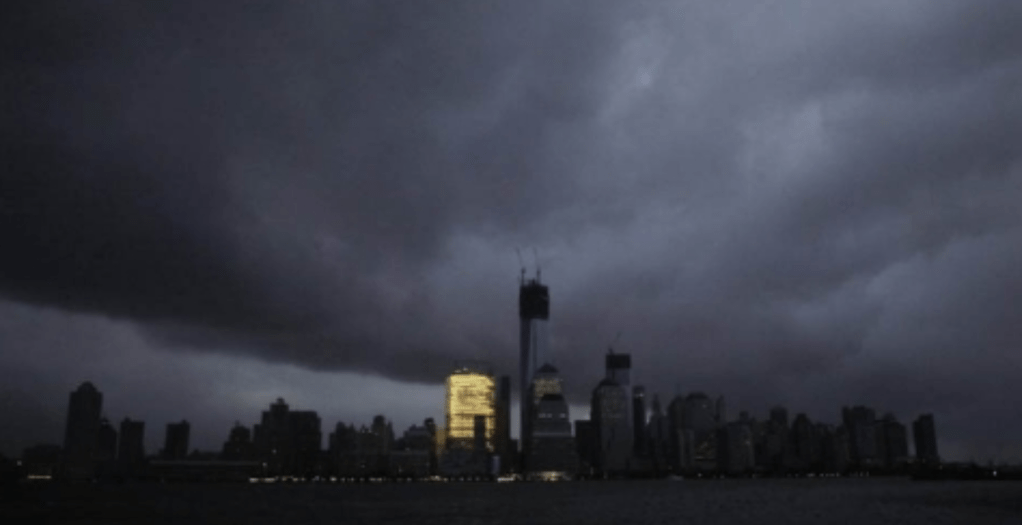
A viral picture of the Goldman Sachs building that remained powered and largely unscathed despite being in a mandatory evacuation zone during Hurricane Sandy in 2012.1

The point is not abstract. During Hurricane Sandy in 2012, a widely shared image showed the Goldman Sachs building in lower Manhattan lit and operational while much of the surrounding area was dark. The firm had invested heavily in resilience infrastructure. Business continuity became a competitive advantage.

In a 2015 speech,2 Mark Carney, then Governor of the Bank of England, argued that climate change is a “tragedy of the horizon” because its worst effects will be felt beyond the traditional horizons of business planning, political cycles, monetary policy, and financial regulation. Current decision‑makers therefore have weak incentives to act even though future generations will bear the costs, creating a structural mismatch between where the risks sit and where the power to respond lies.

He highlighted three channels through which climate change threatens financial stability:2

  • Physical risks: losses from more frequent and severe floods, storms, heatwaves, and other weather‑related disasters.
  • Liability risks: lawsuits and compensation claims against firms and directors for contributing to or failing to manage climate harms.
  • Transition risks: repricing of assets as policy, technology, and consumer preferences shift toward a low‑carbon economy, creating “stranded assets,” especially in fossil fuels.

Because standard risk models and planning cycles rarely look out beyond a decade, they miss non‑linear climate shocks and underestimate the scale of structural change required, especially under scenarios that keep warming well below 2°C.34

Climate change is no longer a CSR issue; it is a core strategic, financial, and operational risk56 affecting supply chains, asset location decisions, insurance costs, regulatory exposure, consumer demand, and access to capital.

Breaking the tragedy of the horizon requires extending risk management beyond conventional timeframes and embedding climate risk into today’s decision systems. We are already experiencing climate risk, and there is no way to fully insulate every asset from its effects.

For financial institutions, climate risk shows up as credit risk (borrowers’ ability to repay), market risk (asset price changes), operational risk (disruptions to operations), and reputational risk (backlash over financing high‑emitting activities). Empirical work on banks shows that exposures to transition risk are currently modest in portfolio terms but concentrated in specific sectors, and that banks signing net‑zero alliances have begun to reduce lending to the riskiest industries.78

For corporations, the following may help:

  • Risk identification: Map climate hazards and drivers (heat, floods, drought, storms, sea‑level rise; carbon prices; regulations; technology shifts) to specific assets, operations, and supply chains.
  • Assessment and quantification: Use tools ranging from high‑level heatmaps to asset‑level hazard models and financial impact assessments (e.g., revenue at risk, cost of goods sold, capex needs).
  • Integration into Enterprise Risk Management (ERM): Incorporate climate risks into risk registers, materiality assessments, internal controls, and capital budgeting, with clear thresholds for escalation.

For financial institutions, more technical steps include:

  • Exposure mapping: Quantify portfolio exposure to vulnerable sectors and geographies as a share of lending and investment books.
  • Climate-adjusted credit analysis: Incorporate emissions intensity, transition plans, and physical risk exposure into underwriting and pricing.
  • Scenario stress testing: Use Network for Greening the Financial System (NGFS) or equivalent scenarios to assess losses under combinations of policy tightening and physical shocks.

Regulators increasingly expect banks and insurers to demonstrate that climate risks are integrated into their internal capital adequacy assessments, risk appetite statements, and supervisory dialogues.9

For banks and investors, an important nuance is that reducing portfolio emissions too mechanically by divesting from high‑emitting sectors can undermine real‑economy transition, because those same sectors (power, steel, transport) require capital to decarbonise. Leading practice therefore shifts from simple “brown exclusion” to engagement, conditional finance, and transition‑linked instruments.1011

All of this reframes climate change from a distant macro-risk into an immediate business continuity problem. The question is no longer whether climate risk matters, but how organisations operationalise it within decisions made today. Businesses and financial institutions must change how they allocate capital and design products. Climate‑aligned finance involves both reducing exposure to misaligned activities and growing exposure to solutions.12

For non‑financial corporates:

  • Shift capex toward energy efficiency, low‑carbon technologies, and resilience measures (e.g., relocating assets, flood‑proofing, cooling infrastructure), guided by scenario‑tested business cases.
  • Integrate internal carbon pricing into investment decisions and product design to reflect transition risk and incentivise low‑carbon choices.
  • Explore innovative risk‑sharing instruments, such as parametric insurance for climate‑related losses or resilience bonds linked to infrastructure upgrades.

For financial institutions:

  • Develop green and sustainability‑linked products (green bonds, sustainability‑linked loans, transition bonds) with clear use‑of‑proceeds criteria and performance‑based pricing.
  • Use portfolio alignment tools (e.g., implied temperature rise metrics, sectoral pathways) to steer lending and investment toward net‑zero‑compatible activities, while monitoring credit risk.
  • Avoid “paper decarbonisation” that simply sells high‑emitting assets to less regulated owners; instead, engage with clients to finance credible transition plans and set conditions for continued support.

Research shows that, so far, banks’ transitions have been gradual and often focus more on emissions metrics than on real‑economy outcomes, underscoring the need to link commitments to enforceable policies and incentives.

To translate this into an actionable agenda, organisations can focus on a staged approach:

  1. Diagnose and govern: Brief boards on climate risk exposure. Assign clear oversight at board and executive levels.
  2. Measure and disclose: Strengthen scenario analysis, emissions tracking, and exposure metrics. Build data systems aligned with emerging standards.
  3. Integrate into risk and strategy: Embed climate considerations into ERM, capital budgeting, procurement, and sector strategies.
  4. Align capital and incentives: Set science-based targets with interim milestones. Adjust lending and investment policies to phase out clearly misaligned activities while scaling transition and resilience finance.
  5. Engage and collaborate: Work with regulators, alliances, clients, and suppliers to raise standards and avoid a race to the bottom.

Traditional business continuity frameworks assume that shocks are temporary, insurable, and geographically contained. Climate risk increasingly violates all three assumptions. The tragedy of the horizon is therefore not just about time, but about governance. Climate risks accumulate slowly, crystallise suddenly, and cascade across balance sheets, supply chains, and communities. By the time they appear in backward-looking metrics, strategic options have already narrowed.

For corporations and financial institutions alike, the challenge is no longer one of awareness or disclosure. It is whether decision-making systems — capital allocation, product design, credit assessment, and continuity planning — can be rewired to operate under conditions of deep uncertainty and irreversible change. Those that succeed will not eliminate climate risk (that’s impossible). They will internalise it early, adapt faster, and preserve optionality as the transition unfolds. Those that do not may find themselves where many firms were in the early 2010s—surprised by risks that were already visible, and outperformed by competitors who prepared earlier.

Sources

  1. Sandy Tech – Business Unusual
  2. Breaking the Tragedy of the Horizon – Speech by Mark Carney
  3. Guide to Climate Scenario Analysis for Central Banks and Supervisors (NGFS – 2025 Update, PDF)
  4. Climate Analysis Likely Understates Risk, Say FSB and NGFS – Central Banking
  5. Climate Risk Applications: Guidance and Practices (UNEP FI – From Disclosure to Action)
  6. Global ESG Standards & Climate Risk Alignment – Council Fire Guide
  7. U.S. Banks’ Exposures to Climate Transition Risks (SSRN Working Paper)
  8. U.S. Banks’ Exposures to Climate Transition Risks (New York Fed Staff Report)
  9. Enhancing Banks’ and Insurers’ Approaches to Managing Climate‑Related Risks – BCLP
  10. Divestment and Engagement: The Effect of Green Investors on Corporate Carbon Emissions – Harvard Law School Forum
  11. Greening Brown Sectors Through Transition Finance – SMU Centre for Climate Finance & Investment
  12. IMPACT+ Principles for Climate‑Aligned Finance (Climate Alignment Initiative / RMI, PDF)