Can AI be a new economic factor of production?

This is not a regular post, just me musing out aloud here. AI is economically disruptive not because it is intelligent, but because it behaves unlike anything our existing factors of production were designed to describe.

Economics does not have a formal checklist for what qualifies as a factor of production, but there is a recognisable pattern. A factor tends to be:123

  • A necessary input to production (you can’t produce at scale without some of it)
  • ​Scarce relative to demand (so it commands a price and has an opportunity cost)
  • ​Distinct enough that tracking its quantity and return separately actually improves our understanding of the economy

This is how we ended up with land, labour, capital, and entrepreneurship.

FoPs also have their own characteristic of return:4

S. No.FactorReturn
1.LandRent
2.LabourWages
3.CapitalInterest
4.EntrepreneurshipProfit
5.Artificial Intelligence (?)Data/ Information (?)

What stands out immediately is that all traditional returns are monetary, because economics measures factor rewards in money terms. A person lifting a bag and moving it somewhere else is not “producing money”; they are supplying labour that is then valued in money. At the moment we don’t have anything like a standardised, broad market that prices raw data or AI outputs in the same way. AI primarily produces streams of information—predictions, classifications, strategies, compressed knowledge. Money appears later, once those outputs are embedded into decisions and products.

Another difference is agency. All existing factors require humans to operate them. AI operates within parameters set by humans, and will likely continue to do so for the foreseeable future. But within those parameters, it can often act independently—choosing, ranking, deciding. That alone makes it behave differently from land, machines, or even software in the traditional sense.

A factor of production isn’t just a philosophical label. It exists to help us explain and measure the economy. If adding a factor doesn’t improve growth accounting, policy design, or business strategy, economists won’t bother. This is why some researchers talk about “digital labour” or “machine intelligence”: not because they want new categories, but because too much productivity is currently being buried in the Solow residual—the box labeled “we don’t quite know where this came from.”

AI clearly enhances human productivity. That part isn’t controversial. In that sense, today’s AI can reasonably be described as technology—a powerful one, but still technology. It processes information created by humans and executes objectives defined by humans. Like other technologies, it raises output.

But AI also does something no previous technology has done at this scale. It automates parts of cognition itself. Even if it is only rearranging human-made information, no human can do so at its speed, breadth, or consistency. This is where the analogy with ordinary technology starts to strain.

If AI were simply capital, it would behave like other capital goods. It doesn’t. If it were just labour-saving technology, it would enhance labour without resembling it. It increasingly does resemble labour—except non-human, infinitely replicable, and made rather than born.

This is why I’m inclined to think AI may become a factor of production—not because it is “intelligent” in a human sense, but because it fits awkwardly into every existing category. I’m wondering if, when something doesn’t fit any of the existing buckets cleanly, maybe it deserves its own bucket. For now, AI probably still sits closest to technology: a tool that dramatically enhances output. But it is an unusual tool—one that changes the production function itself by substituting for certain kinds of cognition while amplifying others.

My next thought was what would happen if we did recognise AI as a separate factor. No country’s GDP would suddenly change; what would change is how we explain and decompose that GDP.

GDP today is built from three equivalent views:56

  • Production approach: sum of value added = output − intermediate inputs
  • Expenditure approach: C + I + G + (X − M)
  • Income approach: sum of factor incomes (wages, profits, interest, rent) plus taxes less subsidies

All three are about the value of final goods and services produced in a period, not about how many “factors” are in the textbook. So just declaring “AI is now a factor” would not suddenly make India’s or any country’s GDP number jump.

In growth economics, output of an economy is often represented as a function of two primary, measurable inputs:78

  • Labour
  • Capital

A standard production function can be written as:

Y = F(K, L, A)

where Y is income, K is capital, L is labour, and A is a catch‑all “technology” term—the Solow residual. If AI or “digital labour” became a recognised factor, you’d move to something like:

Y = F(K, L, A, D)

where D is an explicit AI/digital labour input, and A remains the residual technology that is not AI.

That doesn’t change the level of Y we measure as GDP, but it does change the story of where Y came from: part of what is now “mystery productivity” (TFP/Solow residual) would be reassigned to a measured AI input. In other words, the pie stays the same size, but we start saying, more precisely, which ingredient did how much of the baking.

Sources

  1. https://corporatefinanceinstitute.com/resources/economics/factors-of-production/
  2. https://www.britannica.com/money/factors-of-production
  3. https://www.investopedia.com/ask/answers/040715/why-are-factors-production-important-economic-growth.asp
  4. https://www.investopedia.com/terms/f/factors-production.asp
  5. https://byjus.com/commerce/gdp-formula/
  6. https://en.wikipedia.org/wiki/Gross_domestic_product
  7. https://www.investopedia.com/terms/s/solow-residual.asp
  8. https://aniket.co.uk/condev/lec2.html

The economics of remanufacturing

Remanufacturing is a structured industrial process where a used product (the “core”) is disassembled, cleaned, inspected, repaired or upgraded, and reassembled to at least “as‑new” performance, often with a new warranty. It differs from simple repair (which restores function) and recycling (which recovers materials) by preserving the value embedded in complex components like housings, castings, and precision parts.1

In circular economy terms, remanufacturing is one of the highest‑value loops because it keeps products in use with minimal additional material and energy input. That makes it strategically attractive in sectors where products are capital intensive, long‑lived, and technically durable—think engines, industrial equipment, medical devices, and high‑end electronics.2

Remanufacturing reduces exposure to volatile raw material prices and supply disruptions, a growing concern highlighted in circular economy policy discussions by conserving the bulk of materials in complex products3 and reports indicate that remanufacturing can cut greenhouse gas emissions by two-thirds or more compared with producing new parts, making it economically attractive for firms facing carbon constraints or reporting obligations.4 This is why policies that push producers to take responsibility for products at end‑of‑life (through take‑back schemes or design requirements) naturally encourage remanufacturing models as they can extract more value from returned goods.45

Economics
The economics is all about the margins for organisations:

Cost side

  • Production cost savings: Many empirical and industry studies show remanufacturing can reduce unit production costs by roughly 40–65% compared with making a new product, mainly by reusing major components and cutting material and energy demand. Industry examples like Caterpillar’s “Cat Reman” report remanufactured parts costing 45–85% less to produce than brand‑new equivalents while meeting the same specifications.6
  • Customer price level: Remanufactured products are typically sold at 60–80% of the price of new products, attractive enough to win price‑sensitive customers while still leaving room for solid margins.7
  • Resource and energy savings: Preserving existing components means far less raw material and process energy; some studies and industrial programs report 65–87% cuts in energy use and greenhouse gas emissions relative to new manufacture.8

Cost Structures

Predictable core supply, stable technical yield, and cost‑efficient operations are the most important factors in any business working in the remanufacturing sector. These can be divided into three main factors, which are then further subdivided as shown in the list below:

  1. Core acquisition and collection: Remanufacturers must get used products back, through buy‑back programs, deposits, leasing, or authorised channels (approved distribution or collection pathways), which adds logistics, handling, and sometimes incentives to the cost base.9 Economic models and case studies show that profitability is highly sensitive to the “core return rate”: low or erratic returns undermine capacity utilisation and can drive up unit costs.10 Interestingly, research on “seeding” (deliberately placing additional new units into the field to increase future cores) finds that active management of core flows can increase total remanufacturing profits by around 20–40%10 in some product lines: this means the business depends on both- active new sales, and a specific life of the products which are being sold.​
    • From an economic perspective, the supply of cores is not an exogenous input but an intertemporal decision variable. New products placed into the market today become the core inventory available for remanufacturing in the future, linking current sales decisions to future production capacity. Formal models show that firms may rationally increase new product sales, adjust leasing terms, or subsidise returns in order to secure a predictable flow of future cores, even when short-term margins are lower. The profitability of remanufacturing therefore depends on managing a stock of recoverable products over time rather than on one-period cost comparisons. When core returns are volatile or poorly controlled, remanufacturing capacity cannot be fully utilised. Unit costs rise and the apparent economic advantage shrinks, even if average cost savings look attractive on paper.
  2. Core quality and yield: Not all returned products are economically remanufacturable; if too many cores fail inspection or require heavy rework, the effective cost advantage shrinks.10 Models that combine technical constraints with cost and collection rates show that limited component durability and uncertain core quality can make remanufacturing unprofitable unless screened and priced correctly.11
    • ​A further economic complication is uncertainty. Unlike new manufacturing, where inputs are standardized, remanufacturing faces stochastic variation in both core quality and remanufacturing cost. Inspection and testing therefore act as economic screening investments rather than mere technical steps: firms incur upfront costs to reveal information about whether a core should be remanufactured, downgraded, or scrapped. Economic models frame this as an option-value problem, where remanufacturing decisions are deferred until uncertainty is resolved. Even when average remanufacturing costs are low, high variance in core condition can reduce expected profits and lead firms to reject a substantial share of returns. This helps explain why observed remanufacturing volumes are often lower than simple cost‑savings calculations would predict.
  3. Process Complexity: Disassembly, inspection, testing, and reassembly require specialised skills and flexible processes, which can raise overhead relative to straight‑through new manufacturing.12
  4. Overheads: Since remanufacturing has extra process steps (process complexity), overhead is often a larger share of total cost than in straightforward new manufacturing.13

Revenue side

  • Margin structure: If a new product sells for 100 monetary units and costs 70 to make, the margin is 30; a remanufactured equivalent might sell for 70–80 and cost only 30–40, producing a margin in the same range or better.6
  • New customer segments: Lower price points allow firms to address more price‑sensitive markets, geographies with lower purchasing power, or customers who would otherwise buy used or off‑brand products.9

A central economic tension in remanufacturing is cannibalisation: every remanufactured unit sold potentially displaces a sale of a new product. Economic models consistently show, however, that remanufacturing can increase total firm profit when it functions as a form of price discrimination rather than simple substitution. By offering a lower-priced remanufactured product, firms can capture demand from customers with lower willingness to pay who would otherwise buy used, grey-market, or competitor products, while preserving higher margins on new products for less price-sensitive customers. In this equilibrium, remanufactured products expand the market rather than erode it, provided the price gap between new and remanufactured goods is carefully managed. This logic explains why OEMs often restrict remanufacturing volumes or channels even when unit margins are attractive: the optimal remanufacturing rate is determined not by production cost alone, but by its interaction with new-product pricing and demand segmentation.

Market Structures
At the moment, remanufacturing markets tend to be fragmented and dominated by many small third‑party firms, with pockets of oligopoly or even monopoly power (A monopoly is a market structure where one firm dominates the entire market supply, and an Oligopoly is a market structure with only a few suppliers in the market rather than many) around strong brands and OEM‑controlled (OEM = Original Equipment Manufacturer) take‑back systems. The exact structure depends on who remanufactures (OEM vs independent), how products are collected, and how new and remanufactured products compete in closed‑loop supply chains.1415

From an industrial-economics standpoint, the persistence of fragmented remanufacturing markets reflects the shape of remanufacturing cost curves. While new manufacturing often exhibits strong economies of scale, remanufacturing benefits from scale only up to a point. Input heterogeneity, variable inspection effort, and the need for flexible processes limit the gains from large-scale standardisation. As volume increases, coordination and screening costs rise, flattening the cost curve and reducing the competitive advantage of very large firms. These structural features help explain why remanufacturing markets tend to support many small and mid-sized firms alongside selective OEM participation, rather than converging toward high concentration.

In remanufacturing, market structure is usually discussed along three dimensions:16

  • Industry concentration: how many firms remanufacture a given product, and how large the biggest players are.
  • ​Vertical structure in the closed‑loop supply chain: which tiers (OEM, retailer, specialist remanufacturer, collector) perform remanufacturing and who controls access to cores (used products).
  • Horizontal competition: how new and remanufactured products compete (prices, perceived quality, channels), often modeled with monopoly, duopoly or oligopoly game‑theoretic frameworks.​

These structures are shaped by cost savings from remanufacturing, consumer valuation of remanufactured products, regulatory pressure, and how easy it is to access used products (cores).

Empirical industry structures16
Across sectors such as automotive parts, industrial machinery, electronics and heavy equipment, studies and market reports converge on a broadly fragmented structure with a long tail of small non‑OEM remanufacturers and a smaller number of large OEMs and global service providers.​

Key empirical patterns:

  • Automotive parts: global automotive parts remanufacturing is characterised as fragmented, with many regional and local remanufacturers, plus major OEM programs (e.g., engines, gearboxes, turbochargers).17
  • Industrial machinery and heavy equipment: growth is strong, but the market still has many specialised firms; OEMs, dealer networks and third‑party remanufacturers often coexist, sometimes in parallel closed‑loop chains.18
  • Overall EU/US picture: an EU‑level study notes a skewed structure with “a significant number of smaller non‑OEMs” and relatively few large OEM‑affiliated remanufacturers.

This leads to typical hybrid structures:

  • Many small firms competing in price and service quality for commodified parts.
  • Local monopolies around niche technologies or proprietary know‑how.
  • Regional oligopolies in popular product lines (e.g. certain automotive components).

What’s happening in India?
India’s remanufacturing story is still nascent and uneven, but it is being pushed forward indirectly by waste‑management laws, Extended Producer Responsibility (EPR) rules for e‑waste, plastics and batteries, and the historic strength of the kabadiwala / scrap‑dealer ecosystem. Most circular‑economy action on the ground still looks like repair, reuse and informal recycling rather than full OEM‑style remanufacturing, yet the latest e‑waste rules and their refurbishing‑certificate mechanism create legal hooks that remanufacturing‑type businesses can use.19 India doesn’t yet have a “Remanufacturing Act”, but multiple waste rules create incentives and legal categories that overlap with remanufacturing.

E‑waste (Management) Rules20

The 2022 Rules:

  • Put legal responsibility on producers, manufacturers, refurbishers and recyclers of listed electrical and electronic equipment to meet quantified EPR targets for e‑waste, using a central online portal.
  • Require all these actors (including refurbishers) to register on the CPCB EPR portal, report flows of products and e‑waste, and obtain authorisations before operating.
  • Explicitly recognise refurbishing as a distinct activity: registered refurbishers can extend the life of products, send any residual e‑waste only to registered recyclers, and generate refurbishing certificates that allow producers to defer part of their EPR obligation into later years.

The 2024 Amendment Rules keep the 2022 structure but tune how the system actually works:

  • They add a new rule 9A that lets the central government relax timelines for filing returns “in public interest or for effective implementation”, acknowledging practical compliance bottlenecks.
  • They refine definitions (including “dismantler”) and insert new sub‑rules in rule 15 that allow the government to create platforms for exchange/transfer of EPR certificates and empower CPCB to set floor and ceiling prices for those certificates, tying prices to environmental‑compensation logic.

That last bit is important: it means refurbishing and recycling certificates now sit inside a semi‑regulated compliance market, rather than in a completely opaque bilateral space. For any firm doing serious refurbishment or remanufacturing of electronics, the financial value of each “saved” device is no longer just the resale price; it also includes the value of refurbishing certificates producers will need to meet their EPR targets.

One of my favourite things about waste management in India is the local kabadiwala (waste-person) system, where a person who runs a reverse-logistics business comes to people’s homes and BUYS the waste they wish to remove from their homes. The kabadiwala networks that move e‑waste and scrap in cities haven’t changed because of the 2024 amendment—but the way the state talks about integrating them has become more concrete.

Official statements on the 2022 rules repeatedly say the new EPR regime is meant to “channelize the informal sector to the formal sector”, by making collection and processing possible only via registered producers, refurbishers and recyclers.21 Circular‑economy concept notes for municipal waste still highlight that informal workers and kabadiwalas do the heavy lifting of collection and separation, and must be integrated into contracts, data systems and formal infrastructure.22 Case studies on informal e‑waste collectors (kabadiwalas) emphasise that they remain the primary collection channel for household e‑waste, but usually sell to small dismantlers who operate outside the 2022–2024 EPR framework.23

Against that backdrop, the 2022–2024 e‑waste regime offers two big levers for integration:

  • Partnerships between registered refurbishers/recyclers and kabadiwala networks: the law doesn’t mention kabadiwalas by name, but nothing stops a registered refurbisher from building sourcing and sharing arrangements with informal collectors, bringing their material into the formal portal system.24
  • Data and platform logic: the new certificate‑trading platforms and CPCB portals are building a data spine for reverse logistics; if cities and social enterprises plug informal actors into that spine, kabadiwalas become the front‑end of a traceable, compliance‑generating remanufacturing pipeline instead of sitting outside it.25

In practice, though, most of what happens today is still repair, cannibalisation for parts, and low‑value recycling. The regulatory architecture is now sophisticated enough to support high‑value remanufacturing and refurbishment at scale, but the hard work is social and institutional: defining quality standards, building trust in “remanufactured” products, and finding ways to bring kabadiwalas and other informal workers into those new value chains without erasing their livelihoods.

Sources

  1. https://www.sciencedirect.com/topics/engineering/remanufacturing
  2. https://www.europeanreman.eu/files/CER_Reman_Primer.pdf
  3. https://www.europarl.europa.eu/topics/en/article/20151201STO05603/circular-economy-definition-importance-and-benefits
  4. https://www.sciencedirect.com/science/article/abs/pii/S0921344920300033
  5. https://www.weforum.org/stories/2024/02/how-manufacturers-could-lead-the-way-in-building-the-circular-economy/
  6. https://circuitsproject.eu/2025/12/02/economic-benefits-of-remanufacturing/
  7. https://www.circulareconomyasia.org/remanufacturing/
  8. https://moretonbayrecycling.com.au/remanufacturing-in-a-circular-economy/
  9. https://ideas.repec.org/a/bla/popmgt/v28y2019i3p610-627.html
  10. https://www.semanticscholar.org/paper/Assessing-the-profitability-of-remanufacturing-a-Duberg-Sundin/7e21580086860f1a2077d00068fb25848eac5f77
  11. https://flora.insead.edu/fichiersti_wp/inseadwp2003/2003-54.pdf
  12. https://techxplore.com/news/2024-06-remanufacturing-profitable.html
  13. https://scholarworks.utrgv.edu/cgi/viewcontent.cgi?article=1742&context=leg_etd
  14. https://arxiv.org/html/2512.03732v1
  15. https://pubsonline.informs.org/doi/10.1287/mnsc.1080.0893
  16. https://www.remanufacturing.eu/assets/pdfs/remanufacturing-market-study.pdf
  17. https://www.researchandmarkets.com/reports/6003938/automotive-parts-remanufacturing-market-global
  18. https://www.technavio.com/report/industrial-machinery-remanufacturing-market-industry-analysis
  19. https://app.ikargos.com/blogs/epr-e–waste-in-india-101
  20. https://cpcb.nic.in/rules-6/
  21. https://www.pib.gov.in/PressReleasePage.aspx?PRID=2102701
  22. https://mohua.gov.in/pdf/627b8318adf18Circular-Economy-in-waste-management-FINAL.pdf
  23. https://www.sciencedirect.com/science/article/pii/S0892687523001681
  24. https://www.thekabadiwala.com/services/circular-economy-services
  25. https://cpcb.nic.in/all-epr-portals-of-cpcb/


The invisible costs of pollution

From an economic point of view, pollution is an inefficiency, a “misplaced resource” that has been discarded because it has no market value.1

The Linear Economy, which operates on a “Take-Make-Waste” principle. Raw materials are extracted, transformed into products, used briefly, and discarded. The fatal flaw is that the “Waste” component almost always represents an externality invisible to market prices.2 The linear model generates massive environmental consequences. Resource extraction creates habitat destruction and biodiversity loss. Manufacturing produces pollution across air, water, and soil. The disposal phase concentrates waste in particular locations, often in low-income communities. The model also concentrates wealth and opportunity in few hands, increasing social inequality. Plastic costs appear cheap only because the price tag excludes 500 years of cleanup costs.3

Currently:

  • At the current rate, there will be more plastic in the oceans than fish by 2050.4
  • Over 100 billion tonnes of raw materials are extracted globally every year.5
  • More than 91% of it is wasted after a single use.6
  • Approximately 30% of all plastics ever produced are not collected by any waste management system and end up as litter in rivers, oceans, and land.7

This economic blindness began to crack in the 1960s. Environmental economics emerged in response to visible environmental damage documented by works like Rachel Carson’s Silent Spring. Rather than viewing environmental problems as side effects of economic activity as in traditional economics, it treats them as central questions about how we value nature, why markets fail to protect it, and what policies can correct those failures.8

Environmental economics asks three fundamental questions:910

  1. What policies can correct those failures?
  2. How do we value nature in economic terms?
  3. Why do markets fail to protect the environment?

Invisible Costs111213
In economics, this invisible cost of pollution is called an externality.

An externality is a cost or benefit imposed on a third party who did not choose to incur it and for which the responsible party does not pay. When a factory pollutes a river, the operation generates profits for the owner, but downstream communities bear the costs through health impacts, cleanup expenses, and biodiversity loss. The market price of the factory’s product is artificially low because it fails to reflect these environmental damages, the benefits of which are private while the costs are external, invisible to market actors.

Positive externalities occur when an activity benefits others without compensation. For example, when more people adopt public transportation, road congestion decreases for all drivers, creating a spillover benefit that the road users don’t pay for. Negative externalities, such as pollution, habitat destruction, or resource depletion, are far more prevalent in discussions of environmental economics because they represent genuine welfare losses for society that the price system ignores.

While early economists like Arthur Pigou identified externalities in the 1920s, it wasn’t until the mid-20th century that the field formalised the study of how shared resources are managed, or mismanaged. Over time, the field grew and various other theories were added to the discipline, for example:

Public goods or Common-Pool Resources are non-excludable (you cannot prevent people from using them) and non-rivalrous (one person’s use doesn’t reduce availability for others). Climate stability exemplifies this problem: no single company owns a stable climate, so no single company has a financial incentive to protect it.14

The Tragedy of the Commons describes what happens when individual users, acting in their own self-interest, deplete a shared resource even though this outcome harms everyone in the long term. The atmosphere and oceans are classic examples. Each polluter has a private incentive to externalise their waste, but the aggregate effect of millions of such decisions degrades the resource for all.15

Can We Replace Nature?1617
A central debate in environmental economics is whether natural capital (forests, minerals, clean water) can be substituted by human-made capital (machines, technology, infrastructure). The substitutability view (weak sustainability) assumes technology can replace nature. The complementarity view (strong sustainability) argues natural capital and human capital must work together:

  • Substitutability / Weak Sustainability: An approach to sustainability that assumes different types of capital (natural capital like forests and metals, human-made capital like machines and buildings, human capital like knowledge and skills) are interchangeable. Under weak sustainability, losing a natural forest can be considered sustainable if the economic value generated (through agriculture or development) equals or exceeds the value of lost biodiversity. Weak sustainability assumes technological substitution—we can replace nature with machines.
  • Complementarity / Strong Sustainability: An approach that treats certain natural capital assets as incommensurable, meaning they cannot and should not be substituted by human-made alternatives. Strong sustainability recognises that some natural systems have critical ecological functions that cannot be replaced. A natural forest cut down and replanted elsewhere is not sustainably managed under this view because the biodiversity loss and wider ecological disruptions cannot be measured or offset.

The debate over sustainability was fundamentally altered in 2009, when a group of scientists led by Johan Rockström at the Stockholm Resilience Centre introduced the concept of Planetary Boundaries. They argued that Earth has quantitative limits, or “safe operating spaces”, that humanity must not cross.18

Planetary Boundaries1920
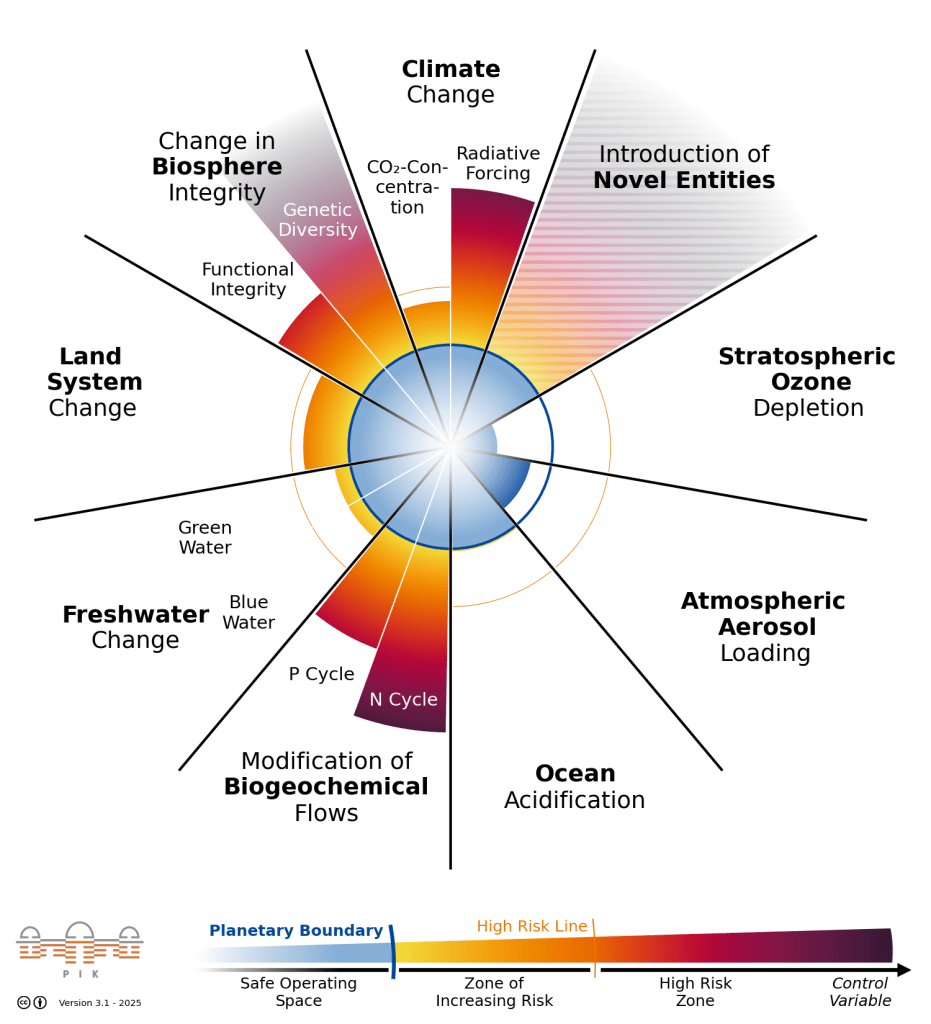
Planetary Boundaries represent a framework identifying nine critical Earth system processes (climate change, biodiversity loss, ocean acidification, land system change, freshwater use, biogeochemical flows, ocean oxygen depletion, atmospheric aerosol loading, and chemical pollution) that regulate planetary stability. Crossing these boundaries increases risks of large-scale, abrupt, or irreversible environmental changes. The current status of the nine Planetary Boundaries is depicted in this visualisation by the Potsdam Institute for Climate Impact Research:

Planetary Boundaries visualised (this is the version for colour blind people)21

To understand why externalities pose existential threats, we must recognise that the Earth operates as a closed thermodynamic system. We receive energy from the sun, but practically no matter enters or leaves. The water, carbon, and minerals present today are the same atoms that existed millions of years ago. While companies test asteroid mining and space-based resource extraction, commercial operations remain infeasible. We are not going anywhere else, and neither is anything else any time soon.

Traditional economics assumes an implicit model of an open system where waste can vanish into a void without damaging the planet and new resources are in unlimited supply.2223 Due to this, in traditional economics, environmental externalities don’t matter.22 In reality, extraction depletes stocks, and waste accumulates until organisms recycle it or it decomposes into usable molecules. This closed-loop reality means that all environmental externalities eventually cycle back, imposing costs on the system that produces them.

Ecosystems provide services worth far more than human-created capital. The real economic value of ecosystem services includes provisioning services (food, water), regulating services (carbon storage, water purification, disease control), supporting services (nutrient cycling, pollination), and cultural services (aesthetic, recreational, spiritual value). These services are valued at over $150 trillion annually, which is approximately twice global GDP, yet most remain invisible to the financial market.24

When ecosystems collapse from pollution or overexploitation, the cascading effects are severe. Freshwater species populations have declined by 83%25 in fifty years. Research demonstrates that losing 40% of key species can trigger collapse of 40% of remaining species throughout the system: ecosystems don’t gradually decline but flip to new, often irreversibly degraded states.2627 These ecological transformations represent enormous negative externalities that the economic system counts at no cost for the polluter.

Regime Shifts
When a planetary boundary is crossed, the Earth system risks undergoing a regime shift—an irreversible transition to a new, less hospitable state.

  • Systemic Financial Risk: These physical risks are becoming material financial risks. Current projections suggest that unmitigated boundary breaches could cause profit losses of 5-25% by 2050 for unprepared sectors. More dangerously, the “tipping point” in nature creates a “tipping point” in the economy, where insurance markets fail because risks become uninsurable (e.g., no one will insure property in a zone of permanent wildfire).28
  • Non-Linear Damages: Traditional Cost-Benefit Analysis (CBA) struggles here because it assumes linear damages (e.g., 2 degrees of warming is twice as bad as 1 degree). However, crossing a tipping point (like the collapse of the Amazon rainforest or the West Antarctic Ice Sheet) causes damages to spike asymptotically to infinity, representing an existential threat rather than a marginal cost.29

The efficiency trap3031
In 1865, economist William Stanley Jevons observed a counter-intuitive trend in his book The Coal Question: James Watt had introduced a vastly more efficient steam engine that required less coal to do the same amount of work. Logic suggested that coal consumption would drop. Instead, it skyrocketed.

This is the Jevons Paradox: Because the new engine made energy cheaper, making it profitable to use steam power in thousands of new applications where it was previously too expensive. Increases in efficiency often lead to increases in overall consumption, rather than decreases.

Circularity
If Earth is a closed system, our economy must become one too. The circular economy is a fundamentally different way of thinking about production and consumption. Instead of extracting → making → disposing, the circular model aims for continuous circulation.

The Ellen MacArthur Foundation, which pioneered much of the circular economy theory, defines it as follows: “A circular economy is an economic model aimed at minimising waste and maximising resource efficiency. It focuses on reusing, repairing, refurbishing, and recycling existing materials and products to create a closed-loop system that reduces impact on the environment.”32

At its core, the circular economy operates on a radical premise: there is no such thing as waste. Circularity isn’t just about recycling more; it’s about redesigning civilisation so that the concept of “waste” becomes obsolete. It mimics biological cycles where the waste of one species becomes food for another.

The more traditional concept of the circular economy rests on three complementary principles, often called the “Three Rs”:3334

  1. Reduce: The most fundamental principle. Use less. Design products that require fewer materials. Choose quality over quantity. The environmental benefit of not using a material in the first place is greater than the benefit of recycling it later.
  2. Reuse: Keep products in use for their original purpose as long as possible. A bottle is reused for storage. Clothing is worn by multiple people across time. Furniture is repaired and maintained rather than discarded when fashion changes. Reuse requires durability—products must be built to last.
  3. Recycle: When a product reaches the end of its useful life, its materials are recovered and transformed into new products. But recycling is the least preferred option in the circular model, coming only after reduction and reuse. Why? Because recycling requires energy, and recycled materials often degrade in quality (a process called “downcycling”).

However, there are other Rs too:353637

  • Refuse: Refuse to buy what is not required.
  • Repair: To repair is to fix something that is broken and return it to working condition, and it extends products’ lives.
  • Refurbish: Refurbishment is the professional process of restoring a used product to like-new condition through cleaning, testing, repair of worn components, and quality assurance.
  • Remanufacture: Remanufacturing is the industrial process of returning end-of-life products to like-new condition, often exceeding new product quality. Unlike refurbishment (which typically involves minor repairs and cosmetic restoration), remanufacturing involves complete disassembly, assessment of every component, replacement of worn parts, cleaning, reassembly, and testing.
  • Recover: Resource recovery is the process of extracting materials from used products and waste, converting waste into valuable inputs for manufacturing new products. Instead of garbage going to landfills, its materials are recovered and re-entered into production cycles.
  • Regenerate: Regeneration is the final and highest aspiration of circular economy: not just reducing harm, but actively improving ecosystems, building natural capital, and leaving the world richer than you found it.

Circular principles include design for durability and repairability to extend product lifespans, material selection to enable recycling, take-back programs where manufacturers manage end-of-life, and remanufacturing to extract value from used products.38

Industrial ecology formalises this concept by analysing material and energy flows through industrial systems. The goal is to create industrial ecosystems where output from one facility becomes input to another, mimicking natural food webs where energy and matter cycle through trophic levels. Successful industrial ecology requires partnerships among industries to exchange byproducts and shared infrastructure for waste processing.39

The transition from linear to circular creates fundamental business model changes. Instead of maximising production volume, circular firms optimise product lifespan, material recovery, and service delivery. Instead of profit from disposal, revenue comes from extended use and material recapture.38 

From an environmental economics perspective, the circular economy represents internalising all externalities by forcing companies to account for their entire product lifecycle. When manufacturers know they’ll eventually manage end-of-life—or when cost of future pollution regulations is incorporated into today’s decisions—they’re incentivised to eliminate waste at design stage rather than manage it at disposal stage.

Pricing Nature
To fix the market failure, we first need to measure the damage. Forcing the market to account for costs previously external-to-firm decision-making by making polluters pay for environmental damage, market prices finally reflect true social costs. This can occur through multiple mechanisms: taxes, regulations, cap-and-trade systems, liability rules, or disclosure requirements. When externalities are internalised, the price of polluting goods rises to reflect their true cost.40

The foundational principle that whoever causes pollution or environmental damage must bear the cost of preventing, mitigating, and repairing that damage is called the Polluter Pays Principle (PPP). Formally articulated by the OECD in 1972 and incorporated into the Rio Declaration in 1992, PPP creates economic incentives for polluters to reduce their damage. It shifts responsibility from the public (who would otherwise pay cleanup costs) to the private parties who profit from pollution.41 For this, we first need to be able to find the monetary value in question:

  • Replacement Cost Method:42 A valuation approach that estimates the value of an ecosystem service by calculating what it would cost to replace that service with human-made technology. For example, if replacing a wetland’s filtration service with a treatment plant costs $2 million, the ecosystem service is valued at $2 million.
  • Direct Valuation:43 A method that estimates environmental value by asking people how much they would be willing to pay for environmental improvements (like cleaner water) or willing to accept as compensation for environmental losses. For example, surveys can estimate how much people value a protected forest by asking their willingness to pay for conservation. This captures existence value—what people value simply knowing something exists, even if they never use it.
  • Hedonic Pricing (Indirect Valuation):43 A method that estimates the value of environmental attributes (clean air, clean water, scenic views) by analysing how they affect market prices. For example, homes near clean lakes or parks sell for more; the price difference reflects the value of the environmental amenity.
  • Travel Cost Method (Indirect Valuation):44 A method that estimates the value of environmental amenities (national parks, beaches, forests) by analysing how much people spend to visit them. The travel costs (fuel, lodging, time) are used as a proxy for environmental value.
  • Avoided Cost Method:45 A cost-based valuation approach that estimates ecosystem service value by calculating the costs that would be incurred if those services were lost. For example, the value of wetlands for flood protection can be estimated by calculating the property damage that would occur without the wetland’s protection.

Internalisation
After we’ve found the cost of pollution, the next step (once politically convenient) is to internalise the costs to those who pollute. This part of the post discusses some accepted measures.

1. Tax-Based Instruments464748
Pigouvian taxes, named after the previously-mentioned economist Arthur Pigou, are a direct approach to internalisation. A Pigouvian tax sets a fee equal to the marginal (in economics, marginal means additional) external damage at the socially optimal output level. For example, a carbon tax places a cost on CO2 emissions equivalent to climate damages. This transforms polluters’ incentives: with the tax in place, reducing emissions becomes cheaper than paying the tax, so firms invest in efficiency and cleaner technologies.49

The advantage of Pigouvian taxes lies in flexibility. Rather than mandating specific pollution control technology, taxes allow firms to find the most cost-effective way to reduce emissions, whether through process changes, technology adoption, or output reduction.

However, implementing Pigouvian taxes presents challenges. Accurately estimating the monetary value of marginal external costs proves extremely difficult, particularly for long-term, diffuse environmental impacts like climate change. Additionally, poorly designed taxes can be regressive, disproportionately affecting low-income households. Well-designed tax systems can mitigate this through revenue recycling (using tax revenue to fund renewable energy research, reduce other distortionary taxes, or provide carbon dividends to citizens).

The double-dividend hypothesis suggests that revenue-neutral substitution of environmental taxes for income taxes yields two benefits: a better environment (the first dividend) and a more efficient tax system by reducing distortionary income taxation (the second dividend).5051 While theoretically appealing, empirical evidence shows mixed results depending on multiple economic and policy factors.5051

2. Cap-and-Trade Systems48525354
Cap-and-trade (also called Emissions Trading Schemes or ETS) represents an alternative market-based approach to internalisation. Regulators set a total cap on allowable emissions and distribute permits to polluters either for free or through auction. Firms must either reduce pollution or buy additional permits from other firms. Crucially, the cap declines over time, forcing progressively stricter emissions reductions.

The trading mechanism generates a two-fold benefit. First, companies that can reduce emissions cheaply have financial incentive to do so, then sell surplus permits to polluters facing higher abatement costs. This ensures that emissions reductions occur where they’re cheapest—society achieves the environmental target at minimum economic cost. Second, as the cap tightens, permit scarcity increases, creating financial pressure for innovation and investment in clean technologies. 

Comparing cap-and-trade to carbon taxes reveals important trade-offs. Cap-and-trade provides environmental certainty—the government guarantees a specific pollution level through the cap—but costs fluctuate with market conditions. Carbon taxes provide cost certainty—polluters know exactly what they’ll pay per unit—but environmental outcomes depend on market responses. Under uncertainty about abatement costs, taxes work better when marginal benefits are relatively flat; cap-and-trade works better when they’re steep.

Cap-and-trade faces political and practical challenges. It requires sophisticated bureaucratic capacity to determine which companies get covered and how many permits to allocate. The system struggles to cover small polluters as only large facilities typically participate while taxes apply at the emission source (fuel) and thus reach both small and large users. Additionally, international trading risks creating environmental “hot spots” where permits concentrate pollution in particular locations, raising environmental justice concerns.55

India’s approach offers a developing-country model. India’s Carbon Credit Trading Scheme, notified in 2024-2025, uses an intensity-based baseline-and-credit system covering nine energy-intensive industrial sectors. Entities that overachieve their emissions intensity targets earn Carbon Credit Certificates; those falling short must purchase or surrender certificates. The scheme also includes a voluntary domestic crediting mechanism allowing non-covered entities to register emission reduction projects.

3. Extended Producer Responsibility56575859
Extended Producer Responsibility (EPR) shifts waste management liability from governments to manufacturers. By holding producers responsible for their products’ entire lifecycle—from material extraction through end-of-life disposal—EPR incentivises design changes that reduce waste at source.

Under EPR, manufacturers can implement reuse, buyback, or recycling programs, or delegate responsibility to Producer Responsibility Organisations (PROs) paid for used-product management. This shifts the burden from government to private industry, obliging producers to internalise waste management costs in product prices and ensure safe handling.

EPR functions as a powerful design incentive. When manufacturers know they’ll pay for disposal, they redesign products to use fewer materials, improve recyclability, avoid toxic substances, and extend product lifespans. Successful EPR implementation requires clear regulations defining which products are covered, what producers must fund, and how compliance is verified. 

4. Market-Based Instruments Compared6061
Research comparing different internalisation mechanisms reveals nuanced trade-offs. Market-based instruments (taxes, permits, subsidies) achieve environmental goals by altering the fundamental market framework and letting firms minimise costs. Choice-based instruments (eco-labels, voluntary certifications) let firms meeting criteria signal their qualifications to consumers, allowing consumers to express environmental preferences.

Empirical analysis shows that emission taxes prove more effective than voluntary environmental programs at enhancing environmental quality and welfare. While eco-labels capture additional consumer surplus from environmentally conscious buyers, taxation more effectively curtails emissions from inefficient firms by changing all firms’ incentives. Command-and-control regulation—mandating specific technologies or performance standards—typically costs more than market-based approaches but provides certainty about pollution outcomes.

In developing countries, command-and-control remains the predominant approach because regulations are easier to design initially using existing administrative apparatus. However, they often prove economically inefficient and prone to weak enforcement. Market-based instruments promise greater efficiency but require sophisticated governance structures, robust monitoring, and developed markets—typically scarce in developing nations. Effective environmental management likely requires hybrid strategies combining command-and-control for baseline standards with market mechanisms for achieving further improvements.

5. Command-and-Control Regulation6263646566
Command-and-control regulation involves governments directly prescribing environmental standards and mandating compliance. The approach includes technology-based standards (requiring specific pollution control technologies), performance-based standards (setting pollution limits without specifying methods), and permits and licensing systems. 

The clarity of command-and-control is its primary strength. Rules are explicit, leaving little ambiguity about compliance requirements. This predictability enables businesses to make precise investment decisions in pollution control. For regulators, assessment against specific benchmarks is straightforward.

However, command-and-control exhibits significant limitations. The uniform standards ignore that firms have different abilities to reduce pollution—what’s cheap for one firm may be prohibitively expensive for another. The approach provides no incentive to exceed standards, even if doing so would be cost-effective. Inflexibility about how to reduce pollution means the most efficient abatement pathways may be blocked by regulatory requirements.

Effective command-and-control requires strong institutional capacity for monitoring and enforcement. Many developing countries lack the resources for consistent inspection and credible penalties, enabling regulatory capture where polluting industries exert undue influence on regulatory bodies.

6. Information Disclosure as Policy666768
A third policy wave emerged beyond command-and-control and market mechanisms: information disclosure regulation. The U.S. Toxics Release Inventory (TRI), established in 1986 following the Bhopal industrial disaster, requires manufacturing facilities to publicly report annual toxic chemical releases to air, water, and land.

TRI operates on the premise that public information creates stakeholder pressure. When communities learn about facility emissions, they can pressure companies through reputation damage, consumer choices, or political action, creating incentives for pollution reduction without direct government mandates. The system is cost-effective because enforcement relies on stakeholder pressure rather than government agency capacity.

Research on TRI effectiveness reveals that responsiveness to disclosure varies. Establishments located near corporate headquarters perform better than isolated facilities, suggesting that internal expertise access and sensitivity to reputation in areas with multiple company facilities enhance response. Facilities far from headquarters, large plants in rural areas, or isolated operations may need additional incentives or resources to improve in response to disclosure alone.

7. Voluntary Environmental Standards69707172
Voluntary environmental standards represent commitments organisations adopt beyond legal requirements. These range from ISO 14001 environmental management systems certification to sector-specific standards like Forest Stewardship Council (FSC) certification for forests or Marine Stewardship Council (MSC) for fisheries.

Credibility requires external verification by independent third parties. This process adds weight to environmental claims and provides assurance to stakeholders that standards are genuinely met. However, voluntary standards face limitations: they reach only willing participants; stringency varies across programs, creating opportunities for firms to “venue-shop” across programs requiring lower standards; and participation often hinges on credible threats of future mandatory regulation rather than genuine environmental commitment.

Empirical research on FSC and similar standards reveals mixed outcomes. While standards aim to promote sustainable practices, effectiveness varies across global contexts, with weak governance structures and social capital challenges limiting success in some regions.

8. Payments for Ecosystem Services737475
Payments for Ecosystem Services (PES) represent a market-based approach to conservation. PES schemes compensate farmers or landowners for managing land to provide ecological services—carbon sequestration, watershed protection, biodiversity conservation, pollination services. A transparent system offers conditional payments to voluntary providers who maintain ecosystem functions.

PES advantages include cost-effectiveness. By offering fixed payment for service provision, individuals who can provide the service at or below that price have incentive to enroll, while those with higher opportunity costs do not. This self-selection ensures cost-effective service provision relative to mandatory approaches requiring same actions from all.

However, PES faces challenges, particularly for public goods. When ecosystem services benefit society broadly (like climate stability), individuals lack financial incentive to provide them without compensation. Converting latent demand into actual funding requires compulsory mechanisms—taxation or government payment—to overcome free-rider problems. Additionally, PES programs raise concerns about commodification of nature, potentially privatising commons and reducing indigenous land rights.

9. Mitigation Banking and Conservation Offsets767778798081
Mitigation banking provides another market-based internalisation mechanism. Under the U.S. Clean Water Act Section 404, developers cannot discharge pollutants into waters without compensation. Rather than each developer creating individual compensatory mitigation, centralised mitigation banks allow developers to purchase credits from banks that restore or preserve wetlands or streams elsewhere. Before a 404 permit is issued, applicants must first avoid and minimise impacts; any remaining unavoidable impacts must be offset through compensatory mitigation, which can be accomplished via permittee‑responsible mitigation, in‑lieu fee programmes, or purchasing credits from a mitigation bank. Mitigation banking has evolved as an alternative to project‑by‑project mitigation, allowing developers to buy credits from centralised banks that have already carried out restoration/enhancement activities, which can be faster and administratively simpler for permittees.

This system incentivises restoration over preservation. Mitigation banking regulations reward restored wetlands with more credits than preserved ones, reflecting greater ecological value from restoration. Developers benefit from faster, cheaper compliance; ecosystem managers benefit from predictable funding for restoration; communities benefit from ecosystem protection even if harm occurs elsewhere.

Mitigation banking principles extend to conservation more broadly. Tradable permits for endangered species habitat, conservation easements where landowners voluntarily limit land use in exchange for tax reductions, and habitat credits create markets in environmental services. These approaches rely on Coasean bargaining—if property rights are clearly defined and transaction costs are low, polluters and victims can negotiate mutually beneficial agreements without government intervention.

10. Liability Rules and Environmental Compensation828384
Some jurisdictions implement strict liability for environmental damage, requiring polluters to pay compensation regardless of fault. This differs from fault-based liability requiring proof of negligence. The Polluter Pays Principle underpins this approach, making polluters bear responsibility for restoration, remediation, and third-party compensation. 

India’s National Green Tribunal has developed frameworks for environmental compensation, imposing penalties on industries violating environmental regulations. Compensation includes assessment costs, restoration costs, and compensation for direct and indirect damages to human health, property, flora, fauna, and ecosystem functions.

A Contextual Note on Climate Justice
We cannot equate the carbon produced by a family burning wood to survive the winter with the carbon produced by a millionaire flying a private jet. One is a symptom of energy poverty and a lack of alternatives—a victim of the system. The other is a symptom of excess—a beneficiary of the system.

The poorest 50% of the world is responsible for 10% of global emissions while bearing the greatest harm from climate impacts.8586 Meanwhile, a private jet can emit 2 tonnes of CO2 in a single hour, which is more than an average person in many developing nations emits in an entire year.87888990 Treating survival emissions as equal to luxury emissions is morally corrupt.

Sources

  1. Environmental Economics – Definition, Importance, Scope
  2. Linear economy – EFS Consulting Insight
  3. Effects of Plastic Pollution on the Environment
  4. Discount Rate Ethics → Term
  5. What Are Real-World Examples of Jevons Paradox?
  6. The Circularity Gap Report 2022: The World Is Only 8.6% Circular
  7. The Economics of Managing Plastics: The Recycling Plan That Can Work
  8. Environmental Economics – GKToday
  9. Environmental economics: Market failure – Britannica Money
  10. Chapter 4 Market Failure | Environmental Economics – David Ubilava
  11. The Economics of Welfare (1920) – Pigou (PDF, pombo.free.fr)
  12. The Economics of Welfare – Pigou (Archive.org scan)
  13. The Economics of Welfare – Liberty Fund PDF
  14. Changes in the Global Value of Ecosystem Services – Costanza et al. 2014 (PDF)
  15. Garrett Hardin – “The Tragedy of the Commons” (1968 PDF)
  16. “Can We Replace Nature?” – YouTube
  17. Weak vs Strong Sustainability – EJOLT
  18. Planetary Boundaries – Stockholm Resilience Centre
  19. Interview with Johan Rockström – Earth.org
  20. All Planetary Boundaries Mapped Out for the First Time – Six of Nine Crossed
  21. Planetary Boundaries – Images (including colour-blind friendly graphic)
  22. Sustainability Scientists’ Critique of Neoclassical Economics – Global Sustainability
  23. Steady-State Economics – Herman Daly (1991 PDF)
  24. Global Valuation of Ecosystem Services – Ecosystem Services (2021, Elsevier)
  25. WWF Living Planet Report – 69% Drop in Wildlife Populations
  26. “Tipping Elements in the Earth’s Climate System” – Lenton et al. (PMC2685420)
  27. “Early-Warning Signals for Critical Transitions” – Scheffer et al. (PMC12229672)
  28. “Climate Impacts on Economic Growth as Systemic Risk” – PIK Working Paper (PDF)
  29. Planetary Boundaries 2025: Business Impact of Crossed Limits – Fiegenbaum Solutions
  30. W. Stanley Jevons – The Coal Question (1865) – Yale Energy History
  31. Jevons Paradox – GeoExPro
  32. Circular Economy – Introduction and Overview – Ellen MacArthur Foundation
  33. Three R (Reduce, Reuse, Recycle) – ILS
  34. “Reduce, Reuse, Recycle: Why All 3 R’s Are Critical to a Circular Economy” – Scientific American
  35. “What the R? The 9R Framework and What You Should Know About It” – Malba Project
  36. R-Strategies for a Circular Economy – Circularise
  37. Circular Economy Principles – Ellen MacArthur Foundation
  38. Linear Economy vs Circular Economy – Conquest Creatives
  39. How Does Industrial Ecology Contribute to Waste Management? – Andean Path Travel blog
  40. Pigouvian (Corrective) Taxes → Term
  41. Polluter Pays Principle – IAS Preparation (Testbook)
  42. Cost Avoided, Replacement Cost, and Substitute Cost Methods – Ecosystem Valuation
  43. Valuation of Ecosystem Services – SEEA Experimental Ecosystem Accounting (UN PDF)
  44. Economic Valuation of Wetlands – Smith School/Queen’s (Travel Cost example, PDF)
  45. Cost Avoided, Replacement Cost, and Substitute Cost Methods – Ecosystem Valuation (same as 42)
  46. Pigouvian Tax – Corporate Finance Institute
  47. Pigouvian Tax – Topic Overview (ScienceDirect)
  48. What Is Carbon Pricing? – World Bank Carbon Pricing Dashboard
  49. Pigouvian (Corrective) Taxes → Term (same as 40)
  50. “The Double Dividend Hypothesis of Environmental Taxes” – CESifo Working Paper 946 (PDF)
  51. “A Note on the Double Dividend Hypothesis” – Econstor Working Paper (PDF)
  52. The Ultimate Guide to Understanding Carbon Credits – CarbonCredits.com
  53. Benefits of Emissions Trading – ICAP (PDF)
  54. Demystifying India’s Carbon Emission Trading System – CEEW
  55. Cap-and-Trade vs. Carbon Tax – Earth.org
  56. What Is Extended Producer Responsibility (EPR)? – Rev-log
  57. Extended Producer Responsibility and Economic Instruments – OECD
  58. Enabling Effective Extended Producer Responsibility (EPR) Systems – SWITCH-Asia (PDF)
  59. Producer Responsibility Organisation (PRO) – URBN Vendor Guidance
  60. Comparing the Effectiveness of Market-Based and Choice-Based Environmental Policies – Journal of Environmental Management
  61. Eco-labels vs Emission Taxes – SSRN Working Paper (VEP vs taxes)
  62. Efficacy of Command-and-Control and Market-Based Environmental Regulation in Developing Countries – Annual Review of Resource Economics
  63. What Is Command-And-Control Regulation? → Question
  64. EPA Guidelines: Regulatory and Non-Regulatory Approaches to Environmental Protection – Chapter 4 (PDF)
  65. Command-and-control regulation – Khan Academy
  66. Rethinking Environmental Disclosure – California Law Review
  67. Rethinking Environmental Disclosure – University of Florida Faculty Publications (PDF)
  68. What Is the Toxics Release Inventory? – US EPA
  69. What Is ISO 14001:2015 – Environmental Management System? – ASQ
  70. Understanding Voluntary Sustainability Standards – UNCTAD (PDF)
  71. Social and Environmental Impacts of Forest Management Certification (FSC) – PLOS ONE
  72. Voluntary Environmental Programs: A Comparative Perspective – Aseem Prakash (PDF)
  73. Payments for Ecosystem Services: A Best Practice Guide – UK (CBD)
  74. Payments for Ecosystem Services: Program Design and Participation – Oxford Research Encyclopedia (US Forest Service PDF)
  75. Local Government, Public Goods, and the Free-Rider Problem – Frontiers in Political Science
  76. Mitigation Banks under CWA Section 404 – US EPA
  77. Mechanisms for Providing Compensatory Mitigation under CWA Section 404 – US EPA
  78. Mitigation Banking under Section 404 of CWA – Environment at 5280
  79. The Political Economy of Environmental Policy with Overlapping Generations – NBER Working Paper 21903
  80. Background on Compensatory Mitigation – Environmental Law Institute
  81. Coasian Bargaining – EJOLT
  82. Distinguish Between Strict Liability and Fault-Based Liability under the Polluter Pays Principle → Term
  83. General Framework for Imposing Environmental Damage Compensation – Ikigai Law
  84. CPCB – Environmental Compensation Regime (PDF)
  85. World’s Richest 10% Produce Half of Carbon Emissions While Poorest 3.5 Billion Account for Just 10% – Oxfam
  86. Global Carbon Inequality over 1990–2019 – Nature Sustainability
  87. Private Aviation Is Making a Growing Contribution to Climate Change – Communications Earth & Environment
  88. Air and GHG Pollution from Private Jets – ICCT Press Release
  89. “Carbon Emissions of Richest 1% Increase Hunger, Poverty and Deaths” – Oxfam/Guardian Article
  90. The Carbon Inequality Era – SEI & Oxfam Feature

A note on traditional economics

Traditional, as opposed to Environmental Economics, which is a later discipline, and will be a later post.

Economics is the science of human choices, because resources are limited, but human wants are unlimited. This is why every individual, business, and nation must constantly answer one question: how do we allocate our limited resources? We must decide how much goes to needs (essential for survival) and how much to wants (additional desires). This inquiry forms the cornerstone of economic thinking and shapes how modern finance, banking, and capital markets function.12

Because resources are scarce, and each resource can be put to multiple uses, when we choose one thing, we sacrifice something else. This sacrifice is called opportunity cost—the value of the best alternative forgone when making any choice. This is pervasive. An hour of time can be spent cooking, sleeping, watching cricket, gardening, socialising, reading, eating, working out, or any number of other activities. If one activity is chosen, the satisfaction from the others becomes the opportunity cost of that choice.12

Opportunity costs exist at every scale- for each person, for each group of persons (such as a family, or a nation, or our entire species), and for each resource, so that a rupee spent on something is also a rupee not spent on something else. At all times, we are making two choices: how to use our resources, and therefore, how not to use them.12

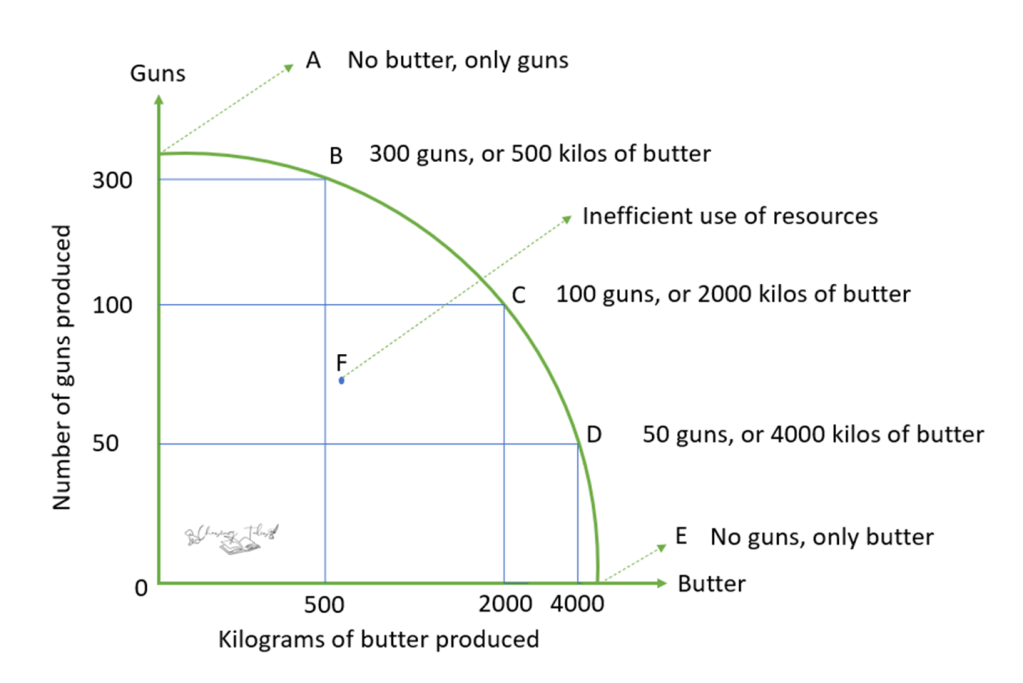
Imagine a hypothetical world where all resources can only be used to produce either ‘guns’ (military goods) or ‘butter’ (civilian goods). The more guns an economy produces, the fewer kilos of butter it can make, because resources are finite. This trade-off is represented by the Production Possibility Frontier (PPF), which shows all efficient combinations of the two goods. In an efficient economy, all resources must be used to produce either of these products, and when an economy chooses to produce less than it can, it is considered inefficient use of resources.34

Production Possibility Curve

Moving along the curve from more butter and fewer guns to more guns and less butter shows the opportunity cost: how many units of butter society must give up to produce one more unit of guns. That sacrifice is the opportunity cost of additional guns. Points outside the curve are unattainable with current resources and technology; they can only be reached if the economy grows or technology improves. Points inside it represent waste or unemployment, where some resources are idle or misallocated.34

Every economy must answer three fundamental questions:​15

What should be produced?: This is about the mix of goods and services: food vs. defence, education vs. luxury items, public infrastructure vs. private consumption.

  • In a market economy (capitalism), this question is largely answered by consumer demand and profit signals. If people are willing to pay more for smartphones than for pagers, firms produce smartphones.
  • In a centrally planned economy, the government decides: for example, a state plan might say “this year we will produce X tonnes of steel and Y units of tractors.”
  • In mixed economies (which is almost every modern country), markets decide most things, but governments step in for public goods and basic needs (roads, schools, defence, basic healthcare).

How should it be produced?: This relates to production methods, technology, and the combination of factors of production.

  • A labour‑abundant country might choose labour‑intensive methods (for example, more workers, fewer machines) because labour is relatively cheap.
  • A capital‑rich country might use highly mechanised production lines and automation.
  • Environmental policies can also play a role: stricter pollution laws might push firms toward cleaner but more expensive technologies.

For whom should it be produced?: This is about distribution: who gets the goods and services once they are produced?

  • In a pure market system, distribution is based largely on income and wealth. Those with higher incomes can command a larger share of output.
  • Governments modify this market outcome through taxes, subsidies, and transfer payments. Different societies choose different degrees of redistribution depending on their values about equity, efficiency, and fairness.

As with all things in economics, this model too is based on multiple assumptions and is a drastically simplified explanation of the real world:

  • Resources are fixed for the time period analysed
  • Technology does not change
  • The model shows only two goods for simplicity
  • All resources are fully and efficiently employed

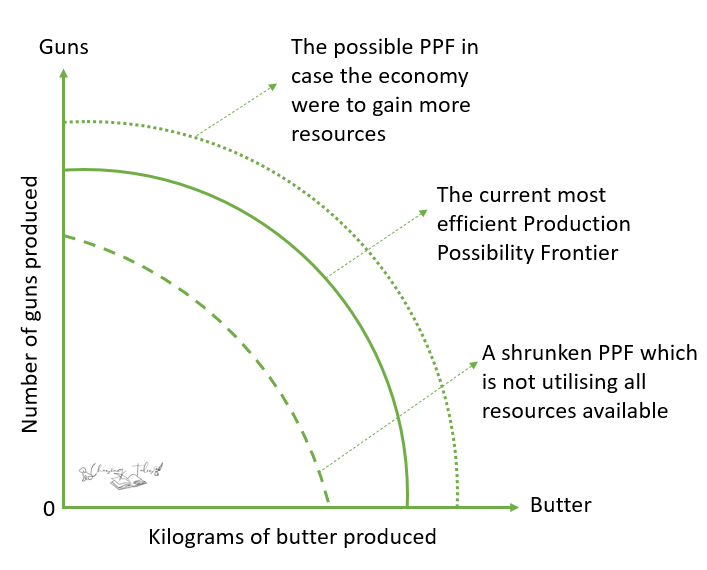
In the real world, economies grow over time as they acquire more resources (labour, capital) or develop better technology. This shifts the PPF outward, allowing production of more goods and services. Conversely, wars, natural disasters, or institutional collapse can shrink the PPF inward. Here’s a diagram depicting what happens to the PPF when such events occur:

An expanding or contracting Production Possibility Frontier

Factors of Production67
There are currently four accepted factors of production in economics: Land, Labour, Capital, and Entrepreneurship.

  • Land represents all natural resources, such as soil, water, minerals, forests, etc. The availability of these resources depends on a country’s location and directly influences which industries it can develop. A nation rich in oil has different economic opportunities than one with abundant forests or fertile farmland.​
  • Labour is the physical and mental effort people use to produce goods and services, including their skills, knowledge, and time. Education, training, the quantity of population, and workforce health directly impact a nation’s productive capacity.
  • Capital are the physical and financial resources used in production. Physical capital includes machinery, buildings, tools, and equipment that help workers produce more efficiently. Financial capital refers to the money available for investment in developing new factories, technologies, or infrastructure. A country with abundant capital can invest heavily in production facilities and research, accelerating economic growth.
  • Entrepreneurship is an intangible factor of production- the ability and willingness of individuals to take risks, innovate, and create new businesses. Entrepreneurs identify opportunities, combine the other factors of production in new ways, bearing risk and driving innovation and economic change.​

These factors of production interact with each other to create an economy.

Microeconomics891011
Microeconomics focuses on individual decision-makers such as consumers, workers, and businesses, and how they allocate their limited resources.

The key to understanding microeconomic behavior is the concept of utility. “Utility” is the satisfaction, happiness, or value a person receives from consuming a good or service. Imagine an individual is very thirsty. They therefore drink water, and gain satisfaction from their thirst being quenched. At this point they can continue drinking water if they are still thirsty, and continue to gain satisfaction. However, the second cup of water will not be as pleasant as the first. The third is likely to be even less so. This is the principle of diminishing marginal utility (in economics, “marginal” means additional): each additional unit of consumption provides progressively less satisfaction than the previous one, until a point is reached when zero additional utility is gained from consuming water (or whatever). After this point, marginal utility turns negative: if they keep consuming more water, they’ll get sick.

Diminishing marginal utility explains everyday consumer behavior. At each decision point, consumers unconsciously ask: “Is the satisfaction I’ll get from this additional unit worth what I’m paying for it?” When marginal utility (the satisfaction from one more unit) exceeds the price, consumers buy. When it falls below the price, they stop. This individual decision-making across millions of consumers creates the market’s total demand and helps determine market prices.

Microeconomics also examines production decisions. Businesses constantly ask: Should we expand production? Should we hire more workers? Should we invest in new equipment? These decisions depend on costs and expected revenues, which means they depend on whether the marginal benefit of an additional unit of production exceeds the marginal cost. A business expands as long as producing one more unit adds more to revenue than it adds to cost. When marginal cost exceeds marginal revenue, expansion stops.

Macroeconomics12131415
Macroeconomics studies the economy as a whole. It asks large-scale questions: Why do some nations grow faster than others? What causes inflation? Why does unemployment rise during recessions? How can governments influence these aggregate outcomes?​

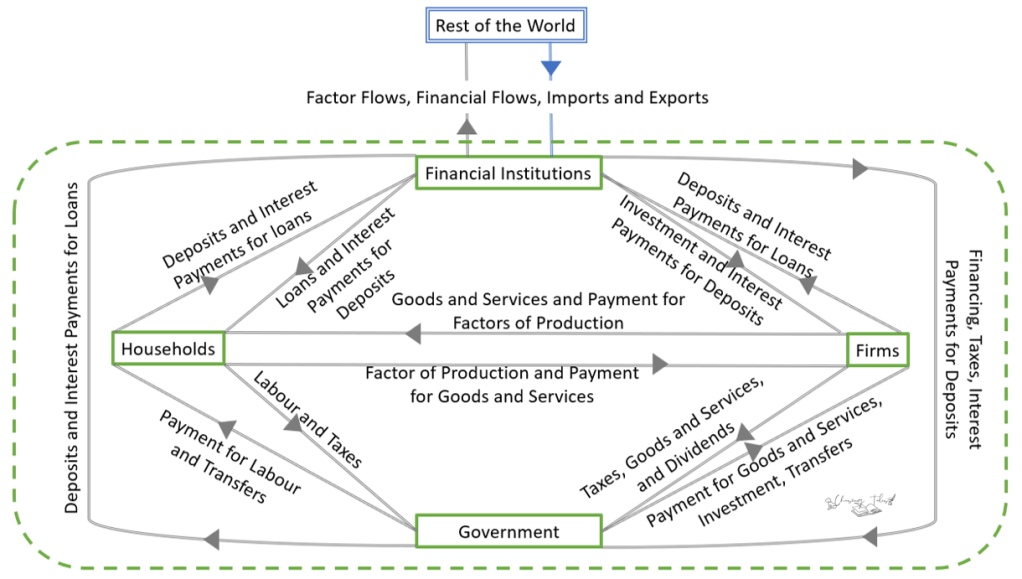
Here’s a diagram:1617

The Circular Flow of Money

This diagram is called the ‘Circular Flow of Money’, and is a schematic representing the flow of money and goods and services in the economy.

Transfer payments are payments made by government (or sometimes private institutions) to individuals or businesses where no good or service is produced or exchanged in return. Unlike government purchases, which are payments for goods and services the government uses (like buying equipment or paying workers to build roads), transfer payments simply redistribute money from one group to another. The money is transferred from the government’s coffers (funded by taxes) to recipients who are then able to spend it into the economy. These payments are injections into household and firm budgets, and examples include unemployment benefits, lower or no cost medical facilities, food aid, business subsidies, etc.

There are five actors in this diagram: within an economy (inside the green dashed line), are Households, Firms, Financial Institutions, and Governments. Outside the economy being studied is the Rest of the World. Each country or economy in the world will have the same four actors according to this model.

  • Households are individuals and families who own the factors of production (land, labour, capital, and entrepreneurship) and consume goods and services. They supply labour to firms and government, provide capital to financial markets through savings, and spend their income on consumption.
  • Firms (businesses) are organisations that combine factors of production to create goods and services. They pay households for labour, borrow from financial institutions for investment, pay taxes to government, and trade with the rest of the world.
  • Government (local, regional, and national) collects taxes, provides public goods and services, makes transfer payments, employs workers, and uses financial markets to manage surpluses and deficits. They inject money into the economy through purchases, wage payments, as well as transfers/ redistribution, and withdraw money through taxation.
  • Financial Institutions (banks, investment firms, stock markets) accept savings from all sectors, provide loans and investment capital, facilitate all transactions in the economy, and connect domestic savers with both domestic and international borrowers.
  • The Rest of the World represents all international economic activity—foreign countries, their consumers, their businesses, and their financial institutions. It connects domestic economies to global trade and international capital flows.

Since this is a schematic, the circular flow is based on simplifying assumptions, and is in any case a theoretical snapshot. It does not explicitly capture:

  • Underemployment or unemployment
  • Inequality and wealth concentration
  • The detailed behaviour of governments and financial institutions
  • Financial crises or speculative bubbles

The fundamental exchange of labour and capital flowing from households to firms, while goods and wages flow back represents the engine of the economy. One person’s spending becomes another’s income, creating a self-sustaining circular motion. When you buy groceries, you become income for the store’s employees, the farmer, the truck driver, and countless others in the supply chain. When they spend their wages, they create income for teachers, mechanics, doctors, and others.

This is why consumer spending matters so much for economic health. When households reduce consumption due to economic uncertainty, the immediate effect is lower revenue for firms. Firms respond by producing less, hiring fewer workers, and paying lower total wages, which means less income for households to spend, further reducing consumption. This negative feedback loop can trigger recessions. Conversely, when consumer confidence is high and households spend freely, firms expand, hire workers, pay higher wages, and the positive feedback loop accelerates growth.

Scaling individual choices
While individual consumers make utility-maximising choices and individual businesses make profit-maximising decisions, the aggregate of all these individual decisions creates macroeconomic outcomes.​

When millions of consumers reduce their spending due to economic uncertainty, the aggregate effect is lower total consumption, reduced business revenues, lower investment, and slower economic growth. When governments lower taxes, households have more income to spend, which increases aggregate demand, prompting businesses to expand production and hire more workers. The multiplier effect amplifies these changes—an initial increase in spending creates a chain reaction of income and spending throughout the economy.

Interest rates illustrate this connection perfectly. A central bank raises interest rates to control inflation. Individually, this makes borrowing more expensive for a business considering a factory expansion. Collectively, as thousands of businesses postpone investment due to higher borrowing costs, aggregate investment falls, economic growth slows, and inflation moderates. The macroeconomic outcome emerges from millions of individual microeconomic decisions.

Individual choices by producers and consumers aggregate to determine what the entire economy produces and how. People choose what they want, whatever they think is best for them in the given moment keeping their personal constraints and preferences in mind, and this helps the entire economy choose what to produce, and how much, and using what methods.

How does this happen? The point at which the entire market settles is called an equilibrium. This is the point where the total demand in the economy matches the total supply.

Aggregate demand (AD) is the total amount of all goods and services that all buyers in an economy want to purchase at different price levels. It includes:

  • Consumer spending (households buying groceries, clothes, services)
  • Business investment (firms buying machinery, building factories)
  • Government purchases (roads, schools, defence)
  • Net exports (exports minus imports)

When the overall price level in the economy rises (inflation), people can afford less with their income, so the total quantity of goods and services demanded tends to fall. Conversely, when the price level falls, purchasing power increases, and aggregate demand rises.

Aggregate supply (AS) is the total amount of goods and services that all producers in an economy are willing to supply at different price levels.

In the short run, firms respond to higher prices by producing more (because higher prices mean higher profits). So when the price level rises, the quantity of goods and services supplied tends to increase. When prices fall, firms have less incentive to produce, so aggregate supply falls.

Over the long run, however, aggregate supply is determined by the productive capacity of the economy—the factors of production available (labour, capital, land, entrepreneurship) and the technology used. In this longer view, the price level does not affect how much the economy can fundamentally produce; that is determined by real resources and efficiency.

Macroeconomic equilibrium occurs when aggregate demand equals aggregate supply at a particular price level. At this equilibrium:

  • The total amount consumers, businesses, and governments want to buy matches the total amount firms want to supply.
  • There are no unintended accumulations of inventory (which would push prices down).
  • There are no widespread shortages (which would push prices up).
  • The economy settles at this price level and output level, unless something external changes.

When aggregate demand exceeds aggregate supply: The total spending in the economy is greater than the total output available. Imagine households and businesses want to buy more goods and services than firms can produce. This creates upward pressure on prices because:

  • Firms see strong demand and can raise prices without losing customers.
  • Businesses invest more to expand capacity.
  • Workers may demand higher wages due to tight labour markets.
  • This tends to push the price level upward (inflation).

If this imbalance persists, it can lead to “overheating” of the economy—rapid inflation as the economy bumps against its productive limits.

When aggregate supply exceeds aggregate demand: The total output produced is greater than what people want to buy. Firms end up with unsold inventory and spare capacity. This creates downward pressure on prices because:

  • Firms lower prices to try to sell their excess stock.
  • Businesses postpone investment and lay off workers due to weak demand.
  • Workers have less bargaining power, and wage growth slows.
  • This tends to push the price level downward (deflation or disinflation).

If this imbalance persists, it can lead to recession or stagnation, low growth, rising unemployment, and falling prices as the economy operates below its potential.

Over time, price changes and behaviour adjustments push the economy back toward equilibrium:

  • If demand is too high and inventories are depleting, firms raise prices. Higher prices cool demand (people buy less because it is more expensive) and encourage supply (firms produce more because profit margins are higher). Gradually, demand and supply rebalance.
  • If demand is too low and inventories build up, firms cut prices. Lower prices stimulate demand (people buy more because it is cheaper) and discourage supply (firms produce less because margins shrink). Again, they move toward balance.

In theory, this self-correcting mechanism should prevent persistent shortages or surpluses (this is what economists call “the invisible hand”, a metaphorical description of how the market corrects over‑ and under‑production, over‑ and under‑pricing, and similar imbalances). However, in the real world, these adjustments take time, and other factors (such as government policy, shocks, or expectations) can push the economy away from equilibrium before it settles.

AspectMicroeconomicsMacroeconomics
FocusIndividual consumers, workers, firmsEntire economy, aggregate levels
Key questionsHow do people allocate limited resources? Why do prices change?Why do economies grow? What causes inflation and unemployment?
Key actorsConsumers, workers, businessesHouseholds, firms, governments, financial institutions, rest of world
Unit of analysisUtility, profit, marginal decisionsAggregate demand, aggregate supply, price levels, employment
Difference between Micro and Macro Economics

Modern applications1819
Traditional economic theory provides the foundation for understanding modern economies, which operate through sophisticated systems of banking, credit creation, and financial markets.

In traditional economies, money was often physical (coins and notes) and the money supply was limited by the amount of precious metal a nation possessed. Modern economies operate through a very different system where banks create money through lending: imagine a saver deposits INR 1,000 in a bank, the bank immediately lends most of that money to a business seeking a loan- let’s say INR 900. The business spends that INR 900, which ends up as deposits in another person’s bank account. That second bank then lends 90% of the INR 900, and the process repeats.​ They don’t lend the entire amount because they are required to keep a certain amount in reserve with the central bank. In India, this is called the Cash Reserve Ratio.20

The Cash Reserve Ratio is the percentage of a bank’s total deposits that must be held as liquid cash with the central bank, such as the Reserve Bank of India (RBI). It is a monetary policy tool used by the central bank to manage the money supply, control inflation, and ensure banks have enough liquidity to meet withdrawal demands (that is, the bank should have the money required for a normal amount of withdrawals). Banks cannot use this money for lending or investment, and they do not earn interest on it.

Suppose:

  • The CRR is 10%.
  • A person deposits INR 1,000 in a commercial bank.

The bank must keep INR 100 (10%) as reserves with the RBI, and can lend out INR 900. When that INR 900 is deposited by someone else:

  • The second bank keeps 10% (INR 90) as reserves and lends out INR 810.
  • The process repeats: each round, 10% is held as reserves, and 90% is lent out again.

In theory, the maximum amount of new deposits that can be created from the original INR 1,000 is determined by the money multiplier, which equals 1 divided by the reserve ratio (this is a simplified ‘maximum’ scenario. In practice, banks may be constrained by capital requirements, borrower demand, regulation, and risk management, so the actual expansion of money is usually smaller than the theoretical maximum).

If the reserve ratio (CRR) is 10% (or 0.10), then the money multiplier is 1 ÷ 0.10 = 10.

This means that the original deposit of INR 1,000 can theoretically support up to INR 10,000 in total deposits across the banking system (INR 1,000 × 10 = INR 10,000).

  • Banks may hold extra reserves.
  • People may hold some cash rather than depositing all their money.

This process is called credit creation or the money multiplier effect, where the original INR 1,000 deposit can eventually support INR 10,000 or more in total money supply in the economy. Banks don’t simply lend out existing money; they create “new” money through the lending process. This is why controlling the money supply is central to macroeconomic management.

In conclusion, traditional economic theory, built on scarcity, opportunity cost, and the interaction of supply and demand, gives us a language for understanding economic choices. It does not tell us what ought to be produced or who should benefit, but it clarifies the trade-offs and shows how millions of individual decisions aggregate into the performance of entire economies.

Sources

  1. Lesson summary: Scarcity, choice, and opportunity costs – Khan Academy
  2. Scarcity and Opportunity Cost – LibreTexts, Econ 101: Economics of Public Issues
  3. Production Possibility Frontier (PPF): Purpose and Use – Investopedia
  4. Complete Guide to the Production Possibilities Curve – ReviewEcon
  5. Scarcity, Choice and Opportunity Cost – Physics & Maths Tutor (A‑level notes, PDF)
  6. Factors of Production – Wall Street Prep
  7. Factors of Production: Land, Labor, Capital and Entrepreneurship – Corporate Finance Institute
  8. Microeconomics – Investopedia
  9. Microeconomics course home – Khan Academy
  10. 14.01SC Principles of Microeconomics – MIT OpenCourseWare
  11. Microeconomics – Encyclopedia Britannica
  12. Macroeconomics – Investopedia
  13. Macroeconomics course home – Khan Academy
  14. What is macroeconomics? – Board of Governors of the Federal Reserve System
  15. Macroeconomic and Fiscal Policy – World Bank (Economic Policy topic)
  16. The Circular Flow of Income – Saylor “Economics: Theory Through Applications”
  17. Circular Flow Model: Definition & Examples – Study.com
  18. Multiplier Effect: How Fractional Reserve Banking Creates Money – Management Study Guide
  19. Banking and the Expansion of the Money Supply – Fiveable (AP Macroeconomics)
  20. Cash Reserve Ratio (CRR): Meaning, Objectives & Current CRR – ClearTax