Markets

NB: Not an economist. At all.

I found that I was constantly writing about different kinds of markets without explicitly talking about them, so here’s a quick primer on what markets are. Generally on this website, I speak of markets as a general‑purpose system for allocating burdens, risks, and rewards through prices (or price‑like trade‑offs), rather than a narrow place where “goods are sold”, however, let’s look at how economics looks at them.

Scarcity12
Markets originate from scarcity.

Most resources are scarce, so they attract competition for who can possess or use them. The scarcer a resource, the greater the competition.

This causes a conflict, because many of us want the same scarce things, and so not all of us can have it (scarcity), therefore there needs to be a mechanism which allows us to “distribute” the resources in question.

Economists typically distinguish between natural scarcity (finite deposits of oil, land) and artificial scarcity (patents, exclusive licences, paywalled content), where supply is deliberately restricted rather than inherently limited. Artificial scarcity is a choice someone made, and is often a market feature used to incentivise creation (like patents) but becomes a market failure when it merely protects a monopoly; natural scarcity is a constraint the world imposed.

A market is a decentralised way to coordinate who gets what, when, and on what terms, using prices (or price‑like trade‑offs) instead of a central command.

Markets34
In economics, a marketplace need not actually be a place. It is any set up where buys and sellers can meet, whether physically, postally, or digitally, where they can exchange goods and/ or services for a price both parties agree upon. A market must have the following three qualities:

  1. Buyers and sellers can find each other (directly or via intermediaries).
  2. They can propose and respond to prices.
  3. They can actually complete trades under some agreed rules.

The price can be the explicit price, such as rupees per kilo, dollars per share, or an implicit one where there is a trade‑off in time, risk, or access.

Here are some examples:

  1. Buying goods and services: Retail shops, online platforms, and local mandis are all market institutions.
  2. Working for pay: Job boards, recruitment drives, and informal hiring channels are part of labour markets.
  3. Saving and borrowing: Bank deposits, loans, mutual funds, and stock trading are ways of participating in financial markets.
  4. Using shared resources: Paying for mobile data, electricity, or spectrum licences involves markets (sometimes heavily regulated) for underlying rights or capacity.

For markets to exist, these three conditions must exist:

  1. Mutual benefit: Voluntary trade only happens if both sides believe they are better off after the trade than before. I value the thing I’m buying more than the money I give up; you value the money more than the thing you’re selling. If either side does not feel this way, the trade simply doesn’t happen. After a VOLUNTARY trade, at least one party is better off and neither is worse off than before- this is called a Pareto Improvement. Note that the trade must be voluntary. This condition breaks down when markets shade into exploitation instead of exchange, such as when there is coercion, lack of real alternatives, or misinformation.
  2. Property and usage rights: There has to be some notion of “mine” and “yours.” You must be allowed to sell or lease what you hold; I must be allowed to buy it. This can be formal (land titles, contracts) or informal (everyone in the village agrees that this field is yours), but some recognised right to control and transfer is needed.
  3. Trust and enforcement: When I hand over my money, I need to trust that I will actually receive the good or service, and vice versa. That trust might rest on law courts, regulators, reputation, or community norms. Without some enforcement—formal or informal—exchange becomes too risky to sustain.

Price45
In economics, a price is the amount of something you must give up to get one more unit of something else. Most of the time that “something” is money- for example, rupees per kilo of rice, dollars per share of stock, but it can also be another good in a barter trade, your time, or a change in risk you are willing to accept.

More formally: In a money economy, price is the amount of money required to purchase one unit of a good, service, or right. In barter, it is the rate at which two goods exchange—for example, “three eggs for one roti.”

In relative terms, you can think of the relative price of A in terms of B as “how many units of B does one unit of A cost?” So a price is a rate of exchange. It tells you “one unit of this is worth this much of that, here and now.”

You can immediately separate three related but different ideas:

  • Price: what is actually paid or quoted in the market at a given moment.
  • Cost: what it takes the seller to produce and offer the thing (inputs, effort, time).
  • Value: how much the buyer feels it is worth to them, which may be higher or lower than the price.

In everyday speech, “price” can mean the tag on a product, a number in a contract, or the figure someone mentions in a negotiation.

Economists usually distinguish:

  • Asking price / list price: What the seller initially posts or demands.
  • Bid price: What a buyer is currently willing to pay.
  • Transaction price (or market price): The price at which an actual trade happens.

In a competitive, active market, many transactions happen over time. The market price at a moment is the going rate at which the good or service is trading—what buyers are paying and sellers are accepting in that marketplace. In your posts, when you say “price”, this is usually what you’re pointing to: the number that comes out of the interaction of demand and supply, not just what one side wishes it were.

Another couple of useful adjectives for later:6

  • Nominal price: The price expressed in current money terms—“₹100 today.”
  • Real price: The price adjusted for the overall price level (inflation) or expressed relative to another good (“how many bus rides a kilo of tomatoes costs compared to last year.”)

For most of this primer, “price” can safely mean the simple, nominal market price. The real/relative distinction becomes important when you compare across time or across goods.

Prices do two jobs:

  1. Carry Information7: This is called “Price Signal”. A rising price often signals that, at current quantities, demand is strong relative to supply; a falling price signals the opposite. You do not need to know the full back‑story (crop failure, input cost increase, a viral social‑media trend). The change in price is a compact way the market tells everyone, “this has become relatively scarcer/desirable” or “this has become relatively more abundant/unwanted.”
  2. Provide Incentive: Higher prices encourage producers to supply more (if they can) and discourage some buyers from purchasing; lower prices do the reverse. This is just the law of supply and demand written as a feedback loop.

There is this cool essay called “The Use of Knowledge in Society” by Friedrich A. Hayek which argues that no central planner can ever gather or process the dispersed, local knowledge held by millions of individuals, and yet prices aggregate all of that knowledge into a single number that everyone can act on without needing to know the backstory.4

This was demonstrated in 1986 after the Challenger Space Shuttle disaster89, when on January 28, 1986, the Space Shuttle Challenger tragically broke apart 73 seconds into flight due to a failure of the O-ring seals in the right solid rocket booster. The rocket boosters were manufactured by Morton Thiokol. While the official investigation took months, the stock market reacted within minutes of the explosion with heavy selling. Twenty-one minutes after the explosion, Lockheed’s stock was down 5%, Martin Marietta’s was down 3%, and Rockwell was down 6%. But something unusual was happening with Thiokol. So many investors were trying to sell its shares, and so few were willing to buy, that the New York Stock Exchange halted trading in Morton Thiokol almost immediately, the only one of the four contractors to be suspended. When trading resumed nearly an hour later, the stock was already down 6%. By market close, it had fallen nearly 12%, shedding approximately $200 million in market capitalisation in a single day. The other three contractors, by contrast, recovered through the afternoon and ended the day down only 2-3%.

The market turned out to be correct. When the Rogers Commission released its report in June 198610, it concluded that the O-ring seals on the booster rockets manufactured by Thiokol had failed in the cold temperatures of that January morning, allowing hot gases to escape and ignite the main fuel tank. Thiokol was held liable. The other three contractors were exonerated. Finance professors Michael T. Maloney and J. Harold Mulherin, who studied the market’s reaction in detail, found no evidence of insider trading or manipulation — the market had simply aggregated the dispersed, partial knowledge of thousands of investors, each acting on their own reading of publicly available information, and produced a price signal that pointed, with remarkable precision, to the right culprit within half an hour of the disaster. The $200 million wiped from Thiokol’s market cap that afternoon, Maloney and Mulherin concluded, turned out to be almost exactly what the company eventually lost in real cash flows once culpability was formally established.

This is truly one of my favourite anecdotes about markets. Price is not arbitrary. It is the outcome of many pushes and pulls, such as what people are willing to give up, what it costs to provide, how many alternatives there are, and what rules and power structures sit around the transaction.

Choice11
Because resources are scarce, they have prices attached to them, and because people don’t have unlimited barter goods or money, they have to make a choice about how to use their barter goods and money so they can have their most desired resources.

Each individual decides what resources they wish to have, and how much they are willing and able to pay for it given their own resource constraints (limited amount of money or barter goods). This is the demand side of the economy.

At the same time, each producer, or owner of resources, decides how much they wish to sell or barter their resources for. As we saw above, prices carry information and nudge behaviour- when a resource has many potential buyers, its price will naturally rise up as some people will be willing to pay more for it than others, and this will continue until the demand equals the amount of the resource that is available for sale.

The sale side of the market is called the supply side. Markets exist where demand = supply.12

However, when buyers pay less than they were willing to pay, the difference is called consumer surplus. When sellers receive more than their minimum acceptable price, the difference is known as producer surplus. These two ideas explain how much voluntary trade benefits both sides, and why markets, when they work well, are not zero-sum games- when both surpluses are added together, economists call it total welfare or social surplus. Basically:

  • Consumer Surplus13: The “I would have paid $10 but it only cost $5” feeling.
  • Producer Surplus14: The “It only cost me $2 to make, but I sold it for $5” feeling.
  • Total Welfare: The sum of both. This is why economists get so upset about taxes or regulations that “shrink the pie” (the permanent loss of total welfare, called deadweight loss).

Opportunity Costs1516
An interesting and slightly esoteric concept, opportunity cost is the cost of the alternative people don’t choose.

Economists assume people are rational (as we know, this is not always true, and it has been demonstrated by some economists- it’s not that people are “stupid” or “irrational”; it’s that we have limited time, limited information, and “shortcuts” (heuristics) in our brains), which means that they are able to rank how much they desire different resources. Because (in a money market), their resources to purchase the different resources are scarce, economists assume that they will buy a higher ranked resource before they purchase a lower ranked resource. But, they did desire the lower ranked resource too, just not as much as the higher ranked one, so their choice of purchase is double edged- when a person chooses to purchase something, because their resources are scarce, they are also choosing to not purchase something. The cost of what they did not purchase is called the opportunity cost.

Why does it matter? Because we are now aware of what we are giving up, we are forced to understand the trade off, and it helps us make the best choices possible for our particular situation (how much money we have and what we need to buy).

The concept of opportunity cost helps make better choices by accounting for scarcity of resources and highlighting what we are giving up when we make a choice to have something else instead of the lower ranked item, and it guides individuals and firms to choose options that yield the highest possible returns.

In economics, it is used in the following ways:

  • Decision-Making: It forces individuals and businesses to consider what they lose by choosing one option over another. In business, it helps managers determine the best use of limited resources (time, money, labour), such as choosing between two different projects.
  • Investment Strategy: Investors use it to weigh potential returns of one asset against another, evaluating what they forego by holding a particular investment.
  • Policy Analysis: Governments use it to assess the true cost of policies, such as the expense of infrastructure versus healthcare.
  • Valuing Time: Economists convert time spent into monetary values to measure the cost of non-monetary choices.

So, every time you say “Yes” to a purchase or a project, you are implicitly saying “No” to everything else you could have done with the resources you are spending on it- time, money, or any other resource you use as payment. Price is what you pay; Opportunity Cost is what you lose.

What Markets Do417
Markets are where prices meet choices.

Individuals and organisations constantly face choices: buy or not buy, work here or there, save or spend, invest now or later. Price is the visible side of the trade‑off; their time, energy, money, and goals are the invisible side.

At a very high level:

  • If the price of something is below what it is worth to you, you are tempted to buy.
  • If the price is above what it is worth to you, you walk away.
  • If you are a seller, you are more willing to supply when price is high enough to comfortably cover your costs and effort; less willing when it is not.

A market is the environment in which all those individual “yes/no/ how much?” decisions, at given prices, add up to visible quantities traded and visible prices changing over time. This is called Aggregation. Markets bring together millions of individual choices and converge on one data point- price of the resource on sale.

Market Structures181920
Different resources live in different types of markets. Market structure is the degree of competition among buyers and sellers. The four canonical structures are:

StructureSellersPrice ControlExample
Perfect competitionManyNone- the price is determined entirely by the aggregate market. Perfect competition is an analytical ideal that rarely exists in pure form — it functions as a benchmark against which real markets are measured, not a description of reality.Agricultural commodities come closest, but there is no real market which is perfectly competitive, except in economists’ dreams.
Monopolistic competition. ManySlight- to an extent, sellers can decide their price bands. Restaurants, clothing brands
Oligopoly. The buyer side equivalent is called an Oligopsony (few buys many sellers).FewSignificant- because there are fewer sellers, buyers are price takers, that is, they have less control as a group on the prices being charged for the resource as there are few alternative sellers availableTelecom, airlines. For oligopsony: the handful of large apparel brands sourcing from thousands of small garment manufacturers.
Monopoly. The buyer-side equivalent is called a Monopsony (one buyer many sellers). OneHigh- since there is only one seller, this seller can dictate the price to the market.Utilities, some pharmaceutical drugs. For monopsony: the government’s procurement of agricultural produce through MSP (Minimum Support Price)

Understanding structure matters because it shapes how and how likely a market is to fail.

Market Failure212223
Markets are a powerful mechanism for allocating resources, but they are not infallible. A market failure occurs when the price mechanism produces an outcome that is inefficient or socially suboptimal. This happens when the prices that buyers and sellers agree on fail to reflect the full costs or benefits of a transaction to everyone affected by it. Economists identify four core causes.

  • The first is externalities24: when a transaction imposes costs or confers benefits on parties outside the trade itself, those effects go unpriced. A factory that dumps waste into a river lowers costs for its shareholders while imposing costs on every downstream community, which are costs the market price of its product never captures. Most externalities (like pollution) happen because property rights are poorly defined—no one ‘owns’ the air, so no one can charge the factory for using it as a trash can.
  • The second is public goods25: goods that are non-excludable (you cannot stop people from using them) and non-rival (one person’s use doesn’t reduce another’s), such as clean air, national defence, or open-source software — private markets systematically underprovide these because no one can easily charge for them.
  • The third is information asymmetry26: when one side of a trade knows something the other doesn’t, prices become distorted. A seller of a used car knows its history; the buyer doesn’t. An insurer cannot fully verify how recklessly a policyholder will behave once covered- this specific problem is called moral hazard. A related problem, called adverse selection, happens before the deal is made: the pool of sellers disproportionately contains those with worse goods to offload, because owners of high-quality goods are less likely to sell.
  • The fourth is market power: when a single firm or a cartel of firms controls enough of the supply to set prices above competitive levels, buyers pay more and less of the good is produced than society would collectively prefer.

    These four failures are precisely why the most contested markets such as for carbon, for data, for healthcare, are so politically charged: they are riddled with externalities, public-good characteristics, and deep information asymmetries, which means the price that emerges from voluntary trade systematically underestimates the true social cost, or overestimates the true social benefit, of what is being exchanged.

Markets answer who gets what (whoever has the most purchasing power and willingness to pay), but they do not answer who should get what. Even a perfectly functioning market with no failure can produce outcomes that are efficient but deeply unequal. This is the gap that political economy and policy fill, because market prices can give very misleading signals for long periods, as the 2008 financial crisis demonstrated, and as climate change, the canonical externality failure, continues to demonstrate.

Government Failure272829
Government intervention is the standard prescription for market failure- but governments fail too, and in predictable ways. Regulators can be captured by the industries they oversee, producing rules that protect the producers rather than consumers or the public. Governments also face the same knowledge problem that price signals solve in markets: setting the right carbon price, the right drug approval threshold, or the right spectrum fee requires information that is dispersed, contested, and often unavailable to any central authority. Politicians respond to electoral incentives, not social welfare functions, so policies tend to favour the short-term and the visible over the long-term and the diffuse. And interventions in complex systems produce unintended consequences: for example, rent controls create housing shortages, agricultural price supports depress farmers in poorer countries, financial regulations push risk into unregulated corners of the system.

The choice is therefore never “flawed market vs. perfect government.” It is always “this particular market failure vs. this particular government failure”, which is precisely what makes policy so hard, and so interesting.

Non-Market Allocations3031
To define what a market is, it often helps to briefly mention what it isn’t. If we don’t use markets to allocate scarce resources, we use:

  • Rationing: A central authority decides.
  • Queuing: First come, first served.
  • Lottery: Random chance.
  • Violence/ Power: Might makes right.
  • Social Norms and Reciprocity – The economist Elinor Ostrom won the Nobel Prize in 2009 for showing that communities can sustainably manage shared resources, such as fisheries, forests, irrigation systems, without either markets or top-down authority, using informal rules and reputation. (Ostrom’s contribution was specifically about common-pool resources, which are goods that are rival (one person’s use depletes the stock) but non-excludable (cannot prevent anyone from using them), such as fisheries and groundwater. This is distinct from public goods (non-rival, non-excludable), and from private goods. Her insight was that this middle category could be self-governed through community institutions. Her work directly challenged Garrett Hardin’s influential 1968 argument, known as the tragedy of the commons, that shared resources are inevitably destroyed because each individual has an incentive to exploit them before others do.32)33

In practice, most real-world allocation systems are hybrids. A hospital’s ICU uses queuing (who arrived first), rationing (clinical triage), and implicit pricing (quality of insurance) simultaneously. Pure market allocation is an analytical ideal, not an empirical description.

Whenever you see me write about markets, I’m not just talking about money. I’m talking about how we, as a society, are currently calculating what is scarce, what is valuable, and who is willing to pay the price to claim it.

Sources
For most of the concepts in this primer, see any introductory microeconomics textbook. I personally love the ones by Ambika Gulati, who taught me economics in XI and XII grades.

  1. Scarcity — Investopedia
  2. Market Equilibrium — Economics Help
  3. Market Economy — Investopedia
  4. The Use of Knowledge in Society — Friedrich A. Hayek (EconLib)
  5. Price — Investopedia
  6. Nominal Value — Investopedia
  7. The Economics of Price and Quantity Signals — The Daily Economy
  8. The Stock Market Reaction to the Challenger Crash — Maloney & Mulherin (PDF)
  9. The Disaster Market — Slate
  10. Report of the Presidential Commission on the Space Shuttle Challenger Accident — NASA
  11. Law of Supply and Demand — Investopedia
  12. Supply & Demand Market Equilibrium — ReviewEcon
  13. Consumer Surplus — Investopedia
  14. Producer Surplus — Investopedia
  15. Opportunity Cost — Investopedia
  16. Opportunity Cost — Corporate Finance Institute
  17. Prices & Resource Allocation — Maths with David
  18. Market Structure — Investopedia
  19. Market Structure — Corporate Finance Institute
  20. Market Equilibrium — Economics Help
  21. Market Failure — Investopedia
  22. Market Failure — Corporate Finance Institute
  23. Market Failure — Ecoholics
  24. Market Failure (Externalities) — Economics Help
  25. Public Goods — EconLib Encyclopedia
  26. Writing “The Market for Lemons” — George Akerlof (Nobel Prize)
  27. Regulatory Capture — Investopedia
  28. Regulatory Capture — Economics Help
  29. What Are Market Failures? — Oxford Scholastica
  30. Governing the Commons — Elinor Ostrom (Internet Archive)
  31. Elinor Ostrom — EconLib Biography
  32. Tragedy of the Commons — Ostrom Workshop, Indiana University
  33. The Tragedy of the Commons (2008 Essay) — Elinor Ostrom (PDF)
A note on traditional economics

Traditional, as opposed to Environmental Economics, which is a later discipline, and will be a later post.

Economics is the science of human choices, because resources are limited, but human wants are unlimited. This is why every individual, business, and nation must constantly answer one question: how do we allocate our limited resources? We must decide how much goes to needs (essential for survival) and how much to wants (additional desires). This inquiry forms the cornerstone of economic thinking and shapes how modern finance, banking, and capital markets function.12

Because resources are scarce, and each resource can be put to multiple uses, when we choose one thing, we sacrifice something else. This sacrifice is called opportunity cost—the value of the best alternative forgone when making any choice. This is pervasive. An hour of time can be spent cooking, sleeping, watching cricket, gardening, socialising, reading, eating, working out, or any number of other activities. If one activity is chosen, the satisfaction from the others becomes the opportunity cost of that choice.12

Opportunity costs exist at every scale- for each person, for each group of persons (such as a family, or a nation, or our entire species), and for each resource, so that a rupee spent on something is also a rupee not spent on something else. At all times, we are making two choices: how to use our resources, and therefore, how not to use them.12

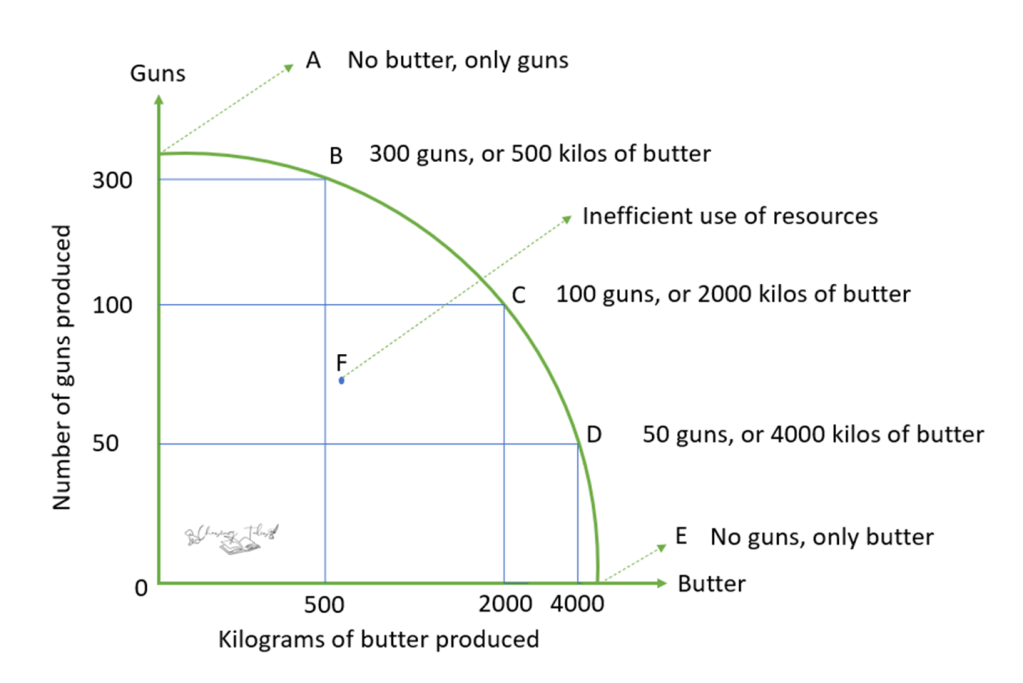
Imagine a hypothetical world where all resources can only be used to produce either ‘guns’ (military goods) or ‘butter’ (civilian goods). The more guns an economy produces, the fewer kilos of butter it can make, because resources are finite. This trade-off is represented by the Production Possibility Frontier (PPF), which shows all efficient combinations of the two goods. In an efficient economy, all resources must be used to produce either of these products, and when an economy chooses to produce less than it can, it is considered inefficient use of resources.34

Production Possibility Curve

Moving along the curve from more butter and fewer guns to more guns and less butter shows the opportunity cost: how many units of butter society must give up to produce one more unit of guns. That sacrifice is the opportunity cost of additional guns. Points outside the curve are unattainable with current resources and technology; they can only be reached if the economy grows or technology improves. Points inside it represent waste or unemployment, where some resources are idle or misallocated.34

Every economy must answer three fundamental questions:​15

What should be produced?: This is about the mix of goods and services: food vs. defence, education vs. luxury items, public infrastructure vs. private consumption.

  • In a market economy (capitalism), this question is largely answered by consumer demand and profit signals. If people are willing to pay more for smartphones than for pagers, firms produce smartphones.
  • In a centrally planned economy, the government decides: for example, a state plan might say “this year we will produce X tonnes of steel and Y units of tractors.”
  • In mixed economies (which is almost every modern country), markets decide most things, but governments step in for public goods and basic needs (roads, schools, defence, basic healthcare).

How should it be produced?: This relates to production methods, technology, and the combination of factors of production.

  • A labour‑abundant country might choose labour‑intensive methods (for example, more workers, fewer machines) because labour is relatively cheap.
  • A capital‑rich country might use highly mechanised production lines and automation.
  • Environmental policies can also play a role: stricter pollution laws might push firms toward cleaner but more expensive technologies.

For whom should it be produced?: This is about distribution: who gets the goods and services once they are produced?

  • In a pure market system, distribution is based largely on income and wealth. Those with higher incomes can command a larger share of output.
  • Governments modify this market outcome through taxes, subsidies, and transfer payments. Different societies choose different degrees of redistribution depending on their values about equity, efficiency, and fairness.

As with all things in economics, this model too is based on multiple assumptions and is a drastically simplified explanation of the real world:

  • Resources are fixed for the time period analysed
  • Technology does not change
  • The model shows only two goods for simplicity
  • All resources are fully and efficiently employed

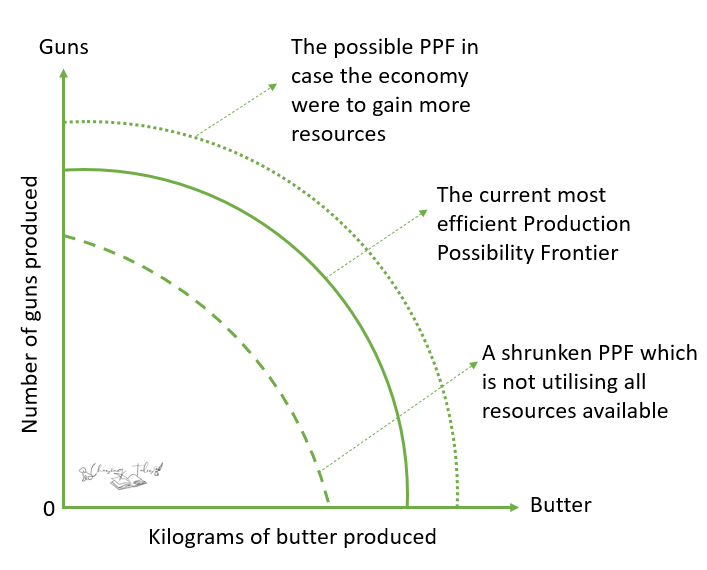
In the real world, economies grow over time as they acquire more resources (labour, capital) or develop better technology. This shifts the PPF outward, allowing production of more goods and services. Conversely, wars, natural disasters, or institutional collapse can shrink the PPF inward. Here’s a diagram depicting what happens to the PPF when such events occur:

An expanding or contracting Production Possibility Frontier

Factors of Production67
There are currently four accepted factors of production in economics: Land, Labour, Capital, and Entrepreneurship.

  • Land represents all natural resources, such as soil, water, minerals, forests, etc. The availability of these resources depends on a country’s location and directly influences which industries it can develop. A nation rich in oil has different economic opportunities than one with abundant forests or fertile farmland.​
  • Labour is the physical and mental effort people use to produce goods and services, including their skills, knowledge, and time. Education, training, the quantity of population, and workforce health directly impact a nation’s productive capacity.
  • Capital are the physical and financial resources used in production. Physical capital includes machinery, buildings, tools, and equipment that help workers produce more efficiently. Financial capital refers to the money available for investment in developing new factories, technologies, or infrastructure. A country with abundant capital can invest heavily in production facilities and research, accelerating economic growth.
  • Entrepreneurship is an intangible factor of production- the ability and willingness of individuals to take risks, innovate, and create new businesses. Entrepreneurs identify opportunities, combine the other factors of production in new ways, bearing risk and driving innovation and economic change.​

These factors of production interact with each other to create an economy.

Microeconomics891011
Microeconomics focuses on individual decision-makers such as consumers, workers, and businesses, and how they allocate their limited resources.

The key to understanding microeconomic behavior is the concept of utility. “Utility” is the satisfaction, happiness, or value a person receives from consuming a good or service. Imagine an individual is very thirsty. They therefore drink water, and gain satisfaction from their thirst being quenched. At this point they can continue drinking water if they are still thirsty, and continue to gain satisfaction. However, the second cup of water will not be as pleasant as the first. The third is likely to be even less so. This is the principle of diminishing marginal utility (in economics, “marginal” means additional): each additional unit of consumption provides progressively less satisfaction than the previous one, until a point is reached when zero additional utility is gained from consuming water (or whatever). After this point, marginal utility turns negative: if they keep consuming more water, they’ll get sick.

Diminishing marginal utility explains everyday consumer behavior. At each decision point, consumers unconsciously ask: “Is the satisfaction I’ll get from this additional unit worth what I’m paying for it?” When marginal utility (the satisfaction from one more unit) exceeds the price, consumers buy. When it falls below the price, they stop. This individual decision-making across millions of consumers creates the market’s total demand and helps determine market prices.

Microeconomics also examines production decisions. Businesses constantly ask: Should we expand production? Should we hire more workers? Should we invest in new equipment? These decisions depend on costs and expected revenues, which means they depend on whether the marginal benefit of an additional unit of production exceeds the marginal cost. A business expands as long as producing one more unit adds more to revenue than it adds to cost. When marginal cost exceeds marginal revenue, expansion stops.

Macroeconomics12131415
Macroeconomics studies the economy as a whole. It asks large-scale questions: Why do some nations grow faster than others? What causes inflation? Why does unemployment rise during recessions? How can governments influence these aggregate outcomes?​

Here’s a diagram:1617

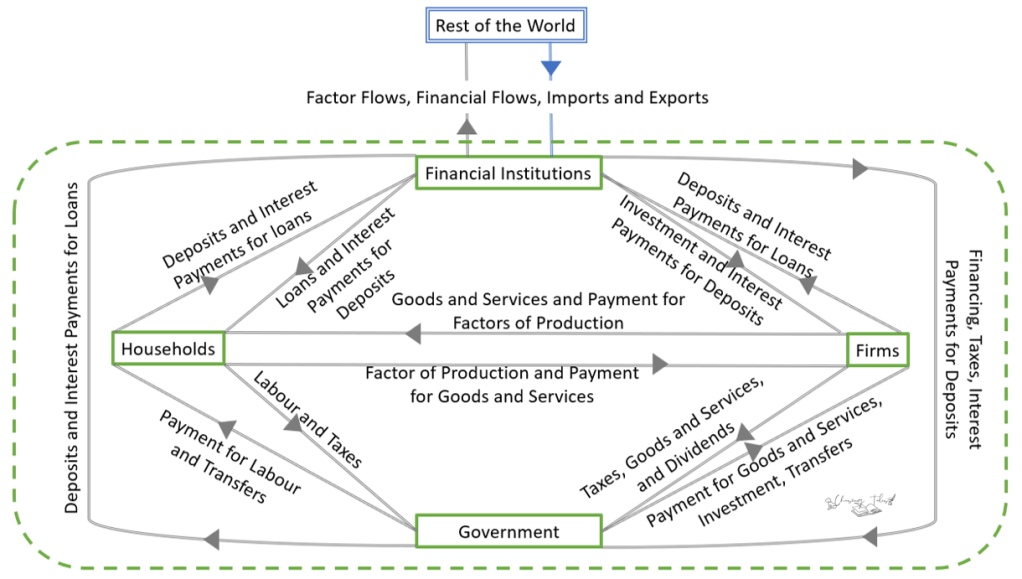
The Circular Flow of Money

This diagram is called the ‘Circular Flow of Money’, and is a schematic representing the flow of money and goods and services in the economy.

Transfer payments are payments made by government (or sometimes private institutions) to individuals or businesses where no good or service is produced or exchanged in return. Unlike government purchases, which are payments for goods and services the government uses (like buying equipment or paying workers to build roads), transfer payments simply redistribute money from one group to another. The money is transferred from the government’s coffers (funded by taxes) to recipients who are then able to spend it into the economy. These payments are injections into household and firm budgets, and examples include unemployment benefits, lower or no cost medical facilities, food aid, business subsidies, etc.

There are five actors in this diagram: within an economy (inside the green dashed line), are Households, Firms, Financial Institutions, and Governments. Outside the economy being studied is the Rest of the World. Each country or economy in the world will have the same four actors according to this model.

  • Households are individuals and families who own the factors of production (land, labour, capital, and entrepreneurship) and consume goods and services. They supply labour to firms and government, provide capital to financial markets through savings, and spend their income on consumption.
  • Firms (businesses) are organisations that combine factors of production to create goods and services. They pay households for labour, borrow from financial institutions for investment, pay taxes to government, and trade with the rest of the world.
  • Government (local, regional, and national) collects taxes, provides public goods and services, makes transfer payments, employs workers, and uses financial markets to manage surpluses and deficits. They inject money into the economy through purchases, wage payments, as well as transfers/ redistribution, and withdraw money through taxation.
  • Financial Institutions (banks, investment firms, stock markets) accept savings from all sectors, provide loans and investment capital, facilitate all transactions in the economy, and connect domestic savers with both domestic and international borrowers.
  • The Rest of the World represents all international economic activity—foreign countries, their consumers, their businesses, and their financial institutions. It connects domestic economies to global trade and international capital flows.

Since this is a schematic, the circular flow is based on simplifying assumptions, and is in any case a theoretical snapshot. It does not explicitly capture:

  • Underemployment or unemployment
  • Inequality and wealth concentration
  • The detailed behaviour of governments and financial institutions
  • Financial crises or speculative bubbles

The fundamental exchange of labour and capital flowing from households to firms, while goods and wages flow back represents the engine of the economy. One person’s spending becomes another’s income, creating a self-sustaining circular motion. When you buy groceries, you become income for the store’s employees, the farmer, the truck driver, and countless others in the supply chain. When they spend their wages, they create income for teachers, mechanics, doctors, and others.

This is why consumer spending matters so much for economic health. When households reduce consumption due to economic uncertainty, the immediate effect is lower revenue for firms. Firms respond by producing less, hiring fewer workers, and paying lower total wages, which means less income for households to spend, further reducing consumption. This negative feedback loop can trigger recessions. Conversely, when consumer confidence is high and households spend freely, firms expand, hire workers, pay higher wages, and the positive feedback loop accelerates growth.

Scaling individual choices
While individual consumers make utility-maximising choices and individual businesses make profit-maximising decisions, the aggregate of all these individual decisions creates macroeconomic outcomes.​

When millions of consumers reduce their spending due to economic uncertainty, the aggregate effect is lower total consumption, reduced business revenues, lower investment, and slower economic growth. When governments lower taxes, households have more income to spend, which increases aggregate demand, prompting businesses to expand production and hire more workers. The multiplier effect amplifies these changes—an initial increase in spending creates a chain reaction of income and spending throughout the economy.

Interest rates illustrate this connection perfectly. A central bank raises interest rates to control inflation. Individually, this makes borrowing more expensive for a business considering a factory expansion. Collectively, as thousands of businesses postpone investment due to higher borrowing costs, aggregate investment falls, economic growth slows, and inflation moderates. The macroeconomic outcome emerges from millions of individual microeconomic decisions.

Individual choices by producers and consumers aggregate to determine what the entire economy produces and how. People choose what they want, whatever they think is best for them in the given moment keeping their personal constraints and preferences in mind, and this helps the entire economy choose what to produce, and how much, and using what methods.

How does this happen? The point at which the entire market settles is called an equilibrium. This is the point where the total demand in the economy matches the total supply.

Aggregate demand (AD) is the total amount of all goods and services that all buyers in an economy want to purchase at different price levels. It includes:

  • Consumer spending (households buying groceries, clothes, services)
  • Business investment (firms buying machinery, building factories)
  • Government purchases (roads, schools, defence)
  • Net exports (exports minus imports)

When the overall price level in the economy rises (inflation), people can afford less with their income, so the total quantity of goods and services demanded tends to fall. Conversely, when the price level falls, purchasing power increases, and aggregate demand rises.

Aggregate supply (AS) is the total amount of goods and services that all producers in an economy are willing to supply at different price levels.

In the short run, firms respond to higher prices by producing more (because higher prices mean higher profits). So when the price level rises, the quantity of goods and services supplied tends to increase. When prices fall, firms have less incentive to produce, so aggregate supply falls.

Over the long run, however, aggregate supply is determined by the productive capacity of the economy—the factors of production available (labour, capital, land, entrepreneurship) and the technology used. In this longer view, the price level does not affect how much the economy can fundamentally produce; that is determined by real resources and efficiency.

Macroeconomic equilibrium occurs when aggregate demand equals aggregate supply at a particular price level. At this equilibrium:

  • The total amount consumers, businesses, and governments want to buy matches the total amount firms want to supply.
  • There are no unintended accumulations of inventory (which would push prices down).
  • There are no widespread shortages (which would push prices up).
  • The economy settles at this price level and output level, unless something external changes.

When aggregate demand exceeds aggregate supply: The total spending in the economy is greater than the total output available. Imagine households and businesses want to buy more goods and services than firms can produce. This creates upward pressure on prices because:

  • Firms see strong demand and can raise prices without losing customers.
  • Businesses invest more to expand capacity.
  • Workers may demand higher wages due to tight labour markets.
  • This tends to push the price level upward (inflation).

If this imbalance persists, it can lead to “overheating” of the economy—rapid inflation as the economy bumps against its productive limits.

When aggregate supply exceeds aggregate demand: The total output produced is greater than what people want to buy. Firms end up with unsold inventory and spare capacity. This creates downward pressure on prices because:

  • Firms lower prices to try to sell their excess stock.
  • Businesses postpone investment and lay off workers due to weak demand.
  • Workers have less bargaining power, and wage growth slows.
  • This tends to push the price level downward (deflation or disinflation).

If this imbalance persists, it can lead to recession or stagnation, low growth, rising unemployment, and falling prices as the economy operates below its potential.

Over time, price changes and behaviour adjustments push the economy back toward equilibrium:

  • If demand is too high and inventories are depleting, firms raise prices. Higher prices cool demand (people buy less because it is more expensive) and encourage supply (firms produce more because profit margins are higher). Gradually, demand and supply rebalance.
  • If demand is too low and inventories build up, firms cut prices. Lower prices stimulate demand (people buy more because it is cheaper) and discourage supply (firms produce less because margins shrink). Again, they move toward balance.

In theory, this self-correcting mechanism should prevent persistent shortages or surpluses (this is what economists call “the invisible hand”, a metaphorical description of how the market corrects over‑ and under‑production, over‑ and under‑pricing, and similar imbalances). However, in the real world, these adjustments take time, and other factors (such as government policy, shocks, or expectations) can push the economy away from equilibrium before it settles.

AspectMicroeconomicsMacroeconomics
FocusIndividual consumers, workers, firmsEntire economy, aggregate levels
Key questionsHow do people allocate limited resources? Why do prices change?Why do economies grow? What causes inflation and unemployment?
Key actorsConsumers, workers, businessesHouseholds, firms, governments, financial institutions, rest of world
Unit of analysisUtility, profit, marginal decisionsAggregate demand, aggregate supply, price levels, employment
Difference between Micro and Macro Economics

Modern applications1819
Traditional economic theory provides the foundation for understanding modern economies, which operate through sophisticated systems of banking, credit creation, and financial markets.

In traditional economies, money was often physical (coins and notes) and the money supply was limited by the amount of precious metal a nation possessed. Modern economies operate through a very different system where banks create money through lending: imagine a saver deposits INR 1,000 in a bank, the bank immediately lends most of that money to a business seeking a loan- let’s say INR 900. The business spends that INR 900, which ends up as deposits in another person’s bank account. That second bank then lends 90% of the INR 900, and the process repeats.​ They don’t lend the entire amount because they are required to keep a certain amount in reserve with the central bank. In India, this is called the Cash Reserve Ratio.20

The Cash Reserve Ratio is the percentage of a bank’s total deposits that must be held as liquid cash with the central bank, such as the Reserve Bank of India (RBI). It is a monetary policy tool used by the central bank to manage the money supply, control inflation, and ensure banks have enough liquidity to meet withdrawal demands (that is, the bank should have the money required for a normal amount of withdrawals). Banks cannot use this money for lending or investment, and they do not earn interest on it.

Suppose:

  • The CRR is 10%.
  • A person deposits INR 1,000 in a commercial bank.

The bank must keep INR 100 (10%) as reserves with the RBI, and can lend out INR 900. When that INR 900 is deposited by someone else:

  • The second bank keeps 10% (INR 90) as reserves and lends out INR 810.
  • The process repeats: each round, 10% is held as reserves, and 90% is lent out again.

In theory, the maximum amount of new deposits that can be created from the original INR 1,000 is determined by the money multiplier, which equals 1 divided by the reserve ratio (this is a simplified ‘maximum’ scenario. In practice, banks may be constrained by capital requirements, borrower demand, regulation, and risk management, so the actual expansion of money is usually smaller than the theoretical maximum).

If the reserve ratio (CRR) is 10% (or 0.10), then the money multiplier is 1 ÷ 0.10 = 10.

This means that the original deposit of INR 1,000 can theoretically support up to INR 10,000 in total deposits across the banking system (INR 1,000 × 10 = INR 10,000).

  • Banks may hold extra reserves.
  • People may hold some cash rather than depositing all their money.

This process is called credit creation or the money multiplier effect, where the original INR 1,000 deposit can eventually support INR 10,000 or more in total money supply in the economy. Banks don’t simply lend out existing money; they create “new” money through the lending process. This is why controlling the money supply is central to macroeconomic management.

In conclusion, traditional economic theory, built on scarcity, opportunity cost, and the interaction of supply and demand, gives us a language for understanding economic choices. It does not tell us what ought to be produced or who should benefit, but it clarifies the trade-offs and shows how millions of individual decisions aggregate into the performance of entire economies.

Sources

  1. Lesson summary: Scarcity, choice, and opportunity costs – Khan Academy
  2. Scarcity and Opportunity Cost – LibreTexts, Econ 101: Economics of Public Issues
  3. Production Possibility Frontier (PPF): Purpose and Use – Investopedia
  4. Complete Guide to the Production Possibilities Curve – ReviewEcon
  5. Scarcity, Choice and Opportunity Cost – Physics & Maths Tutor (A‑level notes, PDF)
  6. Factors of Production – Wall Street Prep
  7. Factors of Production: Land, Labor, Capital and Entrepreneurship – Corporate Finance Institute
  8. Microeconomics – Investopedia
  9. Microeconomics course home – Khan Academy
  10. 14.01SC Principles of Microeconomics – MIT OpenCourseWare
  11. Microeconomics – Encyclopedia Britannica
  12. Macroeconomics – Investopedia
  13. Macroeconomics course home – Khan Academy
  14. What is macroeconomics? – Board of Governors of the Federal Reserve System
  15. Macroeconomic and Fiscal Policy – World Bank (Economic Policy topic)
  16. The Circular Flow of Income – Saylor “Economics: Theory Through Applications”
  17. Circular Flow Model: Definition & Examples – Study.com
  18. Multiplier Effect: How Fractional Reserve Banking Creates Money – Management Study Guide
  19. Banking and the Expansion of the Money Supply – Fiveable (AP Macroeconomics)
  20. Cash Reserve Ratio (CRR): Meaning, Objectives & Current CRR – ClearTax