Financing Climate Solutions – VI: Mechanisms

This is a quick post explaining the various common types of green finance mechanisms.

Financial Instruments123456
Before getting into specific instruments, it helps to see that every financial mechanism, at its core, answers the same small set of questions. Whether it is a bond, a guarantee, a carbon credit, or a crowdfunding campaign, the structure is really a way of formalising: who puts money in, who gets money out, under what conditions, over what time horizon, and with what risks attached.

The first design step is to be clear about purpose and users. A mechanism should specify: Who is this for? Is it aimed at sovereigns, cities, large corporates, project developers, households, or small farmers? And what is it trying to achieve—cheap long‑term capital for infrastructure, early‑stage risk capital for new technology, quick payouts after disasters, or a way for individuals to participate in small projects? The same high‑level tool (say, a bond) will look very different if it is structured for a G20 sovereign building a metro system versus a Small Island Developing State financing a mangrove restoration programme.

Then there is the cash‑flow logic: where the money comes from, and how it is repaid. Any mechanism should make transparent:

  • What is the return? This could be a fixed interest rate, a share of project revenues, a one‑off payout if a trigger event happens, or the sale of carbon credits over time, or any other means of return.
  • How is the return calculated? For a bond, it is a coupon (interest rate) on the face value; for a carbon project, it might be the number of verified tonnes of CO₂ times a contracted price; for a crowdfunding loan, it might be a fixed annual percentage of the amount invested.
  • Over what time horizon? Some mechanisms (like grants or one‑year parametric insurance contracts) are short‑term; others (like sovereign green bonds or infrastructure PPPs) can run 10–30 years. Matching the tenor of the finance to the underlying project is a key design choice.

Alongside cash flows, a good mechanism makes risk allocation explicit. Every contract should answer: What could go wrong, and who bears which risk? In climate projects, typical risks include:

  1. Construction risk (the project is delayed or over budget),
  2. Operating risk (it underperforms technically),
  3. Market risk (power prices or carbon prices are lower than expected),
  4. Policy risk (subsidies or regulations change), and, for some instruments,
  5. Physical climate risk (storms, droughts, floods).

Different tools push these risks onto different shoulders: guarantees shift credit risk from banks to public guarantors; blended finance pushes first losses onto concessional funders; results‑based finance pushes performance risk onto the developer; parametric insurance transfers climate shock risk from farmers or governments to insurers. A “good” mechanism is not one where there is no risk (this does not exist), but one where risks are held by the actor best able to manage them.

    Because these are contracts, not just concepts, they also need clear rules and triggers. This includes: what counts as success or failure; what data will be used to judge performance; who verifies it; what happens if targets are missed or events don’t unfold as expected (for example, does the interest rate step up, does a guarantee get called, does a results‑based payment simply not happen?). In climate finance, this is where measurement, reporting and verification (MRV) comes in: a mechanism that pays “per tonne of CO₂ avoided” or “per tonne removed” has to say exactly how those tonnes will be measured, by whom, and according to which standard.

    Finally, every mechanism needs some thought on governance and alignment. Who decides which projects are eligible? How are conflicts of interest handled (for example, if the verifier is paid by the project developer)? How are environmental and social safeguards built in, so that climate finance does not create new harms? And how does the mechanism align with broader frameworks—national climate plans, sustainable finance taxonomies (A taxonomy is just a classification system: a structured way of deciding “what counts as what” and grouping things into clear categories. A sustainable finance taxonomy is a list of economic activities, with detailed criteria, that a country or region has decided will count as “environmentally sustainable” or “transition‑aligned”. The point is to give investors and regulators a common language so they can tell when an investment is genuinely green, and reduce greenwashing. The EU Taxonomy defines which activities (renewables, buildings, transport, etc.) are aligned with EU climate and environmental goals, and sets technical thresholds and “do no significant harm” rules)7, or net‑zero standards? Answering these questions up front helps determine whether the instrument will attract serious capital and be seen as credible.

    Once you see these common building blocks—purpose and users, cash flows and returns, risk allocation, rules and triggers, and governance and alignment—the individual instruments in the table below become much easier to understand. Each one is simply a different way of arranging those elements to solve a particular climate finance problem.

    A note:

    • Use‑of‑proceeds instruments (green, blue, transition bonds, green sukuk, most multilateral loans) = money must be spent on eligible activities.​8
    • Performance‑linked instruments (SLBs, some RBCF and AMCs) = money can be used broadly, but cash flows change depending on whether measurable indicators are met.1


    Here’s an explanation of typical green finance instruments:

    1. Carbon Credits69

    • First: what is a carbon credit? A carbon credit is a certificate that represents one tonne of CO₂ (or equivalent greenhouse gas) either not emitted or removed from the atmosphere. It’s like a “receipt” that a verified climate benefit has occurred somewhere.
    • How carbon credits work: A project (for example, a wind farm, a forest protection programme, or a direct‑air‑capture plant) is measured against a “baseline” of what emissions would have been without the project. The difference—verified by independent auditors—can be turned into credits. Each credit can be sold to a company or individual that wants to “offset” or compensate for their own emissions.
      • Two big families: 1) Avoidance/reduction credits – the project prevents emissions (e.g., replacing coal power with wind, distributing clean cookstoves, avoiding deforestation). 2) Removal credits – the project draws CO₂ out of the air and stores it (e.g., reforestation, biochar, direct air capture with geological storage).
    • Why it matters: Carbon credits turn climate outcomes into a tradable product. That creates a revenue stream for climate projects, which can unlock financing from banks and investors.

    2. Green bonds1011

    • First: what is a bond? A bond is basically an IOU: an investor lends money to a government or company; in return, the issuer promises to pay regular interest and repay the principal at a fixed date. It’s like a structured loan that many investors can buy.
    • What is a green bond? A green bond is a regular bond where the money raised is earmarked for environmentally beneficial projects. The issuer commits that the proceeds will go only to qualifying “green” activities (renewable energy, energy efficiency, clean transport, green buildings, etc.), and usually reports on how the funds are used.
    • How it works in climate projects: Instead of financing “general corporate purposes”, a green bond might finance: a solar farm (emissions avoidance), a mass‑transit rail line (avoidance), or potentially large‑scale reforestation or wetland restoration (carbon removal). The bond itself doesn’t change financially—what makes it “green” is the use of proceeds and the issuer’s transparency and reporting.

    3. Blue Bonds1213

    First: what is a bond? A bond is essentially a tradable IOU. An investor lends money to a government, development bank, or company; in return, the issuer promises to pay regular interest and repay the principal at a set maturity date. It’s a way for issuers to raise large sums from many investors at once.

    What is a blue bond in simple terms? A blue bond is a special type of green bond where the money raised is earmarked specifically for ocean and water‑related projects. In other words, it is a debt instrument issued to finance activities that protect or sustainably use marine and freshwater resources—things like healthy oceans, coasts, rivers, and water systems.​

    Blue bonds are bonds issued by governments, development banks, or other entities to raise funds from investors for marine and ocean‑based projects that generate positive environmental, economic, and climate benefits.​ They are a “subset” of green bonds, with a narrower focus on the “blue economy”—the part of the economy that depends on oceans and water (fisheries, shipping, tourism, coastal infrastructure, etc.).​

    What kinds of projects do blue bonds finance? Proceeds must go to clearly defined “blue” uses, for example:

    • Marine conservation: Expanding and managing marine protected areas, coral reef and mangrove restoration, protection of endangered marine species.​
    • Sustainable fisheries and aquaculture: Transitioning fisheries to sustainable quotas, improving monitoring and enforcement, supporting low‑impact aquaculture that doesn’t destroy habitats.​
    • Coastal resilience and adaptation: Restoring mangroves and wetlands to act as natural flood defences, reducing coastal erosion, protecting communities from storm surges and sea‑level rise.​
    • Water and wastewater management: Improving urban water supply, wastewater treatment, and preventing sewage or nutrient pollution from entering rivers and seas.​
    • Pollution reduction: Cutting plastic leakage into oceans, improving solid‑waste management, and cleaning up polluted waterways.​
    • Sustainable “blue economy”: Supporting eco‑friendly coastal tourism, low‑carbon shipping, and offshore renewable energy (e.g., offshore wind).​

    Who issues blue bonds?

    • Sovereign blue bonds: Issued by national governments—Seychelles (2018) was the first, using a US$15 million sovereign blue bond to support sustainable fisheries and ocean conservation.​
    • Development banks and IFIs: Institutions like the World Bank or IFC issue blue bonds or blue loans to finance portfolios of water/ocean projects.​
    • Sub‑sovereigns and corporates: State‑owned utilities, port authorities, or private companies involved in shipping, water utilities, tourism, or fisheries can also issue blue bonds.​

    How are blue bonds structured financially? Financially, blue bonds work like normal bonds: investors receive periodic interest payments and principal at maturity. What makes them “blue” is: (1) the use‑of‑proceeds commitment to eligible blue projects, (2) adherence to blue/green bond guidelines, and (3) ongoing reporting on how funds are used and what environmental benefits they deliver.​ Often, multilateral banks or climate funds provide credit enhancements—like guarantees or concessional loans—to reduce risk and make the bond attractive. In the Seychelles case, the World Bank guarantee and GEF concessional funding cut the effective interest rate from about 6.5% to 2.8% for the issuer.​

    Blue bonds and debt‑for‑nature swaps: In some cases, blue bonds are combined with sovereign debt restructuring. For example, Belize and Seychelles used “blue bond + debt‑for‑nature swap” structures to reduce their overall debt burden while committing to long‑term marine conservation (note: not all blue bonds are tied to swaps—some are plain use‑of‑proceeds bonds with no debt restructuring component)12​ Creditors accepted changes in the terms of existing debt in exchange for conservation commitments, while new blue bonds or blue loans financed marine protection. This hybrid model makes blue bonds especially attractive to small island and coastal developing states that are both ocean‑dependent and heavily indebted.​

    Why blue bonds matter in climate discussions: Healthy oceans and coasts are crucial for climate mitigation and adaptation: they absorb a large share of global CO₂, protect coasts from storms and sea‑level rise, and support livelihoods in many vulnerable countries. Yet “blue” sectors have historically received little climate finance compared to energy or land‑based projects. Blue bonds offer a way to channel large‑scale capital into the sustainable ocean economy, supporting: (a) mitigation via nature‑based solutions and low‑carbon maritime activities, and (b) adaptation via coastal resilience.​

    4. Sustainability‑linked bonds (SLBs)114

    • First: difference vs. green bonds. Green bonds restrict how the money is spent. Sustainability‑linked bonds do not; instead, they change the financial terms depending on performance.
    • What is an SLB? An SLB is a bond where the issuer (a company or government) promises to meet certain sustainability targets—for example, “reduce our greenhouse gas emissions by 40% by 2030.” If the issuer fails, the bond’s coupon (interest rate) usually steps up, meaning the issuer pays more to investors.
    • How it works in climate: The bond can finance anything (new factories, general operations, etc.), but the issuer is financially rewarded or penalised based on whether it hits climate‑related key performance indicators (KPIs). To reach these KPIs, the issuer might: invest in avoidance (efficiency, renewables, new processes) and/or removal (buying high‑quality carbon removals, investing in carbon capture). For investors, SLBs are a way of tying climate performance to money even when funds are not ring‑fenced.

    5. Transition and Climate Transition bonds1516

    • First: what is “transition finance”? Transition finance is funding that helps high‑emitting companies or sectors move from “brown” to “green”, even if they’re not green yet. Think of steel, cement, aviation, oil and gas—industries that can’t decarbonise overnight.
    • What is a transition bond? A transition bond is similar to a green bond, but specifically aimed at financing credible transition activities in high‑emitting sectors—such as replacing old coal plants with much cleaner alternatives, upgrading industrial processes, or adding carbon capture equipment. The money must be used for projects that materially reduce emissions relative to business‑as‑usual. Climate Transition Bonds go a step further, following specific guidelines (e.g., by ICMA) requiring a science‑based transition plan and strong disclosure.
    • How it works in climate: Proceeds mainly support emissions avoidance (e.g., process efficiency, fuel switching), but can also finance removal‑enabling infrastructure, like CO₂ transport and storage hubs or BECCS/CCS installations on existing plants. The aim is to fund the journey from high emissions to low emissions in a transparent, Paris‑aligned way.

    6. Blended finance171819

    • First: what problem is it solving? Many climate projects (especially in developing countries or new technologies like direct air capture) are too risky or unfamiliar for purely commercial investors. Their returns might be fine on paper, but perceived risks (country risk, technology risk, policy risk) scare capital away.
    • What is blended finance? Blended finance is a structure, not a single product. It combines “concessional” capital from public or philanthropic sources with commercial capital from private investors. The concessional portion takes on more risk or lower returns—through first‑loss tranches, subordinated debt, or guarantees—so that private investors feel safer coming in.
    • How it works in climate: Imagine a fund where a development bank provides a junior, low‑return tranche, and private investors provide a senior, market‑rate tranche. If things go wrong, the public tranche loses money first, protecting the private investors. This can make renewables in emerging markets, efficiency upgrades, or early‑stage CDR projects bankable. Blended finance is thus a risk‑sharing tool to crowd in private capital to projects that serve the public good but would otherwise be under‑financed.

    7. Results‑based climate finance (RBCF)2021

    • First: what is results‑based finance? Instead of paying for inputs (like building a plant) or promises, results‑based finance pays only when measurable, verified outcomes are delivered—like “X MWh of clean electricity” or “Y tonnes of CO₂ reduced”.
    • What is RBCF in climate? In results‑based climate finance, a funder (often a government, climate fund, or development bank) agrees to pay a fixed amount per tonne of CO₂ reduced or removed, or per unit of a climate‑relevant result (e.g., number of clean cookstoves in regular use). Independent auditors verify the results; only then is money disbursed.
    • How it works in climate: For an avoidance project, payments might be made per tonne of emissions avoided by a renewable plant compared to a fossil baseline, or per hectare of forest not cut down. For a removal project, payments might be made per tonne of carbon actually stored in restored forests or wetlands. RBCF aligns finance with verified impacts, and can complement or substitute carbon credit revenues.

    8. Concessional loans & grants2223

    • First: what is concessional finance? Concessional finance is money offered on softer terms than the market—for example, loans with below‑market interest rates, longer grace periods, longer maturities, or even outright grants that don’t have to be repaid. It is usually provided by governments, development banks, or climate funds.
    • Grants vs. concessional loans: A grant is money given with no expectation of repayment, often used for project preparation, technical assistance, or to cover parts of capital costs. A concessional loan must be repaid, but on easier terms than commercial loans (cheaper and slower).
    • How it works in climate: Concessional finance is used to: (a) make marginal projects (like rural solar mini‑grids, resilience infrastructure, or new removal technologies) financially viable; (b) absorb early‑stage risks; and (c) support countries or communities that cannot afford purely commercial debt. It can directly fund projects or be used inside blended‑finance structures to crowd in private capital.

    9. Guarantees2425

    • First: what is a guarantee? A guarantee is a promise by a third party (the guarantor) to repay part or all of a loan if the borrower defaults. This third party can be a development bank, a government agency, or a specialised guarantee fund. Think of it as “credit insurance”: it doesn’t provide money up front, but it stands ready to cover losses if something goes wrong.
    • Types of risk covered: Guarantees can cover commercial risk (borrower can’t pay), political risk (expropriation, currency transfer restrictions), or even certain performance risks of a project.
    • How it works in climate: Suppose a bank is hesitant to lend to a wind project in a lower‑income country. If a multilateral bank guarantees, say, 50% of the loan, the bank’s risk is effectively halved. That means it is more likely to lend and at a better interest rate. Similarly, future CDR projects might be financed if a public entity guarantees minimum carbon price or offtake payments, making long‑term investments less risky. Guarantees are powerful because a small amount of guarantee capital can unlock a much larger volume of private lending.

    10. Multilateral climate funds262728

    • First: what is a multilateral fund? A multilateral fund pools money from many countries (donor governments) and sometimes other contributors, and channels it into projects in developing countries. It is usually overseen by a board representing those countries, and implemented through development banks or UN agencies.
    • Examples: The Green Climate Fund (GCF), Global Environment Facility (GEF), Climate Investment Funds (CIF), and Adaptation Fund.
    • How they work in climate: These funds provide grants, concessional loans, equity, and guarantees to support mitigation (emission cuts), adaptation (climate resilience), and sometimes explicit carbon removal (e.g., forest restoration). Because they are backed by governments, they can take on more risk or accept lower returns than private investors. They often act as anchor funders in blended finance structures, or provide results‑based payments to governments and project developers. For many low‑income countries, multilateral funds are the primary external source of climate finance.

    11. Debt‑for‑Climate swaps2930

    • First: what is a “swap” in this context? In general finance, a “swap” is an agreement to exchange one set of cash‑flow obligations for another. In the sovereign context here, it’s more like a structured re‑negotiation of debt terms.
    • What is a debt‑for‑climate swap? A debt‑for‑climate (or debt‑for‑nature) swap is a deal where a country’s existing external debt is reduced, refinanced on better terms, or partially cancelled, in exchange for the government committing to invest in specific climate or conservation projects. Creditors might accept a discount on what they are owed, and the “savings” are ring‑fenced for climate activities.
    • How it works in climate: For a country heavily indebted and vulnerable to climate impacts, creditors might agree that US$X of debt is refinanced into a cheaper “blue bond” or climate bond, while the country commits to spend a portion of the freed‑up money on, say, coastal protection, forest conservation, or resilient agriculture. This simultaneously reduces debt stress and increases climate investment. Most current swaps focus on adaptation and conservation (i.e., resilience and avoided emissions), but in principle they could also fund large‑scale ecosystem restoration (a form of carbon removal).

    12. Carbon pricing & CBAM‑linked flows 3132

    • First: what is carbon pricing? Carbon pricing means putting a price on greenhouse gas emissions through either: (1) a carbon tax (pay a fee per tonne of CO₂ emitted), or (2) an emissions trading system (ETS), where companies must hold tradable “allowances” for every tonne they emit. If they emit less, they can sell spare allowances; if more, they must buy extra.
    • How this creates finance: Carbon pricing changes behaviour (by making pollution more expensive) and raises revenue for governments. Those revenues can be used to fund climate projects—grants, concessional loans, results‑based schemes, or subsidies for clean technologies.
    • What is CBAM? CBAM stands for Carbon Border Adjustment Mechanism. It is essentially a system (pioneered by the EU) that charges imports for the carbon embedded in them, so that foreign producers face a similar carbon cost as domestic producers subject to carbon pricing. The idea is to avoid “carbon leakage” (moving dirty production abroad).
    • CBAM‑linked flows: The money collected through CBAM can, in principle, be channelled back into climate finance—for example, supporting decarbonisation in poorer exporting countries, or buying high‑quality credits. Depending on design, this can steer finance towards both avoidance (clean production) and removal (credit purchases or CDR investments).

    13. AMCs for CDR3334

    • First: what is CDR? CDR stands for Carbon Dioxide Removal—any process that actively takes CO₂ out of the atmosphere and stores it for long periods. This includes natural methods (reforestation, restoring peatlands, mangroves) and engineered methods (direct air capture, BECCS, enhanced weathering, biochar, etc.).
    • What is an AMC? An Advance Market Commitment (AMC) is a pledge by buyers—often governments or large companies—to purchase a certain amount of a product in the future at a pre‑agreed price, if that product can be delivered with agreed‑upon standards. AMCs were used successfully to accelerate vaccine development: companies invested in R&D and capacity knowing that a market would exist.
    • What are AMCs for CDR? AMCs for CDR are long‑term purchase commitments for future carbon removals. Buyers say: “If you can remove and durably store CO₂ to standard X, we promise to buy Y tonnes at price Z over the next decade.” This gives CDR developers the revenue certainty needed to secure financing for expensive plants. Without AMCs, many CDR businesses are stuck in the “valley of death” where costs are high and markets uncertain. AMCs therefore are a demand‑side tool to de‑risk investment in new removal technologies.

    14. Parametric insurance353637

    • First: what is insurance in general? Traditional insurance compensates you for actual losses incurred: you prove your loss (e.g., damage from a storm), and the insurer reimburses you up to your policy limit, after assessment. This can be slow and administratively heavy.
    • What is parametric insurance? Parametric insurance pays out automatically when a specified event happens, based on a measurable parameter—such as wind speed above X, rainfall below Y, or an earthquake of magnitude Z or more. Payout is triggered by the parameter, not by proof of actual loss.
    • How it works in climate: For climate‑related risks (hurricanes, droughts, floods), parametric insurance can provide very fast, predictable payouts to governments, utilities, or farmers. For example, a country might get a pre‑agreed payout if a hurricane stronger than Category 4 passes within a certain distance. A solar farm might receive payments if cloud cover or wind speeds deviate too far from the norm. While this doesn’t directly reduce or remove emissions, it improves climate resilience, protects revenue streams for renewable projects, and makes banks more willing to finance assets in climate‑vulnerable regions.

    15. Islamic green sukuk3839

    • First: what is a sukuk? In Islamic finance, charging or paying interest in the conventional sense is prohibited. A sukuk is a Shariah‑compliant financial instrument that is often described as an “Islamic bond”, but technically it represents ownership in an underlying asset or project, and returns are generated via profit‑sharing or lease‑like structures, not explicit interest.
    • What is a green sukuk? A green sukuk is a sukuk where the underlying assets or projects are environmentally beneficial—for example, a solar farm, a wind park, or a water treatment plant. It must satisfy both: (1) Shariah requirements (no prohibited activities, asset backing, fair risk‑sharing), and (2) green criteria (as defined by taxonomies or standards).
    • How it works in climate: Governments and companies in Muslim‑majority countries can issue green sukuk to finance renewable energy, clean transport, efficient buildings, or even nature‑based climate projects. Investors receive periodic distributions from project revenues (e.g., electricity sales), not interest, and gain exposure to both financial and environmental returns. Islamic green sukuk expand the pool of climate capital by tapping investors who prefer or require Shariah‑compliant instruments.

    16. Crowdfunding platforms4041

    • First: what is crowdfunding? Crowdfunding is when many individuals each contribute relatively small sums of money, usually via an online platform, to fund a project, business, or cause. In return, they might get rewards, interest, profit‑sharing, or simply the satisfaction of supporting something they believe in.
    • What are climate/green crowdfunding platforms? These are specialised platforms that allow people to directly invest in or donate to renewable energy, energy‑efficiency, conservation, or climate‑tech projects. Minimum investments can be very low (e.g., €10 or INR25), making participation broadly accessible.
    • How it works in climate: A developer might list a community solar project on a platform; hundreds of individuals fund part of the project and receive a fixed interest payment or share of revenues over time. This model is particularly well‑suited to small‑scale, local avoidance projects—like rooftop solar, community wind turbines, building retrofits—where community buy‑in is crucial. It is less suited (for now) to capital‑intensive, highly technical removal projects, but it plays a powerful role in democratising climate finance and building public support for the transition.

    Sources

    1. Practical Guide to Sustainable Financial Instruments for Public Credit Bureaus and Treasury
    2. SUSTAINABILITY FINANCING DEBT GUIDE
    3. Innovative Financial Instruments for the Mobilization of Private Investment in Climate Change Projects
    4. Cash Flow Engine as a Central Component of Modern Risk and Finance Architectures
    5. Understanding Risk Allocation in FIDIC Construction Contracts
    6. What You Need to Know About the Measurement, Reporting and Verification (MRV) of Carbon Credits
    7. Taxonomy Astronomy: The Global Search to Define Sustainable Finance
    8. Report on Green, Social and Sustainability Bonds Issued by Public Entities
    9. Measuring, Reporting, and Verifying (MRV) Carbon Credits
    10. Green Bond Reporting
    11. Green Bonds: An Instrument for Financing a Sustainable Future
    12. Inventory of Innovative Financial Instruments for Climate Change Adaptation
    13. Seychelles Debt for Climate (DFC) Swap – Case Study
    14. The Economics of Sustainability-Linked Bonds
    15. The Opportunity to Transition: ICMA Climate Transition Bonds, the Transition Loan Principles and the Transition Plan Taskforce
    16. IFSCA Consultation Paper on “Framework for Transition Finance”
    17. Use of Blended Finance in Fund Structures
    18. Making the Most of Concessional Capital
    19. OECD DAC Blended Finance Guidance 2025 – Principle 2
    20. What You Need to Know About Results-Based Climate Finance
    21. Results-Based Climate Finance in Practice
    22. Making the Most of Concessional Capital
    23. The Role of Blended Finance in an Evolving Global Context
    24. Guarantees for Investments in Emerging Markets
    25. Multilateral Development Banks’ Risk Mitigation Instruments for Infrastructure Investment
    26. About the Green Climate Fund
    27. Climate Investment Funds – Operations, Challenges & Opportunities
    28. About the Adaptation Fund
    29. Debt-for-Nature Swaps: The Belize 2021 Deal and the Future of Sovereign Debt Restructuring
    30. Debt for Climate Swaps – A Primer for FiCS Members
    31. EU Carbon Border Adjustment Mechanism (CBAM)
    32. The EU Carbon Border Adjustment Mechanism (CBAM) Explained
    33. An Advance Market Commitment to Accelerate Carbon Removal
    34. Frontier – CDR Advance Market Commitment Assessment
    35. Parametric Insurance for Climate Change Adaptation
    36. Can Parametric Insurance Change the Game in Climate Disasters?
    37. How Parametric Insurance Can Help Protect Properties Against Climate-Related Risks
    38. Financing Green: Exploring Sukuk as a Tool for Sustainable Investment in Islamic Finance
    39. Green Sukuk: A Shariah-Compliant Green Financing Instrument
    40. Crowd Funding – SIMPLA Guidelines
    41. List of the Best Green Energy Crowdfunding Platforms
    Risk – III: Pricing Risk

    A 40-year-old non-smoker in Delhi faces a measurable probability of dying in the next year. If the 40 year old is a woman, she will have a slightly better chance at life than a male counterpart. If she lives in a wealthy area, her chances are once again better than another woman living in a less privileged location.123

    How do we know this? We know this because actuaries work with mortality and health data from millions of people, and build tables that segment risk by age, gender, smoking status, income, and even geography, to price policies accurately.4

    Types of risk
    Over time, experts have classified risk into different types. Here’s a table about the different types of risk:

    RISK TYPEDEFINITIONCHARACTERISTICSEXAMPLES
    HAZARD RISK (Pure Risk)56The possibility of loss from natural events or accidents. The oldest, most intuitive kind of risk.• Unintended—nobody wants them
    • Objective frequency data—insurers have centuries of records
    • Insurable—probability and consequence can be estimated from historical data
    • Cannot create profit—only causes loss
    • Fire and property damage
    • Windstorms and hail
    • Theft and burglary
    • Flooding
    • Liability from personal injury
    OPERATIONAL RISK78910The risk that your business’s internal machinery breaks down. Unlike hazard risk, it’s inherent to doing business—you can’t eliminate it, only manage it. Also cannot be diversified away. Defined by Basel II as: “Risk of loss from inadequate or failed internal processes, people and systems, or external events.”• Inherent to operations—impossible to eliminate
    • Non-diversifiable—all firms in an industry face similar operational risks
    • Hard to quantify—driven by control quality and governance, which are difficult to measure
    • Multiple sources—spans people, processes, systems, and external events
    Process Failures: Accountant enters data incorrectly, leading to wrong financial statements; Wrong calculation of tax liabilities

    Human Error: Surgeon operates on wrong patient; Employee sends confidential email to wrong recipient; Trader executes wrong order

    System Failures: Bank’s payment system crashes; Company’s website goes down during peak shopping season; Database corruption losing customer data

    Fraud: Employee embezzles funds; Vendor submits fake invoices; Internal collusion to bypass controls

    External Events: Natural disaster destroys office; Key supplier suddenly defaults; Cyberattack from external actor
    FINANCIAL RISK111213Risk from changes in financial variables: credit defaults, price movements, or inability to access funds. Encompasses three subcategories.• Market-driven—determined by supply and demand in public markets
    • Observable prices—interest rates, bond spreads, stock prices are public
    • High correlation—multiple financial risks often move together during crises
    Credit Risk: Borrower fails to repay loan; Bank faces default

    Market Risk (Interest Rate, Equity, Currency, Commodity): Interest rates rise, bond portfolio value falls; Stock prices decline; Rupee weakens against dollar; Oil prices spike increasing business costs

    Liquidity Risk (Asset & Funding): Cannot sell asset when needed (asset liquidity); Cannot raise cash when obligations due (funding liquidity)
    STRATEGIC RISK14Risk that your business strategy is wrong. Risk from strategic decisions and competitive threats that can derail long-term objectives. Highest impact, but low frequency.• High impact, low frequency—rare but potentially catastrophic
    • Long-term consequences—effects persist for years
    • Cross-functional impact—affects entire organization
    • Forward-looking—requires anticipating future changes
    • Not quantifiable—each situation is somewhat unique
    Poor Strategy Decisions: Entering unviable new markets; Expanding too quickly into new industries; Pricing strategy that’s unprofitable

    Competitive Threats: New disruptive competitor; Competitor’s aggressive pricing; Merger of competitors

    Technological Disruption: Emerging technology makes business model obsolete (e.g., ride-sharing disrupting taxis); Failed innovation or delayed product launches

    Resource Misalignment: Allocating resources to declining products instead of growth opportunities

    Market/Industry Changes: Shift in customer needs and expectations; Regulatory changes forcing business model changes
    COMPLIANCE & REGULATORY RISK15The risk that you violate laws, regulations, or internal policies, resulting in fines, legal action, or reputational damage. The regulatory environment is constantly changing.• Pervasive—affects all areas of organization
    • Constantly evolving—new regulations, changing requirements
    • Penalties escalating—fines and enforcement becoming more severe
    • Jurisdiction-dependent—different rules in different countries
    • Partly controllable—you can strengthen controls, but regulatory changes are external
    Financial Crimes: Money laundering violations; Bribery and corruption; Sanctions violations

    Data & Privacy: GDPR violations (Europe); CCPA violations (California); HIPAA violations (healthcare); Customer data breaches

    Contract & Market Conduct: False advertising; Market manipulation; Insider trading; Misleading disclosures

    Employment & Safety: Labor law violations; Health and safety violations; Harassment and discrimination

    Industry-Specific: Healthcare regulations (HIPAA); Financial regulations (Banking Acts); Environmental regulations
    REPUTATIONAL RISK1617The risk that negative publicity damages your brand, eroding customer trust, investor confidence, investor perception, or ability to attract talent. One of the hardest risks to quantify.• Hidden until it happens—not visible in normal operations
    • Disproportionate impact—market values reputation more than the direct financial loss
    • Self-inflicted worse than external—fraud damages reputation 2x more than accidents
    • Long recovery time—trust takes years to rebuild
    • Interconnected—affects customer base, employees, investors, partners simultaneously
    Product/Service Failures: Volkswagen emissions scandal (2015): $30B+ in losses, brand destroyed, took years to recover; Boeing 737 MAX crashes: customer confidence shattered; Product recalls damaging trust

    Ethical/Fraud Issues: Wells Fargo account scandal: reputation destroyed despite being largest bank; Facebook/Meta privacy scandals: customer trust eroded

    Workplace Issues: Harassment scandals; Discrimination claims; Executive misconduct

    Environmental/Social: Oil spills; Labor exploitation; Pollution incidents
    CYBER & TECHNOLOGY RISK1819The risk of losses from disruption or failure of IT systems, data breaches, ransomware attacks, or technology obsolescence. Increasingly distinct from general operational risk.• Rapidly evolving threat landscape—new attack vectors constantly emerge
    • Control-dependent—pricing based on current security posture, not history
    • Insurance available—unlike most strategic risks, cyber can be insured
    • Industry-dependent—high-risk sectors (finance, healthcare) pay more
    • Improving controls reduce premiums—strong incentive alignment
    Data Breaches: Hackers steal customer information; Personal data of millions exposed; Regulatory fines and lawsuits follow

    Ransomware Attacks: Criminals lock you out of systems; Demand payment to restore access; Business operations halt

    System Failures: Software bugs or aging infrastructure cause crashes; Website goes down; Payment systems fail

    DDoS Attacks: Website flooded with traffic, becomes inaccessible; Business loses revenue during attack

    Insider Threats: Disgruntled employee steals data; System administrator sabotages operations; Contractor misuses access
    Different types of risks

    Each of these types of risks attracts different prices. Here’s another table:

    RISK TYPEDEFINITIONPRICING CHALLENGEKEY INSIGHT
    HAZARD RISK (Pure Risk)56The possibility of loss from natural events or accidents. The oldest, most intuitive kind of risk.Relatively straightforward to price because: Historical data is abundant and reliable Frequency and severity are stable over timeEasiest to price. Insurers have vast datasets spanning centuries showing how often fires, floods, and accidents occur. This precision makes hazard risk the most competitively priced and cheapest form of risk insurance.
    OPERATIONAL RISK78910The risk that your business’s internal machinery breaks down. Unlike hazard risk, it’s inherent to doing business—you can’t eliminate it, only manage it. Also cannot be diversified away. Defined by Basel II as: “Risk of loss from inadequate or failed internal processes, people and systems, or external events.”• Real drivers (control quality, governance, employee skill) are hard to measure
    • Cannot use simple historical formulas
    • Basel II uses crude proxy: operational risk capital = percentage of gross income
    • Limited historical data compared to hazard risk
    • Outcomes are correlated across firms during crises
    Cannot diversify away. When 100 banks all face the same operational risk (say, a payment system cyberattack), they all suffer simultaneously. This systemic nature makes operational risk expensive to accept and pricing it requires judgment, not just formulas.
    FINANCIAL RISK111213Risk from changes in financial variables: credit defaults, price movements, or inability to access funds. Encompasses three subcategories.• Models based on historical data miss tail risk (rare catastrophic events)
    • Correlation assumptions break during crises (2008 showed this)
    • Pricing assumes future resembles past
    • Volatile and difficult to predict
    Impossible to price accurately at extremes. Financial risk is driven by market sentiment, which can shift suddenly. Models work 99% of the time but fail catastrophically in the 1% (like 2008), when many risks materialize simultaneously.
    STRATEGIC RISK14Risk that your business strategy is wrong. Risk from strategic decisions and competitive threats that can derail long-term objectives. Highest impact, but low frequency.• No historical data for “probability that our strategy fails”
    • Each strategic decision is somewhat unique
    • Cannot use formulas or actuarial tables
    • Outcomes depend on management judgment and execution
    • Extremely difficult to quantify in advance
    Cannot be insured. Strategic risk is almost entirely uninsurable because each company’s strategy is unique. CEOs and boards must accept this risk as part of doing business. Pricing relies on scenario analysis and management judgment, not hard data.
    COMPLIANCE & REGULATORY RISK15The risk that you violate laws, regulations, or internal policies, resulting in fines, legal action, or reputational damage. The regulatory environment is constantly changing.• Probability of enforcement depends on regulator priorities (which change)
    • Penalties are often discretionary and unpredictable
    • New regulations create retroactive compliance challenges
    • Conflicting guidance from different regulators
    • Costs increase with regulatory tightening
    Costs are rising fast. Regulators are increasingly aggressive, penalties are larger, and reputational consequences are severe. Organizations must continuously invest in compliance infrastructure (legal teams, compliance officers, audits) as a cost of doing business.
    REPUTATIONAL RISK1617The risk that negative publicity damages your brand, eroding customer trust, investor confidence, investor perception, or ability to attract talent. One of the hardest risks to quantify.• Stock price falls MORE than announced loss (2x for fraud, 1x for accidents)
    • 26% of company value is directly attributable to reputation (one study)
    • No standard pricing model
    • Very difficult to quantify until it happens
    • Historical data limited
    Stock market values reputation more than we can measure. When a company announces a $1B fraud loss, stock price might fall 5% ($5B loss in value). The extra $4B is “reputational loss”—the market’s judgment that the company is now riskier. Yet most companies can’t quantify or insure this risk.
    CYBER & TECHNOLOGY RISK1819The risk of losses from disruption or failure of IT systems, data breaches, ransomware attacks, or technology obsolescence. Increasingly distinct from general operational risk.• Unlike hazard risk (stable data over decades), cyber threats evolve rapidly
    • Historical data is unreliable—new attack types didn’t exist 5 years ago
    • Pricing focuses on current security posture not past incidents
    • Rapidly changing insurance market (premiums spiked 80% in 2021-2022)
    • Standardization emerging (ISO 27001, NIST)
    Pricing is behavior-based. Unlike traditional insurance (fixed premium regardless of actions), cyber insurance prices based on your current controls. Companies with firewalls, multi-factor authentication, and ISO 27001 certification pay ₹80,000/year. Those with weak security might pay ₹3,00,000 or be denied coverage. This creates powerful incentives to improve security.
    Pricing different types of risks

    General principles of pricing risk
    People react in different ways to risk. Some of us prefer the straight and narrow and others don’t think much of doing things that would be considered too risky by others- think of how some don’t mind skydiving, whereas others prefer their feet firmly on the ground. There are risks associated with both skydiving, and staying on the Earth, but different people like different things.

    Therefore, risk can technically be transferred from one person to another. And this can be offered as a business service, for a price.

    Now, before we go into this further, please understand that some risks can never be transferred- just that the effect of their impact can be mitigated. People will die, that is life. But by buying term insurance, we can ensure our families don’t suffer financial loss as well as the loss of our love and support. Similarly, living beings get sick- by purchasing health insurance we can just make sure we don’t face financial difficulties if we ourselves get sick in a way that costs a lot of money to fix. We are not transferring the death and decay, we are transferring the financial cost of these events.

    1. The Formula2021
    With that out of the way, when someone asks you to bear their risk, you charge them a price. That price is made up of several components:

    Price of Risk = Expected Loss + Administrative Costs + Risk Loading + Profit Margin

    Where:

    • Expected Loss is simply: Probability × Consequence. If there’s a 2% chance of a ₹100,000 loss, the expected loss is ₹2,000.
    • Administrative Costs are the cost of doing business. For an insurer, this includes underwriting (reviewing your application), policy servicing (managing your account), claims processing, and marketing. For a bank, it includes loan documentation, monitoring your creditworthiness, and collecting payments if you default.
    • Risk Loading is the “insurance premium on the insurance premium.” It’s an extra charge you demand to accept the fact that reality might differ from your expectations. This is where variance becomes critical.22
    • Profit Margin is what you keep as profit.

    2. Variance

    Variance is uncertainty about whether actual outcomes will match expected outcomes. As risk increases, variance often increases faster. Why? This happens because most people will fall closer to the middle of the normal distribution (discussed in the post linked at the beginning of the paragraph), but as risk increases, the number of people who are either that risky or are willing to take that risk are fewer and fewer (few will skydive, more will bungee jump, most will fly commercial). The fewer the number of people to whom a risk applies, greater the chances of variance (because the insurer has fewer people over whom to spread the risk). In other words, the law of large numbers works less effectively with small groups. With 1 million people, outcomes average out predictably, so let’s say you get the same or very similar number of claims every year. With 50 people, you might get zero claims one year and three claims the next—massive volatility.

    I just want to be sure this is clear, so here is another example. Suppose two people pool their money every month, and decide that if one of them gets sick, the sick person can to use a certain percentage of the total money pooled (collected) by both of them to pay for the treatment. It is possible that for many years no one gets sick, but it is also possible that one (50%) of the total contributors or both (100% of the total contributors) get sick one day. On the other hand, in a pooled health insurance which has many contributors, say 1 million contributors, if 1 person gets sick, they are 1/1,000,000 of the total number of contributors (or 0.0001% of the pool- much, much less than 50%, right?).

    Secondly, higher-risk individuals have more uncertain outcomes—meaning it’s harder to predict exactly what will happen. A skydiver faces multiple possible outcomes with varying probabilities: they could live unharmed, break bones, die from equipment failure, die from a heart attack mid-jump, or face other unpredictable complications. Each outcome has a different probability, making the overall risk calculation more complex. In contrast, a person simply walking on the ground faces far fewer potential causes of serious injury or death, so the range of possible outcomes (variance) is much narrower. Another way of looking at this is that a 30 year old healthy non smoker likely has fewer known causes of death historically than a 70 year old smoker.

    This is why insurance premiums for risky people increase disproportionately:

    • The insurer must hold more capital to protect against bad luck.
    • A 30-year-old non-smoker with a 0.05% probability of death in a year might have a premium of ₹3,000.
    • A 60-year-old smoker with a 1% probability of death (20x higher) doesn’t pay 20x the premium (₹60,000). They pay 50x+ the premium (₹1,50,000 or more) because:
      • The absolute expected loss is 20x higher.
      • The variance around that expected loss is also much higher (more uncertainty about outcomes).

    Insurers also worry about correlation—the risk that many claims happen simultaneously. A life insurer pricing individual deaths assumes they’re independent. But if a pandemic strikes, many policyholders might die at once. This correlation risk requires extra capital, adding to the risk loading.2324

    Uncertainty
    When an insurer lacks information about a particular risk, they will charge more for it, because they do not know how potent the risk is, or how frequently it occurs.2526

    Suppose a bank is deciding whether to lend to two borrowers, both with self-reported income of ₹10 lakhs per year.

    • Borrower A: A salaried employee with 10 years of bank statements, tax returns, and employer verification. The bank has rich information about their actual, consistent income.
    • Borrower B: A self-employed consultant with only 2 years of tax returns. Income has varied between ₹5 lakhs and ₹15 lakhs per year. The bank’s uncertainty about their true ability to repay is high.

    Both might have estimated default probabilities of, say, 2% based on available data. But the bank will charge Borrower B a higher interest rate, not because their actual default probability is higher, but because the bank’s uncertainty about that probability is higher.

    This principle explains all of the following:

    • Businesses in developed countries with strong financial reporting get cheaper capital than those in developing countries with weak disclosure.2728
    • Companies listed on stock exchanges get better rates than private companies (more transparency).29
    • Established firms in regulated industries get better rates than startups in emerging sectors.30

    Therefore, the more standardised and measurable a risk, the cheaper it is to price and the lower the price demanded. Insurance for hazard risk (with centuries of actuarial data) is cheaper relative to coverage than climate insurance (with only decades of data).31 VaR models for market risk are widely accepted because market prices are observable. But there’s no standard model for reputational risk, so it’s not widely insured.32

    This creates a system where:

    • Predictable, measurable, insurable risks get priced accurately and competitively.
    • Unpredictable, hard-to-measure risks are either:
      • Not insured at all (like most strategic risk).
      • Priced with huge margins because of the uncertainty (like reputational risk).

    This is a profound source of inefficiency in capital allocation. Risks that are easiest to measure and quantify get the cheapest pricing and most capital. Risks that are hardest to measure—sometimes the ones that matter most—get starved of capital or don’t get priced at all.

    A problem that has emerged from this is that historical models can simply not price tail risks (risks at the corners of normal distributions). An area this affects is climate risk, and its pricing.3334 A different example many of us lived through was the 2008-09 subprime financial crisis. In 2008, banks had calculated that simultaneous mortgage defaults across their portfolio should happen once every few thousand years. Yet it happened in 2007-2008. Why?35

    The models went with historical data and assumed:

    • Housing prices wouldn’t decline nationwide (they always went up historically).36
    • Unemployment wouldn’t spike across industries simultaneously.37
    • Banks wouldn’t stop lending to each other.37

    But all three happened together, creating a “perfect storm” that the models had assigned nearly zero probability. The tail risk was real; the pricing was wrong. Financial institutions now conduct stress testing—asking, “What if housing prices fell 30%? What if unemployment doubled? What if credit markets froze?“—precisely because historical models miss these scenarios.

    Thus, if a financial advisor saying “stocks haven’t crashed in 50 years, so the probability is very low” is engaging in tail risk underpricing, and yet, we do still use the method to price some kinds of risk. The next section talks about this and other methods of risk pricing.

    Pricing different risks

    Methodology 1: The Actuarial Approach (Hazard Risk)4
    Insurance companies maintain vast databases of historical claims. For life insurance, they track millions of deaths by age, gender, health status, and lifestyle. For home insurance, they track fire and weather damage claims by location and property type. For auto insurance, they track accidents by driver age, vehicle type, and location. From this data, actuaries calculate frequency (how often does the event occur?) and severity (how much damage when it does?). The math relies on:

    1. Having huge sample sizes (law of large numbers).
    2. Accurate historical data (actuarial tables updated constantly).
    3. Stable risk—the probability of death doesn’t change dramatically over time.
    • Why this works: Hazard risk has all these properties. Insurers have massive datasets, deaths are well-documented, and the probability of death doesn’t swing wildly year to year.
    • Why it fails: When underlying assumptions break, actuarial models fail. During COVID-19, mortality rates spiked unexpectedly, and life insurers faced massive losses. The historical tables became temporarily unreliable.

    Methodology 2: The Credit Approach (Financial Risk)383940
    Banks estimate the Probability of Default (PD) of a borrower. This comes from:

    1. Credit ratings (developed from historical default rates of companies with similar characteristics).
    2. Credit scores (statistical models predicting default probability).
    3. Loan characteristics (collateral, loan-to-value ratio, term length).

    They also estimate Loss Given Default (LGD)—how much money the bank recovers if the borrower defaults. If a borrower defaults on a ₹100 lakh loan backed by ₹60 lakhs of collateral, the LGD is 40%.

    The interest rate spread (the premium above the risk-free rate) is then set approximately as:

    Interest Rate = Risk-Free Rate + (PD × LGD + Risk Loading) + Liquidity Premium + Other Premiums41

    Other premiums:

    Risk PremiumExplanation
    Credit Risk Premium42Compensation for the probability that the borrower defaults and the amount the lender loses if they do (PD × LGD)
    Liquidity Premium43Compensation for holding an asset that is difficult to sell quickly (e.g., corporate loans are less liquid than government bonds)
    Inflation Risk Premium44Compensation for uncertainty about future inflation; if inflation is higher than expected, the real value of repayments falls
    Term Premium44Compensation for lending money for longer periods; longer loans have more uncertainty about interest rates and borrower circumstances
    Currency Risk Premium45Compensation for the risk that exchange rates move unfavorably; relevant when borrowing in a foreign currency
    Sovereign Risk Premium46Compensation for political and economic instability in the borrower’s country; reflects country-level risk beyond individual borrower risk
    Regulatory Risk Premium47Compensation for the risk that changes in laws or regulations will harm the lender’s position
    Prepayment Risk Premium48Compensation for the risk that the borrower repays early (often when interest rates fall), causing the lender to reinvest at lower rates
    Concentration Risk Premium49Compensation for lending a large amount to a single borrower or sector, which increases the lender’s exposure
    Call Risk Premium50Compensation for the risk that the bond issuer redeems the bond early, leaving investors with reinvestment risk
    Event Risk Premium51Compensation for the risk of specific one-off events (mergers, leveraged buyouts, natural disasters) that suddenly change creditworthiness
    Convertibility Risk Premium48Compensation for the risk that capital controls or currency restrictions prevent conversion to foreign currency
    Transfer Risk Premium52Compensation for the risk that a government blocks or restricts cross-border payments, even if the borrower wants to pay
    Different types of risk premiums that may be charged by banks on loans
    • Why this works: Credit markets are large and competitive. Banks have decades of default data. Collateral can be valued. PD and LGD can be estimated with reasonable accuracy.
    • Why it fails: When credit conditions change suddenly (as in 2008), the relationship between PD and actual defaults breaks. A borrower who seemed safe (PD 1%) might suddenly have a 20% probability of default if the economy collapses. This is called “correlation risk”—risks that seemed independent are actually correlated, and they all materialize simultaneously.

    Methodology 3: Value at Risk (Market Risk)5354
    When investment banks, traders, and portfolio managers hold stocks, bonds, or other financial assets, they face a fundamental question: “How much could we lose on a bad day?” Value at Risk (VaR) answers this question: “What’s the maximum loss I might suffer with 95% confidence over a given time period (usually one day)?”

    Suppose you hold a portfolio of Indian stocks worth ₹1 crore. You want to know your VaR at 95% confidence for one day.

    Here’s how you calculate it:

    1. Gather historical data: Look at how much your portfolio’s value changed each day over the past 5 years (roughly 1,250 trading days).
    2. Calculate daily returns: On some days, your portfolio gained 2%. On others, it lost 3%. Most days, changes were small (±0.5%).
    3. Rank all the losses: Sort all the daily changes from worst to best.
      • Worst day: -10% (₹10 lakh loss)
      • 95% of days: losses were less than -7%
      • Typical days: ±1%
    4. Identify the 95th percentile: Find the loss that was exceeded on only 5% of days (the worst 5% of outcomes). Let’s say this was -7%.

    Your VaR is ₹7 lakhs.

    What this means in plain English:
    “Based on historical patterns, we are 95% confident that on any given day, we won’t lose more than ₹7 lakhs. But on 1 out of every 20 days (5% of the time), we might lose more than this—possibly much more.”

    How Banks Use VaR:

    Banks use VaR for three main purposes:

    1. Setting risk limits: “No trader can hold a position with VaR greater than ₹50 lakhs.”
    2. Allocating capital: “This trading desk’s portfolio has VaR of ₹2 crore, so we must set aside ₹2 crore in capital to cover potential losses.”
    3. Pricing risk: “We need to earn at least 10% return on our ₹2 crore capital (₹20 lakhs per year), so the portfolio must generate returns higher than the risk-free rate by at least this amount.”
    • Why this works: Market prices are observable and historical data is abundant. VaR is simple to calculate and widely understood.
    • Why it fails spectacularly: VaR assumes the future resembles the past. When it doesn’t—when a “tail risk” event occurs that’s much worse than historical data suggested—VaR provides false confidence. Black swan events—outliers far beyond historical norms—happen more often in real markets than VaR predicts. This is why sophisticated risk managers now conduct stress tests: “What if housing fell 30%? What if correlation across assets went to 1.0 (everything moves together)?” These scenarios often have probabilities that can’t be estimated from historical data.

    Methodology 4: Reputational Risk Quantification16175556
    Reputational risk is one of the hardest to price because reputation damage is:

    • Invisible until it happens
    • Subjective (how much is brand trust worth?)
    • Interconnected (affects customers, employees, investors, suppliers simultaneously)

    Yet we know reputation has enormous value because research shows that roughly 26% of a company’s market value is directly attributable to its reputation.57 So how do we price something intangible?

    The Stock Price Method: When a company announces a major negative event (fraud, scandal, product failure), the stock price falls. But often, the stock price falls more than the announced financial loss. The difference is the market’s estimate of reputational damage.

    Reputation Risk Quantification Models that try to systematically price reputation risk:

    1. Identify reputation threats: Product recalls, scandals, poor earnings, social media backlash
    2. Estimate frequency: How often does each type of event happen in this industry?
    3. Model financial impact: Customer loss, revenue decline, employee turnover costs
    4. Quantify total effect: Project impact on profits over 3-5 years

    However, unlike life insurance (centuries of death data) or credit risk (decades of default data), reputation damage is:

    • Context-dependent: The same scandal might destroy one company but barely hurt another
    • Hard to predict: Social media can amplify or diminish reputational harm unpredictably
    • Self-reinforcing: Initial reputation damage can trigger customer flight, making things worse

    This is why most companies don’t buy reputation risk insurance:

    • Insurers can’t agree on how to price it
    • Coverage is extremely expensive when available
    • Policies have many exclusions

    So reputation risk remains largely self-insured—companies must manage it through strong governance, ethical culture, and crisis response planning, but they can’t transfer it to an insurer the way they can with fire risk or credit risk.

    Methodology 5: The Security Audit Approach (Cyber Risk)585960
    Historically treated as operational risk, cyber risk is now often priced separately. Unlike traditional hazard risk (based on decades of historical data), cyber insurance prices risk based on current security posture. Insurers conduct security audits assessing:

    • Business context: Industry (finance = higher risk), revenue size, number of employees, data sensitivity.
    • Technical controls: Firewalls, intrusion detection, endpoint protection, multi-factor authentication.
    • Process maturity: Patch management, vulnerability assessment, incident response plans.
    • Compliance: Certifications like ISO 27001 or NIST Cybersecurity Framework.
    • Training: Employee security awareness, phishing simulations.

    Unlike traditional insurance (where you pay a fixed premium regardless of your actions), cyber insurance creates incentive alignment. Companies are rewarded for improving security. This is why cyber premiums vary so widely—from ₹80,000 to ₹3,00,000 for similar coverage, depending on security posture, so if the insured company becomes better prepared, its insurance premium can go down. The industry is evolving rapidly. As cyber threats evolve, pricing models are updated. Premiums spiked 80% in 2021-2022 (due to ransomware explosion) but have stabilized as companies improved controls and insurers refined models.

    Methodology 6: Scenario Analysis (Strategic Risk)6162
    Strategic risk is fundamentally different because:

    • Can’t be insured—no insurer will cover “your strategy might be wrong”
    • No historical data exists for “probability our specific strategy fails”
    • Each decision is unique—your market entry isn’t comparable to another company’s
    • Outcomes depend on management judgment, execution capability, and competitor actions

    Instead of formulas, companies use scenario analysis—imagining multiple possible futures and testing strategy robustness across them.

    The Process:

    Step 1: Define the Current Strategy: Example: An e-commerce company currently selling books and electronics is considering expanding into furniture delivery.

    Step 2: Imagine Alternative Futures (Scenarios): Scenario planning typically develops 3-5 scenarios representing different ways the future might unfold. Assign probabilities to different scenarios and how much loss your company would bear, for example, a company may have a scenario that

    Step 3: Calculate Expected Value (With Huge Caveats).

    Example:

    Scenario A: “Competitive Onslaught”

    • 3 major competitors enter within 18 months
    • Price war erupts, margins drop 20%
    • Company loses ₹50 crore over 3 years
    • Probability: 60%

    Scenario B: “Logistics Nightmare”

    • Delivery complexity exceeds expectations
    • High return rates (15%)
    • Company loses ₹30 crore
    • Probability: 40%

    Scenario C: “Weak Demand”

    • Market adoption slower than projected
    • Company loses ₹80 crore
    • Probability: 30%

    Scenario D: “Success”

    • Market responds positively
    • Company gains ₹150 crore
    • Probability: 20%

    Note: Probabilities don’t need to sum to 100% because scenarios aren’t mutually exclusive—multiple scenarios could occur simultaneously (e.g., you could face both competitive pressure AND logistics challenges).

    Expected Outcome = (Probability of Scenario × Impact)

    = (0.6 × -₹50cr) + (0.4 × -₹30cr) + (0.3 × -₹80cr) + (0.2 × +₹150cr)
    = -₹30cr – ₹12cr – ₹24cr + ₹30cr
    -₹36 crore expected loss

    • Why this works: Strategic risk isn’t insurable. There’s no historical data on “furniture market entry outcomes” for this specific company. Each strategic decision is somewhat unique. Organizations can’t buy insurance for strategic risk; they must manage it through planning, contingency analysis, and management judgment.
    • Why it fails: Scenarios often miss the most important surprises. In 2020, COVID-19 wasn’t in most companies’ scenarios. When reality diverges from scenarios, organizations must adapt on the fly. This is why CEOs, not risk managers, bear ultimate responsibility for strategic risk.

    Sources

    1. Life Actuarial (A) Task Force – APF CSO VM-M (2015)
    2. Gender and Smoker Distinct Mortality Table Development – Ghosh & Krishnaswamy
    3. Socioeconomic inequality in life expectancy in India – BMJ Global Health
    4. Big Data and the Future Actuary – Society of Actuaries
    5. What Is Pure Risk? – Investopedia
    6. Types of Risks—Risk Exposures – FlatWorld (Baranoff)
    7. Operational Risk – Supervisory Guidelines for the AMA – BIS (BCBS196)
    8. Module 3 – Operational Risk Guidance – GFSC
    9. Operational Risk – Basel 3.1 Implementation – Bank of England
    10. Operational Risk Management: The Ultimate Guide – MetricStream
    11. Credit risk, market risk, operational risk and liquidity risk – IndianEconomy.com
    12. Types of Financial Risks – Fiveable
    13. Categories of Risk – OCC
    14. Categories of Risk – OCC (duplicate link)
    15. Operational Risk Management: The Ultimate Guide – MetricStream (duplicate link)
    16. The Market Reaction to Operational Loss Announcements – Boston Fed
    17. Reputational Risk – Does it really Matter Against Financial Risk? – GARP
    18. Cyber Insurance in India – DSCI
    19. Reality check on the future of the cyber insurance market – Swiss Re
    20. Expense Load – IRMI
    21. Chapter 7 – Premium Foundations – Loss Data Analytics (open text)
    22. The Theory of Insurance Risk Premiums – Kahane (ASTIN / CAS)
    23. A review of capital requirements for pandemic risk – BIS FSI Briefs
    24. An alternative approach to manage mortality catastrophe risks under Solvency II
    25. Recursive correlation between voluntary disclosure, cost of capital, and firm value
    26. Cost of capital and earnings transparency – ScienceDirect
    27. Disclosure and cost of equity capital in emerging markets – ScienceDirect
    28. Effect of integrated reporting quality disclosure on cost of equity capital
    29. Going rate: How the cost of debt differs for private and public firms – Notre Dame
    30. Rate of Return Regulation Revisited (utilities) – Haas Berkeley working paper
    31. Climate Change Risk Assessment for the Insurance Industry – Geneva Association
    32. Assessing the Risks of Insuring Reputation Risk – Actuaries / CRO Forum
    33. Tailoring tail risk models for clean energy investments – Nature HSS Communications
    34. Climate Change Risk Assessment for the Insurance Industry – Geneva Association (duplicate link)
    35. Incorrectly Applying Default Correlation Theory: Causes of the Subprime Mortgage Crisis – NHSJS
    36. The Central Role of Home Prices in the Current Financial Crisis – Brookings
    37. Risk Management Lessons from the Global Banking Crisis – SEC / FSB
    38. Expected Loss (EL): Definition, Calculation, and Importance – CFI
    39. Loss Given Default (LGD) – Wall Street Prep
    40. Banking Risk Management (PD, EAD, LGD) – Roopya
    41. An Empirical Decomposition of Risk and Liquidity in Nominal and Inflation‑Indexed Yields – NBER
    42. The Hidden Risks of Private Credit – and How to Spot Them – GARP
    43. What Is Risk Premia – GreenCo ESG
    44. Interest Rate as the Sum of Real Risk‑free Rate and Risk Premiums – AnalystPrep
    45. Categories of Risk – OCC (duplicate link)
    46. Decomposing Government Yield Spreads into Credit and Liquidity Components – Danmarks Nationalbank
    47. Cost of Capital and Capital Markets: A Primer for Utility Regulators – NARUC
    48. Portfolio Risk Management & Investment – ETDB
    49. Concentration Risk on the Buy Side of Credit Markets – CFA Institute Blog
    50. Climate change financial risks: Implications for asset pricing and risk management – ScienceDirect
    51. Event Risk Premia – Sebastian Stoeckl (slides)
    52. Transfer of Risk – Investopedia
    53. Value at Risk (VaR) Models – QuestDB
    54. Introduction to Value at Risk (VaR) – QuantInsti
    55. Reputational Risk Quantification Model – WTW
    56. Reputational risk – the elephant in the room – Airmic
    57. $13.8 TRILLION IN PLAIN SIGHT – The Reputation Driving S&P 500 Value – Echo Research
    58. Cybersecurity Insurance Audit – Insureon
    59. Preparing for Cyber Insurance Audits with Compliance Scanners – ConnectSecure
    60. How to Reduce your Cyber Liability Insurance Premium – Databrackets
    61. Scenario Analysis Explained – Investopedia
    62. Scenario Analysis: Definition, Process, and Benefits – NetSuite

    A note on traditional economics

    Traditional, as opposed to Environmental Economics, which is a later discipline, and will be a later post.

    Economics is the science of human choices, because resources are limited, but human wants are unlimited. This is why every individual, business, and nation must constantly answer one question: how do we allocate our limited resources? We must decide how much goes to needs (essential for survival) and how much to wants (additional desires). This inquiry forms the cornerstone of economic thinking and shapes how modern finance, banking, and capital markets function.12

    Because resources are scarce, and each resource can be put to multiple uses, when we choose one thing, we sacrifice something else. This sacrifice is called opportunity cost—the value of the best alternative forgone when making any choice. This is pervasive. An hour of time can be spent cooking, sleeping, watching cricket, gardening, socialising, reading, eating, working out, or any number of other activities. If one activity is chosen, the satisfaction from the others becomes the opportunity cost of that choice.12

    Opportunity costs exist at every scale- for each person, for each group of persons (such as a family, or a nation, or our entire species), and for each resource, so that a rupee spent on something is also a rupee not spent on something else. At all times, we are making two choices: how to use our resources, and therefore, how not to use them.12

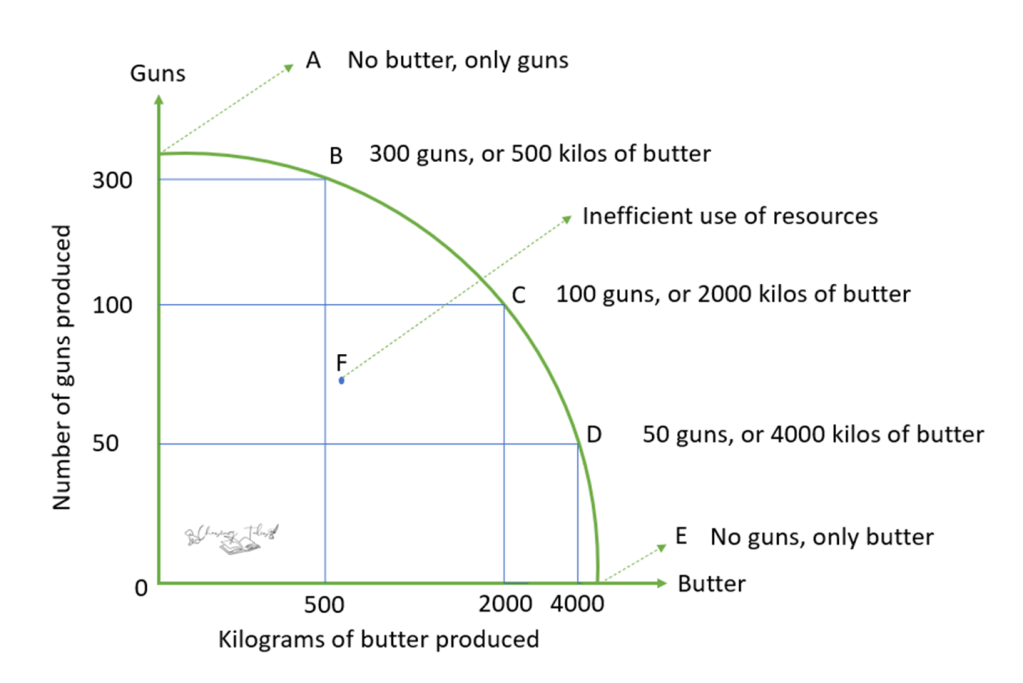
    Imagine a hypothetical world where all resources can only be used to produce either ‘guns’ (military goods) or ‘butter’ (civilian goods). The more guns an economy produces, the fewer kilos of butter it can make, because resources are finite. This trade-off is represented by the Production Possibility Frontier (PPF), which shows all efficient combinations of the two goods. In an efficient economy, all resources must be used to produce either of these products, and when an economy chooses to produce less than it can, it is considered inefficient use of resources.34

    Production Possibility Curve

    Moving along the curve from more butter and fewer guns to more guns and less butter shows the opportunity cost: how many units of butter society must give up to produce one more unit of guns. That sacrifice is the opportunity cost of additional guns. Points outside the curve are unattainable with current resources and technology; they can only be reached if the economy grows or technology improves. Points inside it represent waste or unemployment, where some resources are idle or misallocated.34

    Every economy must answer three fundamental questions:​15

    What should be produced?: This is about the mix of goods and services: food vs. defence, education vs. luxury items, public infrastructure vs. private consumption.

    • In a market economy (capitalism), this question is largely answered by consumer demand and profit signals. If people are willing to pay more for smartphones than for pagers, firms produce smartphones.
    • In a centrally planned economy, the government decides: for example, a state plan might say “this year we will produce X tonnes of steel and Y units of tractors.”
    • In mixed economies (which is almost every modern country), markets decide most things, but governments step in for public goods and basic needs (roads, schools, defence, basic healthcare).

    How should it be produced?: This relates to production methods, technology, and the combination of factors of production.

    • A labour‑abundant country might choose labour‑intensive methods (for example, more workers, fewer machines) because labour is relatively cheap.
    • A capital‑rich country might use highly mechanised production lines and automation.
    • Environmental policies can also play a role: stricter pollution laws might push firms toward cleaner but more expensive technologies.

    For whom should it be produced?: This is about distribution: who gets the goods and services once they are produced?

    • In a pure market system, distribution is based largely on income and wealth. Those with higher incomes can command a larger share of output.
    • Governments modify this market outcome through taxes, subsidies, and transfer payments. Different societies choose different degrees of redistribution depending on their values about equity, efficiency, and fairness.

    As with all things in economics, this model too is based on multiple assumptions and is a drastically simplified explanation of the real world:

    • Resources are fixed for the time period analysed
    • Technology does not change
    • The model shows only two goods for simplicity
    • All resources are fully and efficiently employed

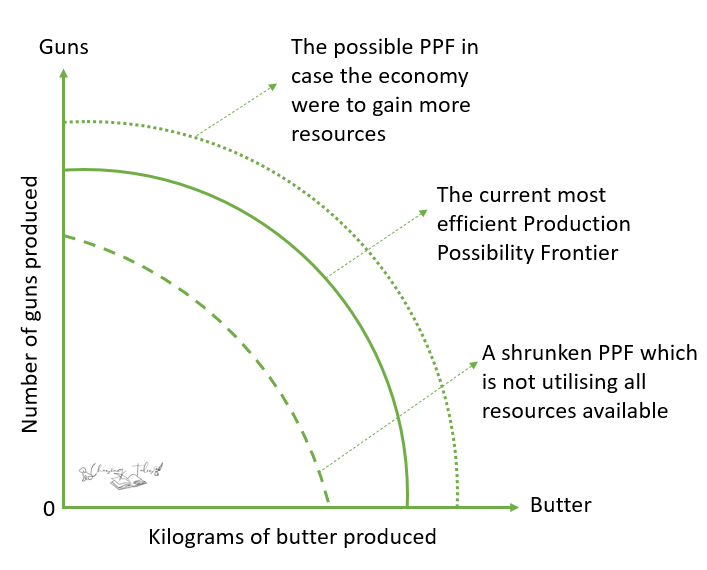
    In the real world, economies grow over time as they acquire more resources (labour, capital) or develop better technology. This shifts the PPF outward, allowing production of more goods and services. Conversely, wars, natural disasters, or institutional collapse can shrink the PPF inward. Here’s a diagram depicting what happens to the PPF when such events occur:

    An expanding or contracting Production Possibility Frontier

    Factors of Production67
    There are currently four accepted factors of production in economics: Land, Labour, Capital, and Entrepreneurship.

    • Land represents all natural resources, such as soil, water, minerals, forests, etc. The availability of these resources depends on a country’s location and directly influences which industries it can develop. A nation rich in oil has different economic opportunities than one with abundant forests or fertile farmland.​
    • Labour is the physical and mental effort people use to produce goods and services, including their skills, knowledge, and time. Education, training, the quantity of population, and workforce health directly impact a nation’s productive capacity.
    • Capital are the physical and financial resources used in production. Physical capital includes machinery, buildings, tools, and equipment that help workers produce more efficiently. Financial capital refers to the money available for investment in developing new factories, technologies, or infrastructure. A country with abundant capital can invest heavily in production facilities and research, accelerating economic growth.
    • Entrepreneurship is an intangible factor of production- the ability and willingness of individuals to take risks, innovate, and create new businesses. Entrepreneurs identify opportunities, combine the other factors of production in new ways, bearing risk and driving innovation and economic change.​

    These factors of production interact with each other to create an economy.

    Microeconomics891011
    Microeconomics focuses on individual decision-makers such as consumers, workers, and businesses, and how they allocate their limited resources.

    The key to understanding microeconomic behavior is the concept of utility. “Utility” is the satisfaction, happiness, or value a person receives from consuming a good or service. Imagine an individual is very thirsty. They therefore drink water, and gain satisfaction from their thirst being quenched. At this point they can continue drinking water if they are still thirsty, and continue to gain satisfaction. However, the second cup of water will not be as pleasant as the first. The third is likely to be even less so. This is the principle of diminishing marginal utility (in economics, “marginal” means additional): each additional unit of consumption provides progressively less satisfaction than the previous one, until a point is reached when zero additional utility is gained from consuming water (or whatever). After this point, marginal utility turns negative: if they keep consuming more water, they’ll get sick.

    Diminishing marginal utility explains everyday consumer behavior. At each decision point, consumers unconsciously ask: “Is the satisfaction I’ll get from this additional unit worth what I’m paying for it?” When marginal utility (the satisfaction from one more unit) exceeds the price, consumers buy. When it falls below the price, they stop. This individual decision-making across millions of consumers creates the market’s total demand and helps determine market prices.

    Microeconomics also examines production decisions. Businesses constantly ask: Should we expand production? Should we hire more workers? Should we invest in new equipment? These decisions depend on costs and expected revenues, which means they depend on whether the marginal benefit of an additional unit of production exceeds the marginal cost. A business expands as long as producing one more unit adds more to revenue than it adds to cost. When marginal cost exceeds marginal revenue, expansion stops.

    Macroeconomics12131415
    Macroeconomics studies the economy as a whole. It asks large-scale questions: Why do some nations grow faster than others? What causes inflation? Why does unemployment rise during recessions? How can governments influence these aggregate outcomes?​

    Here’s a diagram:1617

    The Circular Flow of Money

    This diagram is called the ‘Circular Flow of Money’, and is a schematic representing the flow of money and goods and services in the economy.

    Transfer payments are payments made by government (or sometimes private institutions) to individuals or businesses where no good or service is produced or exchanged in return. Unlike government purchases, which are payments for goods and services the government uses (like buying equipment or paying workers to build roads), transfer payments simply redistribute money from one group to another. The money is transferred from the government’s coffers (funded by taxes) to recipients who are then able to spend it into the economy. These payments are injections into household and firm budgets, and examples include unemployment benefits, lower or no cost medical facilities, food aid, business subsidies, etc.

    There are five actors in this diagram: within an economy (inside the green dashed line), are Households, Firms, Financial Institutions, and Governments. Outside the economy being studied is the Rest of the World. Each country or economy in the world will have the same four actors according to this model.

    • Households are individuals and families who own the factors of production (land, labour, capital, and entrepreneurship) and consume goods and services. They supply labour to firms and government, provide capital to financial markets through savings, and spend their income on consumption.
    • Firms (businesses) are organisations that combine factors of production to create goods and services. They pay households for labour, borrow from financial institutions for investment, pay taxes to government, and trade with the rest of the world.
    • Government (local, regional, and national) collects taxes, provides public goods and services, makes transfer payments, employs workers, and uses financial markets to manage surpluses and deficits. They inject money into the economy through purchases, wage payments, as well as transfers/ redistribution, and withdraw money through taxation.
    • Financial Institutions (banks, investment firms, stock markets) accept savings from all sectors, provide loans and investment capital, facilitate all transactions in the economy, and connect domestic savers with both domestic and international borrowers.
    • The Rest of the World represents all international economic activity—foreign countries, their consumers, their businesses, and their financial institutions. It connects domestic economies to global trade and international capital flows.

    Since this is a schematic, the circular flow is based on simplifying assumptions, and is in any case a theoretical snapshot. It does not explicitly capture:

    • Underemployment or unemployment
    • Inequality and wealth concentration
    • The detailed behaviour of governments and financial institutions
    • Financial crises or speculative bubbles

    The fundamental exchange of labour and capital flowing from households to firms, while goods and wages flow back represents the engine of the economy. One person’s spending becomes another’s income, creating a self-sustaining circular motion. When you buy groceries, you become income for the store’s employees, the farmer, the truck driver, and countless others in the supply chain. When they spend their wages, they create income for teachers, mechanics, doctors, and others.

    This is why consumer spending matters so much for economic health. When households reduce consumption due to economic uncertainty, the immediate effect is lower revenue for firms. Firms respond by producing less, hiring fewer workers, and paying lower total wages, which means less income for households to spend, further reducing consumption. This negative feedback loop can trigger recessions. Conversely, when consumer confidence is high and households spend freely, firms expand, hire workers, pay higher wages, and the positive feedback loop accelerates growth.

    Scaling individual choices
    While individual consumers make utility-maximising choices and individual businesses make profit-maximising decisions, the aggregate of all these individual decisions creates macroeconomic outcomes.​

    When millions of consumers reduce their spending due to economic uncertainty, the aggregate effect is lower total consumption, reduced business revenues, lower investment, and slower economic growth. When governments lower taxes, households have more income to spend, which increases aggregate demand, prompting businesses to expand production and hire more workers. The multiplier effect amplifies these changes—an initial increase in spending creates a chain reaction of income and spending throughout the economy.

    Interest rates illustrate this connection perfectly. A central bank raises interest rates to control inflation. Individually, this makes borrowing more expensive for a business considering a factory expansion. Collectively, as thousands of businesses postpone investment due to higher borrowing costs, aggregate investment falls, economic growth slows, and inflation moderates. The macroeconomic outcome emerges from millions of individual microeconomic decisions.

    Individual choices by producers and consumers aggregate to determine what the entire economy produces and how. People choose what they want, whatever they think is best for them in the given moment keeping their personal constraints and preferences in mind, and this helps the entire economy choose what to produce, and how much, and using what methods.

    How does this happen? The point at which the entire market settles is called an equilibrium. This is the point where the total demand in the economy matches the total supply.

    Aggregate demand (AD) is the total amount of all goods and services that all buyers in an economy want to purchase at different price levels. It includes:

    • Consumer spending (households buying groceries, clothes, services)
    • Business investment (firms buying machinery, building factories)
    • Government purchases (roads, schools, defence)
    • Net exports (exports minus imports)

    When the overall price level in the economy rises (inflation), people can afford less with their income, so the total quantity of goods and services demanded tends to fall. Conversely, when the price level falls, purchasing power increases, and aggregate demand rises.

    Aggregate supply (AS) is the total amount of goods and services that all producers in an economy are willing to supply at different price levels.

    In the short run, firms respond to higher prices by producing more (because higher prices mean higher profits). So when the price level rises, the quantity of goods and services supplied tends to increase. When prices fall, firms have less incentive to produce, so aggregate supply falls.

    Over the long run, however, aggregate supply is determined by the productive capacity of the economy—the factors of production available (labour, capital, land, entrepreneurship) and the technology used. In this longer view, the price level does not affect how much the economy can fundamentally produce; that is determined by real resources and efficiency.

    Macroeconomic equilibrium occurs when aggregate demand equals aggregate supply at a particular price level. At this equilibrium:

    • The total amount consumers, businesses, and governments want to buy matches the total amount firms want to supply.
    • There are no unintended accumulations of inventory (which would push prices down).
    • There are no widespread shortages (which would push prices up).
    • The economy settles at this price level and output level, unless something external changes.

    When aggregate demand exceeds aggregate supply: The total spending in the economy is greater than the total output available. Imagine households and businesses want to buy more goods and services than firms can produce. This creates upward pressure on prices because:

    • Firms see strong demand and can raise prices without losing customers.
    • Businesses invest more to expand capacity.
    • Workers may demand higher wages due to tight labour markets.
    • This tends to push the price level upward (inflation).

    If this imbalance persists, it can lead to “overheating” of the economy—rapid inflation as the economy bumps against its productive limits.

    When aggregate supply exceeds aggregate demand: The total output produced is greater than what people want to buy. Firms end up with unsold inventory and spare capacity. This creates downward pressure on prices because:

    • Firms lower prices to try to sell their excess stock.
    • Businesses postpone investment and lay off workers due to weak demand.
    • Workers have less bargaining power, and wage growth slows.
    • This tends to push the price level downward (deflation or disinflation).

    If this imbalance persists, it can lead to recession or stagnation, low growth, rising unemployment, and falling prices as the economy operates below its potential.

    Over time, price changes and behaviour adjustments push the economy back toward equilibrium:

    • If demand is too high and inventories are depleting, firms raise prices. Higher prices cool demand (people buy less because it is more expensive) and encourage supply (firms produce more because profit margins are higher). Gradually, demand and supply rebalance.
    • If demand is too low and inventories build up, firms cut prices. Lower prices stimulate demand (people buy more because it is cheaper) and discourage supply (firms produce less because margins shrink). Again, they move toward balance.

    In theory, this self-correcting mechanism should prevent persistent shortages or surpluses (this is what economists call “the invisible hand”, a metaphorical description of how the market corrects over‑ and under‑production, over‑ and under‑pricing, and similar imbalances). However, in the real world, these adjustments take time, and other factors (such as government policy, shocks, or expectations) can push the economy away from equilibrium before it settles.

    AspectMicroeconomicsMacroeconomics
    FocusIndividual consumers, workers, firmsEntire economy, aggregate levels
    Key questionsHow do people allocate limited resources? Why do prices change?Why do economies grow? What causes inflation and unemployment?
    Key actorsConsumers, workers, businessesHouseholds, firms, governments, financial institutions, rest of world
    Unit of analysisUtility, profit, marginal decisionsAggregate demand, aggregate supply, price levels, employment
    Difference between Micro and Macro Economics

    Modern applications1819
    Traditional economic theory provides the foundation for understanding modern economies, which operate through sophisticated systems of banking, credit creation, and financial markets.

    In traditional economies, money was often physical (coins and notes) and the money supply was limited by the amount of precious metal a nation possessed. Modern economies operate through a very different system where banks create money through lending: imagine a saver deposits INR 1,000 in a bank, the bank immediately lends most of that money to a business seeking a loan- let’s say INR 900. The business spends that INR 900, which ends up as deposits in another person’s bank account. That second bank then lends 90% of the INR 900, and the process repeats.​ They don’t lend the entire amount because they are required to keep a certain amount in reserve with the central bank. In India, this is called the Cash Reserve Ratio.20

    The Cash Reserve Ratio is the percentage of a bank’s total deposits that must be held as liquid cash with the central bank, such as the Reserve Bank of India (RBI). It is a monetary policy tool used by the central bank to manage the money supply, control inflation, and ensure banks have enough liquidity to meet withdrawal demands (that is, the bank should have the money required for a normal amount of withdrawals). Banks cannot use this money for lending or investment, and they do not earn interest on it.

    Suppose:

    • The CRR is 10%.
    • A person deposits INR 1,000 in a commercial bank.

    The bank must keep INR 100 (10%) as reserves with the RBI, and can lend out INR 900. When that INR 900 is deposited by someone else:

    • The second bank keeps 10% (INR 90) as reserves and lends out INR 810.
    • The process repeats: each round, 10% is held as reserves, and 90% is lent out again.

    In theory, the maximum amount of new deposits that can be created from the original INR 1,000 is determined by the money multiplier, which equals 1 divided by the reserve ratio (this is a simplified ‘maximum’ scenario. In practice, banks may be constrained by capital requirements, borrower demand, regulation, and risk management, so the actual expansion of money is usually smaller than the theoretical maximum).

    If the reserve ratio (CRR) is 10% (or 0.10), then the money multiplier is 1 ÷ 0.10 = 10.

    This means that the original deposit of INR 1,000 can theoretically support up to INR 10,000 in total deposits across the banking system (INR 1,000 × 10 = INR 10,000).

    • Banks may hold extra reserves.
    • People may hold some cash rather than depositing all their money.

    This process is called credit creation or the money multiplier effect, where the original INR 1,000 deposit can eventually support INR 10,000 or more in total money supply in the economy. Banks don’t simply lend out existing money; they create “new” money through the lending process. This is why controlling the money supply is central to macroeconomic management.

    In conclusion, traditional economic theory, built on scarcity, opportunity cost, and the interaction of supply and demand, gives us a language for understanding economic choices. It does not tell us what ought to be produced or who should benefit, but it clarifies the trade-offs and shows how millions of individual decisions aggregate into the performance of entire economies.

    Sources

    1. Lesson summary: Scarcity, choice, and opportunity costs – Khan Academy
    2. Scarcity and Opportunity Cost – LibreTexts, Econ 101: Economics of Public Issues
    3. Production Possibility Frontier (PPF): Purpose and Use – Investopedia
    4. Complete Guide to the Production Possibilities Curve – ReviewEcon
    5. Scarcity, Choice and Opportunity Cost – Physics & Maths Tutor (A‑level notes, PDF)
    6. Factors of Production – Wall Street Prep
    7. Factors of Production: Land, Labor, Capital and Entrepreneurship – Corporate Finance Institute
    8. Microeconomics – Investopedia
    9. Microeconomics course home – Khan Academy
    10. 14.01SC Principles of Microeconomics – MIT OpenCourseWare
    11. Microeconomics – Encyclopedia Britannica
    12. Macroeconomics – Investopedia
    13. Macroeconomics course home – Khan Academy
    14. What is macroeconomics? – Board of Governors of the Federal Reserve System
    15. Macroeconomic and Fiscal Policy – World Bank (Economic Policy topic)
    16. The Circular Flow of Income – Saylor “Economics: Theory Through Applications”
    17. Circular Flow Model: Definition & Examples – Study.com
    18. Multiplier Effect: How Fractional Reserve Banking Creates Money – Management Study Guide
    19. Banking and the Expansion of the Money Supply – Fiveable (AP Macroeconomics)
    20. Cash Reserve Ratio (CRR): Meaning, Objectives & Current CRR – ClearTax

    A tiny primer on principles of finance

    While finance is a vast and multifaceted industry, there are certain principles that underpin every decision or transaction made by it. This post is an explanation of these principles.

    Time Value of Money (TVM)123
    This principle says that money available earlier is worth more than an identical sum available at a later time; so money in the past was worth more than the same amount today, and any amount today is worth more than the same amount at a later date.

    The reason this happens is threefold:
    1. Interest:45 money available at an earlier date can be invested to earn an interest that increases that total quantity of money available at the later date. Interest is a fee paid to any entity (such as an individual, a group, or an organisation) when that entity allows another entity to use its money. For example, if a person deposits their salary in a savings account, the bank pays them interest for keeping the money and making it available for use by the bank. Conversely, if an organisation gives another organisation a loan, the borrower pays the lender interest as a fee for being able to access and use those funds.

    2. Compounding:67 in finance, interest is of two types- simple interest and compound interest. If money is invested so that it earns simple interest, it will earn interest on the original sum that is invested, and only on that amount. Let’s say an individual invests INR 1,000 for 5 years at a simple interest of 10% per annum, they will get an interest amount of INR 100 per annum for 5 years if they do not withdraw any of the original money they deposited (the INR 1,000 which is called the “Principal” in finance). Therefore at the end of their investment period, they will receive INR 1,000 + INR 100 + INR 100 + INR 100 + INR 100 + INR 100 = INR 1,500.

    Compound interest pays a higher rate of interest, because as long as the interest amount earned at the end of the first year was not withdrawn, that INR 100 of interest would also earn an interest (unlike SI which only pays interest on the principal amount of INR 1,000). So, if the individual who invested the INR 1,000 had invested at a rate of 10% compound interest annually, at the end of Year 1, they would receive the same amount as with SI- INR 100, but at the end of Year 2, they would receive 10% interest on INR 1,000 + 10% interest on the INR 100 interest amount that was added to the investment at the end of Year 1. Therefore at the end of Year 2, they would have a total amount of INR 1,000 + INR 100 + INR 100 + INR 10 in their account.

    Here’s a table to help explain this better:

    YearSimple Interest: Year-end Total (INR)7Compound Interest: Year-end Total (INR)6
    11,100 (Principal 1,000 + Interest: 10% × 1,000 = 100)1,100 (Principal 1,000 + 10% of 1,000 = 100)
    21,200 (Last year total 1,100 + Next 100 interest)1,210 (Last year total 1,100 × 10% = 110; 1,100 + 110)
    31,300 (Last year total 1,200 + Next 100 interest)1,331 (Last year total 1,210 × 10% = 121; 1,210 + 121)
    41,400 (Last year total 1,300 + Next 100 interest)1,464.10 (Last year total 1,331 × 10% = 133.10; 1,331 + 133.10)
    51,500 (Last year total 1,400 + Next 100 interest)1,610.51 (Last year total 1,464.10 × 10% = 146.41; 1,464.10 + 146.41)
    Tabular explanation of the difference between calculations for simple interest and compound interest

    Therefore in SI, each year the interest is always INR 100 (just 10% of 1,000), added without change, but in compound interest, each year new year interest is calculated on a bigger amount (previous year’s total), so the yearly interest keeps growing. Notice the difference- via compounding, the investor would have earned INR 110.51 more after the five year period of investment.

    3. Inflation:8 The final reason is something called inflation, which is the rise in the general price levels in the economy (that is, in general, the prices rise or the amount you can buy for a certain amount of money reduces, even if some things remain static in price or may have even reduced in per unit price), which makes it so that the same amount of money will purchase fewer goods and services at a later date, since they have become more expensive in comparison to an earlier date.

    Materiality
    More here.

    Risk
    In finance, “risk” means the uncertainty or variability of returns associated with an investment.910

    There are multiple types of risk in finance. Some risks affect everything, and they simply cannot be avoided, but others can be minimised.

    1. Systematic (or sometimes called systemic) Risk:11 those risks that affect the entire national economy, or in these interconnected times, affect most of the world at the same time. The 2008 subprime financial crisis was an example of one such issue. Imagine somebody, may it never be so, lives in a country that is at war- most sectors in the economy of such a country are likely to be affected by the war. It is unlikely that they could invest in a sector that is not affected at all, not even indirectly. Such risks are simply impossible to minimise. How to know if something is a systemic risk- ask, can the risks be avoided? No? It’s systemic.

    2. Unsystematic (unsystemic) Risk:11 those risks that affect only one sector in the entire economy, or an industry, or even one company. Imagine a corruption scandal erupts at a particular company- the risk will be limited to the company, or at most the industry the company belongs to, rather than spread through the entire national economy. Can the risks avoided? Yes, easily.

    Understanding risk helps individuals make better decisions. There are several specific types of risk that are explained briefly in the table.

    TypeMeaning (Simple Words)Example For Beginners
    Market RiskPrices move because of the whole marketStocks fall when economy dips
    Credit RiskBorrower may not repay moneyPerson takes a loan and can’t pay it back
    Liquidity RiskCan’t sell asset quickly for fair priceYou own a rare toy, but no one wants to buy it today
    Operational RiskFailure inside a company (mistake, fraud)Computer glitch at a bank
    Inflation RiskMoney loses buying power over timePrices of groceries go up, money buys less
    Currency RiskForeign money value changesINR to USD exchange rate changes
    Reputational RiskBad publicity affects businessNews breaks that a company did something unethical
    Types of risk

    Risk and Return Tradeoff1213
    Now, in the example in the Time Value of Money section, we knew exactly how much interest would be earned by the investment. However, there are many avenues of investment that do not guarantee any returns, and may even lead to losses.

    Generally speaking, the higher the risk any investor takes, the higher their expectations of returns for that risky investment. Think about it- if they could achieve the same returns for a lower amount of perceived or actual risk, then would they not opt for getting the same returns for the lower returns? In this way, each percentage point of higher risk taken must reward the risk taker with greater returns, or they would have no incentive to take the extra risk at all.

    This is called also called the Efficient Frontier. It is a graph where the x-axis maps the risk taken, and the y-axis represents the returns for each point of risk taken. Points to keep in mind:
    1. For any given level of risk, the aim is to receive the highest possible expected return; and
    2. For any given expected return, the aim is to take the lowest possible risk.

    Any investment that doesn’t meet these conditions is inefficient: either the investment involves too much risk for the amount of returns they are offering, or too few returns for the amount of risk being taken.

    But what is “too much risk”?

    Every individual has a particular “Risk Tolerance”, or their personal capacity to withstand losses in case something goes wrong with their investments. Investors must always understand what their personal capability is to stomach losses, and this is also why investments must be risk efficient, so that on the occasion of a loss, that loss is not more than they can tolerate. This is a matter of personal comfort with loss.

    Risk tolerance is determined for each individual via multiple factors, such as how soon they need the money invested- those with long investment horizons (let’s say 50 years for example), may invest and easily tolerate shorter term losses since their investment has the time to build back up (this may never happen, but they still have the time to see if it will). Another factor is how much money they have outside of the particular risky investment in question. Those with a large nest egg will naturally feel safe even if the entire amount invested in the riskier investment were to disappear.

    Every individual has a different personal relationship with financial risk, which they must understand thoroughly and stay within their own limits.

    Diversification14151617
    Diversification is the risk management strategy of spreading investments across various assets to reduce exposure to any single investment (an asset is anything that will earn you returns in the future, this post has other such definitions). Diversification is best explained as not putting all your eggs in one basket. By spreading investments across multiple assets classes, geographies, and industries, an investor gains the benefit of never leaving their entire investible corpus or all their savings at the mercy of an unsystematic risk event. If there is an event that affects the entire economy, diversification will not help for any asset classes that are based (fully or partially) in that region, but this too can be diversified against these days- it is now possible to invest in other countries, and this works against the kind of systematic risk that spreads only within the boundaries of a particular nation. In case the risk event has spread across the globe… well, that’s you done for the moment.

    Efficient Market Hypothesis18192021
    Imagine if an individual wanted to buy a house, and the only thing they know is the area they wish to purchase the house in, and what their own budget is. They find out that in that area, no house sales have taken place at all in the last few years (even though it is a residential area with 100s of houses). How would such a person determine what buying the house in the locality would cost them?

    They won’t, because there is no historic price or volume data available at all, and they may withdraw from buying in the area. It is also possible that they decide to pay whatever they are asked for as long as it is within their budget, but there is no way for them to know whether they are receiving the correct value for the money they are being asked to pay, since there is no comparison available.

    Now imagine two houses are sold in the same area- let’s say one for INR 30,00,000 and another for INR 35,00,000: so now the buyer has price data and volume data both- two houses, and around INR 30-35,00,000. Are they likely to offer somewhere in the vicinity of these numbers for any house they may wish to buy, or are they likely to offer much less or more than the established price level? In case the buyer chooses to offer less than the established price level, they are unlikely to get any sellers, correct? And why would they offer much more than the established price level?

    In a financial market, when the historical price and volume data is known, that market is considered to be at the first level of market efficiency, called Weak Efficiency. It is data without which no fair transactions are possible.

    Now, let us say the buyer decides on a few houses they really like, and to find out more about them, they go and ask neighbours about whether those houses are well built, or have any issues. etc. This information is publicly available, and is likely to shape their opinions about the properties in their shopping cart. Let us imagine one of the houses has a well known termite problem- is this new publicly available information likely to change the buyer’s valuation of the product? Then they find out another house in the locality that they have their eyes on has built in parking space for 5 cars- even if they themselves don’t have five cars yourself, are they more likely to look at this house more favourably? Perhaps offer a little more for it in comparison to other houses?

    In a financial market, this is the second level of market efficiency. It is called Semi-Strong Efficiency. All publicly available information is known to everyone.

    And now back to 1984: Strong form market efficiency, where there is no private information- all information, no matter how seemingly private, is known publicly. Clearly (thankfully), such a world does not exist. In the context of markets, this means that there will always be insiders who will know more than outsiders.

    One thing to note here before we move on- since we’re talking about financial markets, the theory is about stock prices.

    Information Asymmetry222324
    Information asymmetry is the situation where one party in a transaction possesses more or better information than other parties, which leads to outcomes that are optimal only for the party with the good information.

    Information problems have significant implications for financial markets. For example, because borrowers know their own financial conditions better than lenders, lenders may not be able to assess the potential borrowers true creditworthiness. Assets may also be priced wrongly due to information asymmetry, again causing inefficiency in the market.

    There are several market intermediaries that help lower information asymmetry, such as credit rating agencies that assess an individual or organisation’s creditworthiness so that lenders may have a level playing field; auditors, who provide independent verification of organisation’s financial claims, and even IPO grading agencies (IPO = Initial Public Offering) that independently evaluate a company’s financial credentials when it is issuing shares to help investors make more informed decisions before subscribing to that IPO.

    Agency252627
    A Principle-Agent relationship is the relationship between the owners, or Principals, and the people who work for them, such as managers, or Agents.

    The larger an organisation, the more agents there will be, and the more information asymmetry there will be between the owners and their agents. Add to that the fact that Agents and Principals have very different inherent motivations, and it’s easy to see conflicts of interests arising between these parties.

    The Principal-Agent problem can manifest in a number of ways, for example, managers may be more interested in short term profits while shareholders may wish to build their organisation up to ensure long term value; or managers may avoid risky but profitable projects over the worry that if it goes wrong they may lose their job even if the shareholders would prefer to go for the project, etc. Information asymmetry exacerbates these issues, as managers typically know more about what is happening in the company and the decisions being taken than shareholders.

    Several mechanisms exist to counter agency problems. Monitoring agent behaviour and decisions through audits and oversight as well as strong corporate governance helps ensure management acts appropriately. Aligning the incentives of the management and the shareholders can be done through compensation packages that include profit-sharing with employees.

    Stakeholders2829
    All those individuals, or groups of individuals, who are affected by the activities of the company are stakeholders of that company. Stakeholders may be internal or external. The table below has examples:

    TypeExampleHow They’re Impacted
    InternalEmployeesTheir jobs, pay, and stability depend on the business.
    InternalManagementMake decisions and want success for their own reputation and bonuses.
    InternalBoard of DirectorsSet the company’s big-picture vision, provide oversight, and uphold good governance.
    InternalShareholdersInvested money in the company, want profits and growth.
    ExternalCustomersUse the products or services produced by the company, seek quality, safety, and value.
    ExternalSuppliersSell goods and supplies, need reliable buyers and prompt payments.
    ExternalLendersThe company owes them money.
    ExternalDebtorsThey owe money to the company.
    ExternalCommunityCare about jobs, environment, local development.
    ExternalGovernmentCollect taxes, set regulations, interested in company compliance and economic contribution.

    Every stakeholder benefits in some way when the company succeeds, and can be hurt if things go badly. In finance, all decisions were made earlier from the perspective and for the benefits of shareholders only. This is now changing towards more holistic stakeholder management which balances (or attempts to) the shareholders’ requirement for profits while also making sure that other stakeholder’s points of views are incorporated into decision making. This is called Stakeholder Capitalism (as opposed to regular capitalism), and it aims to create long term value for everyone affected by the company rather than just prioritising shareholders.

    These are a web of financial concepts that build all financial logic. All higher financial concepts are based on one or an interaction of these concepts. I’ve explained the very basics of these concepts here from my own understanding, but please use all the sources provided through the post as a further reading library.

    Sources


    1. Time Value of Money in Finance (CFA Institute)
    2. Time Value of Money: What It Is and How It Works (Investopedia)
    3. Time Value of Money (TVM): A Primer (Harvard Business School Online)
    4. Interest – Definition, History, Determinants, Types (Corporate Finance Institute)
    5. Interest: Definition and Types of Fees for Borrowing Money (Investopedia)
    6. Compound: What It Means, Calculation, Example (Investopedia)
    7. Understanding Simple Interest: Benefits, Formula, and Examples (Investopedia)
    8. What is inflation: The causes and impact (McKinsey & Company)
    9. How to Identify and Control Financial Risk (Investopedia)
    10. Risks in Large Cap Funds: Difference between Systematic and Unsystematic Risks (Bajaj AMC)
    11. What Makes Systematic Risk and Unsystematic Risk Different (Shiksha.com)
    12. Efficient Frontier – Overview, How It Works, Example (Corporate Finance Institute)
    13. Understanding the Efficient Frontier: Maximize Returns, Minimize Risk (Investopedia)
    14. What Is Diversification? Definition As an Investing Strategy (Investopedia)
    15. Guide to Diversification (Fidelity Investments)
    16. The importance of diversification (Vanguard UK)
    17. Beginners’ Guide to Asset Allocation, Diversification, and Rebalancing (Investor.gov, US SEC)
    18. Market Efficiency (CFA Institute)
    19. The Efficient Market Hypothesis and Its Critics (CFA Digest)
    20. Efficient Market Hypothesis (EMH): Definition and Critique (Investopedia)
    21. Forms of Market Efficiency (AnalystPrep CFA Level 1)
    22. Theory of Asymmetric Information Definition & Challenges (Investopedia)
    23. How to Fix the Problem of Asymmetric Information (Investopedia)
    24. Transaction Costs, Asymmetric Information, and the Free-Rider Problem (LibreTexts)
    25. The Principal–Agent Problem in Finance (CFA Institute, PDF)
    26. What Is Agency Theory? (Investopedia)
    27. Agency Theory in Financial Management (Plutus Education)
    28. Stakeholders: Definition, Types, and Examples (Investopedia)
    29. Stakeholders | Finance Definition + Business Examples (Wall Street Prep)

      ESG investing

      First, a list of definitions:

      1. Asset: Any resource of economic value owned or controlled by an individual or entity, expected to provide future financial benefit.
      2. Asset Class: Broad categories of assets that behave similarly, e.g., equities (stocks), fixed income (bonds), cash, real estate.
      3. Asset Type: Specific forms within an asset class, e.g., large cap, small cap stocks within equity.
      4. Portfolio: A collection of investments held by an individual or entity.
      5. Portfolio Weight: The percentage each asset contributes to the total value of a portfolio.
      6. Asset Allocation: The strategy for distributing investments among different asset classes for balancing risk and return.
      7. Diversification: Investing in different assets to reduce overall portfolio risk.
      8. Rebalancing: Adjusting asset proportions in a portfolio to maintain target allocation that had been decided at the time of deciding asset allocation.
      9. Liquidity: How easily an asset can be converted to cash without affecting its price.
      10. Risk: The chance an investment might lose money or underperform expectations.
      11. Risk Tolerance: Willingness or ability to withstand investment losses or volatility.
      12. Volatility: The degree and frequency of changes in prices of an asset.
      13. Portfolio Risk: The uncertainty of the entire basket of investments losing value or performing below expectations.
      14. Market Risk/ Systematic Risk: Risk due to economy-wide factors affecting all investments.
      15. Credit Risk: Risk that bond issuers or borrowers may default.
      16. Company-specific Risk/ Unsystematic Risk: Risk tied to individual companies or securities.
      17. Downside Risk: The potential for an investment to lose value due to negative market conditions. This focuses only on the probability and quantity of losses rather than the probability of volatility of prices. ESG investing primarily provides downside protection rather than return enhancement.
      18. Volatility: The degree of price fluctuation in either direction in an asset or portfolio over time.
      19. Benchmark: A standard (often an index) for comparing investment performance (e.g., Nifty 50).
      20. Tracking Error: The difference between a portfolio’s returns and the returns of the benchmark its tracking.
      21. Capital Gain: Profit made from selling an asset for more than it’s cost.
      22. Dividend: Payments made by companies to shareholders, usually from profits.
      23. Compound Interest: Earning interest on initial investment plus prior earned interest—critical for long-term growth.
      24. Net Asset Value (NAV): Value per share of mutual funds or ETFs, calculated as total assets minus liabilities divided by shares.
      25. Bull Market / Bear Market: Extended period of rising (bull) or falling (bear) asset prices.
      26. Yield/ Return: Income return on investments, such as interest or dividends.
      27. Turnover: The rate at which securities are bought/sold in a portfolio; high turnover can mean higher costs.
      28. Sharpe Ratio: Measures risk-adjusted return, penalising for volatility.
      29. Portfolio Optimisation: Selecting the best mix of assets to maximise returns for a given risk.
      30. Passive/Active Management: Passive strategies track a benchmark, active invest based on analysis, not constrained to an index.
      31. Index: A selection of securities representing a market or sector, used for performance tracking and benchmarking.
      32. Index Risk Characteristics: How much an index’s value fluctuates due to its components; calculated via weighted average of the securities’ price changes.
      33. Portfolio Tilting: Adjusting portfolio weights to emphasise preferred features (like ESG leaders) while maintaining diversification.
      34. ESG Ratings/Scores: Independent evaluations of companies’ ESG performance.
      35. Materiality: How significantly issues affect a company’s business or financial outcomes.
      36. Greenwashing: Misleading claims of sustainability or ESG compliance by firms, especially the G part.
      37. Greenhushing: Deliberately under-reporting or not reporting genuine environmental action.
      38. Stakeholder: All groups affected by company actions, such as shareholders, employees, customers, suppliers, communities.

      Now onto ESG investing.

      What
      ESG investing is a way to put money into companies while considering more than just their financial returns. The non financial factors considered are Environmental, Social, and Governance (ESG) aspects of the company.

      Here’s a list of ESG laws in India.

      A small list of different ESG aspects:

      Environmental FactorsSocial FactorsGovernance Factors
      Resource use, pollution, waste creation, waste disposal, sustainable procurement, biodiversity impacts, Human rights, equality, equity, diversity, inclusion, human capital management, customer safety, customer satisfaction, Corporate governance, executive compensation, board membership, whistleblower protection, corporate transparency, business ethics, shareholder compensation and rights, stakeholder engagement

      Why
      ESG investing has evolved from a niche ethical consideration to a fundamental component of modern investment strategy due to the recognition that environmental, social, and governance factors pose material financial risks that can devastate companies when left unmanaged. The core imperative for ESG investing lies not in altruism but in financial reality: companies that fail to manage ESG risks face losses that can destroy shareholder value and damage their competitive position.

      Mismanaged environmental risks can result in extensive fines, settlements and other costs, stock price collapse, CEO resignations, criminal investigations, and business model restructuring.

      Examples:
      The Volkswagen emissions scandal: the company was charged over $30 billion in fines, settlements, and other costs after installing “defeat devices” in 11 million diesel vehicles to cheat on emissions tests.1 The misconduct triggered an immediate stock price collapse, forced resignations, sparked criminal investigations across multiple continents, and required the company to fundamentally restructure its entire business model toward electric vehicles.

      The BP Deepwater Horizon oil spill resulted in $20.8 billion in environmental damage settlements, the largest in U.S. history, plus additional billions in cleanup costs, lost revenues, and operational disruptions.23 The environmental damages translated directly into financial losses through fishing industry shutdowns, tourism declines, and permanent ecosystem service losses valued at $17.2 billion.4

      Here’s an explanation of ecosystem services.

      Social risks create equally devastating financial consequences when companies fail to maintain proper governance over workplace culture and employee treatment.

      Examples:
      The Wells Fargo cross-selling scandal, where employees created 3.5 million fraudulent accounts without customer consent, resulted in $3.7 billion in settlements and fundamentally shattered the bank’s reputation for customer-centric service.5 The scandal emerged from toxic sales cultures that imposed impossible quotas on employees, leading to widespread fraud, customer harm, and eventual regulatory intervention.

      In 2025, Google agreed to pay $50 million to settle a lawsuit alleging bias against Black employees.6 Simultaneously, the company paid an additional $28 million to settle claims that it favored white and Asian employees.7 Adding to Google’s social risk exposure, the company faced a separate $118 million gender discrimination settlement involving approximately 15,500 employees.8 These combined settlements totaling $196 million (50+28+118) reflect systematic failures in Google’s workplace culture and diversity management that created material financial liabilities.

      While risk management drives the primary rationale for ESG investing, additional business benefits strengthen the investment case. Better risk management reduces costly scandals and regulatory penalties, improved stakeholder relationships enhance operational resilience, and ESG practices often drive operational efficiencies that reduce costs.

      Investor demand increasingly favors ESG-compliant companies, with over 90% of younger investors showing interest in sustainable investing.9 ESG-focused institutional investments are projected to reach $33.9 trillion by 2026,10 while 89% of investors consider ESG when making investment decisions11. This demand translates into better access to capital and lower financing costs for companies with strong ESG credentials.

      Regulatory momentum makes ESG compliance increasingly mandatory rather than voluntary. The European Union’s Corporate Sustainability Reporting Directive, India’s Business Responsibility and Sustainability Report framework, and similar regulations worldwide require comprehensive ESG disclosures and accountability. Companies failing to meet these requirements face market access restrictions, regulatory penalties, and competitive disadvantages.

      Research demonstrates that ESG investing provides downside protection, especially during social or economic crises.12 During the COVID-19 pandemic, companies with robust ESG practices demonstrated greater financial resilience and risk management capabilities compared to conventional peers.12 This downside protection stems from ESG companies’ superior risk management, stakeholder relationships, and operational flexibility.

      Climate-related weather events are expected to cost suppliers $1.3 trillion by 2026.13 Companies with strong environmental practices position themselves to avoid these costs through improved resilience, supply chain diversification, and proactive adaptation measures. This represents massive potential savings compared to companies that ignore environmental risks.

      How
      ESG investment strategies provide multiple pathways for investors to align their portfolios with environmental, social, and governance principles while pursuing financial returns. Understanding these distinct approaches enables investors to select methods that best match their values, risk tolerance, and impact objectives.

      Negative Screening (Exclusionary Screening)
      Negative screening represents the oldest and most straightforward ESG approach, systematically excluding companies or entire sectors that fail to meet specific ethical or sustainability criteria. This strategy originated in the 1970s with religious investors avoiding industries like tobacco, alcohol, gambling, and weapons manufacturing.1415

      Modern negative screening has expanded significantly beyond traditional “sin stocks” to exclude companies with poor environmental records, human rights violations, or severe governance failures. For example, many European pension funds exclude companies involved in coal mining or controversial weapons, while Norway’s Government Pension Fund Global eliminates companies with severe environmental damage or human rights violations from its portfolio.

      The screening criteria can range from broad sector exclusions to specific revenue thresholds, such as excluding companies that derive more than 10% of revenue from fossil fuel extraction. This approach allows investors to avoid supporting business activities that conflict with their values while maintaining diversification across other sectors.

      Positive Screening (Best-in-Class Selection)
      Positive screening takes the opposite approach by actively seeking companies that demonstrate superior ESG performance within their respective industries. This “best-in-class” methodology allows investors to maintain sector exposure while favoring companies with the strongest sustainability credentials.

      Unlike negative screening, positive screening doesn’t automatically exclude controversial sectors like oil and gas or mining. Instead, it identifies companies within these industries that show the best ESG practices, commitment to improvement, and transition strategies. For instance, an oil company might qualify if it demonstrates the lowest carbon intensity, strongest safety record, and most credible renewable energy transition plan in its peer group.

      BlackRock, the world’s largest asset manager, exemplifies this approach by selecting companies with the highest ESG ratings in each sector for its ESG-focused funds. The Dow Jones Sustainability Indices follow similar principles, annually selecting the top 10% of companies in each sector based on ESG criteria.16

      ESG Integration
      ESG integration systematically incorporates environmental, social, and governance factors into traditional investment analysis alongside financial metrics. Rather than simply screening companies in or out, this strategy uses ESG data to better understand risks, opportunities, and long-term value creation potential.

      This approach recognises that ESG factors can significantly impact a company’s financial performance, competitive position, and operational resilience. Investment analysts examine how climate risks might affect a utility company’s infrastructure costs, how labor relations impact a retailer’s operational efficiency, or how board composition influences strategic decision-making quality.

      Unilever demonstrates ESG integration through its Sustainable Living Plan, which focuses on environmental impact, social responsibility, and governance to reduce risk, build stakeholder trust, and deliver consistent financial performance.

      Thematic Investing
      Thematic investing focuses on specific ESG themes or sectors that address major global challenges while offering growth opportunities. This strategy identifies long-term sustainable trends and invests in companies positioned to benefit from these developments.

      Common thematic areas include renewable energy, clean technology, water management, sustainable agriculture, healthcare access, and financial inclusion. The iShares Global Clean Energy ETF exemplifies this approach by investing specifically in companies involved in solar, wind, and other renewable energy sources.

      Thematic investing differs from broad ESG approaches by concentrating on specific solutions rather than applying general ESG criteria across all sectors. This focused approach can offer higher growth potential but typically involves greater concentration risk.

      Impact Investing
      Impact investing seeks to generate measurable positive social or environmental outcomes alongside competitive financial returns. This approach targets specific problems and requires evidence of additionality- demonstrating that the investment creates positive change that wouldn’t occur otherwise. The Global Impact Investing Network reports that impact investing assets under management have grown to $1.6 trillion in 2024.1718

      Impact investments often focus on underserved markets or pressing global challenges such as affordable healthcare, clean water access, financial inclusion, sustainable agriculture, and climate solutions. Examples include microfinance institutions serving underbanked populations, funds supporting affordable housing projects, and companies developing clean water solutions for developing regions. To be noted, unlike thematic investing, impact investing requires ongoing measurement and reporting of social and environmental outcomes, not just investment in relevant sectors.

      Shareholder Engagement and Stewardship
      Shareholder engagement uses ownership rights to influence corporate behavior and improve ESG practices through dialogue, proxy voting, and shareholder resolutions. This strategy recognises that investors can create positive change by actively engaging with companies rather than simply avoiding or divesting from problematic investments.

      Engagement activities include regular dialogue with management, filing shareholder proposals, voting on proxy measures, and participating in collaborative initiatives with other investors. BlackRock reported conducting over 2,600 engagements with nearly 1,700 companies during 2019, focusing on issues like board diversity and climate risk disclosure.19

      A cinematic example of ESG shareholder activism occurred in 2021 when Engine No. 1, a small hedge fund with just $40 million invested, successfully elected three directors to ExxonMobil’s board to promote climate-focused strategies.20 This campaign demonstrated how strategic engagement can achieve significant influence even with modest shareholdings.

      Norm-Based Screening
      Norm-based screening evaluates companies based on compliance with internationally recognised standards and norms covering ESG factors. This approach screens investments according to frameworks established by organisations such as the United Nations Global Compact, OECD Guidelines for Multinational Enterprises, and International Labour Organization conventions.

      Unlike values-based exclusions, norm-based screening focuses on minimum acceptable business conduct standards rather than sector preferences. Companies failing to comply with basic human rights, labour standards, environmental protections, or anti-corruption measures may be excluded regardless of their industry.

      EUROFIMA exemplifies this approach by monitoring investee compliance with the Ten Principles of the UN Global Compact, derived from international human rights, labour, environmental, and anti-corruption standards. Non-compliant positions must be liquidated and business relationships terminated.21

      Portfolio Tilting and Overweighting
      Portfolio tilting adjusts portfolio weights to favour companies with higher ESG ratings while maintaining similar sector and risk characteristics to a benchmark index. This approach provides ESG exposure without dramatically altering portfolio diversification or risk profiles.

      Rather than completely excluding companies or sectors, portfolio tilting reduces exposure to ESG laggards while increasing allocations to ESG leaders. A fund might replicate the Russell 3000 index structure but tilt toward companies with superior ESG scores, maintaining broad market exposure while expressing ESG preferences.

      This strategy appeals to investors seeking ESG alignment without accepting significant tracking error relative to market benchmarks. The approach balances ESG considerations with traditional portfolio management objectives like diversification and risk control.

      Double Materiality
      Double materiality is the cornerstone of the European Union’s Corporate Sustainability Reporting Directive (CSRD). Double materiality looks at the company’s impact on the environment, which is seen in impact materiality and sustainability issues influence a company’s development, performance, and financial position, which is evaluated through financial materiality.

      Choosing the Right Strategy
      The selection of appropriate ESG strategies depends on individual investor priorities, risk tolerance, and desired level of impact. Many investors combine multiple approaches—using negative screening to exclude unacceptable investments while applying positive screening or ESG integration to select among remaining options.

      Beginners often start with ESG mutual funds or ETFs that employ professional management and established methodologies. More sophisticated investors might combine thematic investments with shareholder engagement activities to maximise both financial returns and positive impact.

      Who
      Pension funds have emerged as significant drivers of ESG investment due to their long-term investment horizons and exposure to ESG-related downside risks.22 According to recent research, 71% of sovereign wealth fund respondents have adopted an ESG approach,23 examples include Norway’s Government Pension Fund Global (GPFG), the world’s largest sovereign wealth fund at $1.3 trillion, which has become a stand-out example of responsible investing through negative screening and divestment from companies causing severe environmental damage.24 Insurance companies are the third influencial group interested in the ESG investing, with 85% of global insurers believing ESG will impact all functions of their business. They identify investments as the single largest area of ESG impact, with 91% recognising significant implications.25 Finally, asset management giants are the remaining very large investor: BlackRock now oversees roughly $320 billion of dedicated ESG funds,26 Vanguard offers both exclusionary ESG funds that filter out certain sectors and actively managed products that allocate capital to companies with leading or improving ESG practices,27 and State Street Global Advisors manages over $516 billion in ESG assets under management, comprising roughly 12.5% of the firm’s total assets under management as of 2021.28

      Current ESG Related Monetary Flows
      The ESG fund flow landscape has experienced significant volatility in recent years. Global sustainable funds recorded the highest inflows of 2024 in the fourth quarter, reaching $16.0 billion. However, the first quarter of 2025 saw record outflows of $8.6 billion, marking the worst quarter on record.​2930 The market showed signs of recovery in the second quarter of 2025 with net inflows of $4.9 billion, driven primarily by European investors who contributed $8.6 billion after redeeming $7.3 billion in the prior quarter.31

      Global sustainable funds attracted $31 billion in net inflows during 2024, though this represented slower growth compared to previous years. The combined assets of mutual funds and ETFs investing according to ESG criteria increased by $8.43 billion to $605.23 billion in the United States alone.3233

      Meanwhile, Germany leads global ESG enforcement with the largest single penalty imposed on DWS (Deutsche Bank’s asset management arm), which paid €25 million ($27 million USD) in 2025 for greenwashing violations;34 Australia has also demonstrated a comprehensive enforcement program with three major greenwashing penalties totaling $23.3 million USD in the last year;353637 United Kingdom reports £7.3 million ($7.3 million USD) in individual penalties during 2024/25, representing a 225% increase from the previous year;38 and even the United States has fined $19 million across multiple actions.3940

      Challenges and Market Evolution

      1. The ESG landscape faces significant challenges from regulatory uncertainty and political backlash, particularly in the United States where ESG principles have become politically controversial.41
      2. The absence of unified global ESG standards represents one of the most persistent challenges facing the sector. 25% of global investors identify inconsistency in ESG scores from different rating providers as their primary challenge, while 37% of executives highlight the lack of consistent reporting standards as a major operational obstacle.42 This fragmentation creates significant compliance burdens for multinational corporations. Companies operating across multiple jurisdictions must navigate the CSRD, TCFD, GRI, SASB, and ISSB standards, each with different disclosure requirements.
      3. Columbia University and London School of Economics research comparing 147 ESG fund portfolios with 2,428 non-ESG portfolios found that companies in ESG portfolios had worse compliance records for both labor and environmental rules. These findings contribute to growing skepticism, with 53% of UK investors considering ESG factors in 2023, down from 65% in 2021.​4344
      4. 46% of investors highlight the lack of comprehensive ESG data as a significant challenge , particularly for Scope 3 emissions and supply chain risk assessments.4546
      5. Supply chain due diligence presents major compliance challenges, as most ESG risks occur outside an organisation’s direct operations. Companies must ensure their entire supply chain complies with ESG standards, which can be resource-intensive, particularly when dealing with suppliers in emerging markets that may lack resources or expertise to meet compliance standards.​47
      6. There is a growing role of artificial intelligence and machine learning in ESG data collection and analysis. Technology solutions address the 46% of investors who identify lack of comprehensive ESG data as a significant challenge, representing a practical solution to implementation barriers.

      In conclusion, understanding these diverse ESG investment strategies enables investors to construct portfolios that reflect their values while pursuing competitive financial returns and contributing to positive environmental, social, and/ or corporate governance changes, if they wish to do so.

      ESG factors represent material business risks that directly impact financial performance, not ancillary social concerns: NYU Stern meta-analysis showing 58% positive relationships and 90% non-negative correlations between ESG performance and financial returns.48 This positions ESG as fundamental risk management rather than values-based investing overlay. Therefore, companies that excel at managing these risks demonstrate superior long-term value creation, while those that ignore ESG factors face potentially catastrophic financial losses that can destroy decades of shareholder value.

      Sources

      1. Volkswagen’s Dieselgate Costs Top $33.6 Billion
      2. U.S. and Five Gulf States Reach Historic Settlement with BP to Resolve Civil Lawsuit Over Deepwater Horizon
      3. BP Settlement in Gulf Oil Spill Is Raised to $20.8 Billion
      4. Economists Price BP Oil Spill Damage to Natural Resources at $17.2 Billion
      5. Wells Fargo to Pay $3.7 Billion for Illegal Conduct That Harmed Millions of Consumers
      6. Google Settles Lawsuit Alleging Bias Against Black Employees
      7. Google to Pay $28 Million to Settle Claims It Favored White, Asian Employees
      8. Google Agrees to Pay $118 Million to Settle Gender Discrimination Lawsuit
      9. Sustainable Signals: Individual Investors 2025 Report
      10. ESG-Focused Institutional Investment Seen Soaring 84% to USD 33.9 Trillion in 2026
      11. 89% of Investors Take ESG Reporting Into Account When Considering an Investment
      12. Resilience of Environmental and Social Stocks Under Stress
      13. Climate Change Will Cost Companies $1.3 Trillion By 2026
      14. Catholic Values Investing Primer
      15. The History of Faith-Based Investing
      16. Dow Jones Best-in-Class World Index
      17. The GIIN Impact Investing Forum 2024: $1.57 Trillion Asset Growth
      18. Let’s Make 2025 the Year Impact Investors Analyze Power
      19. BlackRock 2019 Investment Stewardship Annual Report
      20. Little Engine No. 1 Beat Exxon With Just $12.5 Million
      21. EUROFIMA Norm-Based Screening Framework
      22. Pension Funds and Sustainable Investment
      23. ESG in Sovereign Wealth Funds: Opportunities and Challenges
      24. The Rise and Rise of Sovereign Wealth Funds
      25. ESG Impact on the Insurance Industry
      26. BlackRock Enhances Sustainability Characteristics of $92 Billion of Funds
      27. Vanguard’s Approach to ESG
      28. State Street 2021 ESG Report
      29. ESG Insights for 2025 and Beyond
      30. Global ESG Fund Flows Increase in Q4
      31. Global ESG Fund Flows Rebound in Q2 2025 Despite ESG Backlash
      32. Sustainable Investing Outlook: Strong Returns Amid Net Flow Pressures
      33. ESG Investing Statistics
      34. German Prosecutors Slap $27M Greenwashing Fine on Deutsche Bank DWS
      35. ASIC’s Vanguard Greenwashing Action Results in Record $12.9 Million Penalty
      36. Active Super to Pay $10.5M Greenwashing Penalty
      37. ESG Disputes Bulletin – February 2025
      38. UK FCA Increased Penalties on Individuals in 24/25
      39. SEC ESG Enforcement Tracking
      40. Top 5 SEC Enforcement Developments for November 2024
      41. ESG Investing Trends and Future Outlook
      42. 50 Sustainability Statistics You Need to Know for 2025
      43. The Criticism of ESG: Why Is It Becoming Controversial?
      44. A Closer Look at ESG Investment and Managerial Performance Results
      45. ESG Compliance Glossary
      46. 50 Sustainability Statistics You Need to Know for 2025
      47. ESG Compliance Glossary
      48. NYU Stern ESG and Financial Performance Meta-Analysis

      Financing climate solutions – I

      Climate oriented finance is often a nebulous, not-quite-defined cloud of international funds, bilateral and multilateral agreements, public and private initiatives. It’s an ever changing landscape, and several trillions of United States Dollars are required as of date to truly combat the ever escalating events 1, 2, 3 so there is no one way to pinpoint its exact components, but here is a first primer on climate finance.

      Money used to help adjust to the effects of climate change (adaptation finance), reduce the future burden attributable to climate change (mitigation finance), and/ or help change our current ways of working that contribute to the perpetuation of climate change towards a low (or lower) carbon intensive economy (transition finance) is classified roughly as climate finance. Additionally, money used for capacity building or educating people about climate change and how we can adjust to or tackle the situation in the shorter and longer terms is also part of the money bag.

      There are various mechanisms used to activate financing for climate change related projects, such as:

      i. Multilateral Funding – money provided by a group of countries for a project.

      ii. Bilateral Investments – Funds invested by one country into projects in another country.

      iii. Global or Regional Climate Funds – These funds may operate at any geographical level. Some global examples are the Global Environment Facility (GEF), and the Adaptation Fund.

      iv. Blended Finance – using more than one source of funds in a way that different funding agencies take up different different risks depending on their own risk appetite, as well as different rates of returns. For example, a government agency may not require any rate of return on a project, but a private entity is likely to have a base requirement. These bodies will also have different capacity for risk. using a combination of such sources will allow for projects that may otherwise be difficult to fund. These sources of funds may be sovereign funds, private grants, loans, scholarships, crowd sourced, etc.

      These funding sources use a variety of instruments to distribute money among various deserving projects. Financial instruments are a monetary contract that promise to transfer value from the giver to the receiver. A bank note is an example of a financial instrument. These instruments may be:

      i. Debt, such as climate bonds or loans.

      ii. Equity, such as investing in companies that work directly on climate solutions (for example, a company that researched how to produce electricity from non fossil fuel sources).

      iii. Climate projects may also be financed through what I think of as ‘Indirect Financing’ or ‘Risk Financing’, such as providing guarantees for the funding of higher risk projects, in which case the guarantor is not providing the money to run the project directly, but instead assuring the financier that if they do not meet the required return, the guarantor will meet the deficit.

      iv. Climate Derivatives are a type of instrument in which a party takes on the weather related risk associated with a particular event or project, and depending on the outcome, they may keep the premium paid to them to cover the risk, or they will have to pay for the weather damages.

      As mentioned previously, climate related finance is a complex subject, and while this is a pithy overview of the basics, in the next articles in this series I’ll take up these topics in greater detail.